From Bitcoin to NVIDIA: How Gate Builds an "All-in-One Trading Account" for the Web3 Era?


- Core Viewpoint: Gate exchange aims to break down capital barriers and become a "super account" connecting global financial markets by building a multi-asset trading ecosystem covering crypto assets and traditional finance (TradFi) Contracts for Difference (CFDs). However, the essence of its model is still simulating traditional markets within the crypto ecosystem, and its long-term development faces challenges from regulation and integration pathways.
- Key Elements:
- Gate adopts an "all-encompassing" strategy, providing three pathways: tokenized asset spot trading, crypto derivatives, and traditional CFDs, covering 144 assets including metals, stocks, and indices to meet different scenario needs.
- Its capital efficiency is extremely high. Users can use USDT as unified margin, transfer funds between crypto and TradFi accounts in seconds, and trade, significantly shortening the traditional cross-border path that takes several days.
- For VIP and high-frequency traders, Gate's TradFi fees are competitive. For example, gold CFD fees are much lower than similar crypto perpetual contracts, offering a significant cost advantage.
- The TradFi section is based on the mature MT5 system, enabling fast launch and mature risk control. However, it must follow traditional market rules, such as fixed leverage, market closing times, and potential swap fees, which users need to adapt to.
- Currently, multi-asset trading (especially the CFD model) is still simulating traditional markets within the crypto system, without truly connecting capital flows. Its long-term development is challenged by regulatory attitudes and the entry of traditional financial institutions.
Original | Odaily (@OdailyChina)
Author | Ethan (@ethanzhang_web3)

Late one night, I witnessed an interesting debate in a crypto trader group chat.
It started when someone posted a screenshot of NVIDIA's stock price breaking $190, with the caption: "Told you guys to allocate some to US stocks, now you regret it, right?" The group instantly erupted. Some complained about the hassle of opening a brokerage account, others griped about the painfully slow cross-border fund transfers, and one simply said: "My USDT is just sitting in my wallet, I can't buy even if I wanted to."
Behind this debate lies a deeper contradiction: When macro markets experience wild swings, with US stocks and gold repeatedly hitting new highs, crypto traders holding digital assets find themselves trapped within the crypto ecosystem by an invisible wall—the "account system."
This is not an isolated case. Over the past two months, I've spoken with over a dozen crypto traders, and almost all mentioned similar pain points. The traditional "cross-border" path is simply too torturous: sell crypto, withdraw fiat (T+1), exchange currency, wire funds to a broker, wait for settlement—the entire process takes at least three to five days, often a full week. Each step comes with fee erosion and exchange rate fluctuations. By the time the funds arrive, the market has already moved on.
But recently, the winds seem to be shifting. Before Binance re-entered the stock futures arena, leading exchanges have been racing down the "multi-asset trading" fast lane. From stock futures to RWA, this competition also validates the industry consensus that Web3 platforms are evolving into "super accounts" connecting to global financial markets, fundamentally erasing the boundaries between tradable assets.
In this race, one exchange's moves have been particularly noteworthy—Gate.
Unlike competitors' "launch first, ask questions later" strategy, Gate's multi-asset layout resembles a planned, systematic project. From gradually listing assets like metals, indices, and stocks last year to recently launching the TradFi section integrating traditional financial CFD trading, Gate is building a complete trading ecosystem covering both Crypto and TradFi.
As one user put it: "The macro environment is frantically chasing stocks and gold due to uncertainty, and major exchanges are actively integrating. But so far, Gate seems to be the most comprehensive and fastest one."
Is this assessment objective? To what extent has Gate's multi-asset trading actually progressed? As a journalist long focused on Web3 infrastructure, I decided to dive in for a hands-on experience.
Industry Observation: The Three Major Hurdles of Multi-Asset Trading
Before delving into Gate, I conducted some industry research.
From a product perspective, current "multi-asset trading" solutions in the market roughly fall into three categories:
- Tokenized Asset Spot Trading: Trading traditional assets (like stocks, gold) via tokens that represent them on-chain. Advantages include 24/7 trading and support for fractional shares, but liquidity is generally poor, and prices can easily depeg.
- Crypto Derivatives Expansion: Adding perpetual contracts for assets like stocks to existing futures systems. The advantage is a familiar trading interface for users, but it's essentially still a crypto-market play, potentially deviating from real market prices.
- Traditional CFD Integration: Directly connecting to traditional financial market CFDs (Contracts for Difference), offering trading based on real market prices. Advantages are accurate pricing and good liquidity, allowing simultaneous long and short positions, but it requires handling traditional finance rules like market hours and swap fees.
Most exchanges choose one path. Gate's strategy is: pursue all three paths and build them into a complete, ecosystem-oriented system.
This sounds somewhat aggressive, but from actual experience, this "full coverage" strategy indeed addresses user needs across different scenarios. Next, I'll break down Gate's multi-asset trading capabilities from three key dimensions.
Dimension One: The "Breadth" and "Depth" of Asset Coverage
First, an interesting discovery.
Searching for "Gold" on Gate revealed 12 different trading entry points: including 4 different spot tokens like XAUT, PAXG; 4 different perpetual contracts like XAUUSDT, XAUTUSDT; and 4 different leveraged Gold CFDs in the TradFi section. Initially, I thought this was product redundancy, but after actual use, I found each method has its specific use case.
For example, holding XAUT tokens is akin to holding "on-chain gold," suitable for long-term allocation. Perpetual contracts support 24/7 trading and leverage, ideal for short-term speculation. The TradFi Gold CFD is based on real market prices, closer to traditional finance practices.
This "one asset, multiple ways to play" design is rare on other exchanges. Most platforms offer either tokenized spot or contracts; few have built out the entire trading chain.
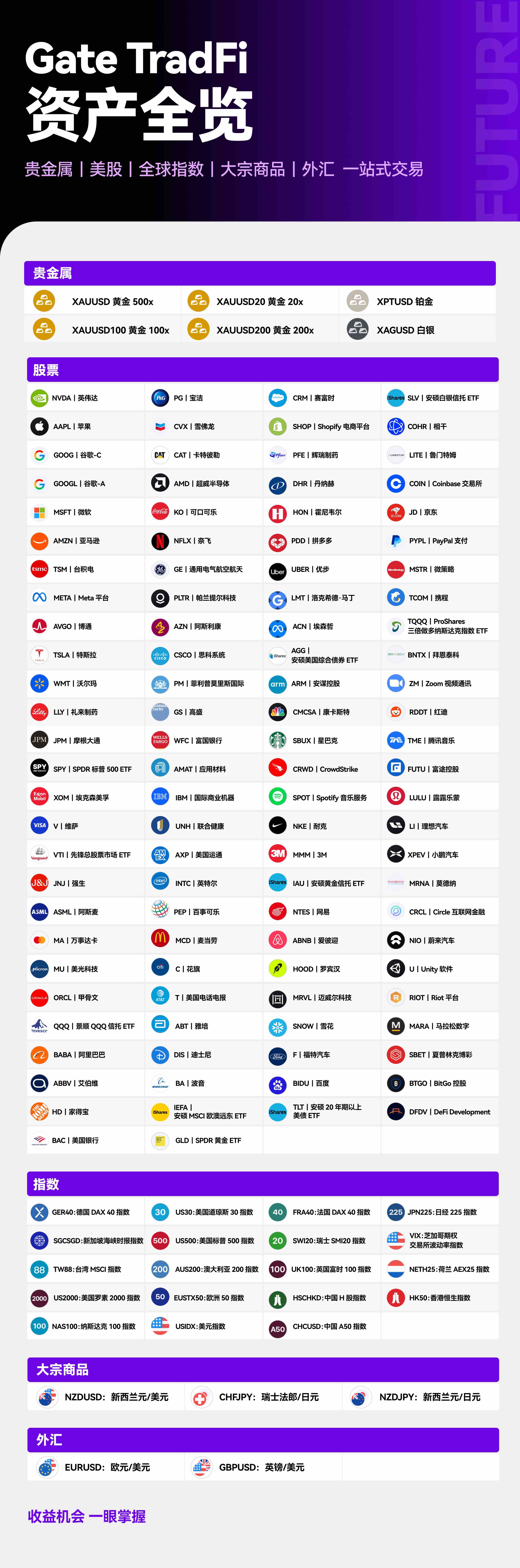
In terms of asset classes, Gate currently covers:
- Metals: 10 metal contracts (Gold, Silver, Platinum, Palladium, Aluminum, Copper, etc.), making it one of the platforms with the most variety in the industry.
- Stocks: 72 stock tokens + 45 stock contracts, covering major sectors like tech, consumer, and finance.
- Indices: 19 global indices, including Nasdaq 100, S&P 500, Hang Seng Index. Notably, Gate was the first platform globally to launch index perpetual contracts, introducing traditional market sentiment indicators into crypto derivatives.
- Forex: 48 forex pairs, covering major currency pairs.
- Commodities: Energy assets like crude oil and natural gas.
Based on the data, Gate's asset coverage indeed holds a leading position in the industry.
However, a key point needs to be made: Having many assets doesn't mean each has good liquidity. I tested several niche contracts and found that some indeed had low daily trading volume, with wider bid-ask spreads than mainstream contracts. For large-volume traders, it's better to prioritize actively traded instruments like gold, Nasdaq index, and major stocks.
Dimension Two: Testing Capital Efficiency
To test capital turnover efficiency, I ran a simple comparative experiment.
Assuming I have 10,000 USDT and want to quickly establish a position when gold breaks a key level. Using a traditional broker, the process is: Sell USDT for fiat → Withdraw to bank card (T+1) → Wire transfer to broker account → Wait for settlement and purchase gold ETF or futures. Conservatively, the entire cycle takes at least 3-5 business days.
On Gate, I only need to: Open the App → Choose a gold contract or TradFi CFD → Open a position directly with USDT (account shows as USDx balance, pegged 1:1). The whole process takes under 30 seconds.
More crucially, it's about the "reusability" of capital. In Gate's multi-asset system, USDT serves as both the pricing unit for the crypto market and the margin for traditional asset trading. When you transfer USDT to the TradFi sub-account, the system automatically converts it to USDx (pegged 1:1 to USDT), requiring no extra conversion and incurring no custody fees.
This means you could be trading BTC futures in the morning and directly switch to NVIDIA stock or gold in the afternoon, with funds transferring between different accounts in seconds with one click. This level of efficiency is completely unmatched by traditional financial accounts.
But a word of caution here: The TradFi section uses a cross-margin mode, and leverage is fixed for different assets (up to 500x for forex/indices, up to 5x for stocks). This means you cannot freely adjust leverage like in crypto futures. Users accustomed to flexible leverage may need some time to adapt.
Dimension Three: The Devil in the Details of Trading Costs
Fees are a top concern for most traders. I spent time comparing Gate's fee structure with several mainstream platforms.
Conclusion first: Gate's fees are indeed competitive within the industry, especially for VIP users and large-volume traders.
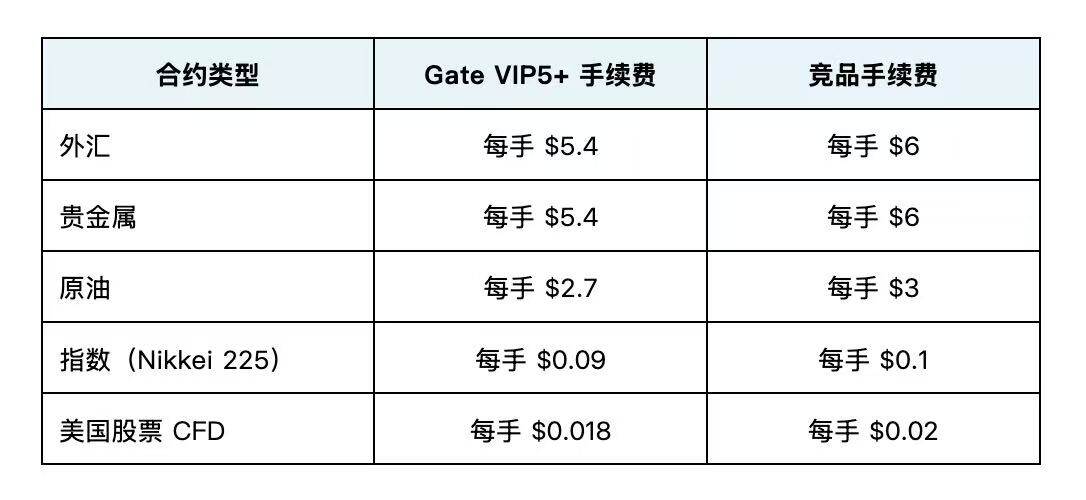
Taking VIP 5 and above users as an example (typically requiring a certain 30-day trading volume or holding platform tokens), the fee for forex-type TradFi contracts is $5.4 per lot, while competitors I surveyed generally charge over $6; the fee for US stock CFDs is only $0.018 per lot, compared to $0.02 for competitors.
This difference might seem small in isolation, but for high-frequency traders executing dozens to hundreds of trades a day, the savings become substantial. (Seeannouncement doc for details)
During testing, however, I found an even more noteworthy point: The cost difference between TradFi and traditional futures trading. I did a simple calculation. Assuming trading 1 lot of gold (approximately $500k USDT in notional value at current prices):
- Using TradFi: Only pay an opening fee of $5.4. No closing fee.
- Using traditional futures (even for a VIP user with a 0.03% fee): Opening $150 + Closing $150 = Total $300.
$300 vs $5.4 — a difference of over 50x. I initially thought I miscalculated and double-checked several times. This cost differential is almost a dimensionality reduction attack for intraday traders. If you trade 10 lots a day, you could save nearly $3,000 just on fees.
The table below summarizes the fee comparison (Gate VIP5+ vs Competitors):
But there are several details requiring special attention:
1. Swap Fee (Overnight Financing Fee)
Contracts in the TradFi section have market hours (unlike the crypto market's 24/7). If you hold a position during market close, a swap fee is charged. The calculation is complex, with three formulas depending on the contract type. I tested a few instruments and found that holding a position over the weekend incurs a swap fee settled for three days at once (as markets are closed Sat & Sun). This has little impact on short-term traders, but if you plan to hold long-term, you must factor in this cost. (Seeannouncement doc for details)
2. Liquidity Disparity
While Gate's asset coverage is broad, not every instrument has the same liquidity. Popular instruments like gold, Nasdaq index, and major stocks have good volume and depth (e.g., XAUT gold contract 24h volume exceeds $489 million, ranking third globally). However, some niche contracts have significantly wider bid-ask spreads. It's advisable to prioritize actively traded instruments.
3. Leverage is a Double-Edged Sword
The TradFi section offers leverage up to 500x, an attractive tool for professional traders. But high leverage means high risk—minor market fluctuations can trigger liquidation. During my testing, I encountered a significant intraday swing in US stocks, and several high-leverage positions nearly got liquidated. If you're a beginner, start with low leverage and gradually increase after familiarizing yourself with the rules.
Hands-On: How I Traded Gold with USDT
Reading about it is one thing; to truly understand Gate's multi-asset trading experience, I decided to try it myself.
I chose gold as the test instrument because: 1) Gold is one of the most liquid traditional assets; 2) Gate offers multiple ways to trade gold, perfect for a comprehensive test; 3) Recent gold price volatility is suitable for short-term operations.
Step One: Product Selection — Multiple Ways to Play Gold
I discovered several ways to trade gold on Gate, catering to different risk appetites:
- Spot Tokens: Gold tokens like XAUT, PAXG. Each token is fully backed by corresponding physical gold, suitable for long-term holding.
- Perpetual Contracts: Metal perpetual contracts like XAU/USDT, XAUT/USDT. Support 24/7 trading, up to 100x leverage, suitable for users looking to capitalize on price volatility for short-term moves.
- TradFi CFD: Contracts for Difference based on real traditional market gold prices. Up to 500x leverage. Trading follows TradFi market hours (has market close), suitable for advanced traders.
It's important to clarify the difference between perpetual contracts and TradFi CFDs: The former are USDT-denominated crypto contracts, tradable 24/7, with relatively moderate leverage (up to 100x). The latter are CFDs based on real traditional market gold prices, following TradFi market hours, with higher leverage (up to 500x), more suitable for professional traders with a deep understanding of traditional financial markets.
Step Two: Placing an Order — Surprises and Minor Pitfalls
I chose a Gold CFD in the TradFi section for my first attempt (mainly to experience this latest feature).
The operation flow was indeed streamlined:
- Open Gate App → Enter TradFi tab → Complete KYC (fast process, I had already done it, so skipped) → Transfer USDT from spot account to TradFi sub-account.
A noteworthy detail here: After transferring USDT to the TradFi account, it displays as a USDx balance (pegged 1:1). I initially worried about conversion loss, but that was unnecessary—it's just an internal unit of account change, with no actual change in asset value.
Next was selecting the trading instrument. The TradFi section's interface maintains Gate's consistent style—candlestick chart, depth chart, order panel, almost identical to the regular futures trading interface. For crypto veterans, there's zero learning curve.
But here I encountered the first "minor pitfall": TradFi leverage is fixed (500x for gold) and cannot be freely adjusted like crypto futures. For someone used to flexible leverage, this took some getting used to—I needed to calculate the position size based on the margin ratio, rather than setting leverage first and then deciding the position.
After adapting, I realized this "fixed leverage" design actually aligns more closely with traditional financial market logic. For users operating on both traditional brokers and Gate, it might even reduce cognitive load.
Placing the order itself was smooth. I opened a small long position near $5030 for gold. The order filled almost instantly. Chart smoothness and depth were good, with no noticeable slippage.
Step Three: Settlement — Fast, But Mind the Details
I held the position for about 6 hours. Gold price rose