






Empowering Trading Terminals and Strategy Platforms, XT Broker Program Officially Launches



- Core Viewpoint: XT.COM has launched a Broker Program aimed at helping trading platforms outsource underlying trade execution to professional infrastructure by providing API-level execution access. This reduces technical complexity and operational costs, allowing platforms to focus on front-end product innovation and user experience.
- Key Elements:
- The program offers two models: API Brokers directly integrate XT's execution capabilities; Independent Brokers manage sub-account trading through a master account, sharing the same infrastructure.
- The incentive mechanism employs a tiered commission structure calculated based on the rolling 30-day trading volume, with commission rates up to 60%, designed to encourage consistent and stable trading participation.
- The program targets professional institutions with real trading scenarios, such as trading terminals, asset management platforms, and quantitative service providers, rather than short-term traffic promoters.
- The core value lies in decoupling trade execution from front-end products, enabling platforms to avoid building and maintaining complex exchange systems (such as matching engines, clearing, and settlement).
- As the infrastructure provider, XT is responsible for ensuring the stability of trade execution, API availability, and clear trade attribution and data statistics.
For many trading platforms, the real challenge does not come from market volatility, but from the increasingly complex real-world environment behind the systems.
System stability under high-concurrency scenarios, continuous technical maintenance for upgrades, cross-regional compliance requirements, and ever-increasing human and operational costs... As the trade execution system becomes more cumbersome, platforms often find that their own development pace is being constrained by infrastructure.
What users truly care about, however, has always been just two things:
Is trading stable, and is the experience smooth?
The XT Broker Program was launched precisely to address this structural contradiction.
By providing API-level execution access, XT enables trading terminals and strategy platforms to directly obtain mature, stable market execution capabilities without the need to build a complete exchange system from scratch, thereby effectively reducing technical complexity and overall operational pressure.
Execution need not be a burden.
Only when trade execution is entrusted to professional infrastructure can platforms truly operate with agility and focus on what they do best and what is most valuable: product innovation and strategy services.
When Execution is No Longer a Differentiator, Crypto Platforms are Re-evaluating Their Path
In the early stages of the crypto industry's development, building a trading product often meant starting an exchange from scratch. Liquidity, trade execution, asset custody, and user access were highly bundled. Platforms competed by controlling the entire technology stack from the matching engine to clearing and settlement. For a considerable period, "full-stack self-building" was almost synonymous with a platform's professionalism and credibility.
But this model is under sustained real-world pressure.
Rising Execution Costs
As market conditions evolve, operating a complete exchange infrastructure has become increasingly complex.
Beyond the order book itself, platforms must also handle system stability during volatile market conditions, evolving compliance and risk control requirements, asset custody risks, and the fragmentation of liquidity across different markets and regions.
Each additional layer of capability introduces new fixed costs and operational risks. In many cases, the growth rate of these costs has significantly outpaced the expansion of the user base. Trade execution, once a competitive advantage, is gradually transforming into a burden that is difficult to sustain long-term, especially when it's impossible to consistently maintain institutional-grade standards.
Frontend Diversification is Reshaping the Competitive Landscape for Trading Platforms
Simultaneously, the frontend forms of crypto trading are rapidly diversifying.
Users no longer participate in the market solely through a single exchange interface but leverage:
- Professional trading terminals
- Automated and quantitative strategy systems
- Asset and portfolio management tools
- Social and copy-trading interfaces
- Wallet products with embedded trading capabilities
The core competitiveness of these products lies more in experience design, trading workflows, and strategic capabilities, rather than in the underlying matching and execution mechanisms themselves.
Consequently, more and more platforms are beginning to ask a new question:
Instead of investing substantial capital, manpower, and risk to "own" execution capabilities, is there a more efficient and rational alternative?
This line of thinking has revived industry interest in the broker model.
By clearly delineating the division of labor between frontend product innovation and backend trade execution, the broker structure allows platforms to participate in real trading activities while avoiding the high-intensity operational and compliance burdens required to run a full-fledged exchange.
For the new generation of trading platforms, the separation of execution and product is evolving from a stopgap measure into a deliberate, long-term strategic choice.
Re-understanding the True Positioning of a Crypto Broker Program
The concept of a "broker program" is frequently mentioned in the crypto industry but is often misunderstood.
In practical communication, it is often simplistically conflated with affiliate, rebate, or referral programs. However, from a fundamental logic perspective, there is an essential difference between the two.
The Core of a Broker Program is Infrastructure Collaboration
At its core definition, a crypto broker program is a long-term cooperation model based on trading infrastructure.
It allows platforms or trading service providers to access an exchange's execution environment on behalf of their users and ensures that all trading activities can be accurately attributed to the corresponding broker entity, thereby enabling clear, auditable settlement and profit-sharing.
In this model, the broker's role is not that of a "traffic driver" but rather a participant and organizer of trade execution.
Its value lies not in how many registered users it brings, but in facilitating real, sustained trading activity.
A standard broker program typically includes the following three core elements:
- Direct market execution access capability, ensuring trades are completed in real markets
- Clear attribution mechanism, binding trading activity to the broker entity
- Sustained infrastructure partnership, rather than a one-time promotional or campaign collaboration
Therefore, a broker's earnings are not based on registrations or click-through conversions, but are directly tied to real trading volume and sustained activity.
The Fundamental Difference Between Broker Programs and Affiliate Mechanisms
Affiliate and referral programs are essentially marketing tools, with the core goal of user acquisition and traffic conversion.
In contrast, a broker program is a cooperation model at the operational and infrastructure layer, focusing on trade execution, data attribution, and long-term participation in trading activity itself.
Broker programs typically require technical integration and assume ongoing system and operational responsibilities.
It is not a short-term incentive mechanism but rather a long-term cooperation framework designed for professional trading platforms and service providers.
Precisely for this reason, broker programs are more suitable for platforms with mature business models, clear trading scenarios, and stable execution needs to participate in, rather than promotional activities aimed at traffic monetization.
How to Achieve API-Based Trading Access via the XT Broker Program
The XT Broker Program is built precisely around this core concept of separation of responsibilities.
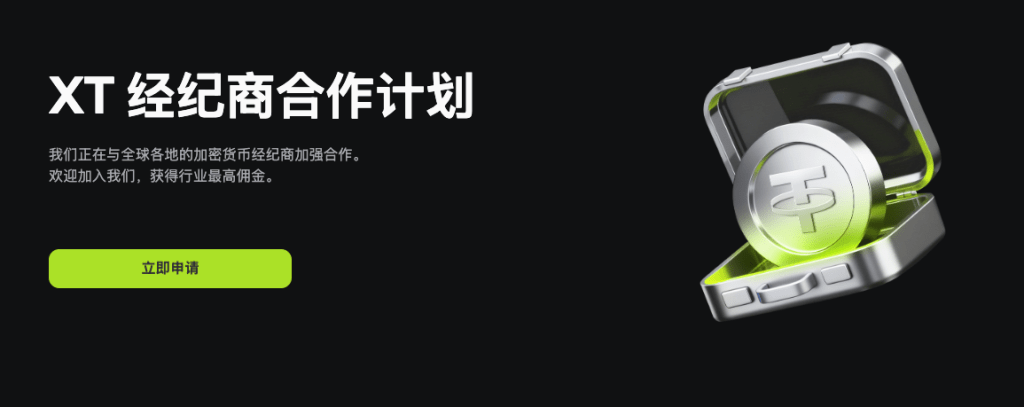 The XT Broker Program is positioned as an infrastructure layer for professional trading platforms, serving business entities that already possess active users and real trading scenarios.
Design Philosophy Centered on Infrastructure
From an overall architectural perspective, the XT Broker Program allows partners to directly access XT's trading infrastructure via API.
All trades completed through this access method are accurately attributed using a broker identification mechanism, enabling transparent tracking, data statistics, and commission settlement based on real trading behavior.
The program's core focus is on:
The stability of execution access and clarity at the operational level, rather than promotion or marketing performance.
Two Broker Models Covering Mainstream Business Structures
Different types of professional trading institutions have varying business structures and management methods in practice.
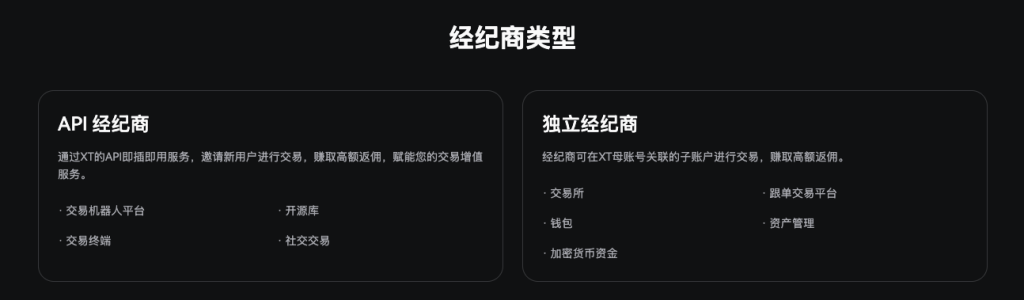 API Brokers access XT's trading capabilities via plug-and-play APIs; Independent Brokers manage trades through a master account linked to sub-accounts.
API Broker
- Directly integrates XT's trade execution infrastructure via plug-and-play APIs
- Routes user orders from trading terminals, automated systems, or strategy platforms to XT
- Trade execution, settlement, and attribution are handled uniformly by XT
- Embeds stable market access capabilities without operating a complete exchange system
Independent Broker
- Conducts proprietary or custodial trading through sub-accounts linked under a master account
- Coordinates trading activities across multiple teams, funds, or custodial accounts
- Maintains centralized account and risk management while executing trades on XT
- Strategy design and account management remain entirely independent
Both models share the same execution infrastructure.
The difference lies in the fact that partners can flexibly configure control methods, automation levels, and client interaction structures based on their own business characteristics, thereby choosing the broker form most suitable for their operational design.
Allocate Resources to Product, Entrust Execution to Infrastructure
The goal of the XT Broker Program is not for trading platforms to operate execution capabilities as a standalone business, but to integrate market access as a key component within their overall product ecosystem.
Through this approach, trading platforms can obtain stable, scalable execution support without dispersing resources and focus, thereby continuously advancing their own product innovation and user experience optimization.
It is in this sense that the XT Broker Program is positioned as the infrastructure foundation supporting the development of the new generation of crypto trading platforms.
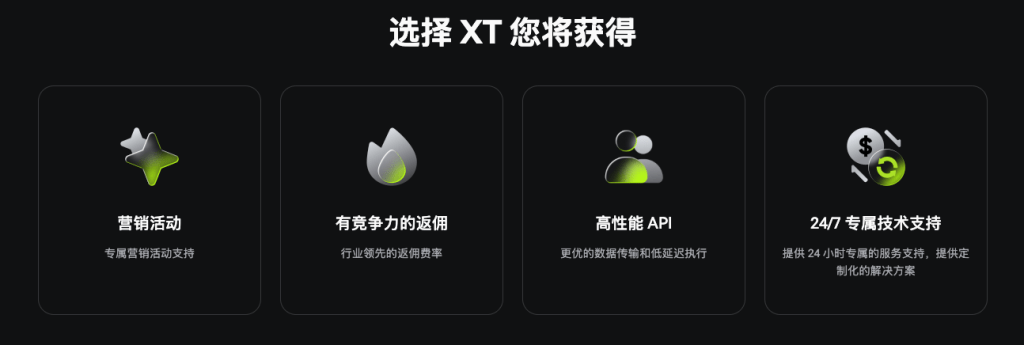 The XT Broker Program integrates execution stability, a competitive economic model, and dedicated support services within a unified infrastructure layer, providing long-term support for professional trading platforms.
Which Trading Businesses are Suitable for Adopting the Broker Model
The XT Broker Program aims to provide flexible cooperation solutions for trading businesses seeking to enhance trade execution capabilities and optimize infrastructure structure.
Whether it's a platform with an established user base or a product team expanding its trading service capabilities, as long as there is a stable trading scenario and execution need, the broker model can provide a more efficient way to access the market.
When designing the broker program, XT focuses on real trading scenarios, sustainable business structures, and long-term cooperation potential to ensure partners can continuously expand their own product and service capabilities based on stable execution.
Business Types Suitable for Adopting Broker Execution Models
In practical application, the XT Broker Program is widely applicable to platforms and service providers that need to coordinate trading activities, integrate execution capabilities, and simultaneously wish to reduce investment in underlying systems.
The following business forms can typically build or expand trading capabilities more efficiently through the broker model:
Business Type Typical Usage Broker Model Value Proposition Trading Terminals & Aggregation Platforms Route and consolidate user orders across multiple markets and trading tools Gain stable, unified execution capabilities without building matching and clearing systems. Asset Management & Strategy Platforms Execute trading strategies on behalf of client accounts or fund accounts Clearly separate strategy design from trade execution infrastructure, improving overall operational efficiency. Social & Copy Trading Services Coordinate group trading or mirror trading behaviors Ensure clear trade attribution and consistent execution, supporting scale. Automated Trading & Quant Bot Service Providers Run continuous or high-frequency trading strategies Rely on stable API interfaces, system availability, and precise attribution mechanisms to ensure strategy continuity. Wallets with Embedded Trading Features Provide trading capabilities as part of the overall product offering to users Seamlessly integrate trading capabilities without altering the core product positioning.
Clarification on the Applicability Boundaries of the Broker Program
The XT Broker Program is more suitable for platforms and service providers that view trading capabilities as a long-term component of their business.
Participating in the broker program typically means completing API integration and continuously utilizing the execution capabilities in real trading scenarios to support the normal operation of one's own products or services.
For cooperation methods primarily aimed at short-term promotion, traffic import, or one-time incentives, the broker model may not be the optimal choice.
XT prefers to collaborate with partners who view the broker role as part of their platform's long-term development strategy, jointly building a stable, sustainable trading ecosystem.
Incentive and Commission Structure of the XT Broker Program
In professional brokerage business, the core goal of incentive mechanisms is not simply to pursue short-term amplification of trading volume, but to strengthen long-term synergy and stable operational capabilities. The XT Broker Program is built precisely on this principle, constructing a reasonable incentive system by linking commission tiers to sustained, verifiable real trading behavior rather than short-term trading peaks.
The Design Logic Behind Tiered Commissions
Tiered commission mechanisms are widely adopted in institutional brokerage businesses because they effectively incentivize sustained performance and operational maturity.
Unlike treating all trading activity equally, the tiered mechanism places greater emphasis on a broker's comprehensive capabilities in the following areas:
- Maintaining stable execution quality over the long term
- Ensuring continuous system and operational reliability
- Sustaining active participation in real markets
In the XT Broker Program, commission tiers are dynamically calculated based on rolling 30-day trading volume, ensuring broker levels accurately reflect recent business performance, not historical highs.
This commission structure is consistent across both the API Broker and Independent Broker models, with clear rules and unified standards.
Broker Tiers and Commission Structure
Broker Tier Minimum 30-Day Trading Volume Requirement Commission Rate VIP 1 ≥ $10 Million 40% VIP 2 ≥ $30 Million 50% VIP 3 ≥ $100 Million 60%
Promotion through broker tiers is entirely based on real trading activity, with a transparent process and clear rules.
A higher tier represents stable operational capability and sustained market participation, not short-term volume spikes or periodic sprints.
The Prerequisite for Incentives is Reliable Execution Capability
The commission rate alone is insufficient to define the value of a broker program. Incentive mechanisms only hold long-term significance when supported by reliable trading infrastructure.
Therefore, the XT Broker Program places equal importance on the following key elements in its design:
- Stability of trade execution
- Performance and availability of API interfaces
- Accuracy of trade attribution and data statistics
Through stable data delivery capabilities, comprehensive technical integration support, and dedicated account management services, XT ensures that incentive mechanisms can guide responsible, sustainable trading participation behavior over the long run.
The goal of the XT Broker Program is to foster long-term synergy between brokers and execution infrastructure, not strategic optimization centered on short-term gains.
What Should Trading Teams Consider Before Introducing the Broker Model
For a trading platform, becoming a broker is not a simple feature extension but a significant phased choice in the platform's development journey. For trading teams evaluating the broker model, the focus should not only be on "whether access is possible" but also on how the broker model supports broader product planning and long-term growth goals.
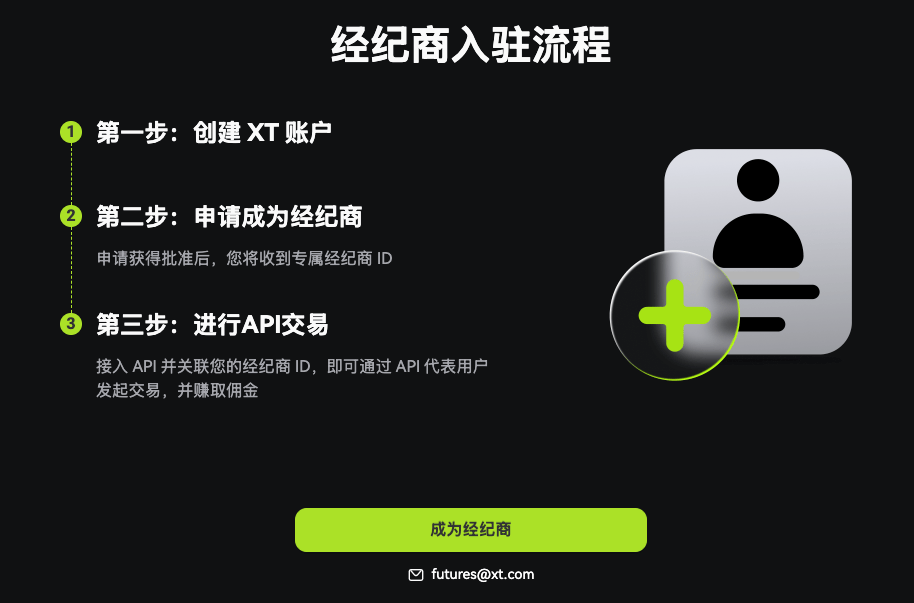 XT.com provides a clear, efficient onboarding process, helping eligible teams transition smoothly from the evaluation phase to broker cooperation in a defined, predictable manner.
The Broker Model Favors Teams with Practical Experience
Teams capable of successfully operating a brokerage business typically already possess mature trading management experience.
They are familiar with real trading processes, can continuously monitor execution quality, ensure system stability, and provide user support during market volatility or peak periods.
Joining the XT Broker Program does not replace these capabilities but rather amplifies and extends them on the existing foundation.
This program is more suitable for teams that view system integration as a long-term capability-building exercise, not a one-time technical connection, and also consider trade execution quality a vital part of the overall user experience.