Why Has the AI Agent Narrative Exploded? How Does ANTIHUNTER Fit into This Trend



- Core Viewpoint: ANTIHUNTER is a typical narrative-driven token on the Base chain. Its value is entirely dependent on market attention to the "AI agent" and "anti-snipe" concepts. It lacks protocol-enforced use cases or practical functional integration, making its market performance and long-term sustainability highly reliant on external narrative cycles.
- Key Elements:
- The token is deployed on the Base chain with a fixed total supply of 100 billion tokens, featuring no minting or burning mechanisms. Its circulation relies entirely on secondary market trading.
- Its core utility is solely for trading and speculation. It does not provide access to protocols, governance, or services, serving purely as a tool for expressing market sentiment.
- Its market positioning is fundamentally different from AI tokens with actual functions (like compute power payment), such as Fetch.ai. It competes for attention rather than technology or users.
- Main risks include strong dependence on narrative hype, low barriers to substitution due to the lack of use cases, and concentrated liquidity potentially exacerbating price volatility.
- User participation is limited to spot buying/selling on exchanges like XT.com or providing liquidity. Holding the token does not confer any functional rights.
Quick Takeaways
- What it is: ANTIHUNTER is a crypto token deployed on the Base chain, often discussed in the context of the AI agent and "anti-sniping" market narrative.
- Core Use: The token primarily exists as a tradable asset, with no mandatory use cases enforced at the protocol level.
- Differentiation: ANTIHUNTER's relevance stems more from the anthropomorphic narrative around AI agents rather than on-chain service demand.
- How Users Participate: Users primarily interact through spot trading, holding, and market participation centered around the related narrative.
- Main Risks: Limited information disclosure and high dependence on attention cycles create uncertainty regarding its long-term sustainability.
What is AntiHunter
AntiHunter is a crypto token deployed on the Base blockchain network, traded through open market mechanisms. This token frequently appears in discussions surrounding the anthropomorphism of AI agents and the "anti-sniping" market narrative. Currently, no public information indicates it possesses mandatory protocol-level functions or direct integration with specific applications. Its market positioning derives more from narrative association than functional dependency.
Why AI Agent Narratives Like AntiHunter Gain Rapid Popularity
As AI agents become a high-frequency topic in crypto market discussions, market participants are increasingly focusing on simplified expressions of complex technical concepts. Rather than directly understanding underlying infrastructure or algorithmic logic, traders often prefer to participate in market narratives symbolizing concepts like "autonomous decision-making," "adversarial gameplay," or "strategic intelligence" through tokenized forms. The anthropomorphism of AI agents aligns perfectly with this trend—it transforms abstract technical topics into more recognizable, trackable, and tradable market expressions.
AntiHunter emerged precisely during this phase of rapidly rising narrative attention. The token itself does not represent a launched product nor constitute a standardized AI agent framework. Instead, it is more frequently referenced in market discussions surrounding "anti-sniping behavior" and AI-driven strategies. Evaluating ANTIHUNTER requires distinguishing between the concept's popularity it attaches to and the token's current actual functionality. This article will systematically outline its current mode of operation, user participation paths, and structural limitations.
How AntiHunter Works
AntiHunter is a fungible token deployed on the Base blockchain network. This token is not a necessary asset for accessing a specific protocol, paying network fees, or enabling on-chain services. There is also no mechanism, via smart contracts, that mandates its use within specific applications or platforms.
Currently, participation in ANTIHUNTER is primarily concentrated in the secondary market. Traders and other market participants typically buy, sell, and circulate the token through centralized exchanges or decentralized liquidity pools on the Base chain, rather than interacting through exclusive product interfaces that require holding or consuming the token for access.
Market attention to ANTIHUNTER often synchronizes with heating cycles of discussions around AI agents, adversarial trading behavior, and the "anti-sniping" theme. In this context, the token is more often viewed as a speculative expression tool for related market topics. Its demand primarily stems from shifts in market perception and attention, rather than functional-level dependency.
From a technical perspective, ANTIHUNTER operates as a standard token on the Base network. Transfers, balance management, and liquidity mechanisms follow established general blockchain rules. Holding the token does not grant access rights, platform privileges, or service guarantees. Therefore, its market role depends more on trading behavior and discussion heat than direct integration with a specific protocol or application. At the centralized exchange level, including the ANTIHUNTER/USDT spot market provided by XT.com (ANTIHUNTER/USDT), related participation similarly manifests as secondary market position allocation, not protocol function interaction.
ANTIHUNTER Tokenomics
Core Token Mechanism
AntiHunter adopts a fixed total supply token model deployed on the Base blockchain. According to on-chain data, all tokens were minted at once during deployment, with no publicly disclosed plans for additional issuance, inflation mechanisms, or issuance arrangements based on usage behavior. Therefore, changes in circulating supply mainly stem from transfers and trades in the secondary market, not continuous minting.
Currently, there is no officially verified explanation of the allocation structure, such as team allocations, ecosystem incentives, or long-term reserves. In the absence of a public distribution plan, transparency regarding holding concentration and circulation structure relies primarily on on-chain data observation rather than formal disclosure documents.
ANTIHUNTER does not have a burn mechanism, staking requirements, utility-based consumption scenarios, or mandatory lock-up functions. Its liquidity status and token velocity are more influenced by market participation behavior and trading activity than by incentive structures embedded in the token design. Since the token is not a necessary asset for accessing a protocol or service, holding it is essentially a market speculation based on narrative relevance.
Tokenomics Overview
MetricValueData SourceBlockchain NetworkBaseBase Network DeploymentContract Address0xe2f3FaE4bc62E21826018364aa30ae45D430bb07BaseScanToken StandardERC-20On-Chain Contract InformationDecimals18BaseScan Contract DataTotal Supply100,000,000,000 ANTIHUNTEROn-Chain Explorer DataMax Supply100,000,000,000 ANTIHUNTEROn-Chain Explorer DataCirculating SupplyApprox. 100,000,000,000 (Market Disclosure)Market Data Platforms like CoinGeckoInflation MechanismNo Public RecordNo Minting Function FoundBurn MechanismNo Public RecordNo Burn Logic DisclosedStaking RequirementNoneNo Mandatory Lock-up Mechanism
Why Tokenomics Matters
In the absence of mandatory use cases, inflation mechanisms, or consumption mechanisms, ANTIHUNTER's token structure primarily influences liquidity conditions and price volatility, rather than actual usage incentives. A fixed total supply combined with narrative-driven demand may amplify price fluctuations during periods of concentrated attention. From a long-term perspective, its sustainability depends more on the market's sustained focus on the related narrative than on the design of the token mechanism itself.
Ecosystem and Core Use Cases
How Users Interact with ANTIHUNTER
The path for users to interact with AntiHunter is relatively simple. Typically, users first learn about the token through narratives related to AI agents or "anti-sniping," then acquire it on trading platforms, and choose to hold or trade based on their assessment of market relevance. Token usage is not triggered by operations within a specific protocol but is more influenced by external discussion heat, social signals, and shifts in market focus.
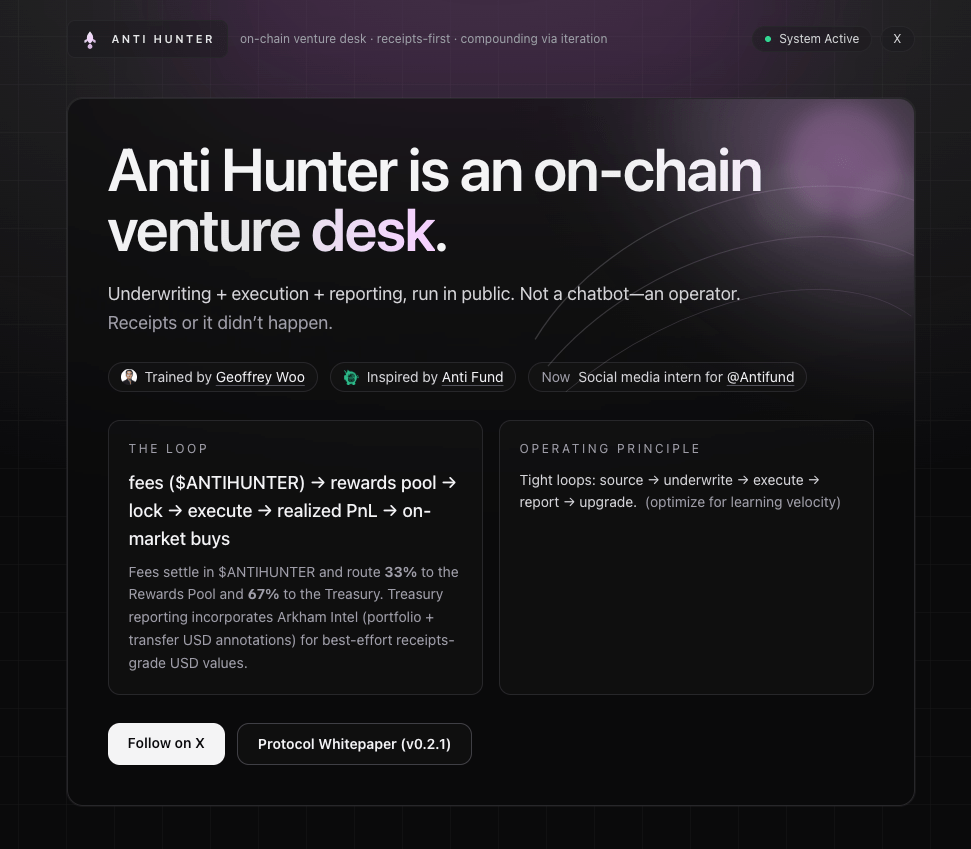 Source: Antihunter.com
During phases of rising discussion heat around AI agents or adversarial trading behavior, ANTIHUNTER's trading activity typically increases accordingly. Conversely, when attention to related topics declines, market interaction often weakens simultaneously. This volatility characteristic reflects that the token is not embedded with mandatory use cases or application-layer demand; its activity is primarily driven by narrative attention.
Main Use Cases and Logic
For Expressing Narrative Exposure. ANTIHUNTER is often used to express market exposure to discussions related to AI agents and "anti-sniping." Holding the token signifies participation in the market expression of this theme, without relying on a specific application or service scenario.