






CZ's Latest Interview: I'm Not a Legend, Just an Ordinary Person


- Core Viewpoint: CZ reviewed his journey from an ordinary immigrant to founding Binance, then reaching a settlement with the U.S. Department of Justice, serving a prison sentence, and finally shifting his focus to public welfare and education. This showcases his minimalist values and his reflections on the industry's future.
- Key Elements:
- Early Life and Entrepreneurship: Worked at McDonald's at age 14, dropped out of university and worked at fintech companies in Tokyo and New York, accumulating experience in trading system development; first started a business in Shanghai in 2005, later pivoted to IT outsourcing due to policy restrictions.
- Entering the Crypto Industry: Introduced to Bitcoin by friends in 2013, decided to sell his Shanghai property and go all-in after in-depth research; subsequently held key technical roles at Blockchain.info and OKCoin, but left both due to cultural misfit.
- The Path to Founding Binance: Attempted to build a trading platform in Japan with partners in 2015 but failed, then shifted to providing software licensing services for trading platforms; inspired by the ICO boom in June 2017, decided to issue BNB and build a crypto-to-crypto trading platform, rising rapidly due to technical advantages and ICO funding.
- Dealing with Regulation and Charges: Began strengthening compliance after first contact with U.S. law enforcement in 2018; engaged in lengthy negotiations with the Biden administration's Department of Justice in 2023, ultimately admitting to violating the Bank Secrecy Act (failure to register and weak KYC/AML procedures), with the company paying a $4.3 billion fine and him pleading guilty personally.
- Prison Experience and Pardon: Sentenced to 4 months in prison in 2024, personally experienced the unwritten rule of racial grouping in a low-security prison in Seattle; pardoned by President Trump in November of the same year after release, believing the new administration's pro-crypto stance and personal empathy were contributing factors.
- Current Status and Future Endeavors: According to the agreement, he no longer manages Binance. His main focus is now on Giggle Academy (a free global education App without tokens) and providing crypto policy consultation for multiple countries. He also believes AI agents will become the largest users of cryptocurrency.
- Personal Philosophy: Emphasizes that he is just an ordinary person, and success relies on principles, continuous effort, and luck; believes that wealth beyond basic needs contributes little to happiness, and that intrinsic rewards like health, family, and free time are more important.
Original Title: Binance CEO: 4 Months in Prison, $4 Billion Fine, and What Comes Next
Original Author: All-In Podcast, YouTube
Original Compilation: Peggy, BlockBeats
Editor's Note: This interview documents the complete journey of one of the most influential and controversial figures in the global cryptocurrency industry—CZ (Changpeng Zhao)—from his peak, to imprisonment, and to rebirth.
It shatters the mythical image of a billionaire titan, revealing an extremely real and minimalist ordinary person: he flipped burgers at McDonald's, wrote low-level code at Bloomberg, and even after achieving financial freedom, he still habitually booked economy class flights. Beyond the rise of Binance, what is most astonishing is his first detailed disclosure of the intricacies of his dealings with the government's Department of Justice. He reveals how he maintained absolute emotional stability while facing weeks of psychological warfare, the risk of extortion amplified by media portrayal, and the complex racial gang rules inside a Seattle prison.
CZ candidly revisits the entire saga of his relationship with SBF and the time he broke down in tears when forced to step away from Binance's management. Today, he has pivoted to a purely philanthropic global education initiative that involves no tokens. This is not just a chronicle of the crypto industry; it is a profound introspection on power, money, and the boundaries of freedom.
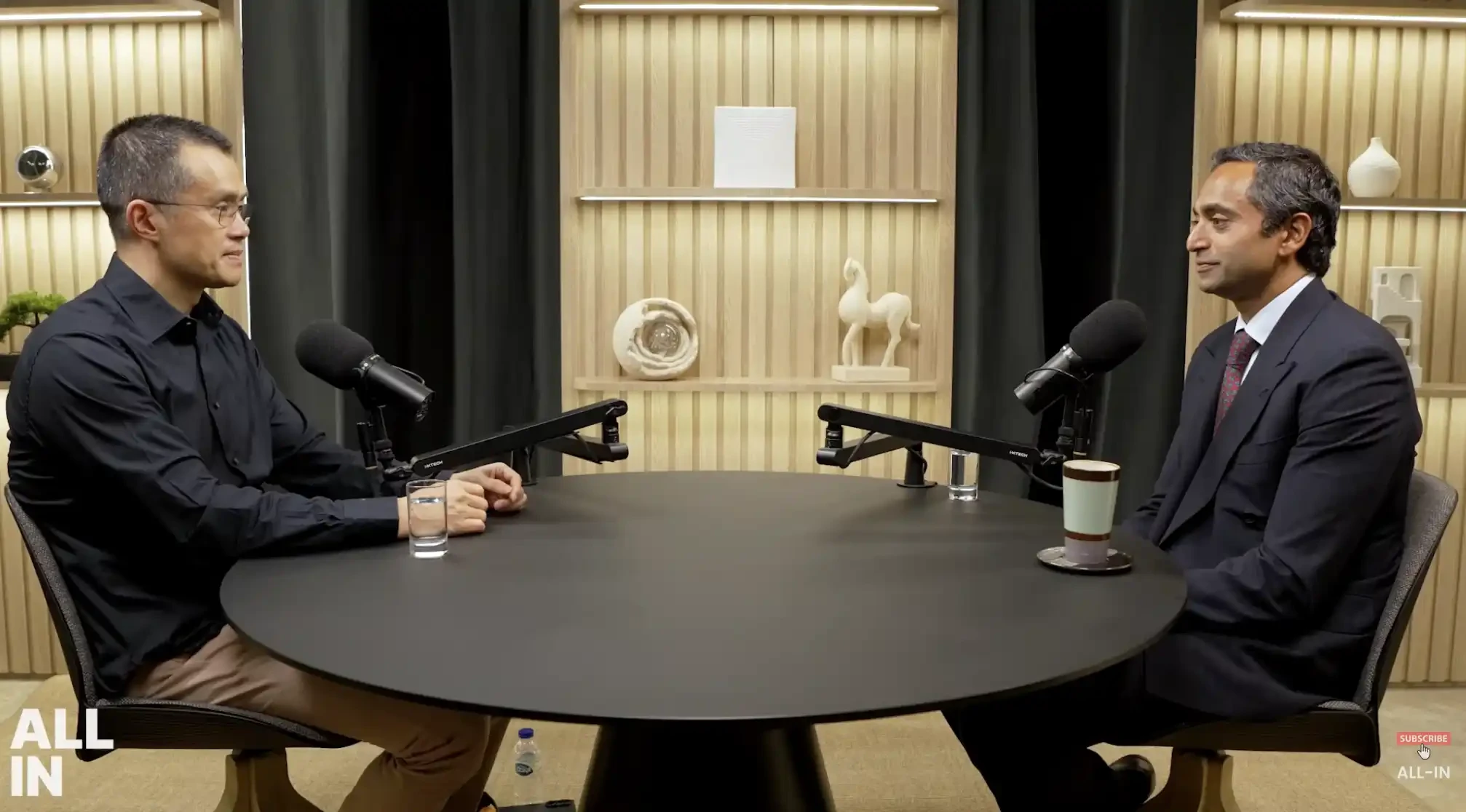
Highlights
· Early Years: From China to Canada
· CZ's Early Career: Surprisingly 'Ordinary'
· Founding His First Company in Shanghai
· Discovering Bitcoin
· Going All-In on Crypto
· Why Found Binance?
· The FTX Saga: Relationship with SBF and Its Collapse
· Confronting the Biden Administration's 'Anti-Crypto' DOJ
· What is Life Like Inside a Federal Prison?
· Life and New Ventures After Leaving Binance
The following is the full transcript of the podcast conversation:
Early Years: From China to Canada
Chamath: CZ, welcome to the All-In Podcast. I want to rewind the timeline to the very beginning because I think many people don't know your background, at least not as much as they should. Your early years in Canada are very similar to mine, and that part particularly resonates with me. You worked at McDonald's, I worked at Burger King.
CZ: My father went to Canada to study in 1984.
Chamath: How did that opportunity come about? Did he stay in Canada after that?
CZ: He would come back to visit us, once or twice a year, but he spent most of his time in Canada.
Chamath: Was he a teacher in China?
CZ: He was a teacher, a professor. First, he went to the University of Toronto for an exchange program, then a few years later, he went to the University of British Columbia in Vancouver. Later, we started applying to join him. Back then, getting a passport was very difficult; it could take three or four years. We started applying around 1985, and it took about two or three years to get our passports.
Chamath: You mean Chinese passports?
CZ: Yes, Chinese passports. Then getting the visa took several more years; the process was just that slow back then.
Chamath: What was it like moving to Vancouver?
CZ: Completely different, it was a whole new country. I had studied English for a year or two in school in China, but I wasn't fluent at all. But Vancouver was great. Canada, you know, has good greenery, open spaces, everything is quite beautiful, the standard of living is high, things are clean. The fruit is bigger too. The overall environment was very comfortable.
Chamath: After the family reunited, did both your parents work?
CZ: My dad was an assistant professor at the university, earning about 1,000 Canadian dollars a month. The school also provided very cheap faculty housing, so we lived on campus.
On our third day in Canada, my mom went to work at a garment factory, doing sewing and stitching clothes. She was a math and history teacher in China, but her English wasn't good enough, so she couldn't find a job at the same level. She had to work in a factory for minimum wage. She worked there for seven to ten years, just doing that.
Chamath: My mom was a nurse in Sri Lanka. After we immigrated and got refugee status, my father couldn't find work. My mom worked as a housekeeper to make ends meet. Later, she went back to doing something like a nursing assistant. I think I got my first paycheck around age 14.
CZ's Early Career: Surprisingly 'Ordinary'
CZ: Yeah, right, I was also around 14 or 15 when I got my first job at McDonald's.
Chamath: We're the same age, so probably 14. Do you remember what the minimum wage was in British Columbia back then?
CZ: I do, the minimum wage was 6 dollars.
Chamath: That's incredible. In Ontario, it was 4.55 dollars.
CZ: But at McDonald's, they only paid 4.5 dollars. That was below the legal minimum wage because McDonald's seemed to have a special exemption back then, since they employed a lot of young people. I remember applying on my 14th birthday, and a week later I was flipping burgers there. That was my first income.
Chamath: Were you one of those precocious 'tech prodigies' back then? The kind of kid who coded 24/7 and was deep into computer science?
CZ: No, I don't think I was that. I was tech-savvy, studied computer science in university, and got interested in programming and started teaching myself in high school. But I was definitely not a programming genius. I was a decent programmer, wrote some decent code in my career. But around 28 to 30 years old, I started moving away from the code layer to do more business development, sales, and that kind of work.
Chamath: Did you have many friends back then?
CZ: Quite a few.
Chamath: Mostly Asian friends, or a mix of people?
CZ: A mix. Actually, I had both Asian and non-Asian friends. But in our school, most Asian kids stuck with other Asian kids. I was an exception; I had quite a few white friends, various social circles. My teenage years in Canada were fantastic, some of the best years of my life. I think that period really shaped my optimistic personality. I'm generally a pretty happy person.
Chamath: How did you feel when you didn't get into my alma mater, the University of Waterloo, and had to 'settle' for McGill? Did you feel dumb?
CZ: Well, actually, I was torn between Waterloo, McGill, and the University of Toronto. But I knew I definitely didn't want to go to UBC because I wanted to change cities. UBC actually accepted me, but I just didn't want to go. A very respected elder advised me at the time that I should become a doctor because it's a respectable life with good pay. I took her advice and chose biology. Waterloo wasn't known for biology, right? So I went to McGill. But after one semester, I told myself: no more biology, I'm switching to computer science.
Chamath: Was that typical college life? Did you land amazing summer jobs? Or were you like a regular college student scrambling to pay tuition?
CZ: I worked every summer, and I also had part-time jobs during the school year.
Chamath: So no debt? Were you thinking: I must graduate without any debt?
CZ: Yes, I didn't take a student loan the first year. Actually, I still took 6,000 Canadian dollars from my dad. The second year, I was still short, and my sister gave me 3,000 dollars. After that, I never asked my family for money again, completely self-sufficient. So luckily, I had no student debt, but that came from working non-stop every summer.
Chamath: You know what was the best thing about Waterloo, and what saved me? The co-op program. I got some really great internships. Even so, I graduated with about 30,000 dollars in debt, but I was pretty active in stock trading back then.
Later, my boss, a guy named Mike Fisher, did something incredibly generous for me. I was a derivatives trader at a bank, my main job, but I also traded stocks privately and made him a lot of money. He asked, 'How much debt do you have?' I said about 30k, 32k to be exact. He said, 'Go downstairs to CIBC right now and pay it off, I'll write you a check.'
CZ: Wow.
Chamath: He wrote me a check for 32,000 Canadian dollars on the spot.
CZ: You should have told him it was 33,000, or 300,000.
Chamath: That's the incredible thing about Canada. You can get an excellent education and not be crushed by debt that you can never escape, which is impossible for many people in the US now.
CZ: Even at McGill, there were many people from the US who came to study. They paid international student fees but found it was still cheaper than studying in the US. I thought that was crazy. So we were really lucky; tuition in Canada was reasonable.
Chamath: So what did you do after graduating from McGill's computer science program?
CZ: Oh, actually, I didn't graduate from McGill. I studied there for four years. In my third year, I got an internship, and in my fourth year, the internship was extended, so I didn't go back to McGill. So I don't have a McGill degree.
Later, I found out I needed a bachelor's degree to apply for a work visa in Japan. It was around 2000, the peak of the dot-com bubble. I enrolled in an online education program called the 'American College of Computer Science' and got a degree from there.
Chamath: My god! So nominally, you're a graduate of that school?
CZ: Nominally, yes.
Chamath: Okay, so which internship did you get that made you decide to just stay there?
CZ: It was an internship in Tokyo. From my first year, I had been doing programming-related work. I wrote simulation software for a company called Original SIM. In my third year, I joined a company in Tokyo called Fusion Systems Japan. They were developing order execution systems for brokers on the Tokyo Stock Exchange platform.
Chamath: Was that a Japanese company with an office in Montreal or Canada?
CZ: No, I flew directly to Tokyo.
Chamath: You went to Tokyo?
CZ: Yes, actually, it was a company started by a few Americans in Tokyo.
Chamath: So you thought it was an adventure, like, I'm going to spend a summer in Tokyo.
CZ: Think about it, I was just a college student. Living in Tokyo was like a dream.
Chamath: What kind of software were you mainly developing back then?
CZ: Mainly order execution software. Simply put, systems that handle and transmit trading orders.
Chamath: Similar to the underlying logic that powers Binance's business today?
CZ: Basically, yes, the architectural style is very similar. However, all the software I worked on didn't involve decision-making algorithms; they were just for executing orders efficiently.
Chamath: When you first got into this field, was your reaction 'Oh my god, I love this,' or was it just 'I got a coding task, I understand the logic, let's get it done'? Were you drawn to the business itself, or was it just a job?
CZ: Initially, it was purely a job. I was too young back then, lacking a macro understanding of different industries. When I first joined the company, I was assigned to develop a digital image storage system. It wasn't simple like an iPhone photo album; it was a professional system for medical imaging.
But soon after, the company's core business shifted to order execution systems, and I got involved. That became the focus of my career. I liked it because it demanded high technical expertise. The core of this field is efficiency: extreme speed and ultra-low latency. This pursuit of efficiency subconsciously aligned very well with my personality.
Chamath: Let's dive deeper. High-frequency trading firms like Jump go to almost any length to optimize efficiency and latency, even building their own circuit breakers and physical fiber infrastructure to save a few milliseconds. At the software level, how is this extreme optimization manifested? How do you handle these boundary conditions when writing code?
CZ: It works on multiple levels. First is software architecture optimization; you must ensure the system is absolutely efficient. For example, to eliminate latency, we removed all database queries and moved everything to memory. We also streamlined calculation logic, especially for pre-trade and pre-order risk checks. More advanced stages involve hardware, like using Field-Programmable Gate Arrays (FPGAs), which are programmable chips integrated into network cards.
Chamath: So data doesn't have to travel back and forth between memory and the processor, further increasing speed.
CZ: Exactly. About ten years ago when I was still coding, one round trip of data took about 100 microseconds; with hardware optimization, you could reduce latency to 20 microseconds. Then there's physical infrastructure optimization, like seeking server co-location to minimize physical distance.
Chamath: This reminds me of Groq in the AI field. We had a similar insight when we started a decade ago: shuttling data between GPUs and HBM (High Bandwidth Memory) is very inefficient. So we decided to use SRAM, keeping all data on the chip.
This approach works very well in the decoding phase of inference. Since high-frequency trading involves such huge amounts of money, why haven't these firms tried developing custom Application-Specific Integrated Circuits (ASICs)? I understand the use of FPGAs, but it seems no one has gone as far as developing their own specific chips (ASICs), or have they done it secretly?
CZ: I think chip-level customization on that scale isn't widespread, mainly because algorithms iterate too quickly. While chip design is very efficient, once you need to modify the logic, the development cycle is too long. In comparison, FPGAs strike the best balance between performance and reconfigurability. Even so, programming an FPGA takes about ten times longer than pure software.
Chamath: Was the company you worked for in Japan successful?
CZ: Very successful. Right before the dot-com bubble burst in 2000, that company was acquired by a Nasdaq-listed company.
Chamath: Was it a large acquisition?
CZ: It was about 52 million dollars at the time. That was a huge amount of money back then.
Chamath: Was that the moment you sensed a business opportunity and decided to start your own venture? Or was there something else?
CZ: No, I was in my early twenties, still too young. In the company, I was just a regular programmer, a 'salaryman' as they say in Japanese.
Chamath: Got it. So what happened after that?
CZ: After the acquisition, there was a severe culture clash between the parent company and the original team. That was the first time I realized the potential difficulties of corporate mergers and acquisitions. Management didn't get along, so the original partners decided to start another company.
I didn't get any money from that acquisition, but the partners made a lot. They rented extremely luxurious offices. However, the new company only lasted a year. That proved past success doesn't guarantee future success; it can even be misleading. They spent lavishly but had no revenue, and the company went bankrupt in 2001. In early 2001, I started looking for new opportunities, and Bloomberg happened to be hiring. This was before 9/11; I got the offer but hadn't officially started.
Chamath: Where was the position, New York?
CZ: I was still in Tokyo, but the position was in New York. After 9/11 happened, I called Bloomberg to ask if the position was still valid, if they still wanted me. They asked me, 'Are you still willing to come?' I said, 'No problem.' So I arrived in New York in November 2001.
Chamath: What was the atmosphere like then?
CZ: The streets were quiet, but I adapted well. New York was subdued for a few months but quickly regained its usual vibrancy. It wasn't too troubling for me. I worked at Bloomberg for four years.
Chamath: During that time, were you still just an employee? Working in a large corporation, getting a salary, bonus, maybe some options.
CZ: Yes, I joined as a senior developer and was assigned to the 'Tradebook Futures' team. It was their newly established department aimed at integrating and developing futures trading systems on the Bloomberg Terminal.
Chamath: Still no thoughts of starting a business back then?
CZ: Really, no.
Chamath: What were you pursuing then? Stability? Why choose to work at Bloomberg in New York?
CZ: I was only 24, 25 years old then, just a young person looking for a good job, wanting to


