Detailed Explanation of China Concept Stocks: How Tokenized Stocks Help Achieve Global Asset Allocation



- Core View: Tokenized China concept stocks provide crypto-native investors with a tool to conveniently gain exposure related to China's economic and policy cycles on-chain. However, their core value lies in introducing differentiated risk drivers to optimize global asset allocation, not in reducing investment risk itself.
- Key Elements:
- The risk exposure of China concept stocks (e.g., Alibaba, JD.com, Futu, TSMC) is multi-layered, encompassing China's economic structure, overseas listing location rules, and corporate governance structures, making them independent from US stocks.
- Tokenized stocks mirror traditional stock prices through blockchain technology. The primary change is in trading accessibility and operational efficiency (e.g., trading in the same environment as crypto assets, fractionalization), not the market and policy risks of the underlying assets.
- Diversification within crypto assets often fails due to high resonance with macro factors like global liquidity. True diversification requires introducing risk sources with different sensitivities, such as stocks reflecting corporate earnings or China concept stocks influenced by local policies.
- Platforms like XT.com offer trading for tokenized China concept stocks like BABAON and JDON, serving as tools to access market views related to China. However, position sizing and risk management remain decisions for the investor.
- Investing in tokenized China concept stocks requires attention to market risk, Chinese policy and geopolitical risk, as well as the structural risks of the tokenized products themselves. It is essential to establish clear position limits and disciplined usage principles.
Quick Takeaways
- China concept stocks offer differentiated allocation value, with their performance influenced by multiple factors such as China's economic structure, policy cycles, and listing venue structure.
- Effective diversification is not simply about increasing the number of assets, but about introducing new, different sources of risk drivers into a portfolio.
- Tokenized stocks primarily enhance investment accessibility and position management flexibility; they do not eliminate the inherent risks of the stocks themselves or geopolitical risks.
- Tokenized China concept stocks (e.g., BABAON for Alibaba, JDON for JD.com, FUTUON for Futu, TSMON for TSMC) allow crypto-native investors to express market views related to China within the same trading environment.
- XT.com provides multiple trading channels for tokenized China concept stocks, complementing global market-related assets to help investors achieve more efficient cross-market allocation.
What Are Tokenized China Concept Stocks
China concept stocks provide global asset allocation with a different source of risk exposure compared to US and European markets by introducing exposure related to China's economic operations and policy cycles. Building on this, tokenized stocks lower the barrier to entry in a crypto-native way, making such China concept stocks easier to incorporate into crypto portfolios. It must be emphasized that tokenization is not equivalent to risk restructuring. The diversification effect that China concept stocks can bring still depends on factors such as product structure, position control, and the macro environment, rather than solely from the technical form of "tokenization" itself.
Why the Logic of Global Diversification Differs in Crypto-Native Portfolios
As the digital asset market matures, the core issue facing crypto-native investors is no longer whether they can access risk, but whether they can access risks from different sources.
On the surface, many crypto portfolios appear to have achieved diversified allocation, covering multiple tokens, sectors, or ecosystems. However, during periods of market stress, the performance of these assets often converges. The synchronized fluctuations of seemingly unrelated assets reflect a high degree of resonance with the global liquidity environment, risk appetite, and macro expectations.
It is precisely this structural concentration of risk that prompts investors to expand their horizons from purely crypto assets to broader asset classes such as stocks, interest rates, and regional growth drivers. In this process, China concept stocks have long occupied a unique position in global portfolios. They not only reflect the operational conditions of China's domestic economy but also carry policy cycles, regulatory logic, and cross-border capital flow characteristics significantly different from those of the US and European markets.
Simultaneously, tokenized stocks are reshaping how investors participate in traditional financial markets. By introducing stocks and ETFs into the on-chain trading system, tokenization provides crypto-native portfolios with the possibility of more flexibly introducing non-crypto risk factors.
This article will focus on the role of China concept stocks in global asset allocation, analyze what tokenized stocks truly change and what they do not, and explore how tokenized China concept stocks can be more rationally incorporated into an overall global diversification framework.
Why Are China Concept Stocks Considered a Distinct Asset Class for Allocation
China concept stocks typically refer to companies whose core business and revenue sources are closely tied to China, but whose shares are listed and traded on markets outside Mainland China, with the most common listing venues being the United States and Hong Kong, China.
 Image Source: Dreamstime
In external narratives, China concept stocks are often simplified as tools for "betting on China's growth." However, at the practical investment level, they represent a multi-layered overlay of risk and return exposure, mainly reflected in the following three aspects:
Economic exposure.
Company performance is influenced by multiple factors such as China's domestic consumption structure, industrial policies, technology penetration processes, and industry regulatory environment.
Listing venue structure exposure.
ADRs listed in the US and shares listed in Hong Kong correspond to different investor structures, index inclusion rules, liquidity characteristics, and regulatory frameworks, resulting in price behavior and valuation logic that are not entirely consistent.
Structural and governance exposure.
Cross-border corporate structures, audit and information disclosure requirements, and evolving regulatory standards often independently impact valuation levels and volatility beyond fundamentals.
It is precisely due to the intertwining of these factors that China concept stocks have long been viewed by global investors as a distinct allocation target separate from US domestic stocks, rather than a simple extension of US equities. Understanding this is particularly crucial before discussing their diversification value.
Looking at practical cases, this layered characteristic is particularly evident in different types of China-related enterprises. Consumer and platform companies represented by Alibaba and JD.com, business models highly correlated with capital market activity like Futu, and manufacturing leaders at the core of the global supply chain such as TSMC, respond differently to combinations of domestic demand, policy direction, and changes in global capital flows.
Correspondingly, the tokenized versions of these stocks still reflect the aforementioned differences in price performance and risk characteristics. Although the method of participation has changed, their underlying economic and market logic has not been reshaped as a result.
What Are Tokenized Stocks? How Are They Different from Traditional Stocks
Tokenized stocks are asset forms built on blockchain technology, designed to track the price performance of traditional stocks or exchange-traded funds (ETFs). They achieve market exposure through crypto-native trading infrastructure, typically settled with stablecoins, and support more flexible fractional position management.
From a practical usage perspective, tokenization primarily changes the way stock exposure is accessed and managed. Tokenized stocks can be traded alongside crypto assets within the same trading environment, allowing investors to adjust positions, switch assets, or manage funds without relying on traditional securities accounts, thereby enhancing operational efficiency and overall liquidity.
It is important to clarify that tokenization does not alter the market attributes of the asset itself. Tokenized stocks still fully bear the impact of corporate earnings cycles, interest rate changes, policy adjustments, and overall market volatility, and similarly cannot avoid risks arising from stock market corrections or macro shocks.
Furthermore, a distinction should be made between price exposure and ownership rights. Under different product structures, tokenized stocks may only reflect price movements without directly conferring traditional shareholder rights such as voting rights or dividends. Related corporate actions are typically handled through platform-level mechanisms rather than by direct investor participation.
Tokenized Stocks vs. Traditional Stocks
DimensionTokenized StocksTraditional StocksTrading Method & AccessTraded via crypto-native infrastructure, often settled with stablecoins, supporting fractional positionsTraded through traditional brokerage accounts, subject to fixed trading hours and minimum trading unitsAsset IntegrationCan be managed uniformly alongside crypto assets within the same trading environmentTypically managed separately from crypto assetsPrice ExposureTracks the price performance of the corresponding stock or ETFDirectly holds the corresponding stockPrice ExposureMarket RiskFully exposed to earnings cycles, interest rates, policies, and market volatilityFully exposed to earnings cycles, interest rates, policies, and market volatilityShareholder RightsDepends on product structure; may not include voting rights or dividend rightsTypically includes voting rights and dividend rightsCorporate Action HandlingProcessed through platform-level proceduresHandled directly by the listed company and the exchange system
Overall, tokenized stocks change the method of participation and operational processes, not the essence of risk. They are better understood as a tool to enhance accessibility and execution efficiency, rather than a mechanism to reduce investment risk.
Why Diversification Cannot Stop at "Within Crypto Assets"
In practice, many crypto portfolios have already diversified across token types, narrative themes, or ecosystems. However, it is important to note that diversification at the asset level does not necessarily equate to diversification of risk sources.
Across different market cycles, crypto assets are often simultaneously influenced by a similar set of factors, such as:
- Changes in the global liquidity environment
- Expectations regarding the direction of monetary policy
- Fluctuations in overall market risk appetite
For this reason, seemingly diversified crypto portfolios may still behave as a highly concentrated macro bet at critical junctures.
True diversification should introduce exposure to different economic sensitivities. For example:
- Stock markets more reflect changes in corporate earnings growth and valuation cycles;
- Bond markets are more sensitive to interest rate levels and inflation expectations;
- Regional markets are more influenced by local policy environments and changes in domestic demand.
On this dimension, China concept stocks provide a set of drivers that are not always synchronized with US stocks or crypto assets. Although correlations may rise temporarily during periods of heightened global risk aversion, under different market conditions, China concept stocks may still exhibit differentiated price behavior.
Ultimately, the core of diversification is not to avoid volatility itself, but to reduce reliance on a single narrative or a single macro variable.
What Tokenized China Concept Stock Assets Does XT.com Offer
For investors looking to express views related to China's economy or policy cycles, tokenized stocks offer a more flexible and efficient participation method compared to traditional brokerage channels.
Unlike being mere "stock substitutes," tokenized China concept stock assets are better understood as targeted exposure tools for the Chinese market, helping crypto-native portfolios gain exposure to companies whose performance is highly correlated with China's domestic economy, capital markets, and regulatory environment.
In this context, XT.com currently offers several tokenized China concept stock assets. These assets are more suitable as tools for expressing China-related risk exposure rather than standalone diversification solutions.
- BABAON/USDT – Tokenized price exposure for Alibaba, reflecting the development of China's consumer internet and e-commerce ecosystem.
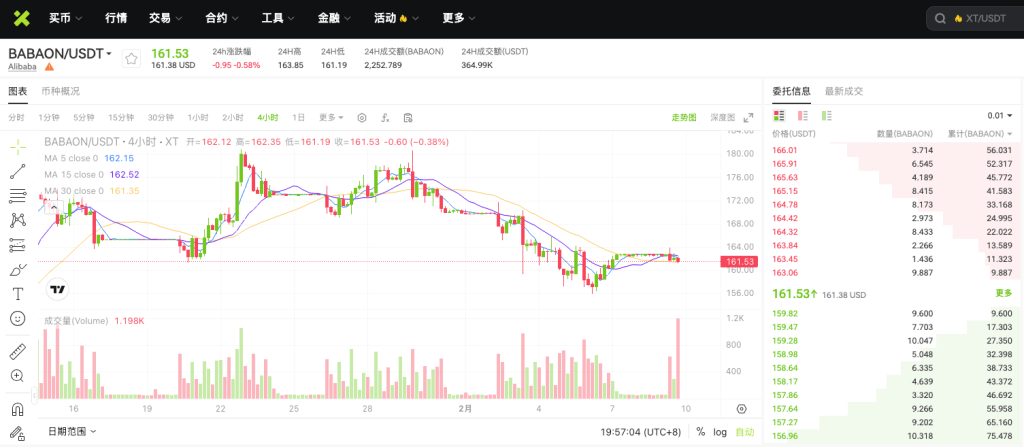 BABAON/USDT spot trading is now live on XT.com.
- JDON/USDT – Tokenized price exposure for JD.com, representing the logistics-centric e-commerce model and domestic consumption trends.
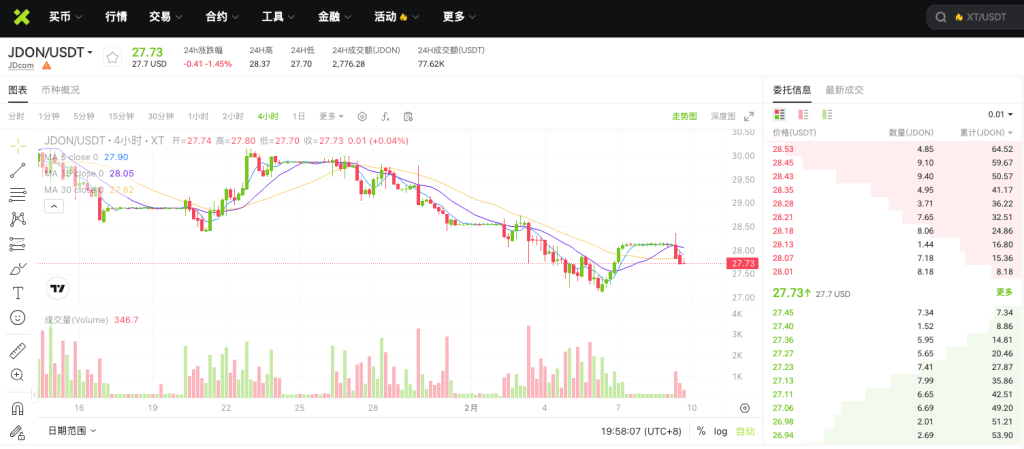 JDON/USDT spot trading is now live on XT.com.
- FUTUON/USDT – Tokenized price exposure for Futu, a digital brokerage serving the China market, highly sensitive to capital market activity and investor sentiment.
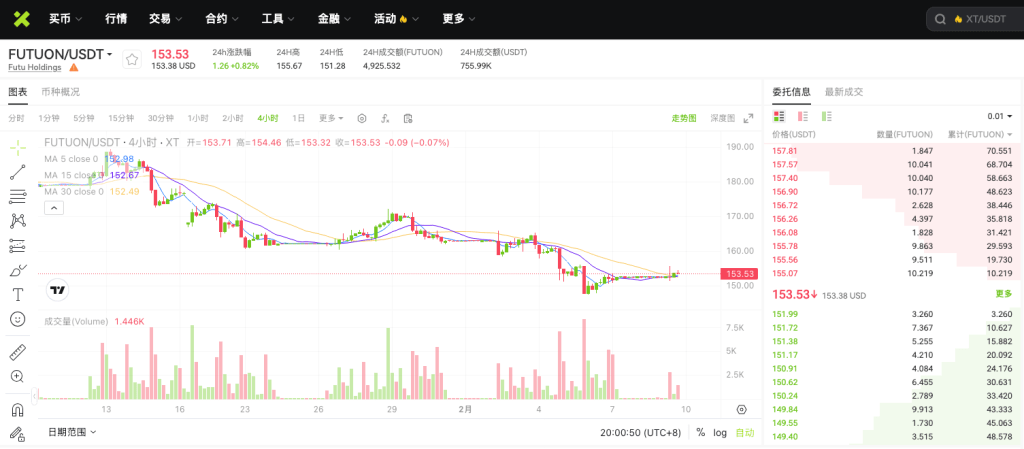 FUTUON/USDT spot trading is now live on XT.com.
- TSMON/USDT – Tokenized price exposure for TSMC. As a key enterprise in the global semiconductor industry chain, its performance is often discussed alongside advanced manufacturing, tech competition, and China-related geopolitical issues.
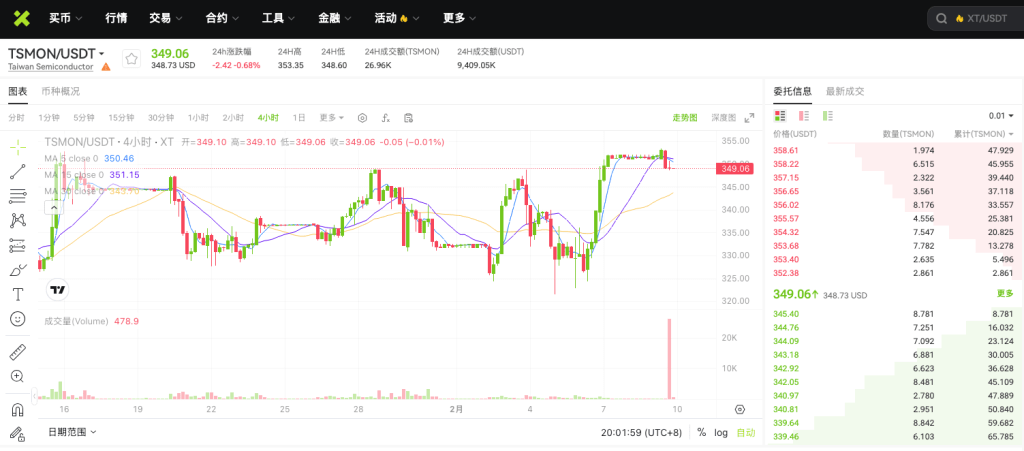 TSMON/USDT spot trading is now live on XT.com.
These tokenized assets enable investors to express judgments related to China's economy, policies, or specific industries while maintaining clear position control, and incorporate them into more diversified portfolios.
Within this framework, XT's role is that of an "access layer", providing a unified entry point for crypto-native portfolios to access global and China-related stock exposure; the specific asset allocation, position management, and risk control remain decisions for the investors themselves.
What Are the Main Risks of Tokenized China Concept Stocks
When evaluating tokenized China concept stocks, investors should focus on the following core risk categories:
Market Risk.
Stock and bond prices may decline due to changes in corporate earnings cycles, valuation adjustments, or shifts in the macro environment.
Policy and Geopolitical Risk.
China concept stocks are highly sensitive to changes in regulatory policies, trade relations, and cross-border regulatory coordination. Related information often directly impacts market expectations and volatility levels.
Structural and Product Risk.
Tokenized stocks also involve risks related to product structure design, counterparty risk, liquidity conditions, and how corporate actions (such as dividends, stock splits) are handled.
Assessing these risks within a unified framework helps investors avoid misinterpreting "tokenization" as a reduction in risk itself. Tokenization simplifies the trading path and operational process, not the investment outcome.
How Should Investors Rationally Use Tokenized Stocks
Before incorporating tokenized stocks into an investment portfolio, investors should establish clear usage principles in advance:
- Define the role each tokenized stock plays in the portfolio regarding China-related exposure.
- Set position limits and rebalancing rules in advance to avoid emotional adjustments.
- Focus on the macro environment and policy signals, not just narratives within the crypto market.
- Regularly review product disclosure information and structural details to ensure understanding of mechanism changes.
- Prepare mentally and financially for periods of declining liquidity or increased volatility.
When used prudently and with discipline, tokenized stocks can significantly expand the toolkit of globalized, crypto-native investors, helping them navigate an increasingly interconnected market environment.
Core Conclusion: Tokenized stocks enhance the efficiency of accessing global and China-related stock exposure, but the ultimate diversification effect depends on portfolio structure, the diversity of risk sources, and investment discipline, not the tokenized form itself.
Further Reading