Etherean Repricing: From Rollup-Centric to "Security Settlement Layer"


- Core Viewpoint: Vitalik's latest reflection marks a strategic shift in Ethereum's focus from reliance on Layer 2 to strengthening the mainnet itself. Its core value is transitioning from pursuing traffic and protocol revenue to building a globally trusted settlement layer with security, neutrality, and predictability. Consequently, the valuation logic for ETH is undergoing a structural migration.
- Key Elements:
- Paradigm Shift: Ethereum has entered an "L1-first paradigm." Direct mainnet scaling and fee reductions have invalidated the original assumption that L2s are the core vehicles for scaling.
- Redefining the Role of L2s: The slow progress of L2 decentralization has led to their role being redefined as a spectrum of networks with varying trust levels, rather than uniform "branded shards" inheriting Ethereum's security.
- Migration of Core Value: The core value of ETH is shifting from "traffic" and protocol revenue to "settlement sovereignty"—the institutional premium derived from being the world's most secure EVM settlement layer and its native monetary asset.
- Valuation Framework Restructuring: ETH's pricing logic is moving from a cash flow model to an asset premium model. The weighting for security and institutional credibility is rising significantly, while the weighting for transaction fees and platform effects is declining.
- Institutionalization as a Second Curve: With the development of compliant products like spot and staking ETFs, ETH may transition from a high-volatility asset to a configurable asset with predictable returns, potentially being integrated into traditional financial settlement and collateral systems.
Original Authors: Jacob Zhao & Jiawei @IOSG
On February 3, 2026, Vitalik published a significant reflection on X regarding Ethereum's scaling roadmap. As the practical difficulty of Layer 2 networks evolving towards a fully decentralized form is being re-evaluated, and with the mainnet's own throughput capacity expected to increase substantially in the coming years, the original vision of "L2 as the core vehicle for Ethereum scaling" is no longer tenable. Ethereum's strategic focus is shifting back to the mainnet itself—strengthening its position as the world's most trusted settlement layer through institutionalized scaling and protocol-native security mechanisms. Scaling is no longer the sole objective; security, neutrality, and predictability are once again becoming Ethereum's core assets.
Core Changes:
- Ethereum is entering an "L1-First Paradigm": With direct mainnet scaling and persistently declining fees, the original assumption that L2s would bear the core role of scaling is no longer valid.
- L2s are no longer "branded shards," but a trust spectrum: The decentralization of L2s is progressing far slower than expected, making it difficult to uniformly inherit Ethereum's security. Their role is being redefined as a spectrum of networks with varying levels of trust.
- Ethereum's core value shifts from "traffic" to "settlement sovereignty": ETH's value is no longer limited to Gas or Blob revenue, but lies in its institutional premium as the world's most secure EVM settlement layer and native monetary asset.
- Scaling strategy is adjusting towards protocol-native integration: Building upon the ongoing direct scaling of L1, the exploration of protocol-layer native validation and security mechanisms may reshape the security boundaries and value capture structure between L1 and L2.
- Valuation framework undergoes a structural shift: The weight of security and institutional credibility rises significantly, while the weight of fees and platform effects declines. ETH's pricing is transitioning from a cash flow model to an asset premium model.
This article will analyze the paradigm shift in Ethereum's pricing model and valuation reconstruction through a layered approach of facts (technological and institutional changes that have occurred), mechanisms (impact on value capture and pricing logic), and deduction (implications for allocation and risk-return).
Returning to the Origin: Ethereum's Values
Understanding Ethereum's long-term value lies not in short-term price fluctuations, but in its consistent design philosophy and value orientation.
- Credible Neutrality: Ethereum's core goal is not efficiency or profit maximization, but to become a credibly neutral infrastructure—with public, predictable rules that do not favor any participant, are not controlled by a single entity, and allow anyone to participate without permission. The security of ETH and its on-chain assets ultimately relies on the protocol itself, not any institutional credit.
- Ecosystem First, Not Revenue First: Ethereum's key upgrades consistently demonstrate a decision-making logic—actively sacrificing short-term protocol revenue in exchange for lower usage costs, a larger ecosystem scale, and stronger system resilience. Its goal is not to "collect tolls," but to become an irreplaceable neutral settlement and trust foundation for the digital economy.
- Decentralization as a Means: The mainnet focuses on the highest level of security and finality, while Layer 2 networks exist on a spectrum of connection to the mainnet with varying degrees: some inherit mainnet security and pursue efficiency, while others find value in differentiated functionalities. This enables the system to serve both global settlement and high-performance applications simultaneously, rather than acting as L2 "branded shards."
- Long-Termist Technical Roadmap: Ethereum adheres to a slow but certain evolutionary path, prioritizing system security and credibility. From the PoS transition to subsequent scaling and confirmation mechanism optimizations, its roadmap pursues sustainable, verifiable, and irreversible correctness.
Security Settlement Layer: Refers to the Ethereum mainnet providing irreversible finality services for Layer 2 networks and on-chain assets through decentralized validator nodes and consensus mechanisms.
This positioning as a security settlement layer signifies the establishment of "settlement sovereignty." It marks Ethereum's transition from a "confederation" to a "federation," its "constitutional moment" as a digital nation-state, and a crucial upgrade to its architecture and core.
After the American Revolutionary War, under the Articles of Confederation, the 13 states resembled a loose alliance, each printing its own currency and imposing tariffs on each other. Each state was free-riding: enjoying common defense but refusing to pay; benefiting from the alliance's brand but acting independently. This structural issue led to a decline in national credit and an inability to conduct unified foreign trade, severely hindering the economy.
1787 was America's "constitutional moment." The new Constitution granted the federal government three key powers: the power to levy taxes directly, regulate interstate commerce, and issue a unified currency. However, what truly brought the federal government to life was Alexander Hamilton's 1790 economic plan: the federal government assumed state debts, honored them at face value to rebuild national credit, and established a national bank as the financial hub. A unified market unleashed economies of scale, national credit attracted more capital, and infrastructure gained financing capability. The United States transformed from 13 small, mutually defensive states into the world's largest economy.
The structural dilemma of today's Ethereum ecosystem is entirely consistent.
Each L2 is like a "sovereign state," with its own user base, liquidity pools, and governance token. Liquidity is fragmented, cross-L2 interactions face high friction, and L2s enjoy Ethereum's security layer and brand but fail to return value to L1. It is short-term rational for each L2 to lock liquidity on its own chain, but when all L2s do this, the entire Ethereum ecosystem loses its core competitive advantage.
The roadmap Ethereum is now advancing is essentially its constitution-making and establishment of a central economic system—that is, establishing "settlement sovereignty":
- Native Rollup Precompile = Federal Constitution. L2s can freely build differentiated functionalities outside the EVM, while the EVM portion can obtain Ethereum-level security verification through native precompiles. Not integrating is an option, but the cost is losing trustless interoperability with the Ethereum ecosystem.
- Synchronous Composability = Unified Market. Through mechanisms like native rollup precompiles, trustless interoperability and synchronous composability between L2s, and between L2s and L1, are becoming possible. This directly eliminates "interstate trade barriers," and liquidity is no longer trapped on isolated islands.
- L1 Value Capture Reconstruction = Federal Taxation Power. When all critical cross-L2 interactions return to L1 for settlement, ETH once again becomes the settlement hub and trust anchor for the entire ecosystem. Whoever controls the settlement layer captures the value.
Ethereum is using a unified settlement and verification system to transform the fragmented L2 ecosystem into an irreplaceable "digital nation-state." This is a historical inevitability. Of course, the transition process may be slow, but history tells us that once this transformation is complete, the unleashed network effects will far exceed the linear growth of the fragmented era. The United States used a unified economic system to turn 13 small states into the world's largest economy. Ethereum will also transform its loose L2 ecosystem into the largest security settlement layer, and even a global financial carrier.
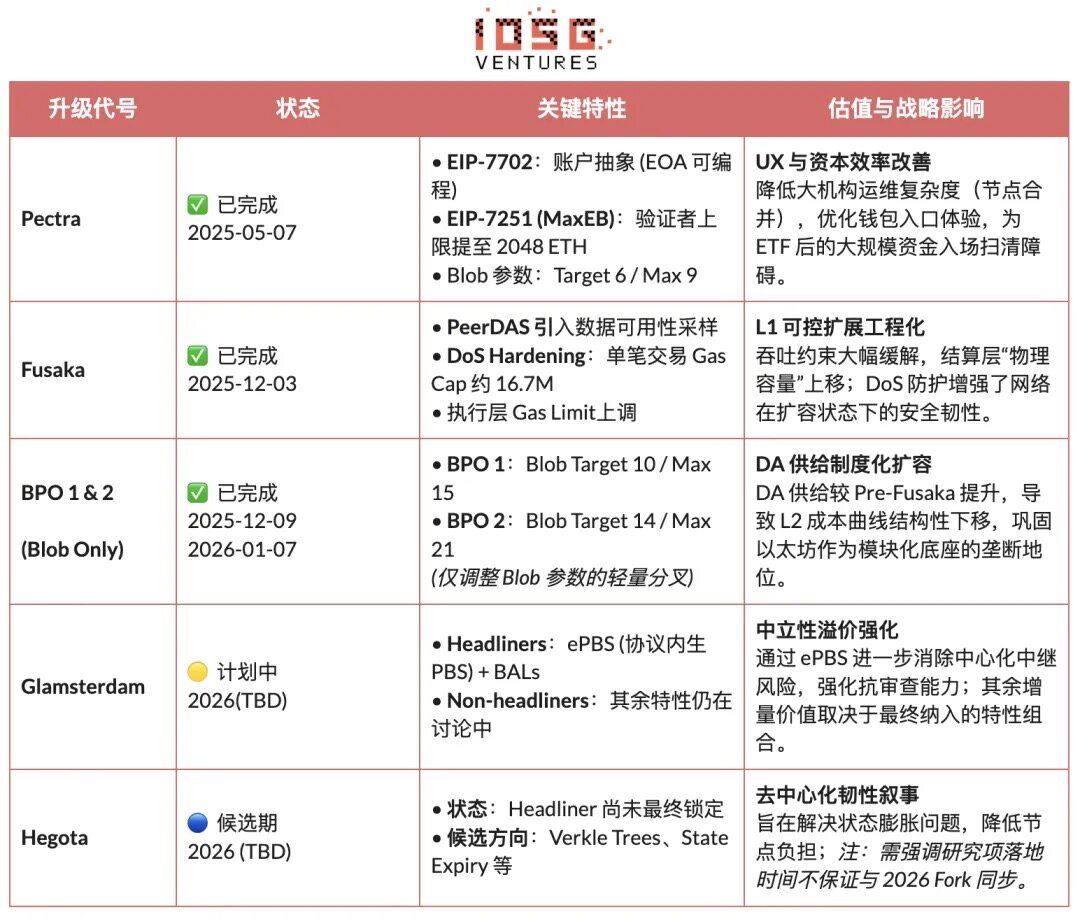 Ethereum Core Upgrade Roadmap and Valuation Impact (2025-2026)
Valuation Misconception: Why Ethereum Should Not Be Viewed as a "Tech Company"
Applying traditional corporate valuation models (P/E, DCF, EV/EBITDA) to Ethereum is essentially a category error. Ethereum is not a company aiming for profit maximization, but an open digital economic infrastructure. Companies pursue shareholder value maximization, while Ethereum pursues ecosystem scale, security, and censorship resistance maximization. To achieve this, Ethereum has repeatedly actively reduced protocol revenue (e.g., through EIP-4844 introducing Blob DA, structurally lowering L2 data publication costs, and reducing L1 fee income from rollup data)—akin to "revenue self-destruction" from a corporate perspective, but from an infrastructure perspective, it sacrifices short-term fees for long-term neutrality premium and network effects.
A more reasonable framework is to view Ethereum as a globally neutral settlement and consensus layer: providing security, finality, and credible coordination for the digital economy. ETH's value is reflected in multiple structural demands—the rigid demand for final settlement, the scale of on-chain finance and stablecoins, the impact of staking and burn mechanisms on supply, and the long-term, sticky capital brought by institutional adoption such as ETFs, corporate treasuries, and RWAs.
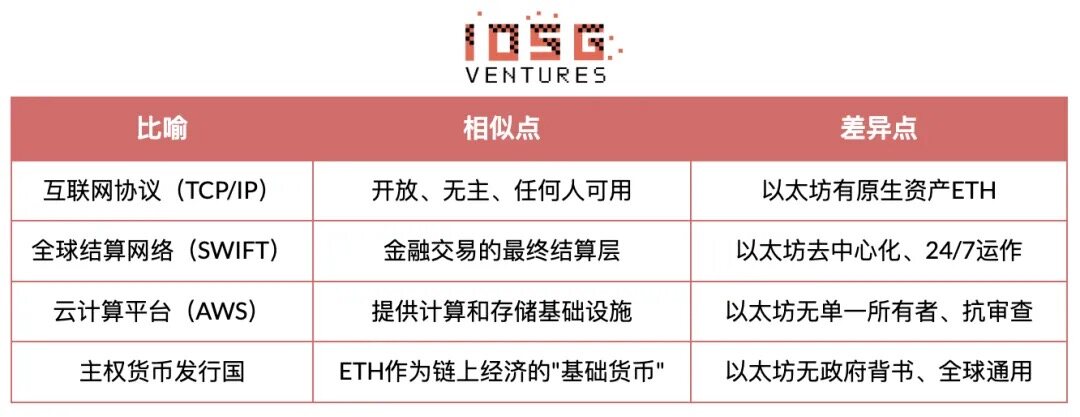
Paradigm Reconstruction: Finding Pricing Anchors Beyond Cash Flow
The ethval.com platform launched by the Hashed team at the end of 2025 provides a comprehensive, reproducible set of quantitative models for Ethereum, but traditional static models struggle to capture the dramatic narrative shift for Ethereum in 2026. Therefore, we have reused its systematic, transparent, and reproducible underlying models (covering yield, monetary, network effects, and supply structure) while reshaping the valuation architecture and weighting logic:
- Structural Reconstruction: Mapping the models to the four major value quadrants of "Security, Monetary, Platform, Revenue," and summing pricing by category.
- Weight Rebalancing: Significantly increasing the weight of security and settlement premium, while weakening the marginal contribution of protocol revenue and L2 expansion.
- Risk Control Overlay: Introducing a circuit breaker mechanism sensitive to macro and on-chain risks, enabling the valuation framework to adapt across cycles.
- Eliminating "Circular Reasoning": Models containing current price inputs (e.g., Staking Scarcity, Liquidity Premium) are no longer used as fair value anchors, retained only as indicators for adjusting positioning and risk appetite.
Note: The following models are not for precise price point prediction, but to depict the relative pricing direction of different value sources across different cycles.
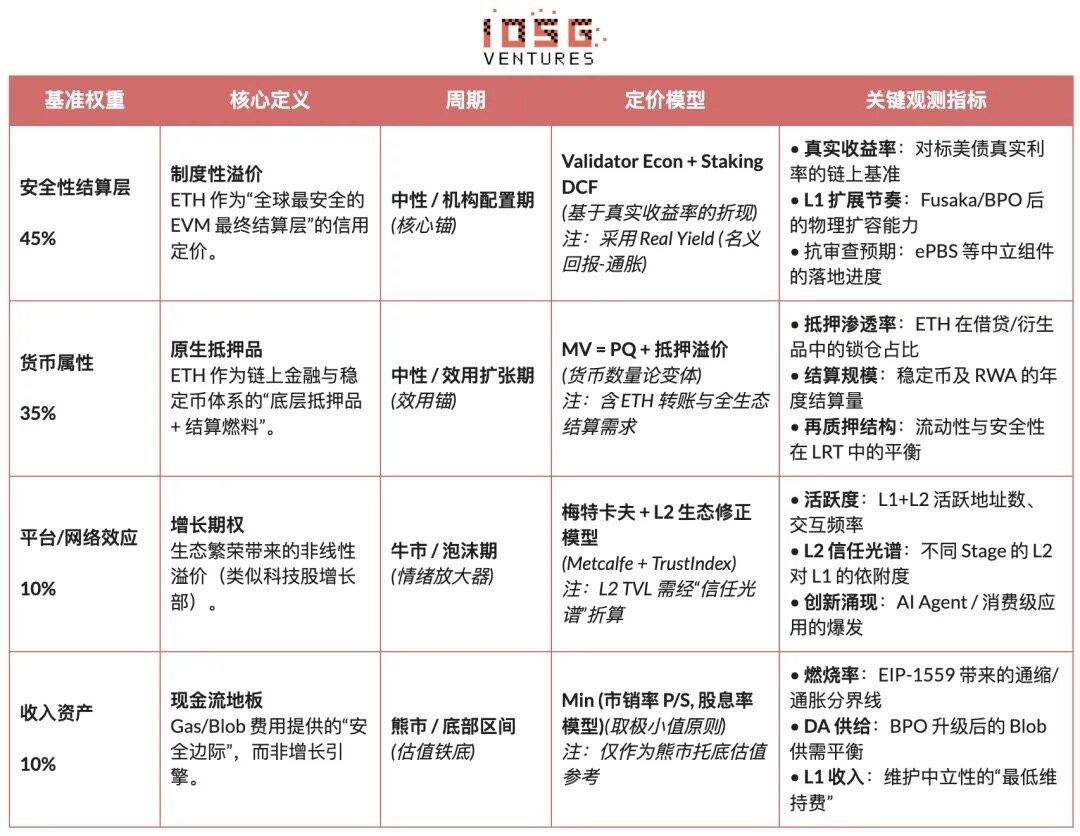
Security Settlement Layer: Core Value Anchor (45%, Upward Adjustment in Risk-Off Periods)
We view the security settlement layer as Ethereum's most core source of value, assigning it a baseline weight of 45%; this weight is further increased during periods of rising macro uncertainty or falling risk appetite. This judgment stems from Vitalik's latest definition of "truly scaling Ethereum": the essence of scaling is not increasing TPS, but creating block space fully backed by Ethereum itself. Any high-performance execution environment relying on external trust assumptions does not constitute scaling of the Ethereum entity.
Under this framework, ETH's value primarily manifests as the credit premium of a global, sovereign-less settlement layer, not protocol revenue. This premium is jointly supported by structural factors such as validator scale and decentralization, long-term security track record, institutional adoption, clarity of compliance pathways, and protocol-native rollup validation mechanisms.
For specific pricing, we primarily employ two complementary methods: Validator Economics (yield equilibrium mapping) and Staking DCF (perpetual staking discount), together depicting ETH's institutional premium as the "global security settlement layer."
- Validator Economics (Yield Equilibrium Pricing): Derives a theoretical fair price based on the ratio of annualized staking cash flow per ETH to the target real yield:
- Fair Price = (Annual Staking Cash Flow per ETH) / Target Real Yield
- This expression is used to depict the equilibrium relationship between yield and price, serving as a directional relative valuation tool, not an independent pricing model.
- Staking DCF (Perpetual Staking Discount): Treats ETH as a long-term asset capable of sustainably generating real staking yield, discounting its cash flow in perpetuity:
- M_staking = Total Real Staking Cash Flow / (Discount Rate − Longterm Growth Rate)
- ETH Price (staking) = M_staking / Circulating Supply
In essence, this value layer is not对标 the revenue capability of platform companies, but resembles the settlement credit of a global clearing network.
Monetary Properties: Settlement and Collateral (35%, Dominant in Utility Expansion Periods)
We view monetary properties as Ethereum's second core source of value, assigning it a baseline weight of 35%, becoming the primary utility anchor during neutral markets or on-chain economic expansion phases. This judgment is not based on the narrative that "ETH equals the US dollar," but on its structural role as the native settlement fuel and ultimate collateral asset of the on-chain financial system. The security of stablecoin circulation, DeFi liquidations, and RWA settlement all rely on the settlement layer underpinned by ETH.
For pricing, we employ an extended form of the Quantity Theory of Money (MV = PQ), but model ETH's use cases in layers to account for orders-of-magnitude differences in velocity across different scenarios: Layered Monetary Demand Model:
High-Frequency Settlement Layer (Gas payments, stablecoin transfers)
- M_transaction = Annual Transaction Settlement Volume / V_high
- V_high ≈ 15-25 (referencing historical on-chain data)
Medium-Frequency Financial Layer (DeFi interactions, loan liquidations)
- M_defi = Annual DeFi Settlement Volume / V_medium
- V_medium ≈ 3-8 (based on capital turnover rates of mainstream DeFi protocols)
Low-Frequency Collateral Layer (Staking, restaking, long-term locking)
- M_collateral = Total ETH Collateral Value × (1 + Liquidity Premium)
- Liquidity Premium = 10-30% (reflecting compensation for sacrificed liquidity)
Platform / Network Effects: Growth Option (10%, Bull Market Amplifier)
Platform and network effects are viewed as a growth option within Ethereum's valuation, assigned only a 10% weight, used to explain the non-linear premium brought by ecosystem expansion during bull market phases. We employ a trust-adjusted Metcalfe's Law model, avoiding equal weighting of L2 assets with different security levels in the valuation:
- Metcalfe's Law Model: M_network = a × (Active Users)^b + m × Σ (L2 TVL_i × TrustScore_i)
- Platform/Network Effects Valuation Price: ETH Price(network) = M_network / Circulating Supply
Revenue Asset: Cash Flow Floor (10%, Bear Market Support)
We view protocol revenue as the cash flow floor within Ethereum's valuation system, not a growth engine, also assigning it a 10% weight. This layer primarily functions during bear markets or extreme risk phases, used to depict the valuation floor.
Gas and Blob fees provide the network's minimum operating costs and influence the supply structure through EIP-1559. For valuation, we employ Price-to-Sales and Fee Yield models, taking the conservative value between them, serving only as a bottom reference. As the mainnet continues to scale, the importance of protocol revenue declines relatively, with its core role manifesting as a safety margin during downturns.
- Price-to-Sales Model (P/S Floor): M_PS = Annual Protocol Revenue × P/S_multiple
- P/S Valuation Price: ETH Price (PS) = M_PS / Circulating Supply
- Fee Yield Model: M_Yield = Annual Protocol Revenue / Target Fee Yield
- Fee Yield Valuation Price: ETH Price(Yield) = M_Yield / Circulating Supply
- Cash Flow Floor Pricing (taking the minimum of the two): P_Revenue_Floor = min(P_PS , P_Yield)
Dynamic Calibration: Macro Constraints and Cycle Adaptation
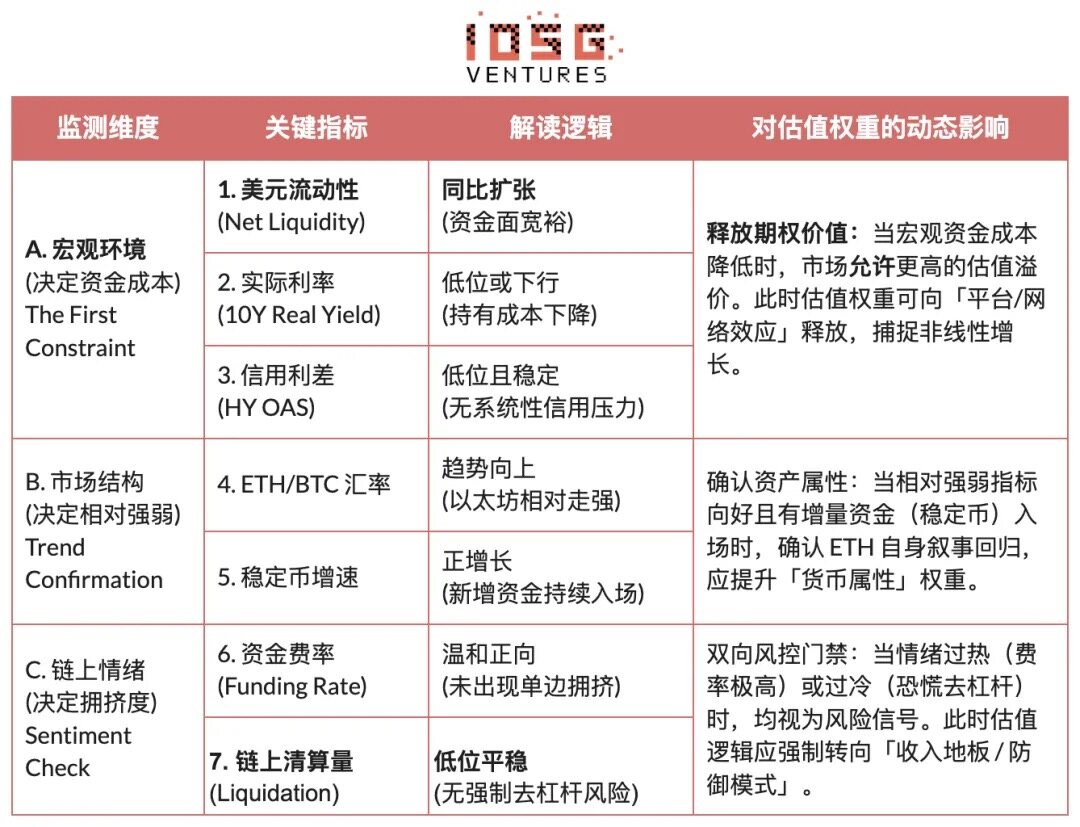
If the previous sections established Ethereum's "intrinsic value center," this chapter introduces an "external environment adaptation system" independent of fundamentals. Valuation cannot operate in a vacuum; it must be constrained by three external factors: the macro environment (cost of capital), market structure (relative strength), and on-chain sentiment (crowding). Based on this, we have constructed a Regime Adaptation mechanism, dynamically adjusting valuation weights across different cycles—releasing option premium during easing periods, retreating to the revenue floor during risk-off periods—thereby achieving a leap from static models to dynamic strategy. (Note: Due to space constraints, this article only presents the core logical framework of this mechanism.)
Conditional Path for the Institutionalization Second Curve
The previous analysis is based on the internal technical, valuation, and cyclical logic of the crypto system. This chapter discusses a different level of problem: when ETH is no longer priced solely by crypto-native capital but is gradually incorporated into the traditional financial system, how will its pricing power, asset attributes, and risk structure change? The institutionalization second curve is not an extension of existing logic, but a redefinition of Ethereum by exogenous forces:
- Change in Asset Attributes (Beta → Carry): Spot ETH ETFs address compliance and custody issues, essentially still price exposure; whereas the future advancement of Staking ETFs introduces on-chain yield into the institutional system through compliant vehicles for the first time. ETH thus transitions from an "interest-free, high-volatility asset" to a "configurable asset with predictable yield," expanding potential buyers from trading capital to yield- and duration-sensitive pensions, insurance, and long-term accounts.
- Change in Usage Mode (Holding → Using): If institutions no longer view ETH merely as a tradable asset but begin using it as settlement and collateral infrastructure