






Why Are AI Agent Tokens Rising on Base? The New Trend Represented by FELIX


- Core Viewpoint: FELIX is a functional token on the Base network bound to an AI Agent brand. Its core value lies in representing the Agent's economic activities and narrative through transparent, verifiable on-chain operations (such as token burns, treasury flows), rather than relying on complex protocol functionalities or governance rights.
- Key Elements:
- Functional Positioning: Serves as a visual signal for Agent economic activities, used to track on-chain behaviors like burns and treasury fund flows; it does not directly provide computing power or governance functions.
- Token Model: Fixed total supply of 100 billion tokens, incorporating a burn mechanism to reduce circulating supply. The supply status (circulating, burned, treasury) is simple and transparent.
- Operational Basis: Relies on automated on-chain operations on the Base network, emphasizing the observability and verifiability of actions, with a simple design.
- Main Risks: Value is highly dependent on the narrative attention of the associated Agent and the transparency of its on-chain operations, rather than on mandatory use cases. Risks include concentrated liquidity and market sentiment volatility.
- Acquisition Method: Users can acquire the token via DEXs on Base or the FELIX/USDT spot trading pair on XT.com.
Quick Summary
- What it is: FELIX is an AI Agent token deployed on the Base network, associated with automated on-chain operations and Agent-related economic activities.
- Core Use: The token is used to support transaction behaviors related to AI Agents, observable treasury fund flows, and participation in the Felix Craft on-chain ecosystem.
- Key Differentiator: Compared to complex protocol mechanisms or governance systems, FELIX emphasizes the transparency of token operations and Agent brand attributes.
- How to Participate: Users can acquire FELIX via decentralized exchanges on Base, or participate through the FELIX/USDT spot trading pair on XT.com, while continuously monitoring token burns, treasury changes, and liquidity shifts.
- Main Risks: FELIX's long-term relevance depends on whether its associated Agent maintains sustained visibility, stable operations, and continued ecosystem attention.
What is FELIX
FELIX is an AI Agent-associated functional token built on the Base network. Through an automated on-chain token operation mechanism, it supports Agent-driven economic activities, enabling transparent fund flows, observable treasury management, and verifiable on-chain participation in the ecosystem.
Why AI Agent Tokens Are Gaining Attention
AI Agent tokens are gradually becoming a distinct category within the crypto market, especially in the Base ecosystem, where experiments with autonomous Agents, social deployment tools, and automated on-chain operations have notably accelerated. Unlike earlier AI narratives centered on computing power or infrastructure, this phase focuses more on the "representational" layer—using tokens to reflect an Agent's activity status, collaborative relationships, or economic presence, rather than the underlying technology itself.
FELIX is a representative case emerging within this context. It does not position itself as a complete protocol or platform but rather as a token bound to an Agent, with its value and relevance primarily stemming from observable and verifiable on-chain behavior. This article will analyze FELIX's functional positioning, operational model, demand sources, differences from similar projects, and key risks to consider during evaluation.
How FELIX Operates
FELIX is a token deployed on the Base network, associated with the Felix Craft project, which is centered around an AI Agent. The project emphasizes automated on-chain operations and publicly verifiable processes. FELIX does not represent ownership of a protocol nor grant users governance rights over a complex system. Its functional positioning is relatively focused, and its on-chain behavior is highly observable.
In practice, FELIX is integrated with Agent-related activities and automated token circulation mechanisms. These on-chain processes include periodic claiming, token burns, and routing of treasury funds. All operations are completed on-chain and can be independently verified by third parties. Therefore, FELIX functions more as an economic signal bound to the operational status of an Agent, rather than a general-purpose utility token.
User interaction with FELIX is primarily observational and participatory. Some users acquire the token via decentralized exchanges to participate in the related Agent narrative and its on-chain operations. Simultaneously, FELIX also offers trading channels on centralized spot markets, such as the FELIX/USDT spot trading pair on XT.com, providing additional price discovery references for the market.
The demand for FELIX does not stem from mandatory functional use but rather from attention, transparency, and narrative alignment. Its relevance depends on whether the associated Agent activities can maintain sustained visibility and hold practical significance within Base's AI Agent ecosystem.
From a technical perspective, FELIX operates based on the standard ERC-20 mechanism on Base, combined with automated operational processes that impact token supply and treasury balances. The overall design deliberately remains simple, relying on on-chain visibility rather than complex abstract structures.
FELIX Tokenomics
Core Token Mechanism
FELIX employs a fixed total supply token model without ongoing issuance mechanisms related to staking, validation, or block production. Its maximum supply is capped at 100 billion tokens, with a portion already permanently removed from circulation through on-chain burns. These burn actions are executed as explicit operational procedures, not as algorithmic measures to counter inflation.
Tokens enter circulation primarily through initial distribution and secondary market trading. Over time, some FELIX is sent to burn addresses, reducing the actual circulating supply. Tokens not burned flow to treasury addresses for centralized management rather than redistribution through incentive programs.
In its design, FELIX does not employ mechanisms like tiered unlocks, complex incentive pools, or multi-stage releases. The token supply is divided into only three observable states: circulating tokens, burned tokens, and treasury-held tokens. This structure lowers the cognitive cost and makes supply changes more intuitive, but it also means FELIX relies more on visibility and ecosystem relevance than embedded economic incentives.
Liquidity primarily comes from decentralized trading pools on the Base network. Additionally, the FELIX/USDT spot trading pair on platforms like XT.com provides the market with extra liquidity and trading activity references. Therefore, the nominal circulating supply and actual available liquidity may differ due to venue depth and holder behavior.
Metric Value On-Chain / Data Source (Source: CoinGecko) Max Supply 100,000,000,000 FELIX Fixed cap set at deployment Current Circulating Supply 97,395,086,031 FELIX Market-tradeable circulating supply Burned Amount 2,604,913,968 FELIX Sent to 0x0000… burn address
Why Tokenomics Matters
The impact of FELIX's tokenomics on users is primarily reflected in supply transparency and liquidity structure, rather than yield-generating mechanisms. The burn mechanism gradually reduces the circulating supply, while treasury accumulation centralizes token value under operational management. Its long-term sustainability depends on whether these mechanisms can remain aligned with ongoing Agent activities, rather than relying solely on short-term attention fluctuations.
Ecosystem and Core Applications
How Users Interact with FELIX
The primary interaction path with FELIX is relatively straightforward. Users typically acquire the token via decentralized exchanges on the Base network and choose to hold it while continuously monitoring its on-chain behavioral performance. Token usage is not triggered by mandatory protocol operations but revolves around operational events like burns, treasury fund movements, and liquidity changes.
The overall participation method is observation-centric. Users are not required to stake, vote, or deploy any infrastructure. Instead, they assess ecosystem activity by tracking whether Agent-related on-chain operations continue to occur and whether the related data remains transparent and consistent.
Main dApps and Use Cases
Representing Agent-related economic activities.
FELIX serves as a visual economic identifier reflecting the activity status associated with a specific AI Agent identity. It does not directly provide execution or computing power functions but rather indicates whether Agent-related operations are occurring and settling on-chain.
Enabling transparency and verifiability of token operations.
FELIX is used in a series of automated processes that generate observable token burns and treasury fund routing behaviors. This allows external participants to verify whether related operations are executed as intended without relying on off-chain disclosures.
Participating in Agent brand narratives within the Base ecosystem.
Holding FELIX signifies participation in the narrative expression of a specific Agent brand within the Base ecosystem. This participation is more symbolic than functional, creating an association between the user and a particular Agent identity.
Serving as a narrative proxy signal for measuring Agent relevance.
FELIX acts, to some extent, as a proxy indicator. Fluctuations in its liquidity, supply changes, and on-chain activity levels reflect shifts in market attention and the relevance of the associated Agent within the broader AI Agent ecosystem.
How to Buy, Use, and Participate in FELIX
FELIX can be acquired via decentralized exchanges operating on the Base network. Users typically need to bridge assets to Base first, verify the official contract address, and then complete the swap through the corresponding liquidity pool. In addition to decentralized channels, XT.com also supports the FELIX/USDT spot trading pair, providing the market with an alternative path for liquidity acquisition and price discovery.
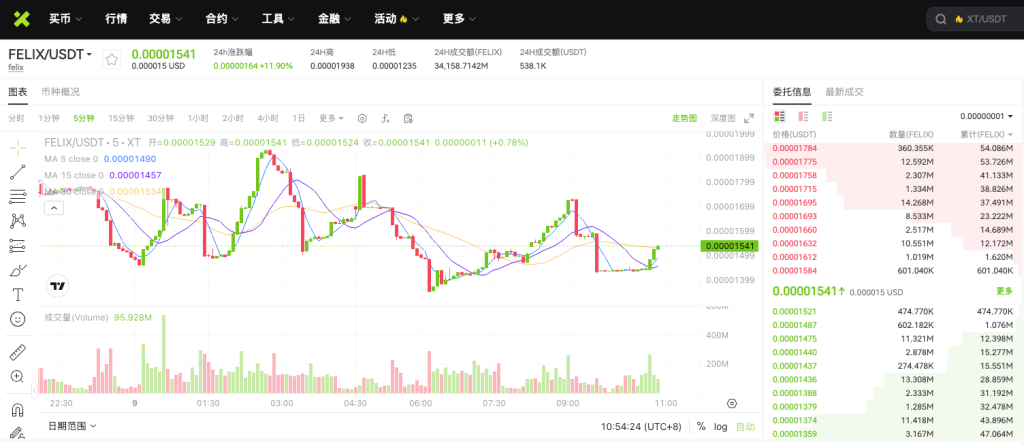 FELIX/USDT spot trading is now live on XT.com.
Holding FELIX itself does not require additional operations. Users can choose to hold it as exposure to Agent-related economic activities or trade it in different liquidity environments. Simultaneously, by observing token supply changes and treasury fund flows, they can use it as an informational reference signal rather than a prerequisite for functional use.
The overall participation method focuses on observing ecosystem and market changes rather than mandatory protocol-layer operations.


