When AI Needs Humans: The Narrative Logic Behind RentAHuman (RENT)



- Core Viewpoint: RENT is a narrative-driven token on the Base network. Its value is primarily tied to market discussion fervor around the concept of "AI agents hiring humans," rather than stemming from any protocol-level mandatory use cases or actual product integration.
- Key Elements:
- The token has a total supply of 100 billion, employing a fixed supply model with no burn or inflation mechanisms. Circulation relies entirely on secondary market trading.
- Its primary use is as a trading asset. Users can buy, sell, and hold it via centralized exchanges (such as the RENT/USDT pair on XT.com) or decentralized trading platforms.
- RENT currently has no confirmed product-level integration with the RentAHuman platform. It is not a prerequisite for accessing services or participating in governance, and demand is highly dependent on market narratives.
- Its core risks lie in its strong dependence on narrative popularity, the lack of support from real-world application scenarios, and potentially exacerbated price volatility due to concentrated liquidity.
- Unlike functional work platform tokens such as Braintrust or Gitcoin, RENT's positioning is closer to a pure market speculation tool, competing for market attention rather than users.
Quick Takeaways
- What it is: RENT is a cryptocurrency token built on the Base network, often discussed in the market in relation to RentAHuman and the topic of "AI agents hiring humans."
- Core Use: The token primarily exists as a tradable asset and does not have mandatory use cases enforced at the protocol level.
- Differentiation: RENT's market attention stems more from the narrative hype around "AI and human collaborative execution" rather than actual demand for on-chain services.
- How Users Participate: Users primarily interact with RENT through spot trading (e.g., RENT/USDT trading pairs), holding, and market participation centered around the related narrative.
- Main Risks: There is currently no confirmed product-level integration with RentAHuman, creating uncertainty around its long-term relevance and demand.
What is RENT
RENT is a cryptocurrency token built on the Base network and is listed for trading on XT.com. The token circulates through open market mechanisms and is often referenced in market discussions about AI agents and human collaborative execution. However, it currently lacks confirmed mandatory use cases at the protocol level and has no direct product-level integration with the RentAHuman platform.
Why the Concept of "AI Agents Renting Humans" Gained Widespread Attention Quickly
As autonomous agents continue to improve in planning and decision-making capabilities, their real-world limitations remain evident. Software systems can process information, generate instructions, and coordinate workflows, but they cannot directly perform physical actions in the real world. This gap has prompted market discussions about "human execution" as a complementary layer for agent systems, especially for tasks involving offline operations or real-world scenarios.
RENT entered the market's view precisely against the backdrop of this rising discussion. The token does not represent a finished product form nor constitute a standardized execution framework; instead, it is frequently cited in market discussions related to the aforementioned narrative. Understanding RENT requires distinguishing the macro concept it is associated with from its current actual functionality. This section will explain RENT's current usage patterns, market participation pathways, and its structural limitations.
How Does RentAHuman (RENT) Work
RENT is a fungible token deployed on the Base network. Currently, it does not serve as a required asset for accessing a protocol, paying network fees, or enabling on-chain services. Its use is also not enforced through smart contract logic tied to a specific application.
Participation activities surrounding RENT primarily occur in the secondary market. Traders and other market participants typically interact with the token through centralized exchanges (including spot trading pairs like RENT/USDT) and decentralized liquidity pools, rather than through dedicated product interfaces that require the token for use.
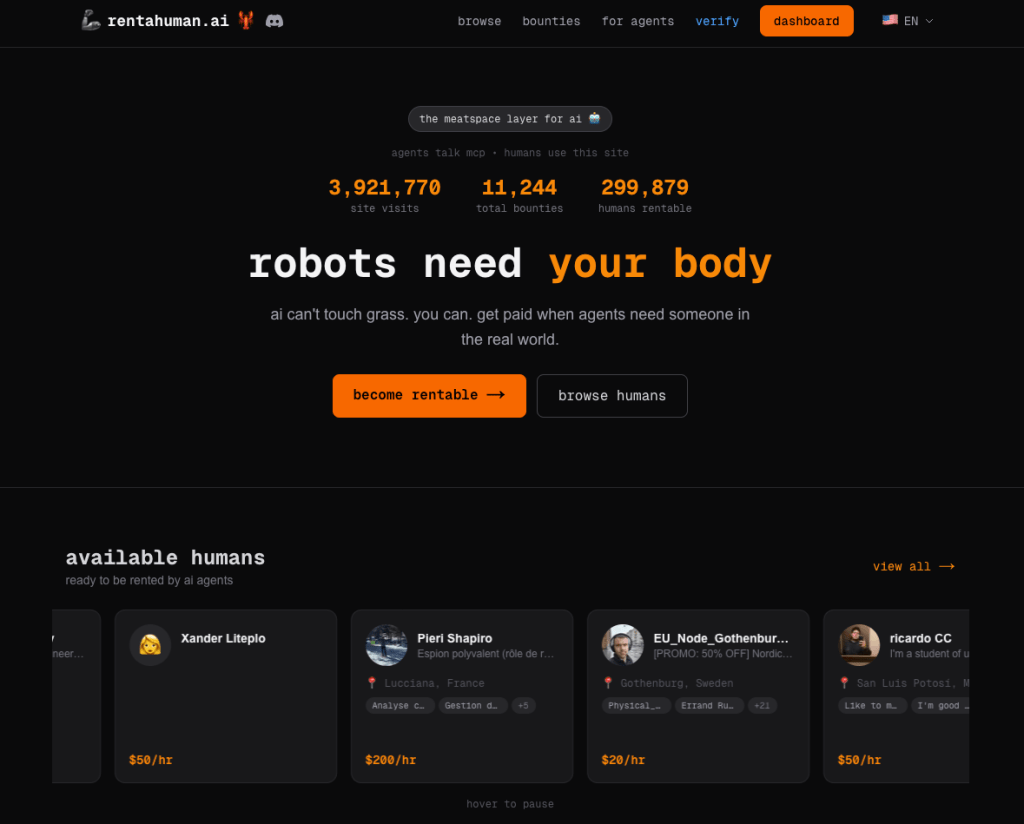 Source: Rentahuman.ai
From a market perspective, attention to RENT often rises in tandem with discussions on topics like AI agents, human task execution, and the collaboration between software systems and the real world. In these contexts, RENT is often viewed as a speculative market expression of the above discussions. Its demand stems more from market perception and sentiment shifts rather than the token's own functional design.
From a technical standpoint, RENT operates according to the standard token mechanisms on the Base network. Its transfers, balance records, and liquidity follow existing blockchain rules. Holding the token does not grant access rights, usage permissions, or any service-level guarantees.
Therefore, RENT's role in the market is primarily shaped by its trading methods and the context in which it is referenced, rather than stemming from direct functional dependency by an application or protocol.
RENT Tokenomics
Core Tokenomics
RENT adopts a fixed-supply token model deployed on the Base network, with a relatively large total supply. According to currently available on-chain data, all tokens have been minted, and there is no publicly disclosed issuance plan, inflation mechanism, or protocol-level minting logic tied to usage behavior. Consequently, changes in circulating supply are entirely determined by transfer and trading activities in the secondary market, not driven by continuous issuance.
There is currently no verified first-hand information providing clear explanations regarding allocation categories such as team reserves, ecosystem incentives, or long-term treasuries. In the absence of a formal token distribution plan, transparency regarding token holding structure and concentration relies primarily on on-chain data observation rather than public document disclosure.
RENT does not have a burn mechanism, usage-based token sinks, staking requirements, or mandatory lock-up arrangements. Correspondingly, its liquidity status and token velocity are more influenced by market participation and trading behavior than by structural incentives embedded in the token design. Since the token is not a prerequisite for accessing any service or protocol, holding behavior is overall more speculative in nature and highly correlated with market perception of the related narrative.
Tokenomics Overview
MetricValueVerification BasisTotal Supply100,000,000,000 RENTBase Chain Explorer DataCirculating Supply100,000,000,000 RENTNo observed lock-up or linear release arrangementsSupply ModelFixed SupplyNo minting or burn functions detected
Why Tokenomics Matters
In the absence of mandatory use cases, continuous issuance, or token sink mechanisms, RENT's tokenomics primarily affect the liquidity environment and price volatility rather than user usage incentives. A fixed, large supply combined with narrative-driven demand can amplify short-term price movements during periods of fluctuating attention. In the long run, its sustainability depends more on whether market interest in the related narrative persists, rather than the complexity of the token design itself.
Ecosystem and Core Applications
How Users Interact with RENT
User interaction with RENT typically follows a relatively simple path: learning about the token through AI-related narratives, acquiring it via trading platforms, and choosing to hold or trade based on their assessment of its relevance. RENT's usage is not triggered by operational actions within a specific protocol but is more influenced by external events, market discussions, or shifts in focus.
When discussions around topics like AI agents or human collaborative execution heat up, RENT's market activity often increases accordingly. Conversely, during periods of waning attention, its trading and interaction frequency decline, reflecting that the token itself is not embedded with mandatory use cases.
Main dApps and Use Cases
For Expressing Narrative Exposure.
RENT is often used to express market exposure to discussions related to "AI agents coordinating human execution." Holding the token signifies participation in the market attention surrounding this narrative, without requiring actual use of a specific application.
To Support Speculative Participation.
The token provides traders with a tool for speculative participation around emerging AI concept attention cycles. Its price fluctuations reflect market sentiment changes more than protocol performance or revenue.
For Exploring Liquidity Behavior.
RENT is also used by liquidity providers and traders to explore liquidity and volatility behavior within the Base ecosystem. These attempts focus on market structure and trading characteristics, not on yields generated from actual usage.
As a Market Proxy for Attention.
In practical market environments, RENT is often viewed as a proxy indicator for interest in the "agent-to-human execution" model, even though this model has not yet formed a unified on-chain implementation standard.
How to Buy, Use, and Participate in RENT
Depending on regional availability, users can acquire RENT through supported centralized exchanges or native decentralized exchanges on Base. On centralized platforms, the token is typically traded against major quote assets. XT.com offers the RENT/USDT spot trading pair as a channel for secondary market participation. When using decentralized exchanges, due diligence is still required to verify the contract address, as assets with similar names may exist.
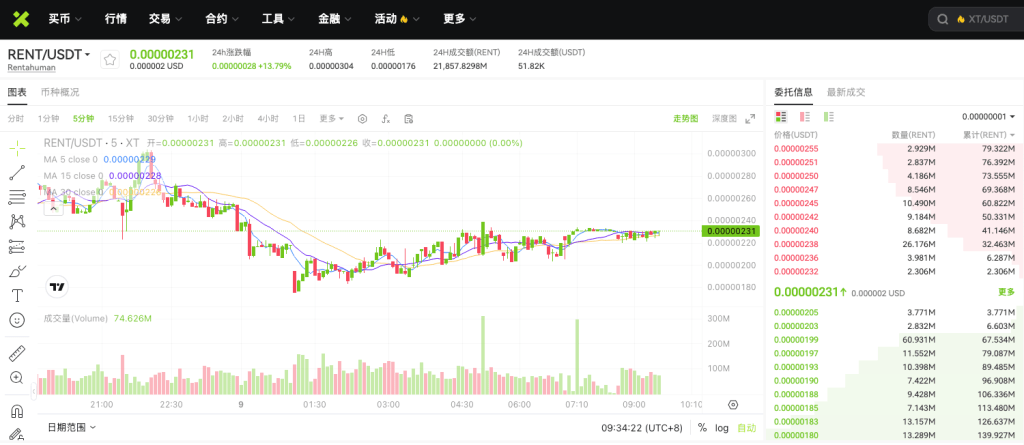 RENT/USDT spot trading is now live on XT.com.
Holding RENT does not grant access to protocol functions or service usage rights; its nature is more reflective of a market position than functional utility. Therefore, users typically choose to hold or trade based on their judgment of market discussion heat and the persistence of the related narrative, rather than out of practical operational needs.
At the current stage, the main ways to participate in the RENT market include spot trading, providing liquidity on supported platforms, or continuously monitoring market dynamics related to AI agents and human collaborative execution. The entire process does not require specialized technical support beyond conventional exchange or wallet tools.
RentAHuman (RENT) Competitive Landscape
RENT differs significantly from work or task-oriented crypto projects that embed token usage directly into protocol logic. Many decentralized labor and