TRIA Explained: Understanding Tria's Cross-Chain Execution Logic from a Chain Abstraction Perspective



- Core Viewpoint: TRIA is the native utility token of the Tria chain abstraction ecosystem. Its core value lies in supporting a unified user interface that integrates wallet, routing, and identity functions through incentive and coordination mechanisms, aiming to reduce friction in multi-chain environments.
- Key Elements:
- The total supply of TRIA tokens is fixed at 10 billion, with no inflation mechanism. Its value is directly tied to the actual usage activity of the Tria platform, rather than relying on passive holding.
- Tria employs an intent-driven execution model. Users only need to set their desired outcome, and the system automatically matches cross-chain paths. TRIA is used to incentivize execution participants.
- Token allocation is heavily focused on the ecosystem, with the community and ecosystem-related portions constituting the largest share (41.04% + 15.00%). Tokens for core contributors and investors are subject to vesting schedules.
- Compared to similar projects, Tria's differentiation lies in its broader scope, integrating user-facing access experience with underlying routing infrastructure.
- Main risks include the complexity of the technical architecture, the long-term token demand relying on genuine ecosystem adoption, and the increasingly fierce competition in the chain abstraction space.
Quick Takeaways
- What it is: TRIA is the utility token of Tria, serving a chain-abstracted crypto interface that covers wallets, routing, and identity.
- Core Use: TRIA is used to support execution routing, ecosystem incentives, and participation mechanisms within a multi-chain application system.
- Differentiation: Tria combines "user-facing crypto access" with "intent-driven chain abstraction," rather than being a single-function wallet or cross-chain bridge.
- How Users Participate: Users can acquire TRIA through trading or rewards and use it within Tria's applications, routing system, and ecosystem features.
- Key Risks: TRIA's long-term relevance depends on the sustained adoption and activity of Tria's chain abstraction layer and execution market.
What is TRIA
TRIA is a utility token issued on Ethereum-compatible infrastructure, designed to support chain-abstracted crypto interactions through an intent-driven execution mechanism, identity primitives, and an incentive system, thereby enabling users to have a unified access and usage experience across multiple blockchains.
Why Tria is Focused on Solving Cross-Chain User Friction
As the crypto ecosystem continues to expand towards a multi-chain future, the user experience has conversely become more fragmented. Wallet management, gas fees, cross-chain bridges, and the selection of execution paths remain structural challenges. For users who need to interact with multiple ecosystems simultaneously, operational costs and the barrier to understanding continue to rise. Chain abstraction and intent-driven execution have emerged in this context, with the goal not of adding another tool layer, but fundamentally reducing usage friction.
TRIA is a component of this trend. Tria is not limited to single functions like a wallet or a cross-chain bridge; instead, it attempts to integrate access, execution, and coordination into a unified system. This article will focus on the role of TRIA within this structure, analyzing its token utility, user participation methods, and its boundaries and potential risks in a competitive environment.
How TRIA Works
TRIA is the native utility token used within the Tria ecosystem. Its core role is coordination and participation, not representing ownership of the protocol itself.
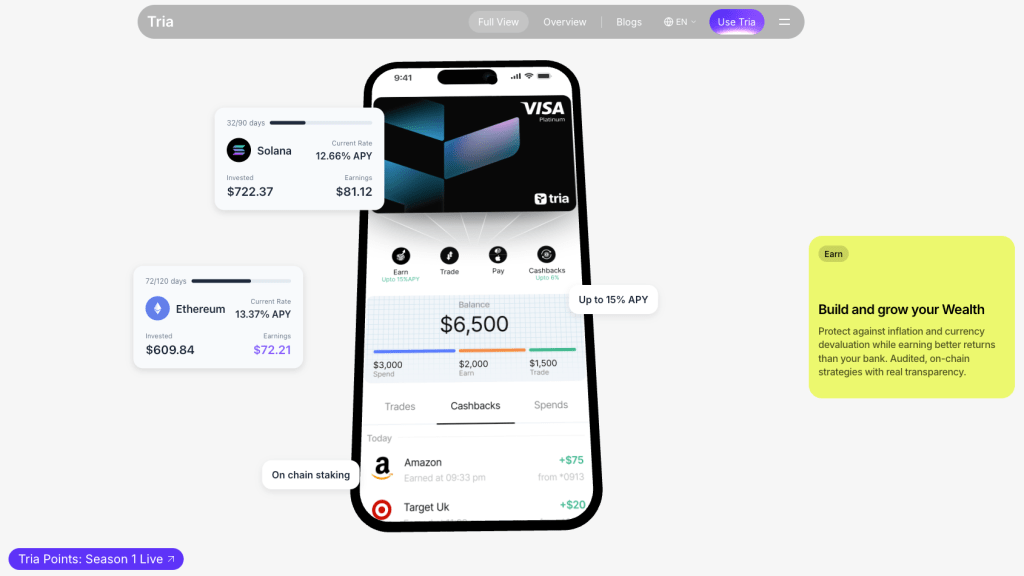
Image Source: Tria.so
TRIA is primarily used by two types of participants: end-users operating through Tria's application interface, and ecosystem participants involved in the execution and routing processes. The demand for TRIA stems from actual usage activities within the Tria ecosystem, rather than relying on external protocols or a single scenario.
Tria employs an intent-centric execution model. Users only need to specify a desired outcome, such as transferring assets or interacting with an application, without having to manage the specific pathways themselves. The system automatically matches and completes the execution path across supported networks. TRIA is used in this process to support participation mechanisms and incentive alignment.
TRIA is also used for reward distribution, ecosystem participation, and access support for certain platform functions. The token itself does not inherently generate yield; its value and relevance depend on the sustained usage of Tria's routing system and application layer.
TRIA Tokenomics Overview
TRIA employs a fixed-supply token model, with its core design centered around ecosystem participation rather than continuous issuance. The total token supply has a hard cap, with a portion entering circulation at genesis and the remainder allocated to long-term ecosystem-related categories. This model does not rely on block rewards, nor does it have a continuous issuance mechanism tied to network operation.
Structurally, community and ecosystem-related allocations constitute the largest proportion, reflecting Tria's emphasis on "usage-driven distribution." Tokens allocated to core contributors and investors are subject to unlock and vesting schedules to mitigate short-term selling pressure and smooth out circulation. Therefore, changes in TRIA's circulating supply primarily stem from ecosystem reward distributions and predetermined unlock schedules, not an inflation mechanism.
Category Numerical Description Max Supply 10,000,000,000 TRIAHard cap, no inflation mechanism Genesis Circulation ~2.19 billion TRIA ~21.9% of total supply Community Allocation 41.04% User rewards and participation incentives Foundation Allocation 18.00% Long-term development and operational support Ecosystem & Liquidity 15.00% Integrations, dApps, and liquidity programs Investor Allocation 13.96% Early funding support, subject to vesting Core Contributors 12.00% Team incentives, based on vesting mechanism Supply Inflation None No block issuance or yield minting
TRIA is not an asset primarily positioned for yield generation. Its utility covers reward distribution, ecosystem participation, and coordination mechanisms between the application and execution layers. Therefore, TRIA's practical utility value is directly tied to the activity level of the Tria platform, rather than relying on a passive holding logic.
Ecosystem and Core Applications
How Users Interact with TRIA
Users typically encounter and use TRIA through Tria's application interface. Initial interactions often start with wallet operations or trading activities, gradually expanding to routing execution, reward acquisition, and broader ecosystem participation.
TRIA can be obtained through ecosystem incentive programs or purchased via trading. Once acquired, TRIA functions as a participatory asset, closely linked to Tria's execution layer and application layer features. Its usage frequency largely depends on the user's reliance on Tria for cross-chain interactions.
Major dApps and Use Cases
Supporting the chain abstraction execution mechanism.
TRIA forms the basis of Tria's routing model, where users only need to set a target outcome without manually managing specific networks. The token is used to coordinate and incentivize the various participants responsible for execution.
Enabling unified access to various crypto functions.
Tria integrates operations like transfers, swaps, and yield-related activities into a single interface. TRIA is used to support the rewards and incentive mechanisms corresponding to this centralized access layer.
Enabling developers to access chain abstraction capabilities without building their own infrastructure.
Tria provides embeddable SDKs and routing tools that developers can directly integrate. TRIA is used within related ecosystem programs to incentivize the integration of third-party applications and services.
Coordinating rewards and participation-based mechanisms.
Referral systems, activity-based incentives, and various ecosystem rewards are distributed via TRIA, creating a direct link between token circulation and actual platform usage.
How to Buy, Use, and Participate with TRIA
TRIA can be acquired on listed centralized and decentralized exchanges. On centralized exchanges, users can trade TRIA on the spot market, including the TRIA/USDT trading pair listed on XT.com.
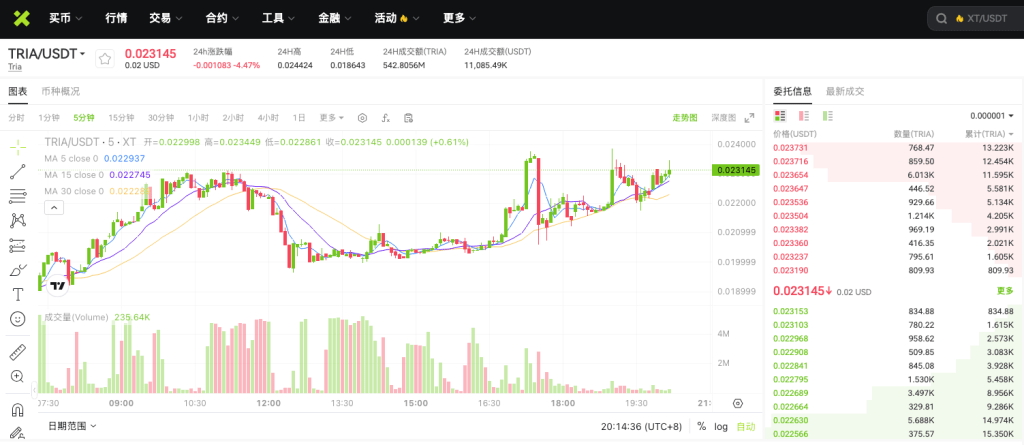
TRIA/USDT spot trading is now live on XT.com.
Some users may also obtain TRIA by participating in reward programs within the Tria application ecosystem, with specific methods and availability potentially varying by region and platform.
After acquisition, TRIA can be stored in compatible wallets that support its underlying network. Holding TRIA can be used to participate in various Tria application functions, including ecosystem reward mechanisms and access to routing execution-related features.
User participation is not limited to holding the token. Depending on currently available platform features, users may also participate in staking, governance signaling, or activity-based incentive programs, further integrating into the Tria ecosystem.
How Tria Differs from Other Chain Abstraction and Execution Projects
Tria operates in a space encompassing routing protocols, intent-driven execution systems, and account abstraction infrastructure. While many projects are attempting to solve cross-chain complexity, they differ significantly in target users, design scope, and the position of the abstraction layer. Comparing Tria with similar projects clarifies its positioning.
Project Primary Focus Difference from TriaTria