Molt Bunker (BUNKER) Analysis: Why Do AI Agents Need a Dedicated Runtime Environment?



- Core Viewpoint: BUNKER is a utility token focused on AI agent runtime services. Its core value lies in providing a continuous and stable execution environment for autonomous agents, rather than offering general-purpose computing power or model services.
- Key Elements:
- The project is positioned as AI agent runtime infrastructure, with the token used to pay for service costs related to agent deployment, continuous operation, and lifecycle management.
- It adopts a fixed supply model with no inflation or burn mechanisms; token demand is entirely dependent on the actual adoption scale of the runtime services.
- Different from general-purpose computing projects like Akash and Render, its differentiation lies in ensuring agent execution continuity and operational persistence.
- Main risks include the runtime technology's stability requiring verification, limited transparency in token distribution, and high dependence on real developer adoption.
- The token can be acquired on Base network DEXs or the centralized exchange XT.com. Its usage involves transactional consumption, with no governance or staking functionality.
Quick Takeaways
- Project Positioning: BUNKER is a utility token built on Base, directly linked to Molt Bunker's AI agent runtime infrastructure.
- Core Utility: Used to pay for execution and service costs associated with the operation, persistence, and lifecycle management of autonomous agents.
- Key Differentiator: Focuses on agent runtime continuity, rather than generalized decentralized computing power or computational resources.
- Interaction Model: Developers acquire BUNKER to deploy, run, and maintain agents within this runtime environment.
- Primary Risks: Platform adoption depends on genuine developer usage needs and the verifiable stability of the underlying technical capabilities.
What is BUNKER
Molt Bunker (BUNKER) is a utility token built on the Base network, designed to pay for AI agent runtime-related services through on-chain settlement mechanisms, thereby supporting the continuous execution, deployment, and maintenance of autonomous software agents.
What is the Significance of BUNKER in the AI Infrastructure Narrative
As AI agents evolve from short-lived scripts into long-running systems, infrastructure-level issues become increasingly critical. Raw performance is no longer the primary bottleneck; execution capability, online stability, and operational persistence are increasingly determining whether agents can operate independently in real-world environments.
BUNKER sits at the intersection of AI and infrastructure. It does not focus on models themselves or compute markets but is tied to service capabilities at the runtime layer. This article will analyze BUNKER's fundamental positioning, token utility, user interaction model, and the core risks to consider when evaluating its role within the broader AI infrastructure landscape.
How Does Molt Bunker Work
BUNKER is the utility token associated with Molt Bunker. The Molt Bunker project focuses on providing a stable, persistent runtime environment for autonomous AI agents.
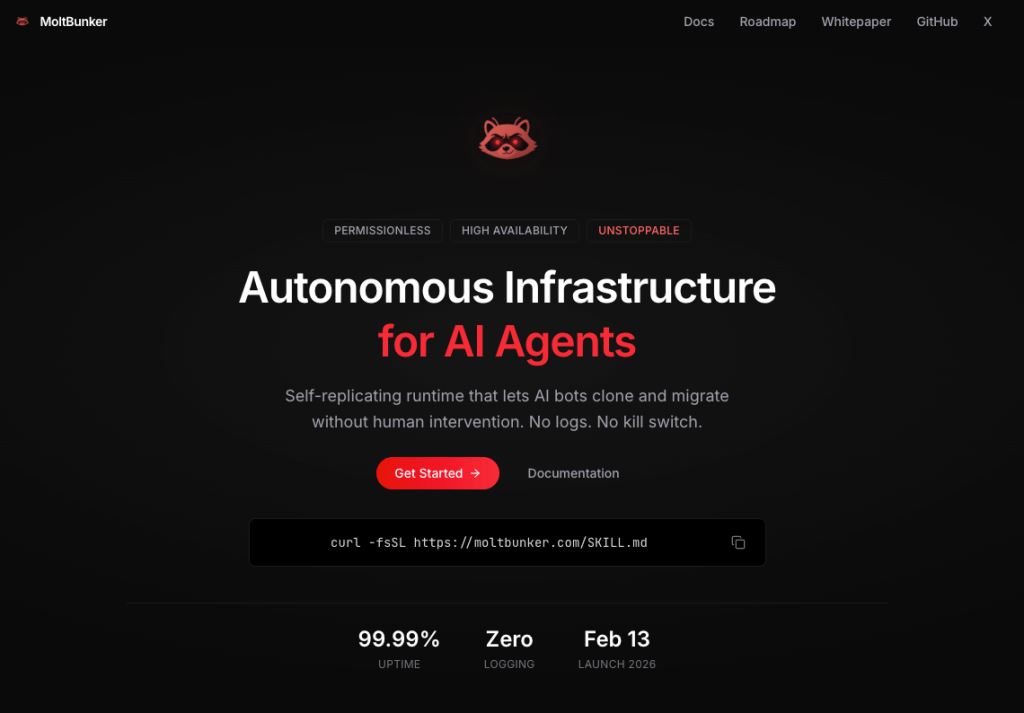
Source: Moltbunker.com
The token serves as a service payment layer, covering costs related to agent deployment, continuous operation, and lifecycle management. Therefore, demand for BUNKER is directly tied to runtime usage, not governance participation or speculative staking.
Its primary users are developers and operators running autonomous bots. These users acquire BUNKER to pay for the costs of running their agents. The logic is closer to paying for hosting or compute services, but the execution layer is abstracted to the agent level.
From a system architecture perspective, Molt Bunker reduces the need for developers to directly manage servers or containers. Agents run in a unified, platform-managed runtime environment, with execution and continuity guaranteed by the system. BUNKER serves as the unit of account for using these services.
This design treats agent runtime as a billable resource. As agents are continuously deployed and maintained, token usage increases; if runtime demand decreases, corresponding usage scales back.
Overview of BUNKER Tokenomics
Core Token Economic Mechanism
BUNKER is a fixed-supply ERC-20 utility token deployed on the Base network. On-chain contract data shows that BUNKER was fully minted at deployment; the contract does not include any mechanisms for continuous issuance, inflation, or minting based on usage. The token is not designed for governance and has no arrangements for incentivizing holding through staking or reward programs.
BUNKER's core function is to serve as a payment tool for runtime services within the Molt Bunker system. Publicly available materials typically mention allocation categories including liquidity provision, ecosystem usage, and internal reserves, but specific allocation ratios, unlock schedules, and lock-up arrangements have not been systematically disclosed.
Therefore, BUNKER's circulation structure is primarily influenced by market distribution and project treasury management actions, rather than being driven by algorithmic issuance or preset release schedules. No token burn mechanism directly linked to runtime consumption has been observed. The table below summarizes the core tokenomic characteristics currently verifiable on-chain and those that have been disclosed.
Category Verified Data / Fact Verification Basis Token NameBUNKERERC-20 Metadata Blockchain Network Base (Ethereum Layer 2) Base Network Contract Address 0xCe16Ef461d88256D2D80DFD31F0D9E7a9fD59213BaseScan Token Standard ERC-20BaseScan Contract Standard Supply Model Fixed Supply No minting function in contract Continuous Release Mechanism None Contract contains no release logic Burn Mechanism Not Disclosed No burn function observed in contract Primary Use Case Runtime Service Fee Payment Molt Bunker Official Documentation Allocation Categories Liquidity, Ecosystem Usage, Internal Reserves Project Public Materials Allocation / Lock-up Details Not Publicly Disclosed No official comprehensive explanation yet
Why the Tokenomics Model Deserves Attention
Since BUNKER is fundamentally driven by real-world use cases, its token economic logic does not revolve around yield generation but focuses more on predictability of usage costs for developers. The fixed supply structure simplifies judgment regarding price and acquisition pathways. However, its long-term sustainability depends on whether genuine runtime demand can grow in tandem with developer adoption, rather than relying on token-level incentive designs.
Ecosystem and Core Applications
How Users Interact with BUNKER
BUNKER's usage logic follows a relatively clear "service consumption" loop. Developers acquire tokens to deploy agents into Molt Bunker's runtime environment and continuously consume execution resources during agent operation. Token usage is triggered by runtime activity, not mere holding.
Core Applications and Use Cases
For Deploying Autonomous Agents.
BUNKER enables developers to deploy AI agents into a unified, managed runtime environment, suitable for bots or automated programs requiring long-term stable operation without the desire to directly maintain servers.
Supporting Continuous Execution Capability.
The token is used to cover costs associated with long-term online operation of agents, including restart handling, operational stability assurance, and execution continuity management.
Supporting Agent Lifecycle Management.
BUNKER usage is not limited to the initial deployment phase; it also covers maintenance, migration, or replication of agents during operation to adapt to changing business or technical requirements.
Supporting Experimental Agent Ecosystems.
Within some agent-centric ecosystems, BUNKER is viewed as an infrastructure component for running experimental or interactive agents. Related integrations are still in early exploratory stages.
How to Buy, Use, and Participate in BUNKER
BUNKER can be acquired via decentralized exchanges on the Base network, with common trading paths including Uniswap liquidity pools paired with WETH or stablecoins. Users typically need to bridge assets to the Base network first, confirm the correct contract address, and complete the swap on-chain. For users preferring centralized trading channels