






Tether's "Gold Standard" Ambition: Decoding XAUt, How the Stablecoin Giant is Hoarding Gold?


- Core Viewpoint: Tether is building the reserve system for its gold-backed stablecoin XAUt through large-scale purchases of physical gold. It has become a significant buyer in the global gold market, and its actions are having a marginal impact on gold supply and demand as well as its price.
- Key Elements:
- Tether holds approximately 140 tons of gold, valued at $23 billion, having purchased over 70 tons last year—a scale comparable to sovereign central banks.
- Its gold-backed stablecoin XAUt represents ownership of 1 ounce of LBMA-standard physical gold stored in Swiss vaults per token, with a total issuance scale of about $2.7 billion.
- Tether plans to allocate 10%-15% of its portfolio to gold, implying it may need to purchase an additional $2-3 billion worth of gold in the future.
- According to institutional estimates, Tether's gold purchases in Q2 and Q3 of 2024 accounted for approximately 12%-14% of global central bank gold purchases during the same period.
- Gold-backed stablecoins aim to enhance the divisibility and liquidity of gold, but their value is linked to the crypto market cycle, potentially introducing new volatility.
Can you imagine a company that started with a Crypto background is now continuously buying gold at a scale close to that of a central bank?
According to Bloomberg, USDT issuer Tether has become one of the world's largest holders of gold reserves—currently owning approximately 140 tons of gold, valued at around $23 billion. Notably, it purchased over 70 tons of gold last year alone, used to replenish its reserves and back its gold-backed stablecoin, surpassing the reported purchases of most national central banks.
Behind such massive gold purchases, Tether is not betting on the price of gold. Instead, it is building a long-term, scalable physical gold supply system for its tokenized gold product, XAUt (Extended reading: The New Narrative in the $5,000 Era: The 'Old King' Returns—How to Understand the Tokenization Logic of Gold?).
1. What is XAUt?
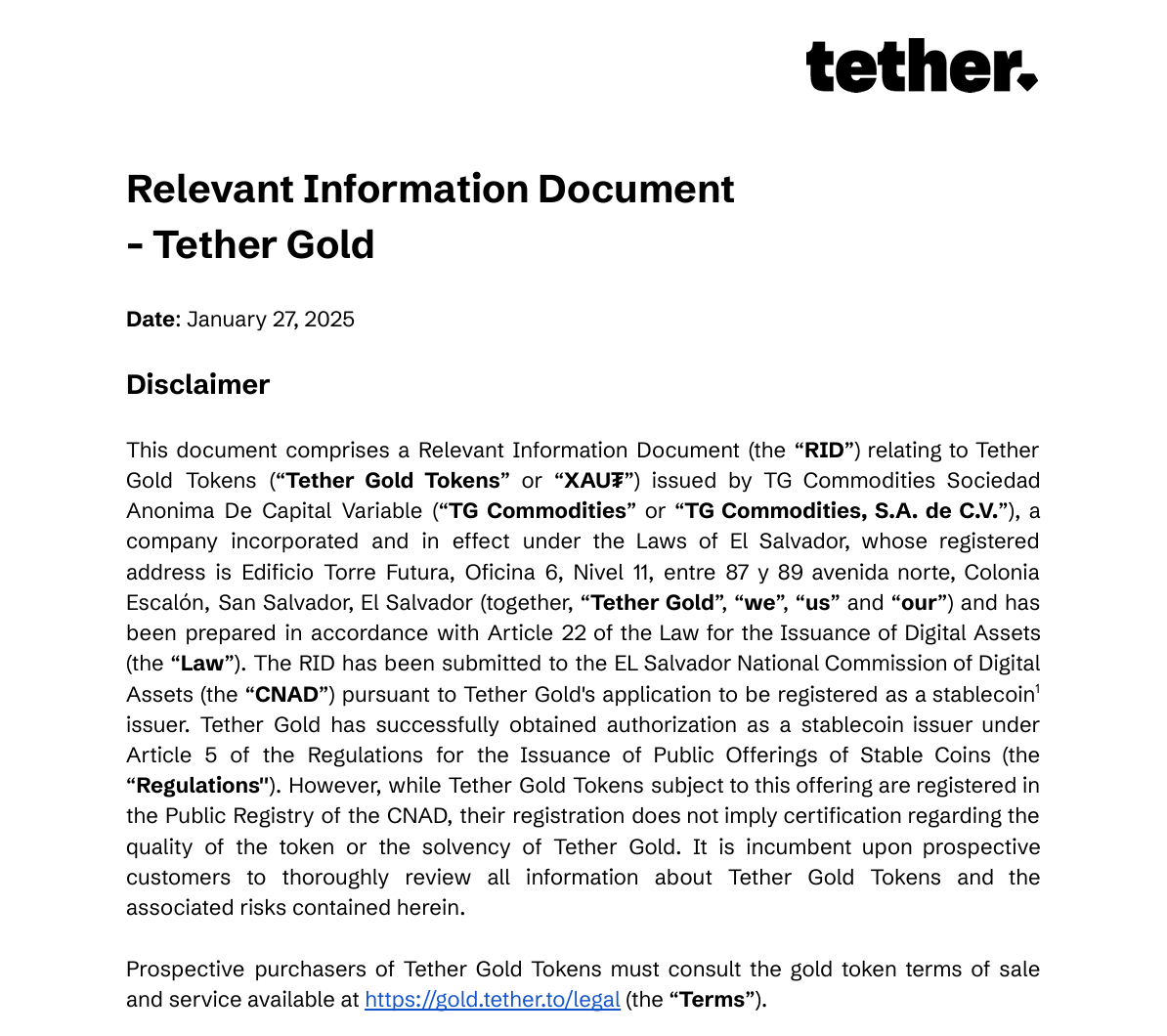
According to the latest version of the whitepaper "Relevant Information Document – Tether Gold (XAU₮)" released on January 27, 2025, Tether Gold (XAUt) is a gold-backed stablecoin issued by the Salvadoran company TG Commodities, S.A. de C.V.
Each XAUt token represents ownership of one troy ounce (approximately 31.1035 grams) of physical gold meeting the London Bullion Market Association (LBMA) Good Delivery standard, stored in a Swiss vault. When an on-chain transaction occurs, the system automatically reallocates the corresponding gold share in the vault, ensuring the tokens held by users always correspond to specific physical assets.
The physical gold is stored in a high-security vault in Switzerland. Although the custodian is a related party, it operates independently with separate financial accounts and customer records. Users can also visit the official "Look-up Website," enter their on-chain address, and directly query the serial numbers, weight, and purity of the gold bars associated with their assets.
However, delivery must be made in whole physical gold bars. According to the whitepaper, as each bar varies in weight (typically between 385 and 415 ounces), the official recommends users deposit at least 430 XAUt to ensure coverage. Any excess tokens will be returned to the user.
Furthermore, delivery must occur within Switzerland, or users can request Tether to liquidate the gold for USD in the Swiss gold market, with the proceeds returned after deducting fees.
Source: Tether
It is worth noting that the issuer, TG Commodities, has also been authorized by El Salvador's National Digital Assets Commission (CNAD), recognized as a regulated stablecoin issuer and an approved Digital Asset Service Provider (DASP). Tracing up to the parent company reveals it is wholly owned by Tether Holdings and Tether Operations.
In fact, the early concept of XAUt can be traced back to late 2019 when Paolo Ardoino, then Chief Technology Officer of Bitfinex and Tether, revealed Tether's plan to launch a gold-backed stablecoin product, Tether Gold. The first version of the XAUT whitepaper was also released on January 28, 2022.
No one could have imagined that in just four years, Tether would become a super gold buyer comparable to sovereign central banks.
2. Tether: A New Force in the Gold Market That Cannot Be Ignored
As mentioned above, the whitepaper clearly states that each XAUt token represents ownership of one ounce of physical gold. Tether commits that every XAU₮ issued is backed by an equivalent amount of physical gold reserves, all stored in "a Swiss vault with top-tier security."
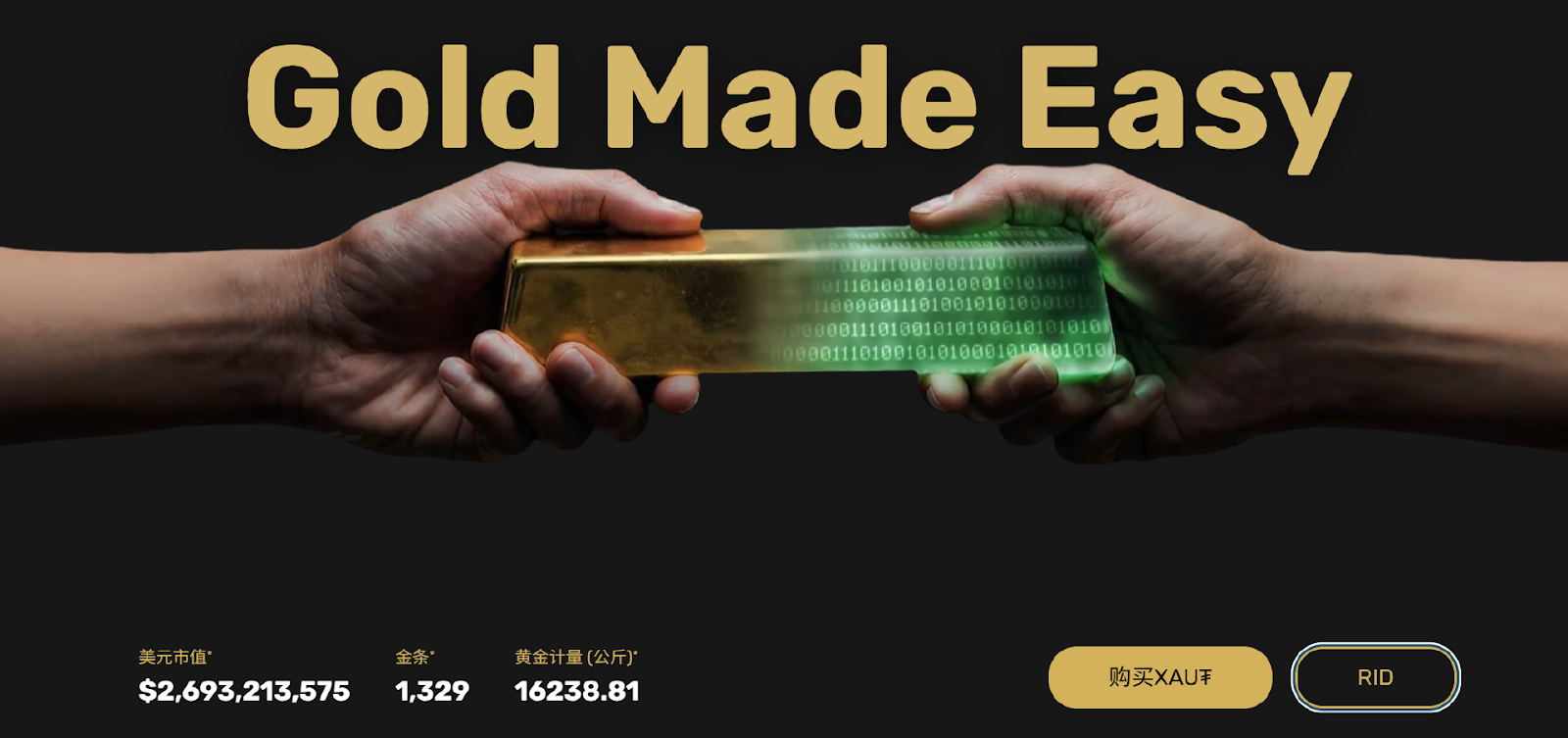
As of the time of writing, the total issuance of XAUt is approximately $2.7 billion, representing the physical reserve of about 1,329 gold bars (totaling 16,238.4 kilograms).
Source: Tether
Interestingly, Tether CEO Paolo Ardoino has publicly stated that Tether plans to allocate 10% to 15% of its investment portfolio to physical gold in the future. It currently purchases about one to two tons of gold per week and plans to continue doing so, aiming for long-term, stable access to gold supply.
According to Bloomberg estimates, Tether purchased over 70 tons of new gold last year alone to replenish reserves and support its gold-backed stablecoin issuance. Combining this with Tether's disclosed financial data for the first three quarters of 2025:
Its annual profit is projected to be close to $15 billion. Its current holdings of gold and Bitcoin reserves are approximately $12.9 billion and $9.9 billion, respectively, accounting for about 13% of its total reserves. To reach the 10%-15% target, Tether would need to purchase at least an additional $2-3 billion in gold, effectively doubling the current scale of XAUt!
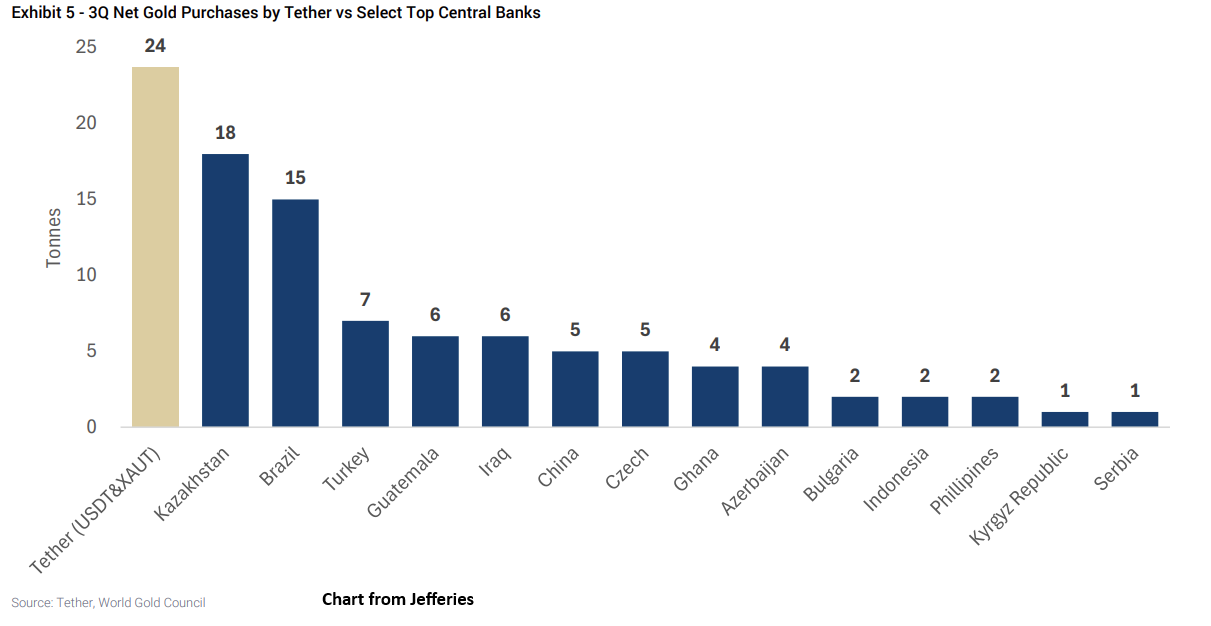
This is why some institutions have begun to view Tether as an unignorable "marginal super buyer" in the gold market. Research from Jefferies shows that in the second quarter, Tether's gold purchases accounted for about 14% of central bank purchases during the same period. This proportion remained around 12% in the third quarter. It can be said that the timing of the second wave of gold price increases highly coincides with the acceleration of Tether's gold purchasing pace.
Considering Tether's current strong profitability and the resilience shown by its stablecoin business amid recent crypto market volatility, this gold purchasing target is not aggressive from a financial perspective.
Source: Wall Street News
3. How to View Gold-Backed Stablecoins?
Of course, the multi-trillion-dollar investment-grade tokenized gold market is far from being targeted by Tether alone.
Over the years, several companies have attempted to provide on-chain representations of gold ownership. This includes Digix, which pioneered the DGX stablecoin backed by physical gold. Each DGX token is backed by 1 gram of LBMA-certified gold bars with 99.99% purity, minted by authorized refineries and stored in The Safe House vault in Singapore.
In addition, there is another more widely known product, PAXG. In 2019, Paxos Trust Company launched PAXG, a gold token approved by the New York Department of Financial Services (NYDFS). Also built on the Ethereum ERC-20 protocol, each PAXG represents one troy ounce of a standard delivery gold bar stored in a professional vault in London.
Paxos users can redeem PAXG for fiat currency, unallocated gold, or directly for physical gold bars. They can also query the serial number, brand, weight, and purity of the corresponding gold bar via their on-chain address at any time.
From a product design perspective, the common goal of these gold-backed stablecoins is clear: to make gold more divisible, more liquid, and more aligned with usage habits in the digital asset era.
However, unlike USD stablecoins, the value proposition of gold-backed stablecoins is more complex. The core proposition of stablecoins is built on the demand for fully collateralized, instantly redeemable digital dollars. In contrast, gold-backed stablecoins inevitably become linked to the cyclical volatility of the crypto market itself.
Therefore, when stablecoin demand changes drastically due to market sentiment or liquidity conditions, this pressure could theoretically be transmitted to the underlying asset-liability structure—and now, part of that structure consists of real, sizable gold reserves.
Especially as players like Tether hold increasingly larger reserves, is this new narrative a digital rebirth for gold, or does it introduce additional volatility factors to gold?
Perhaps this is one of the questions worth pondering for every holder.


