






The Conversation That Best Reflects Warsh's Policy Stance: Inflation Is a Choice for the Fed


- Core View: Former Federal Reserve Governor Kevin Warsh believes the current high inflation is a result of Fed policy choices, not external factors; he advocates controlling inflation by shrinking the balance sheet (QT), thereby creating room to lower interest rates, and calls for the Fed and the Treasury to clarify their respective responsibilities, pursuing a "revival" rather than a "revolutionary" reform.
- Key Elements:
- Warsh's core argument is that "inflation is a choice," central banks have full capability to determine the price level, and the recent inflation is a direct result of the Fed's erroneous policies (particularly prolonged quantitative easing).
- He sharply criticizes the continuous quantitative easing (QE) during the stable economic period (2010-2020), arguing it broke the promise of post-crisis exit, inflated asset bubbles, and set a higher bar for handling subsequent crises.
- His proposed reform path is "practical monetarism": actively shrinking the Fed's massive $7 trillion balance sheet to control inflation, which in turn could create space for lowering nominal interest rates.
- Warsh points out that the Fed's purchases of Treasury bonds have blurred the lines with the Treasury Department, indirectly encouraging fiscal spending, leading to a surge in U.S. debt and heavy interest costs (now exceeding $3 billion daily).
- He advocates that the Fed needs a "revival," returning to its core mission of maintaining price stability, and reaching a new agreement with the Treasury Department, similar to 1951, to clarify respective responsibilities.
- Despite criticizing policies, Warsh is highly optimistic about the U.S. economic outlook, believing technologies like AI will drive a productivity boom similar to the 1980s, provided policies return to rationality.
- As a potential leading candidate for the next Fed Chair, his policy philosophy could logically align with the Trump administration's desire to lower borrowing costs.
Original Author: Long Yue
Original Source: Wall Street News
Recently, Trump's close associate recommended Warsh for Fed Chair. If Kevin Warsh takes over the Fed next year, the market might witness one of the most significant policy shifts at the Federal Reserve in decades.
Earlier this year, in a conversation with Hoover Institution host Peter Robinson, Warsh bluntly pointed out the deep-seated problems within the current Federal Reserve system and put forward an assertion: "Inflation is a choice." He dismissed excuses blaming supply chains or geopolitics for inflation, insisting that central banks are fully capable of determining price levels, and the current situation is the result of the Fed's wrong choices.
Warsh's core argument is built on a critique of "complacency." He pointed out that after the "Great Moderation" period, the Fed mistakenly believed inflation was dead, thus maintaining an excessively large balance sheet during non-crisis times. Quoting Warsh's own words: "When you keep printing a trillion here, a trillion there, it will eventually come home to roost." He believes that the Fed's failure to withdraw in a timely manner during the stable period from 2010 to 2020 meant that when a real crisis (like the pandemic) hit, it had to cross more red lines, leading to today's inflation woes.
As a potential successor to the Fed Chair, Warsh is not just a critic but a reformer. He proposed a specific policy path: "If we were quieter on the printing press, our interest rates could actually be lower." This is a very crucial piece of incremental information — Warsh might lean towards controlling inflation by shrinking the balance sheet (QT), thereby creating space for lowering nominal interest rates.
This is logically consistent with the Trump administration's desire to lower borrowing costs. He termed this strategy "practical monetarism," advocating that the Fed and the Treasury must "stick to their respective roles": the Fed manages interest rates, the Treasury manages the fiscal accounts, and the two need to reach a sort of "new accord" to address the problem of excessively high debt interest, rather than having blurred boundaries and being entangled as in the past.
Regarding market concerns about "radical reform," Warsh offered reassurance. He clearly stated that there is no need to "smash and reform" the Fed, but rather to carry out a "restoration." He analogized: "It's like renovating a great golf course, inspired by the past but not bound by it." The US economy he envisions is not a recession, but a productivity boom driven by AI, similar to the Reagan era. As long as policy returns to rationality, the US economy will demonstrate remarkable resilience.
With current Fed Chair Jerome Powell set to step down in May 2026 (Note: his term as Governor ends on January 31, 2028), former Fed Governor and Hoover Institution research fellow Kevin Warsh has become one of the hottest candidates for nomination by President Trump. At this critical juncture, revisiting this in-depth interview Warsh gave at the Hoover Institution in May of this year may be crucial for understanding the direction of US monetary policy over the next four years. Warsh is not only a firsthand witness to the 2008 financial crisis but also a staunch monetarist.
Key points from the interview are summarized as follows:
- Return to Core Mission: The Fed has deviated from its core mission of maintaining price stability, experiencing "institutional drift," and must reform to regain credibility.
- Inflation is a Policy Choice (Inflation is a Choice): Warsh stated bluntly that inflation is not an accident caused by Putin or supply chains, but a "choice" by the Fed. The central bank is fully capable of determining price levels by controlling money.
- Fed "Repair, Not Revolution": Regarding the Fed's future, he advocates "Restoration" rather than "revolution" — preserving its core structure but eliminating the mistaken policies of the past decade, not an outright overthrow. The core of reform is shrinking its $7 trillion balance sheet to curb inflation, which in turn could create space for lowering interest rates, which are more important for the real economy.
- Harsh Criticism of Normalized Quantitative Easing (QE): He supported the emergency capital injection during the 2008 crisis (QE1) but strongly opposed continued money printing during stable economic periods (like QE2, QE3, and the later stages of the pandemic), believing it was not only ineffective but also fueled asset bubbles. He felt this broke the original tacit understanding of "exiting once the crisis ended" and resigned in protest.
- Practical Monetarism: Warsh proposed a unique path: control inflation by shrinking the balance sheet (QT), thereby creating space for lowering interest rates.
- Fed "Mission Creep": Warsh believes the Fed has gone from being the "lender of last resort" to the banking system to an omnipresent "first responder," and this overreach must stop.
- Fed and Treasury Stick to Their Respective Roles: Calls for the Treasury and Fed to reach a new accord like in 1951, clearly defining their respective boundaries: the Fed is responsible for interest rates, the Treasury for fiscal accounts, avoiding role confusion.
- Collusion of Fiscal and Monetary Policy: He pointed out that the Fed's purchase of Treasury bonds (fiscal dominance) indirectly encouraged Congress's unrestrained fiscal spending, leading to a surge in US debt.
- Optimistic about US Productivity and AI: Despite criticizing policy, he is extremely optimistic about US economic prospects, believing AI and deregulation will bring a productivity explosion similar to the 1980s.
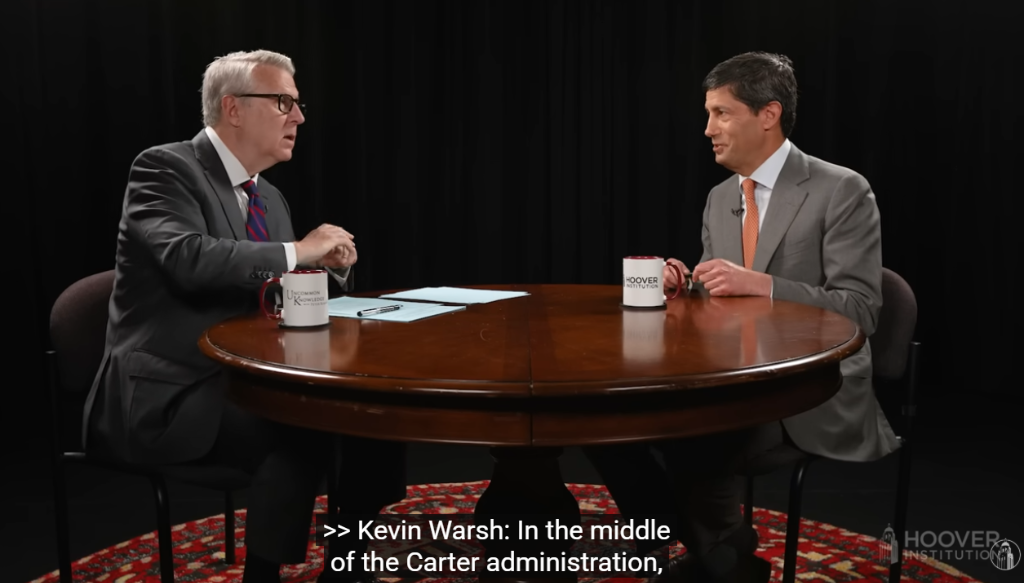
[Full Transcript of the Interview]
Recorded: May 28, 2025
Host: Peter Robinson
Guest: Kevin Warsh
Institution: Hoover Institution, Stanford University - "Uncommon Knowledge"
(The following is a Chinese translation of the interview, assisted by AI tools)
Host Peter Robinson 00:00
For over a century, the Federal Reserve System has been responsible for maintaining price stability and fighting inflation. How is the Fed doing? Our guest today says it should have done better. Kevin Warsh on "Uncommon Knowledge."
Welcome to "Uncommon Knowledge," I'm Peter Robinson. Kevin Warsh is from upstate New York, got his undergraduate degree at Stanford, law degree at Harvard. Mr. Warsh worked early on Wall Street and in Washington. In 2006, President George W. Bush appointed him to the Federal Reserve Board of Governors, where he served until 2011. Note, Mr. Warsh served at the Fed during the 2008 financial crisis, the worst financial crisis in over half a century. Mr. Warsh now splits his time between New York and Stanford, working at an investment firm in New York and also as a research fellow at the Hoover Institution. Kevin, welcome back to "Uncommon Knowledge."
Kevin Warsh 01:10
Great to be back. You hid the most important part, which is that I happen to work for an investment firm that has the world's greatest investor in history, a guy named Stan Druckenmiller (former chief strategist for Soros). But you tried to keep it low-key, I appreciate that. No, I just wanted to brag about my friend.
Peter Robinson 01:24
You keep going on that part, because I want to get him on the show sooner or later. We'll start flattering him now. Okay, Kevin, first question. The Fed was created over a century ago, the institution in the country responsible for maintaining the value of our currency, the dollar. Two quotes. First from the late legendary investor Charlie Munger: "Destroy the currency, heaven knows what happens."
Peter Robinson 01:53
Second quote from a speech you gave this April to a group of bankers called the Group of Thirty. I'll pull from it some of your descriptions of today's Fed: institutional drift, failure to fulfill its statutory duties, fueling a surge in federal spending, overreaching and underperforming. Kevin Warsh, you are attacking a sacred institution. Each of us depends on this institution every day for the integrity of the money we earn and spend. What exactly are you trying to do?
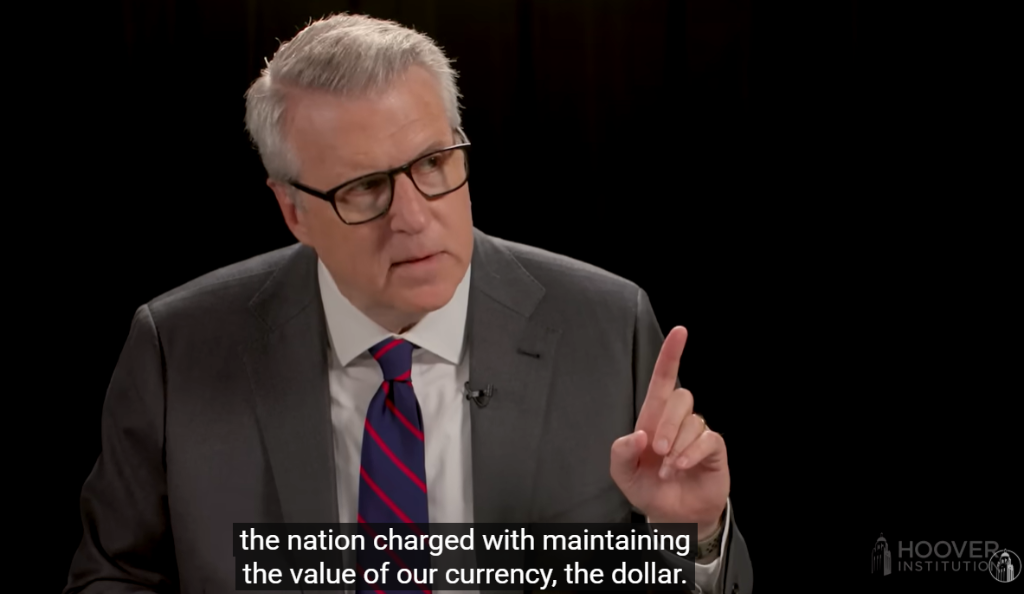
Kevin Warsh 02:33
In central banking, we are taught to keep our criticisms close to the vest. So in that speech, I didn't do a great job. Peter, I described it as a love letter, not a cold critique. You might not have felt it was a love letter. I'm not sure the current governors...
Peter Robinson 02:53
I skipped... I left out the mushy parts.
Kevin Warsh 02:54
It's a love letter because the importance of the institution is as you suggested in your opening. It's a love letter because if the institution can reform itself, it could be a great thing for the institution and the country. But it does mean it's time to get things back on track.
Kevin Warsh 03:14
I should also say this. This is our third central banking experiment in America, and it's the third not because the first two went well — they screwed up, right? This isn't like winning a third Super Bowl, Peter, you know, the more the better. The first two failed because they lost the consent of the governed, lost the ability to deliver on their promises.
Kevin Warsh 03:37
This isn't a history lesson, but think about the Jacksonian era, when some would say, the central bank seemed focused only on those East Coast special interests, forgetting what was happening in the middle of the country.
Kevin Warsh 03:54
That's analogous to my concerns today. So, this central bank has been around for over 100 years, if they can reform themselves, they'll have another great 100 years. Otherwise, I worry. Okay.
Peter Robinson 04:07
We'll get back to your speech later, but first, walk me through. I'm an amateur on these issues. You are a skilled central banker and investor. You understand this world, I don't. So walk me through. I have a few very basic questions. Give me a moment to set this up.
Peter Robinson 04:25
The Federal Reserve System was founded in 1913, with the power — this might be oversimplifying, but essentially — it has the power to set interest rates and regulate the money supply to achieve price stability. Those are big powers. How has it done?
Peter Robinson 04:41
This is Nobel laureate Milton Friedman in 1994: "In the United States, there is no institution with such high public standing and such a poor performance record. The Fed began operations in 1914, it caused prices to double during World War I, it caused a major recession in 1921. The major culprit of the Great Depression was undoubtedly the Federal Reserve System. Since then, it caused prices to double again after World War II. It financed the inflation of the 1970s. The Federal Reserve System has done more harm than good, I have long advocated its abolition." Kevin, why do we need the Federal Reserve System?
Kevin Warsh 05:29
So...
Peter Robinson 05:31
None of this is new to you. Milton Friedman was at Stanford when you were an undergraduate.
Kevin Warsh 05:35
Milton... I had the privilege of being his student. He came here, had a huge impact, not just on me, but on generations of students after. I've spent time in the Hoover archives looking at what Milton said. For example, on Fed chairs, we have a great book by our own Jennifer Burns that includes some of this correspondence. But I had them search and give me all the correspondence between Paul Volcker, Milton Friedman, and Alan Greenspan.
Peter Robinson 06:06
Okay, give us some date context. Volcker was appointed Fed Chair by Jimmy Carter in the late 70s, early 80s, specifically...
Kevin Warsh 06:14
Mid-Carter administration. I don't have the exact date.
Peter Robinson 06:17
Then Ronald Reagan reappointed him, he served until the end of the Reagan administration. Correct. Then Alan Greenspan succeeded him, served until...
Kevin Warsh 06:26
He served 17 years, until Ben Bernanke came along mid-crisis in 2006.
Peter Robinson 06:30
Okay.
Kevin Warsh 06:30
I remember this because I remember I was a junior staffer at the White House at the time, and I found out that not only did Chairman Bernanke (who came from the Fed to the White House, and was going back to take over the heavy lifting from Alan Greenspan) want me to go with him, to take over his old Fed governor seat. So I remember that day.
Kevin Warsh 06:55
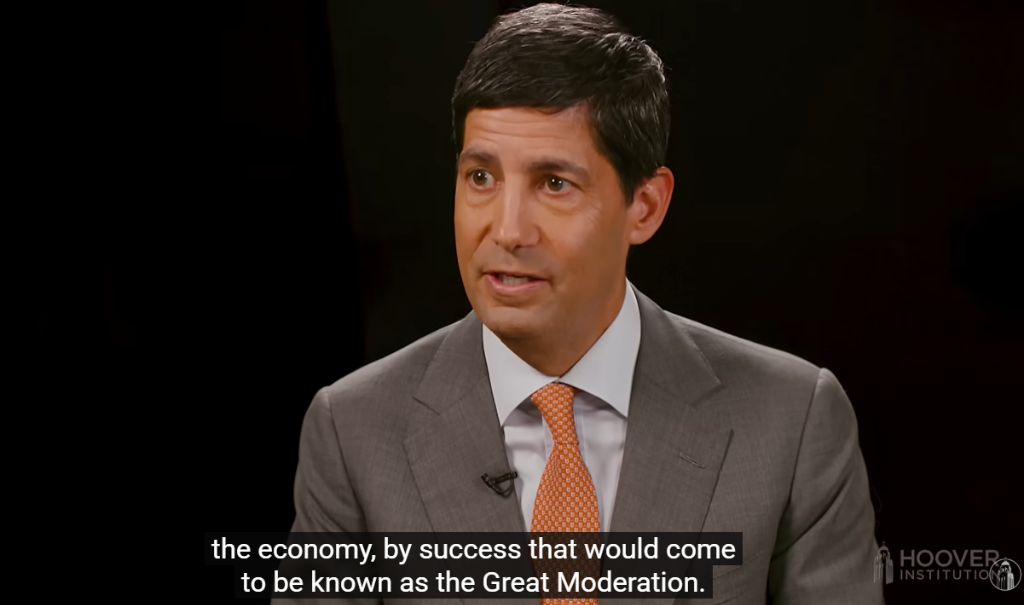
Okay, back to Milton. In that correspondence of Milton's, what's amazing is he constantly re-examined his prior views. He kept asking, were the data and conclusions he drew one year still applicable the next, was his judgment of the institution still applicable. In most of the correspondence during the Volcker era and the Greenspan era, he was fairly comfortable with the change in approach, the new way of thinking about the economy, the success of what later became known as the "Great Moderation." So I wouldn't say Milton thought the Fed was a bad institution. He thought they had bad periods, and they had good periods. I can only speculate what he would say about the "Great Inflation" of the last five or six years, how he would have foreseen it, how he would have warned about it, and likely, the Fed wouldn't...
Peter Robinson 07:46
Listen. Okay, then another basic question. Milton Friedman famously said: "Inflation is always and everywhere a monetary phenomenon." Since inflation is a monetary phenomenon, and the Fed is responsible for the money supply. Then inflation is ultimately always the Fed's fault. Why don't you describe what Paul Volcker did? When Carter appointed Volcker, you would know this. I'm just recalling. When Carter appointed Volcker, I believe we were suffering the highest inflation since the Civil War. And when Paul Volcker left office, inflation was down to around 2%, about 2%. Okay, so Milton Friedman says the Fed is always responsible.
Kevin Warsh 08:34
Yes, so I believe Milton and the view you just conveyed, which is as you said in your opening, "Inflation is a choice." The responsibility for ensuring price stability was given to the Fed


