






Conversation with Vitalik: Technological Triumph, Application Confusion, the Most Dangerous Divide in the Crypto World


- Core Viewpoint: Vitalik Buterin believes Ethereum has achieved tremendous success in technological aspects like scaling, but application layer development has lost its way. Excessive financialization and speculation are eroding the essence of applications like social, and he worries the industry will fail if it cannot build applications with genuine social significance.
- Key Elements:
- Technology-Application Divide: Ethereum's Gas limit target has been raised to 300 million and zkEVM is live, but DAO governance flaws and the prevalence of Memecoin speculation show the application layer has deviated from the early, diverse vision of changing social collaboration.
- SocialFi Dilemma: Overly bundling social with finance leads to financial incentives undermining the essence of social interaction, breeding spam. This is why Farcaster pivoted to the wallet track to seek broader adoption.
- Oracle Risks: Using Polymarket as an example, he points out that oracles relying on Web2 data sources have low security standards, while decentralized solutions like UMA have game-theoretic flaws that could be manipulated by large holders.
- AI and Crypto Intersection: Ethereum, as a permissionless world computer, can provide crucial infrastructure for AI Agents, such as bank accounts, participation in prediction markets, and verifying content authenticity.
- Greatest Risk and Driving Force: His biggest fear is that despite powerful technology, the industry only creates socially meaningless "toys." The core driving force is to prevent the industry from becoming a pure speculation field and to resist a future dominated by centralized AI.
- Application Development Hopes: He most wants developers to build truly user-owned, portable decentralized social platforms, smarter DAOs, and stablecoins pegged not to fiat but to real-world values like CPI or energy.
Original Author: Joe Zhou, Foresight News
"It's been a year, and Vitalik seems to have undergone some subtle changes."
This was the first thought that popped into my head right after my second interview with him in Chiang Mai.
My memory rewinds to late 2024. Our first conversation took place in a closed, quiet room on Nimman Road in Chiang Mai. Back then, he was brimming with excitement about Web3 application-layer innovation. We talked for a full 90 minutes, covering everything from Farcaster to Polymarket to Solana and Base.
This time, the clock had turned to a weekend in late January 2026 in Chiang Mai, and the setting had switched to a completely open space.
That afternoon, Vitalik strolled over from the "Sihai Community" to the "Co-living Space of the 706 Community." On the second-floor balcony, he was sitting alone on a swing, swaying back and forth with a relaxed ease that made him seem like any ordinary community member here. I sat down beside him, and as the swing swayed intermittently, I began asking him a series of questions.
Around us, community members were busy with their own tasks. There was no strict security, nor any deliberate pomp. Before long, noticing our conversation, a few curious members of the 706 Community naturally gathered around. Everyone sat on the floor, looking very much like a group of classmates chatting on a university lawn.
During the subsequent conversation, I was surprised to discover that his intellectual framework had undergone a substantial iteration over the past year.
Whether it was Web3 social, prediction markets, or AI, his perspective had become sharper and more concrete. He deconstructed his observations of leading projects like Polymarket, Farcaster, UMA, Chainlink, MetaDAO, and Base one by one, and unreservedly shared his latest analysis on Ethereum's role in the AI era, decentralized stablecoins, and RWA.
Of course, there were even more things that hadn't changed.
He still has no fixed abode, never staying in one city for more than two months; he still has no bodyguards, queuing up with our large group for the buffet in the cafeteria; he still holds immense enthusiasm for decentralized communities, happily shuttling between various hubs in Chiang Mai.
As the conversation ended and night fell, the swing came to a stop. As usual, he dashed off down the street before it got completely dark, hailed a ride-hailing car by himself, and left.
Outside that decentralized kingdom worth hundreds of billions of dollars, he continues to defend his freedom as an "ordinary person."
Below is my latest dialogue with Vitalik. The final section also includes selected questions from other 706 Community members present.
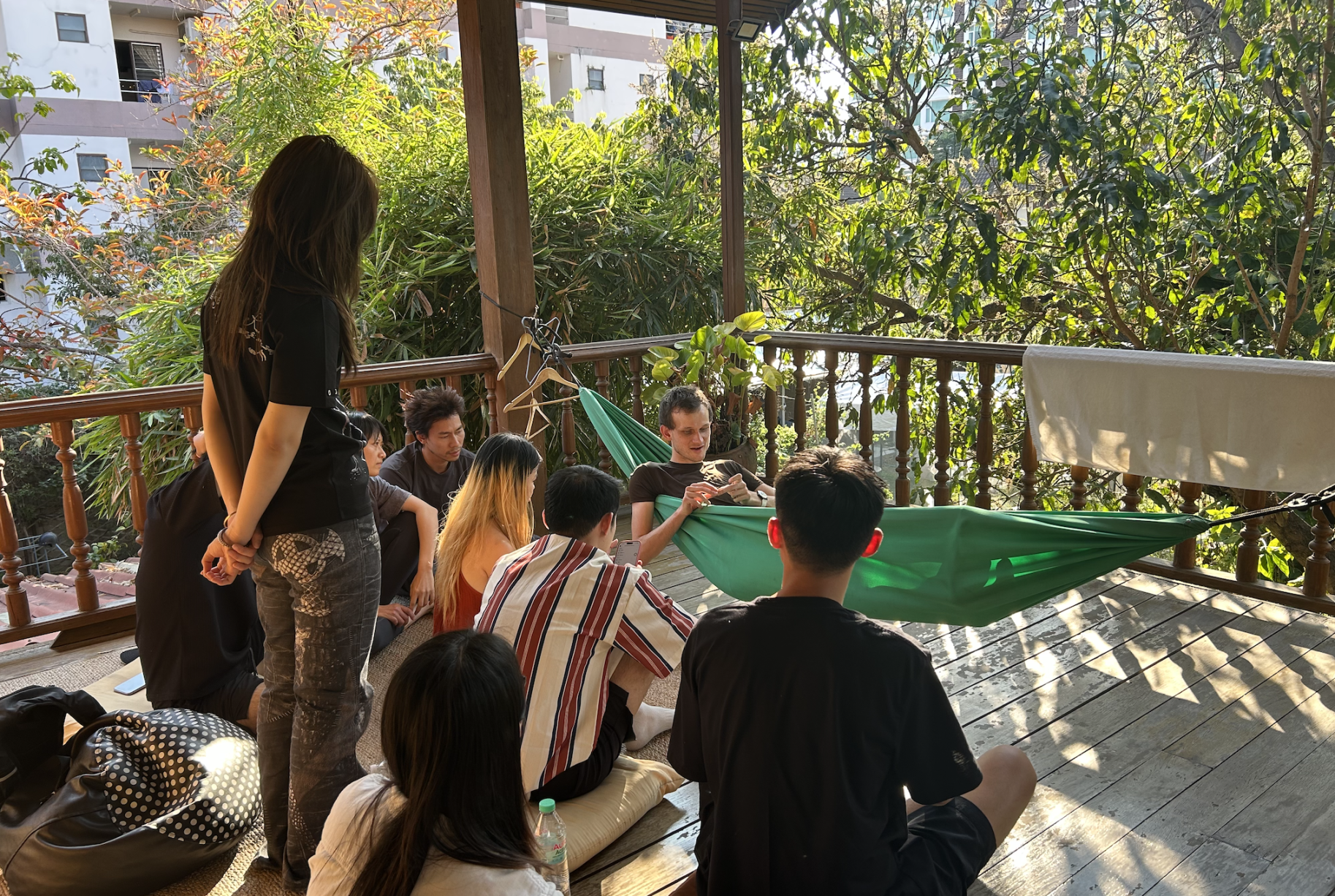
Image: Vitalik at the 706 Community in Chiang Mai
Vitalik's Chiang Mai Reflections: Technical Triumphs, Why Applications Are Lost
Joe Zhou: On the eve of Devcon a year ago, I invited you for an interview in Chiang Mai titled 'Vitalik, Forty-Two Days in Chiang Mai'. A year later, we meet again here. What new personal feelings has this return to Chiang Mai brought you?
Vitalik: I've seen some communities flourishing, like the Sihai Community. They've undergone many different changes. There are many activities, many people, and one most important point—they haven't become boring.
Joe Zhou: Environment and time often reshape thinking. After a year, I'm curious, how has your thinking paradigm regarding the core issues of Crypto shifted? Where is the anchor of your attention now?
Vitalik: The biggest shift is that I see a huge chasm between technology and applications.
Over the past year, Ethereum has made tremendous progress in scaling technology. Our gas limit has increased from 30 million to 60 million, and this year's target is to reach 300 million. This includes the successful launch of zkEVM and significant improvements in infrastructure experiences like wallets—it's fair to say the development on the technical side has been very successful.
But in contrast, I see many underlying concerns on the application layer. Looking back five or ten years, the community actually had very diverse and grand visions for the entire ecosystem. Back then, people were full of hope, thinking about building DAOs, building various decentralized applications that would truly change the way society collaborates, like building a "decentralized Uber." However, I feel that too many people seem to have forgotten these original intentions later on.
Crypto has succeeded financially, but it has lost its way in governance, for example, the flaws in the current "token voting" mechanism of DAOs. The explosion of memecoins in recent years is the most typical example. Even Trump personally launched a memecoin in early 2025. But I think when he greedily issued his second token, MELANIA, his first coin, TRUMP, was essentially dead.
Joe Zhou: Last year we discussed SocialFi applications like Farcaster in depth. A year has passed. From your current perspective, how do you evaluate their development?
Vitalik: SocialFi is currently in a somewhat awkward stage. The biggest structural dilemma for SocialFi is: if you tie social and finance too tightly together, financial incentives often backfire and overwhelm social incentives.
When users come not for quality content but to make money, they will start generating massive amounts of spam to maximize their profits. This is a dangerous signal—because the financial attribute is destroying the essence of social interaction.
I like the Substack model. If you look at Substack's top ten authors, they are all very thoughtful and have substantial content. But if you look at the top ten on some Crypto SocialFi platforms, they are often those who game the system or engage in hype. The difference is: Substack does Curating and Community Building. They work hard to find authors they believe are of high quality and help them migrate to their platform, not just provide a token-issuing tool. This is something Crypto entrepreneurs need to learn.
Joe Zhou: This seems to explain Farcaster's recent pivot—why they are no longer fixated on pure social but have turned to building a wallet?
Vitalik: Yes. They haven't found a way to scale it significantly. They weren't satisfied with being a "small and beautiful" product but aspired to have tens of millions or even hundreds of millions of users. Based on the current path analysis, they believe the wallet track is more likely to achieve that kind of mass adoption scale than pure social.
Joe Zhou: A few years ago, there was a widespread consensus in the industry that the application layer was about to experience a "big explosion," but that hasn't happened. Looking back four years, did you also hold the same optimistic expectations?
Vitalik: Yes, I thought about it. My thinking at the time was: the core bottleneck for applications not taking off was limitations in the underlying technology—like insufficient scalability, being too slow, poor user experience.
But by 2025, at least on L2s (Layer 2 networks), these hard technical obstacles have been largely solved. However, the awkward part is, we still haven't seen good applications emerging on a large scale. The only track that could be called an explosion in 2025 was prediction markets, but frankly, even they have exposed significant problems.
Joe Zhou: What exactly do you mean by "problems"?
Vitalik: If you look at discussions on Twitter, what Polymarket is pushing the most now are often things like "which team will win next week" or "will Bitcoin's price go up or down in an hour." I think in the long run, these short-term bets don't have much social significance. Theoretically, prediction markets as a tool are successful (because they work), but we need more meaningful applications.
I think mechanisms with longer-term incentives would be better. For example, Robin Hanson's concept of Futarchy (prediction market governance) I find very interesting. In traditional governance, people usually vote for people (president, legislators) or vote on means (like "should we build this road"). Robin Hanson's governance idea is: people only vote to decide the "goal" (e.g., we want GDP growth, or we want to lower unemployment), and then use prediction markets to decide the "means." Traders in the market, in order to make money, will use real money to "buy out" the most truthful data. Currently, MetaDAO is experimenting with related attempts.
Behind the $70,000 Profit: Vitalik's "Anti-Crazy" Strategy and Oracle Concerns
Joe Zhou: Do you still use Polymarket? I remember you used it quite frequently last year.
Vitalik: Yes, I made $70,000 on Polymarket last year.
Joe Zhou: What was the principal?
Vitalik: $440,000.
Joe Zhou: Many people lose money. How did you make it?
Vitalik: My method is simple: I look for markets that have entered a "crazy mode," and then bet that "the crazy thing won't happen." For example, there was a market betting on "whether Trump would get the Nobel Peace Prize." Or some markets predicting the US dollar would go to zero next year during extreme panic. When market sentiment enters this irrational "crazy mode," I bet on the opposite side, which usually makes money.
Joe Zhou: What specific areas do you generally follow on Polymarket? Crypto? Politics? Entertainment? Economics?
Vitalik: Politics, technology. If you want to make money, you go to those prediction markets where people have become relatively crazy and irrational. That's when you can make money.
Joe Zhou: You are the founder of Ethereum, so do you have insider information? During the Venezuela war, netizens found that some people seemed to know insider information in advance. Have you encountered similar situations?
Vitalik: Here I want to mention a noteworthy case about Oracle vulnerabilities. There was a prediction market about the Ukraine battlefield, betting on "whether Russian forces would control a certain city." The contract defined the "control" standard as: whether they controlled the city's most important train station. And the data source (Oracle) was anchored to ISW's (Institute for the Study of War) Twitter and maps.
Then something happened: an ISW employee, perhaps by mistake or intentionally, hacked their own company's system, and their map suddenly updated showing Russian forces controlled the train station. This caused something that everyone thought had a 5% probability (almost impossible to happen) to instantly become 100% on the prediction market. Although ISW retracted the update the next day, the money might have already been paid out.
This reveals a huge problem: the security standards for current Oracle data sources (like Web2 news sites, Twitter) are too low. They never imagined that a piece of information they posted would determine the ownership of $1 million on-chain.
Joe Zhou: That does sound like a very crazy thing. You just pointed out some Oracle problems. How should we solve them?
Vitalik: Currently, there are mainly two paths to solve the Oracle problem.
The first path is the centralized model, simply put, trusting one company, like Bloomberg, to provide you with accurate information.
The second path is Token Voting, the decentralized model. Its logic is: let governance token holders vote to decide "what is the truth." UMA is a representative of this model. (Note: UMA is a decentralized oracle protocol on Ethereum that relies on token holder voting to adjudicate data authenticity.)
But recently, trust in UMA has been declining. Because people believe it has a game theory flaw: if large holders (whales) decide to collude to manipulate the voting outcome, ordinary people can hardly resist. Because in this mechanism, even if you vote for the truth, as long as you stand against the majority, the system will rule you lose, and you will lose money. This forces people to follow the whales' votes, not the truth.
I think a credible Oracle is very important. Because any DeFi now needs an Oracle. If you want to build Real World-related applications (like putting real estate on-chain, predicting real-world elections), you need an Oracle. Currently in the DeFi industry, people generally choose to trust Chainlink. But Chainlink's mechanism is also quite complex and relatively centralized.
I've always hoped that in the future we can find a better solution.
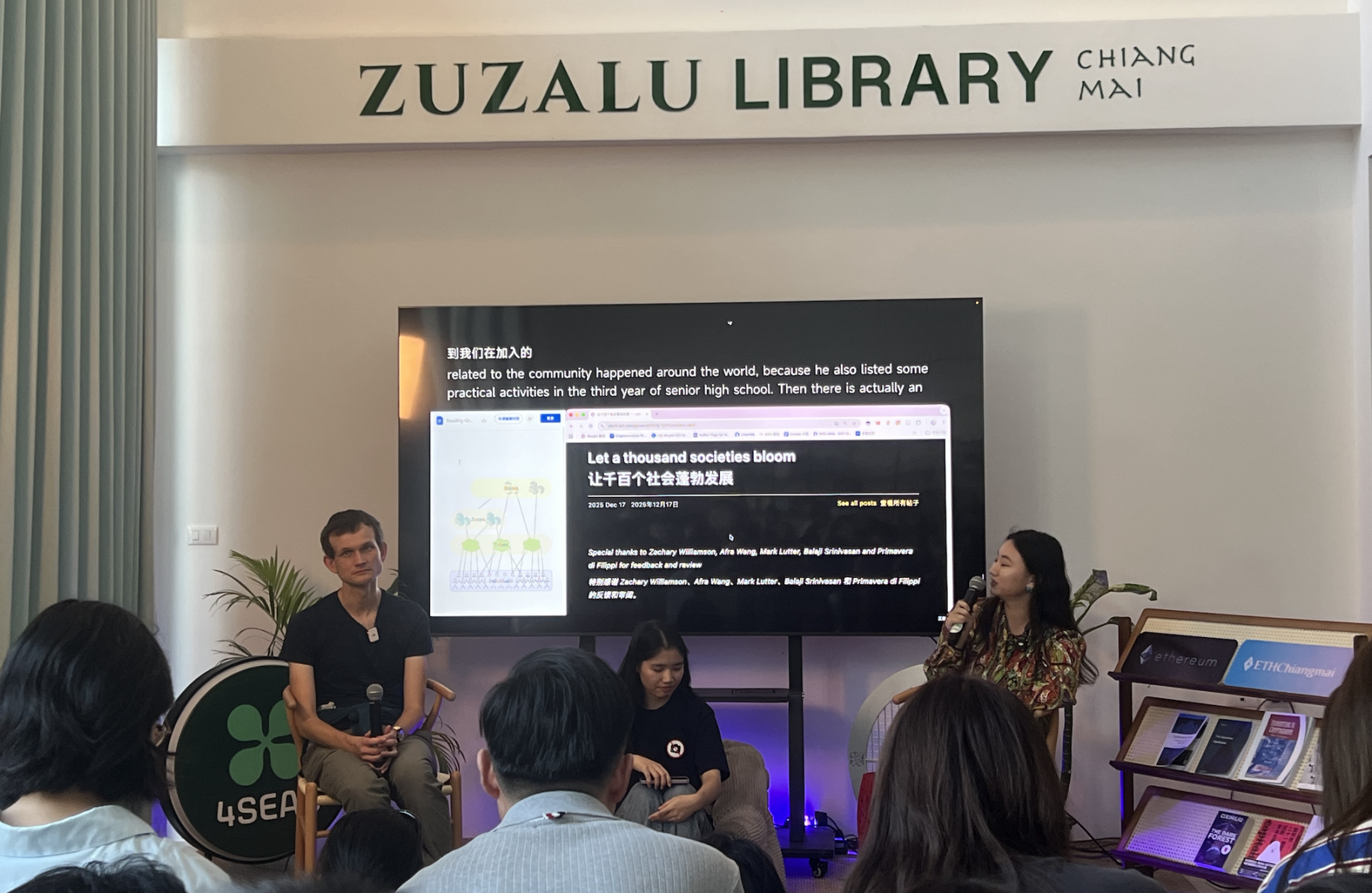
Image: Vitalik sharing at a book club in the Sihai Community, Chiang Mai
Ethereum's Path to Survival in the AI Era
Joe Zhou: I want to discuss the hottest topic right now with you: AI. Over the past year, the market placed infinite high hopes on the combination of AI and Crypto, but the current atmosphere seems to have shifted to a collective sense of confusion. In this new era of AI, what role do you think Ethereum actually plays?
Vitalik: Returning to its essence, Ethereum is a decentralized world computer. Its core attribute is "permissionlessness"—whether it's humans, companies, or AI Agents, they all have equal access rights. This means AI can hold assets on Ethereum, conduct transactions, and even participate in DAO governance. From this dimension, Ethereum is ready.
Joe Zhou: But the point of confusion for everyone is: where is the specific intersection? How do we ground these two grand concepts?
Vitalik: First, we must be wary of a thinking trap: don't combine for the sake of combining.
For example, even in the AI era, our underlying TCP/IP protocol (internet protocol) doesn't need to be restructured because of AI's emergence. The same goes for blockchain—as a foundational trust protocol, it likely doesn't need drastic change.
However, if we look for intersections between AI and Crypto at the application layer, I do think there are several directions worth paying attention to:
One: AI's Bank Account. AI cannot open an account at a traditional bank. If an AI Agent needs funds to execute tasks, Crypto is its only option.
Two: Prediction Markets. AI can participate as a trader in predictions, providing more accurate information.
Three: Content Authenticity: Using blockchain to prove whether content was created by humans or generated by AI.
Joe Zhou: There's a popular term now called "Vibe Coding" (referring to easily writing code with AI assistance, not pursuing details). Do you still write code by hand yourself?
Vitalik: Sometimes. I still maintain the habit of writing code by hand. My coding work is mainly divided into two categories:
The first category is utility scripts, writing small programs for my own use, mainly to improve my personal productivity.
The second category is research verification. When I'm researching some complex cryptographic algorithms, I will personally write an implementation (usually in Python) to verify my mathematical ideas through code.
Joe Zhou: Do you use the more popular AI programming tools on the market now? Like Claude, Gemini, or Manus? Which one do you personally prefer?
Vitalik: Actually, I'm not tied to any specific tool. I mainly use OpenRouter. It's an aggregation platform through which I can call all models. For coding, I still use some mainstream ones, like ChatGPT, DeepSeek, Gemini.
Vitalik in Dialogue with the 706 Community: On Motivation, Original Intent, and Ideals
(The following content is compiled from a joint interview with Vitalik by Joe Zhou and members of the 706 Community.)
706 Community: What is your motivation for doing things now?
Vitalik: My motivation comes mainly from three levels, or rather, three kinds of urgency.
First, to avoid Crypto's "doomsday scenario." The future I worry about most now is: the entire industry ultimately degenerates into a 100% place for trading/speculation, with only speculation and no applications. If that happens, as people slowly get bored, this industry will die in boredom. To avoid that outcome, we must build real value—build better DAOs, build decentralized applications that truly penetrate various industries, and more open DeFi.
Second, make Ethereum's technology better. Frankly, Ethereum's technology is not good enough now. Although L2s have solved the scalability problem, most of them are still highly centralized. We need to make L2s more extreme, more decentralized, so that the application experience truly catches up to Web2.
Third, if we fail in Crypto, the future technological world is very likely to be completely dominated by Centralized AI, which would be a very dangerous future. Crypto is our line of defense against this trend of digital totalitarianism, maintaining diversity and freedom in the technological world.
706 Community: This is a hypothetical question: If you could abandon all of Ethereum's historical baggage now and redesign Ethereum on a blank slate, how would you do it?
<


