Cosmos Ecosystem's Ace Project Noble Departs, Liquidity Crushes the Former Cross-Chain King


- Core Viewpoint: Noble, a key stablecoin infrastructure project within the Cosmos ecosystem, has announced its migration to an independent EVM L1 network. This move highlights the core challenges facing the Cosmos ecosystem: despite its advanced IBC technology, it struggles to compete with the dominant EVM ecosystem in terms of developer community, liquidity, and market scale. This has triggered a chain reaction of project closures or migrations.
- Key Elements:
- The primary reason for Noble's migration is that the EVM ecosystem commands over 75% of the stablecoin market, offering more mature developer tools and broader application scenarios, which aligns with its strategic ambition to become an independent, high-performance stablecoin L1.
- Noble is the liquidity core of the Cosmos ecosystem, with a 30-day IBC transaction volume of $93.84 million, leading by a significant margin. It also handles a large volume of institutional-grade, large-scale stablecoin settlements and distribution.
- The Cosmos ecosystem is experiencing a severe exodus of projects. Besides Noble, several well-known projects like Sei and Akash have announced or are planning migrations to ecosystems like EVM or Solana, and numerous DEXs and other projects have already shut down.
- While Cosmos's core interoperability protocol, IBC, is technologically advanced and highly secure, it has failed to prevent projects from "voting with their feet" and leaving the ecosystem in pursuit of larger market scale and liquidity.
- Liquidity within the ecosystem is highly concentrated, with many chains having low activity. Retail DeFi vitality is severely depleted, leaving only institutional and RWA-related activities to provide support.
Original Author: Sanqing
On January 20th, Noble, a Cosmos application chain focused on stablecoins, announced its migration from the Cosmos ecosystem to an independent EVM L1 network. The Noble EVM is scheduled to launch on March 18th, and the team will continue to support the Cosmos-based blockchain in the short term. Post-migration, Noble's own USDN stablecoin will become the core feature of the EVM L1, and the NOBLE token will serve as the governance asset, tightly linking protocol decisions and value to stablecoin usage across the entire network.
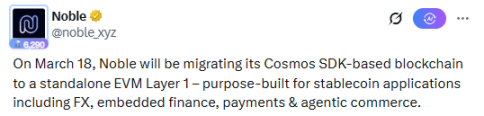
Image Source: Noble Tweet
Subsequently, Cosmos founder responded, stating that Noble's transformation is not a departure from the Cosmos vision but rather an embodiment of its core principle of "sovereignty and interoperability." Noble's migration does not mean disconnection from the Cosmos Hub. On the contrary, through the IBC v2 protocol, the migrated Noble EVM will become a key bridge connecting the EVM ecosystem with the Cosmos economy. He stated, "We are entering an era no longer defined by chain boundaries, but centered around liquidity."
Why is Cosmos's Stablecoin Ace Choosing to Leave?
Noble is one of the most successful stablecoin infrastructure projects within the Cosmos ecosystem. It is the chain that natively issues Circle's USDC into the Cosmos ecosystem, securely and frictionlessly distributing USDC to 50+ chains via IBC, having processed over $22 billion in cumulative transaction volume.
Noble's existence gave the Cosmos ecosystem competitiveness with a "native stablecoin," avoiding the trust risks associated with relying on external bridges.
But why is Noble migrating? The official reasons given by Noble are pragmatic:
The EVM ecosystem holds absolute dominance. Over 75% of the stablecoin market is on EVM chains. Developers, tools, wallets, and dApps are concentrated in the EVM space. If Noble wants to be a "stablecoin infrastructure L1," it naturally must follow the money and the people.
The EVM tech stack is more developer-friendly. EVM has mature tool stacks like Solidity, Remix, Hardhat, etc., making it easier to integrate with protocols like Uniswap and Aave. While the Cosmos SDK is powerful, it has a steep learning curve, and its ecosystem tools are relatively underdeveloped.
EVM offers better performance and real-world use cases. Noble EVM aims for sub-second latency, targeting scenarios like payments, embedded finance, agentic commerce, and FX. While Cosmos's Tendermint consensus is reliable, the EVM stack better aligns with mainstream payment chains.
Noble has its own strategic ambitions. Noble doesn't want to be just a "tool" within Cosmos; it aims to become an independent, high-performance stablecoin Layer 1, directly competing with other stablecoin public chain projects.
So, Noble voted with its feet. Cosmos provided the soil for its start, but EVM offers the future for its scale.
Noble's Departure Takes "Half of Cosmos's Life" With It
Noble is Cosmos's only "superstar." Noble's 30-day IBC transaction volume is as high as $93.84 million, which is 1.8 times that of the second-ranked Osmosis ($50.06 million). Among the 110 Zones connected via IBC in Cosmos, Noble contributes a staggering, unmatched level of liquidity.
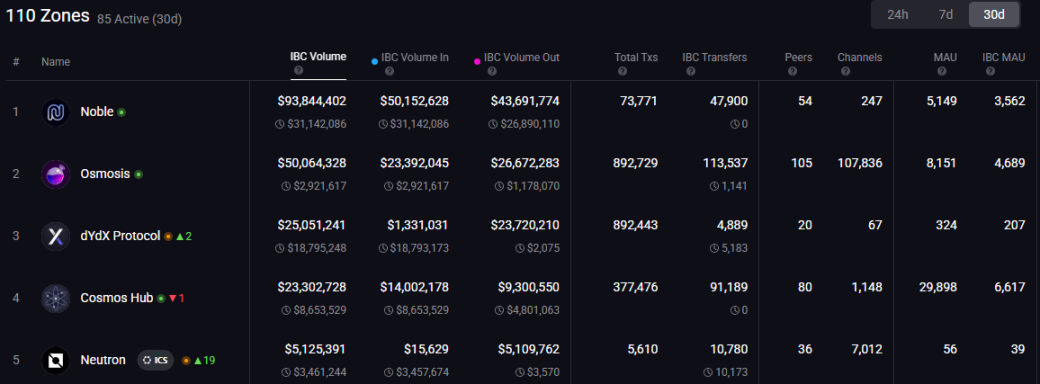
Image Source: MAP OF ZONES
Noble is the "faucet" for institutional capital. Osmosis has nearly 900,000 transaction counts, while Noble has only 73,000. This means Noble's average transaction value is far higher than other chains. It handles not small retail swaps but institutional-grade stablecoin settlements and large-scale distribution.
Although IBC connects 110 Zones, only 85 remain active. This means 23% of the chains are already dead. Liquidity is highly concentrated in the top four chains, while projects beyond the top ten have seen their monthly transaction volume shrink to the million-dollar level. The ecosystem's retail vitality is severely depleted.
The Cosmos Hub has about 30,000 monthly active users, six times that of Noble (around 5,000). However, the money flows decisively to Noble. Most Cosmos users are staking or watching on the Hub, while the stablecoin activity that truly generates value exchange is almost entirely dependent on Noble.
The Soul of the Cosmos Ecosystem: How Does IBC Power the "Internet of Blockchains"?
The core narrative of Cosmos is the "Internet of Blockchains," and the technology realizing this vision is IBC (Inter-Blockchain Communication Protocol).
IBC is Cosmos's most unique and successful invention. It enables independent sovereign chains to communicate and transfer assets securely and trustlessly, akin to TCP/IP for the internet. Its core features:
Minimal Trust: Validates the state of the other chain via light clients, eliminating the need for custodial assets or multi-sig bridges.
Permissionless Interconnection: Anyone can establish a channel, supporting token transfers, Interchain Accounts, Interchain Queries, etc.
Generality: Not limited by consensus mechanism; already connects 110+ chains (Map of Zones data), even extending to non-Cosmos chains like Ethereum and Optimism.
IBC has a strong security record, never suffering a large-scale exploit, with cumulative transfers in the tens of billions of dollars. Even amidst controversies in other parts of Cosmos, IBC itself remains a top-tier interoperability solution in the industry.
However, Noble's migration also exposes IBC's awkward position: it connects the world but struggles to retain projects—after all the interconnection, everyone wants to go dominate as a single EVM chain.
Exodus Confirmed: Which Cosmos Projects Have Died or Migrated in 2025-2026?
From 2025 to early 2026, the Cosmos ecosystem experienced a severe "project exodus/shutdown wave."
First, those projects that completely shut down or ceased operations, most of which were already dead by 2025, leaving behind only community regret and sporadic maintenance attempts.
The privacy chain Penumbra shut down completely, with the team exiting. Although the chain is barely maintained by the community, it is largely ignored, becoming the most typical "completely dead" case. Pryzm also shut down entirely. Comdex and Kujira fell one after another, with the latter even taking down sub-projects like Fusion and Levana, breaking the entire DeFi ecosystem chain.
Stride officially sunset, ceasing operations; Quasar and Tower died successively. After the collapse of Picasso/Composable, it trapped SOL assets bridged in, leaving users with nothing. Drop abandoned its TGE and sunset, Milkyway shut down, Demex failed to recover after a hack, and Evmos is also essentially dead.
These projects covered multiple sectors like DEX, lending, privacy, and NFT. The reasons were mostly lack of growth, insufficient revenue, team attrition, and the long-lasting aftershocks of the Terra collapse.
Meanwhile, some projects chose to migrate to non-Cosmos stacks, representing the biggest betrayal of the Cosmos narrative. Besides Noble, Sei previously decided in its SIP-3 upgrade to abandon its dual-stack architecture, planning to retain only the EVM chain by mid-2026.
Akash is migrating to Solana. Projects like Elys, pStake, Jackal, Omniflix are migrating to Base. Stargaze became an independent chain and plans to migrate to the Cosmos Hub. Shade Protocol (renamed Feather) first migrated to Sei, with potential further EVM-ization later.
The core motivation for these migrations is almost unanimous: the EVM ecosystem's developer tools, liquidity, and market size far surpass Cosmos. Projects are voting with their feet, choosing to follow the capital and opportunities.
Another group of projects, while not dead, have entered maintenance mode or redirected resources, with slow progress.
Osmosis entered maintenance mode; although it still maintains tokenomics and other updates, team resources have clearly shifted elsewhere, and activity has significantly declined. Astroport is similar, basically stagnant. After the Axelar team was acquired by Circle, the original project's influence sharply declined. These projects were once pillars of Cosmos DeFi but have now become symbols of the ecosystem's contraction.
Mantra underwent restructuring (layoffs, cost optimization in January 2026) and the OM token crash (nearly 99% drop), but the project is still progressing. The ERC-20 OM migration is ongoing, with RWA vaults, launchpad, and other features under development. It will continue to operate an IBC-compatible RWA EVM L1.
Furthermore, numerous DEXs like Wynd, Hopers, Junoswap, Loop, TerraSwap shut down in 2024-2025. Retail DeFi has largely cooled, leaving only institutions and RWA holding on.
MAP OF ZONES shows IBC connecting 110 chains, but IBC traffic is highly concentrated among the top few (Noble, Osmosis, Cosmos Hub). Once Noble's liquidity migrates away, the entire ecosystem's activity will worsen dramatically.
Although Cosmos's 2026 roadmap attempts to reverse the decline through EVM compatibility and high-performance upgrades, Noble's "running away from home" undoubtedly reveals a harsh reality: in the face of liquidity, technical narratives often appear pale.