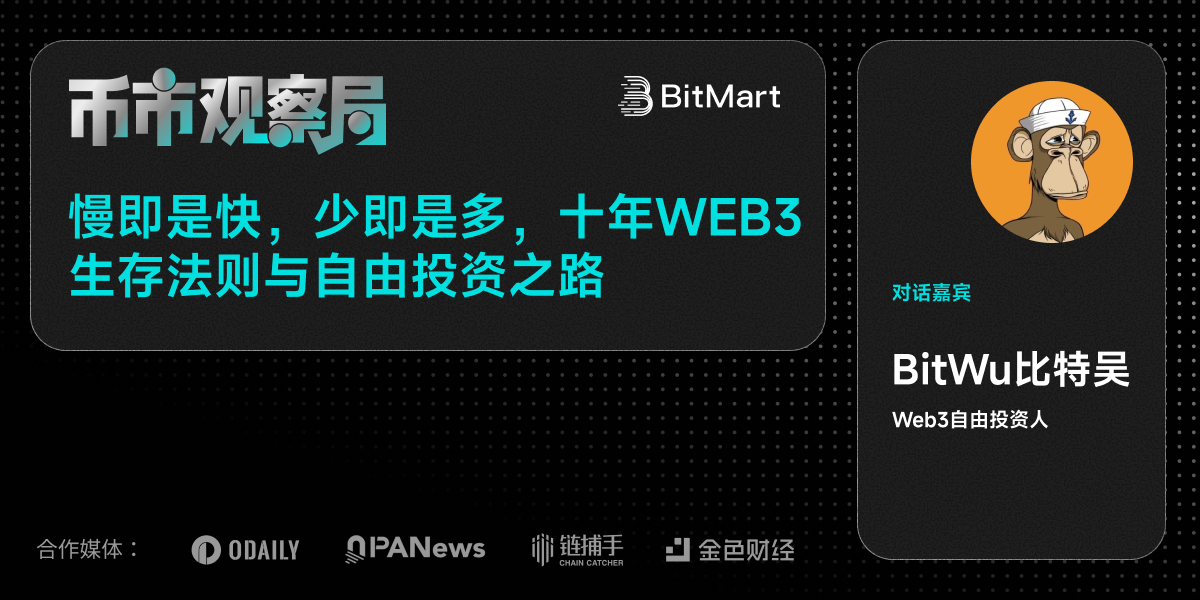
Crypto Market Observer✖️Bit Wu: Slow is Fast, Less is More – A Decade of Web3 Survival Rules and the Path to Free Investment


- Core Viewpoint: Through personal experience, Bit Wu explains that the key to long-term survival in the crypto industry is not chasing short-term windfalls, but being able to survive when market cycles reverse, and achieving sustainability by establishing a steady investment rhythm, risk management, and learning system.
- Key Elements:
- Lessons from two experiences of assets nearly "going to zero," including a >90% shrinkage of high-volatility assets after the 2017 "94" event, and further losses and scam experiences in 2018 due to persisting with wrong strategies.
- Current investment strategy is highly concentrated on Bitcoin and Ethereum (nearly 80% of the portfolio), with major DCA (Dollar-Cost Averaging) completed in 2022-2023. Stopped adding positions after Bitcoin broke through $90,000 due to emotional impact on judgment.
- Proposes that information management requires maintaining an appropriate distance, avoiding 24/7 immersion leading to emotional decisions. Suggests spending only 1-2 hours daily to obtain information through filtered core sources (e.g., X/Twitter).
- Believes the classic "Bitcoin four-year cycle" is weakening, with pricing power shifting towards institutions. Future cycles may be longer and more complex.
- Advice for newcomers emphasizes using AI to assist learning rather than following hype-driven trades. The primary goal is to learn to survive in the market and find a genuine personal connection point with the industry.
BitMart's "Market Observer" is a newly launched in-depth Chinese interview series by BitMart, inviting the most discerning and influential builders, investors, and researchers in the Web3 industry to engage in conversations centered on financial innovation, technological evolution, and long-term trends, leaving behind judgments and experiences of genuine reference value for the industry.
Guest for this episode of "Market Observer": BitWu, a Web3 independent investor.
Host: yuanyuan, BitMart Marketing VP.
In the crypto industry, most narratives revolve around "making quick money," "riding the hype," and "the next big wealth opportunity." However, what truly determines whether one can stay at the table long-term is often not the luck of catching a single market move, but rather:
When the cycle reverses, feedback disappears, and assets approach zero, can they still survive and continue to do the right things?
This is precisely what BitWu has repeatedly validated through his own experiences over the past decade.
From his first real encounter with Bitcoin in 2016 to experiencing two life inflection points that nearly brought him to "zero"; from rapidly accumulating immense wealth during the 2017 ICO wave to rebuilding his understanding and rhythm through prolonged downturns—BitWu does not shy away from failure nor mythologize success.
Compared to labels like "teacher" or "KOL," he prefers to define himself as: an independent investor still learning how to coexist with risk.
The First Time Truly Owning Bitcoin: A Real-World "Initiation Ritual"
BitWu's entry into the industry was not born from grand judgment, but from an extremely practical coincidence.
At the end of 2016, his startup with a partner failed, and the company dissolved. Among the few remaining payments, a miner client, whose bank card was frozen, proposed paying development fees with Bitcoin. That was the first time he truly used Bitcoin to complete a transaction.
Under the client's guidance, he registered an exchange account on the spot, completed the deposit, and converted it to Chinese Yuan. For that test transaction, the client transferred over 800 Bitcoins.
Of course, those Bitcoins were almost immediately sold to cover salaries and settle project debts. But this experience made him realize for the first time:
Bitcoin was not just a concept, but an asset already capable of real-world payments.
Years later, a saying circulating within the community resonated deeply with him: "The moment in your life when you owned the most Bitcoin was often the first time you owned it."
From Obscurity, Illusions of Sudden Wealth, to Two Near-Zeros: A Person Who Has Completed a Full Cycle
In October 2016, BitWu began systematically learning about Bitcoin and blockchain, and consistently produced content on Weibo and WeChat public accounts. That was a phase with almost no feedback.
For half a year, readership was low, follower growth was slow, there were no advertisements, and no income. Savings dwindled rapidly, and real-life pressure mounted. He admitted that if this state had continued for another half year, he would likely have been forced to leave.
The turning point came in the spring of 2017. The ICO wave rapidly gained momentum in China, and many traditional internet professionals began searching for "blockchain explainers." His previously accumulated content was rediscovered, and within a few short months, his followers jumped from a few hundred to hundreds of thousands.
But what truly changed his fate wasn't just "being seen."
In 2017, the market entered an extremely distorted phase: writing an article could earn unreleased project tokens; after a project launched, gains of tens or hundreds of times were common; making money didn't require judgment, just participation.
This experience quickly created a dangerous path dependency—making him mistakenly believe he was earning money through cognition.
After the "September 4th" (2017) regulations in China, the market sharply corrected. His main portfolio was not in Bitcoin or Ethereum, but in highly volatile projects, leading to a rapid asset drawdown of over 90%. Subsequent operations further reduced his assets by 97-98%.
In 2018, in an attempt to "earn it back," he continued the "investment" methods of 2017, overlooking a fundamental change: the incremental bubble had ended.
That year, he faced failures in multiple projects, including the widely known incident of being scammed out of 80 Bitcoins. This was followed by a two-year detention experience.
But recalling this period, BitWu does not view it as mere suffering or unfairness of fate. He admits being grateful for the experience, which gave him profound insights into mindset shaping and understanding human nature. He also marvels at the incredible adaptability of the human species.
Slow is Fast, Less is More: Relearning How to Survive and Make Money
After returning to the industry, BitWu set a seemingly "counter-intuitive" principle for himself: slow down. In his view, "slow" is not conservatism, but respect for rhythm; "less" is not abandoning opportunities, but protecting attention. This methodology gradually manifested in his overall approach to investment, information, and writing.
In asset allocation, his portfolio is highly concentrated in Bitcoin and Ethereum, together accounting for nearly 80%. His main DCA (Dollar-Cost Averaging) for the subsequent cycle was completed between 2022–2023, focused in the $30,000–$70,000 range; he stopped adding positions after Bitcoin surpassed $90,000.
The reason for not continuing to buy was straightforward: if the buying behavior starts affecting emotional judgment, one should stop buying.
Regarding information management, he offers an insightful judgment: one cannot be too close to the industry, nor too far away.
- Too close: Immersed in the 24/7 information flow, inevitably becoming emotional and losing money.
- Too far: Not checking for weeks, potentially missing structural changes.
His approach is:
Using X (Twitter) as the core information source, manually categorizing and filtering information—1–2 hours per day is sufficient. (A list of X and YouTube accounts recommended by BitWu is also compiled at the end for everyone's learning.)
Writing has also become part of this rhythm. It's not about influencing many people, but about keeping himself in a state of continuous thinking.
BitWu, who does not consider himself a KOL, also didn't believe his writing could influence others. However, a meeting with a university student last year changed his perspective. When the student pulled out two thick notebooks densely filled with notes on his past tweets and thoughts, he felt certain for the first time: words may not change everyone, but they can indeed change some. This is also a reason he maintains a high frequency of continuous output today.
Judgments on Cycles, AI, and the Future
On the topic of cycles, he believes:
- The classic "Bitcoin four-year cycle" is weakening.
- Pricing power is shifting towards institutions.
- The future is more likely to present longer, more complex cycle structures.
Regarding AI, he is not anxious about being replaced. At the current stage, AI is more like a cognitive and efficiency tool, assisting with learning, research, and judgment, but not yet sufficient to replace real experience.
Three Pieces of Advice for Newcomers
- Use AI to learn about the industry, not to follow hype and trade.
- First learn to survive, then consider how much money to make.
- Find your genuine connection point with the industry.
On a sufficiently long time horizon, making money is actually the easiest step.
Slow Judgment is the Moat of Long-Termists
Looking back at BitWu's decade, it's not a perfect curve, but a path repeatedly interrupted, corrected, and reconstructed.
In a highly cyclical, temptation-filled industry, what is truly scarce is never opportunity, but the person who can maintain rhythm amidst chaos. As the pinned Churchill quote on his X profile says: "Never let a good crisis go to waste." True opportunities often exist within crises.
—----------------------------
BitWu's Recommended List:
1. X: Morgan Housel - Personality, probability, and long-termism in investing; the inspiration source for my "investment reflection" content.
2. X: Naval Ravikant - Wealth × Cognition × Life Models; the crypto circle needs to learn the "subtraction phase."
3. X: zachxbt - On-chain detective, specializing in exposing crypto scams, rug pulls, and hacker traces. Essential for security and scam prevention.
4. YouTube: Unchained - High-quality interviews, very helpful for understanding protocols, regulation, and industry figures.
5. YouTube: Bankless - ETH & Web3 mainline narratives, capturing long-term structures.
6. YouTube: Lex Fridman Podcast - Long-form, in-depth conversations on AI, philosophy, life, and cognition.
7. YouTube: Farnam Street - Decision-making and mental models for becoming a "long-termist investor."
Recording date for this episode: December 17, 2025.
Full content available on Xiaoyuzhou, Apple Podcast, and Spotify. Search for and follow "Market Observer."
Also welcome to follow BitMart's Twitter/X for more industry insights, market trends, and platform updates.
Risk Disclosure
Statements or opinions expressed in this series represent the personal stance of the guest only and do not represent the views of BitMart or its affiliates, nor should they be considered professional financial investment advice.
Cryptocurrency investment is highly speculative and carries a significant risk of loss. Past performance, hypothetical scenarios, or simulated results do not guarantee future returns. The value of digital assets may be volatile, and buying, holding, or trading digital assets may involve substantial risks. Before participating in trading or holding digital assets, please carefully assess their suitability based on your own investment objectives, financial situation, and risk tolerance. BitMart does not provide any investment, legal, or tax advice.