






New Capital Favors "Old Altcoins"


- Core View: The crypto market is undergoing a structural shift, with capital continuously concentrating towards mature, highly liquid top-tier assets like Bitcoin, significantly squeezing the market space and investment opportunities for altcoins, indicating a trend of consolidation and maturation.
- Key Elements:
- Bitcoin's market dominance has climbed to 65%, reaching a new high since 2021. Its spot ETFs have attracted over $150 billion in institutional capital, solidifying its status as a "safe-haven asset" and a core entry point.
- The combined market cap share of stablecoins and on-chain derivatives is approaching 12.5%, exerting dual pressure on altcoins alongside Bitcoin, squeezing their overall market share.
- The "head effect" within the altcoin sector is intensifying. The proportion of the top 10 altcoins by market cap to the total altcoin market cap has surged from 64% in 2021 to 82% currently.
- The number of altcoins with a market cap exceeding $1 billion has decreased from a peak of around 105 in 2021 to approximately 58, indicating a reduction in altcoins with "investable" qualities.
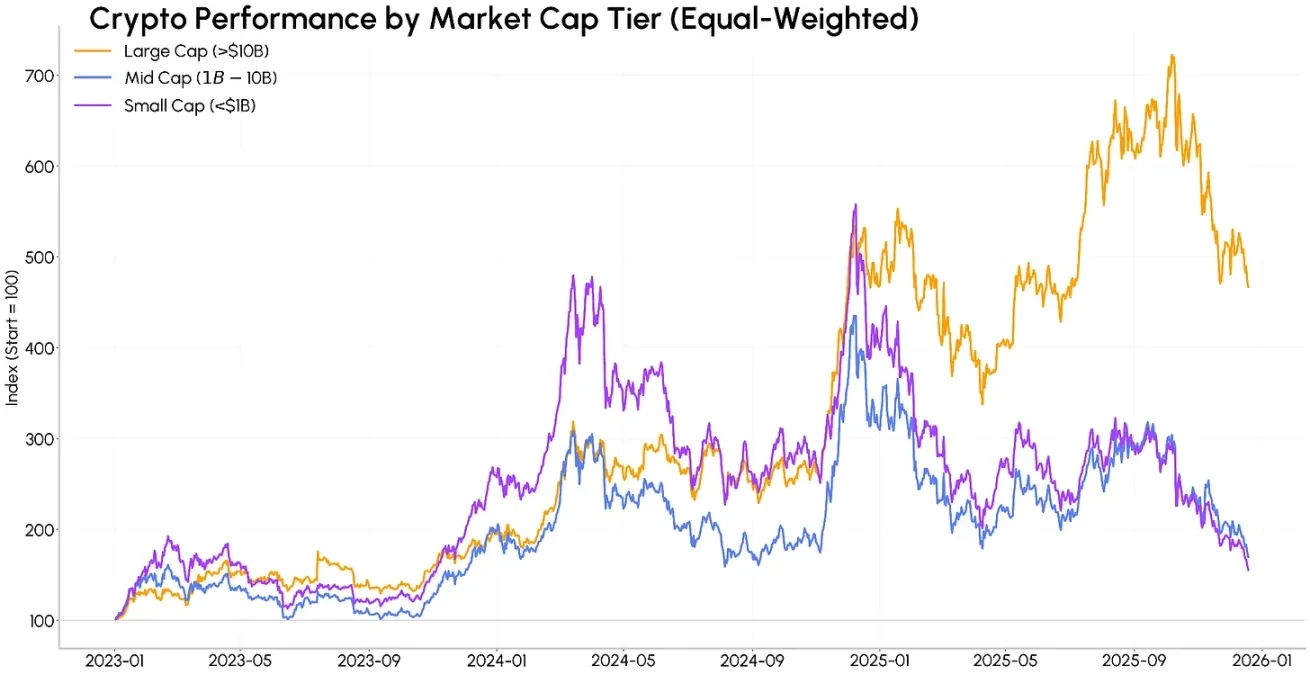
- From 2023 to date, the overall return rate of large-cap coins (~365%) far exceeds that of mid-cap coins (~70%) and small-cap coins (~55%), showing that returns are tilting towards mature assets.
- Risk events such as high-leverage liquidations in the market may further strengthen the trend of capital concentration towards highly liquid, defensive assets.
TL;DR
- The crypto investment landscape continues to expand, yet capital's selection of assets is narrowing: Bitcoin's market dominance shows a sustained upward trend, while the growth of stablecoins and on-chain derivatives is continuously squeezing the market space for altcoins.
- The altcoin market is shrinking, with a significantly enhanced concentration effect at the top: The top ten altcoins by market cap currently account for approximately 82% of the total market cap of the altcoin sector, a substantial increase from 70% five years ago.
- Since 2023, the performance of large-cap crypto assets has significantly outperformed mid-cap and small-cap assets; capital flows following market volatility have further reinforced investors' preference for highly liquid, mature leading assets.
The crypto investment landscape is still expanding. Hundreds of new tokens are launched each year, the number of stock tickers related to digital asset businesses is increasing, and tokenization technology is gradually bringing traditional assets like stocks and commodities on-chain. While investment choices are becoming more abundant, market capital is also becoming more discerning.
Bitcoin's market dominance has rebounded to around 65%, reaching its highest level since early 2021; meanwhile, the combined market cap of stablecoins and on-chain derivatives (such as wrapped tokens, staked tokens, cross-chain bridge tokens, etc.) now accounts for nearly 12.5% of the total crypto market cap. Consequently, altcoins are facing a dual squeeze—despite the growing number of tokens, their overall market share is shrinking.
This edition of the "State of the Network" report will explore whether the crypto market is undergoing a structural shift towards capital concentration. We will analyze trends in market dominance and returns across assets of different market cap tiers and sectors to investigate whether capital is continuously aggregating towards a smaller number of larger, more mature tokens, or if investment opportunities remain widely distributed.
Evolution of Market Cap Dominance
First, we begin our analysis with market cap dominance. Bitcoin's market cap dominance (i.e., Bitcoin's market cap relative to the total crypto market cap) climbed to 65% in 2025, reaching a new high since 2021. Notably, this growth is not a short-term spike but rather a long-term, steady upward trend since hitting a bottom in 2022.
The launch of Bitcoin spot ETFs has accelerated the deepening of institutionalization, attracting over $150 billion in long-term capital, which has further fueled the sustained rise in its market dominance. This trend has solidified Bitcoin's position as a "safe-haven asset" within the crypto market and made it a highly liquid, standardized entry point for traditional institutional investors. Compared to previous bull cycles where "altcoin seasons" quickly diluted Bitcoin's market share, Bitcoin's dominance in this cycle appears more enduring.
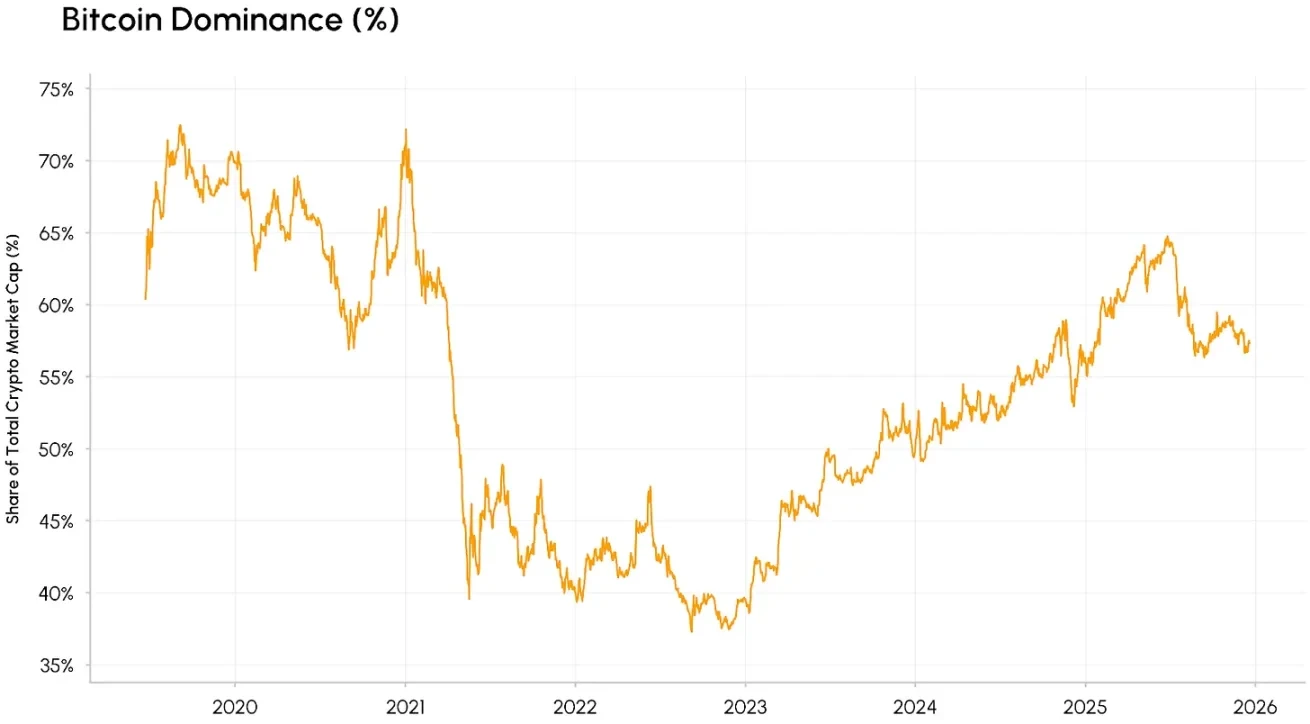
Bitcoin Dominance, Data Source: Coin Metrics
The structure of other assets in the crypto market is also shifting. Stablecoins, with a current market cap exceeding $300 billion, and on-chain derivatives are accounting for an increasing share of the total market cap. These tokens serve different functions within the crypto ecosystem: stablecoins are the primary medium of exchange in the market, while on-chain derivatives provide investors with claims on the returns of underlying assets or channels for generating yield.
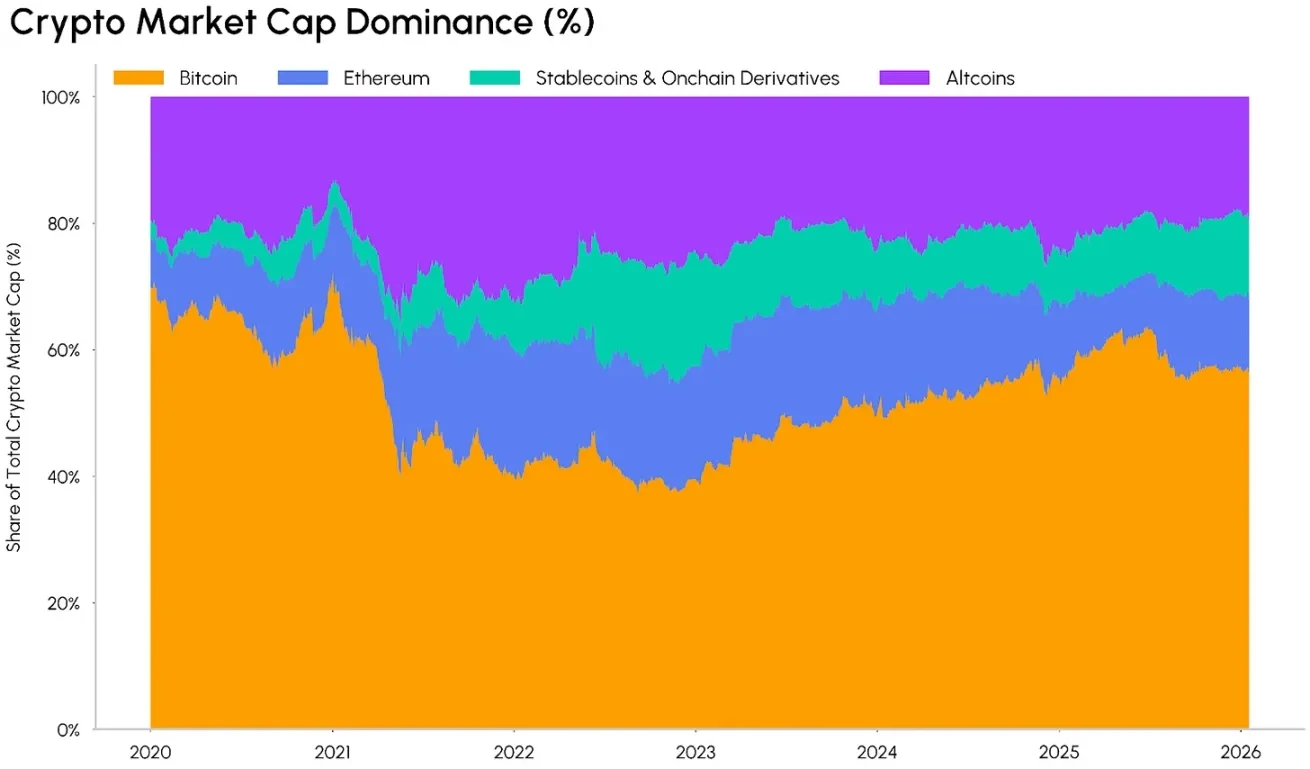
Crypto Market Dominance Distribution, Data Source: Coin Metrics
As a result, the altcoin market faces a dilemma. The scope of remaining investable targets is narrowing, and the concentration effect at the top is becoming more pronounced: market value continues to concentrate towards more liquid and mature assets. These assets typically possess clear use cases, defined regulatory development paths, and can fully benefit from the development waves of stablecoins, decentralized finance (DeFi), and asset tokenization.
Unlike previous market cycles, the speed of capital rotation from major coins to altcoins has significantly slowed in this cycle. ETFs and various institutional investment tools have locked market liquidity firmly into top-tier assets. However, with the implementation of universal listing standards, the launch of altcoin and multi-asset ETFs broadening investment channels for more large-cap altcoins, and the advancement of market structure-related legislation, this market landscape may undergo changes.
The "Giant Monopoly" Trend Within the Altcoin Sector
Even within the altcoin sector itself, the trend of capital concentration is intensifying. The top ten altcoins by market cap (excluding Bitcoin) currently account for approximately 82% of the total market cap of the altcoin sector, a significant increase from 64% during the 2021 bull market. In the previous bull cycle, a large number of small-cap altcoins that briefly created value have gradually exited the market, replaced by a sector structure with stronger top-heavy effects. Furthermore, the lifecycle of various short-term market narratives continues to shorten, making it difficult to sustain the continuous rise in asset value.
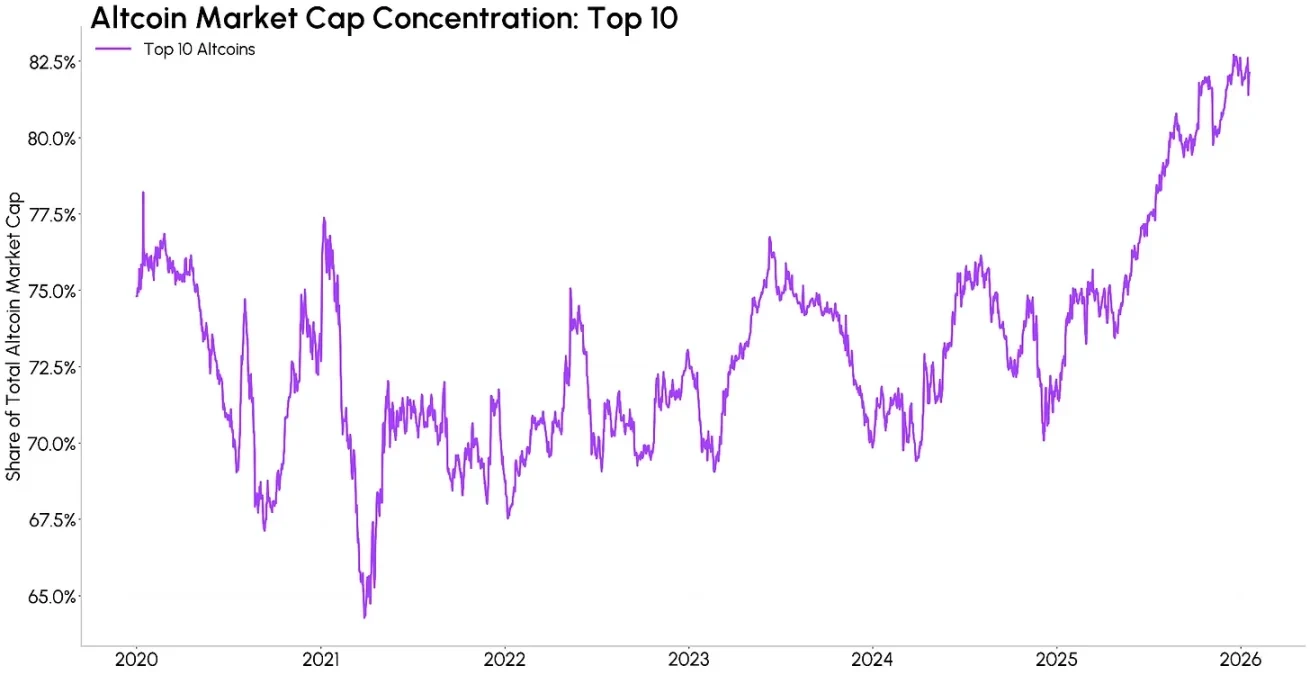
Top 10 Altcoin Market Cap Share, Data Source: Coin Metrics
We can also observe this concentration trend by looking at the number of tokens that have crossed specific market cap thresholds. Although the total crypto market cap has repeatedly reached new all-time highs, the number of altcoins with a market cap exceeding $1 billion has shrunk from a peak of about 105 in 2021 to about 58 currently. This means that even as the total number of assets in the market increases, the number of truly "investable" altcoins is decreasing. While this does not necessarily indicate the decline of the altcoin sector, the focus of market capital may further concentrate towards targets with solid fundamentals and stronger risk resilience.
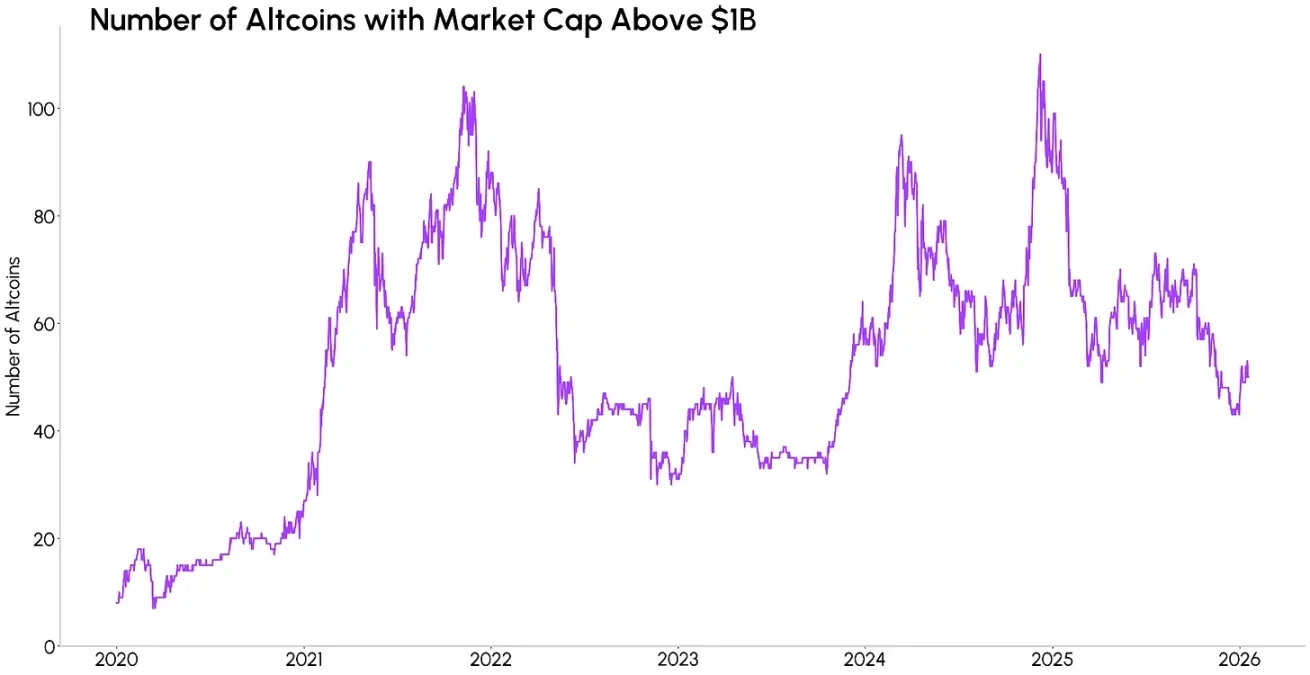
Number of Altcoins with Market Cap Exceeding $1 Billion, Data Source: Coin Metrics
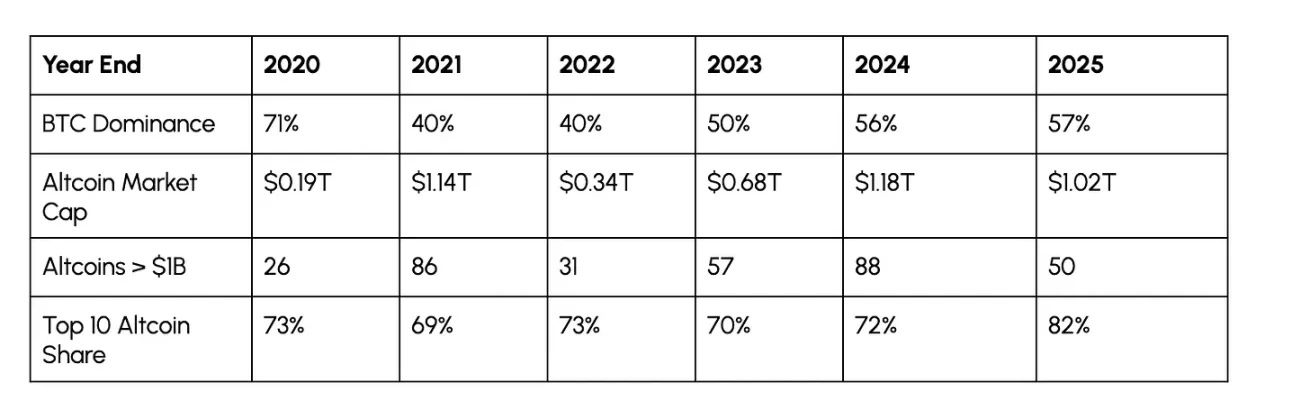
The table below summarizes the annual evolution characteristics of the aforementioned market trends. Some indicators still exhibit cyclical features, such as Bitcoin's market dominance declining in bull markets and rising in bear markets. However, the market share of the top ten altcoins shows a different trend: from 2020 to 2024, regardless of market conditions, this ratio remained stable between 69%-73%, but it surged to 82% in 2025. This change suggests a structural shift in the market favoring mature leading assets, rather than merely short-term "chasing quality assets" behavior.
Data Source: Coin Metrics
Capital Flows Towards Major Coins
This trend of capital concentration is also reflected in asset return performance. Since 2023, mid-cap coins (market cap $1B - $10B), and especially small-cap coins (market cap < $1B), had outperformed large-cap coins (market cap > $10B) during the early and late phases of 2024. However, this trend reversed sharply in 2025, driven by the rapid fading of market sentiment towards Meme coins and other short-term narrative rotations.
Calculated on an equal-weight basis, from January 2023 to the present, the overall return of large-cap crypto assets is approximately 365%, while the returns for mid-cap and small-cap assets are only about 70% and 55% respectively, with most of the earlier gains being given back. This divergence in returns clearly illustrates that market performance is increasingly tilting towards developed, liquid assets, and the gains of small-cap tokens are unlikely to replicate the sustainability seen in previous cycles.
Market Performance of Tokens by Different Market Cap Sizes, Data Source: Coin Metrics
On October 10, 2025, the market experienced a large-scale liquidation event triggered by high leverage positions and liquidity drying up. This event may further reinforce the trend of capital shifting towards defensive assets, with investors increasingly favoring highly liquid assets over significantly more volatile small-cap assets.
Conclusion
Various data points indicate that the crypto market is in a phase of structural change, gradual maturation, and consolidation. Although the number of crypto assets continues to increase, and as underlying infrastructure, the types of traditional assets it carries are becoming more diverse, the overall liquidity pool of the market is limited. Simultaneously, within multi-asset portfolios, crypto assets must also compete for space with popular investment themes in the stock market and traditional safe-haven assets like gold.
Currently, capital is continuously aggregating towards large-cap crypto assets and infrastructure sectors that support the development of stablecoins, tokenized assets, and decentralized finance. The importance of liquidity and scale has increased compared to the past, and the threshold for altcoins to attract long-term capital has risen significantly.
Of course, if market structure-related rules become clearer, altcoin and multi-asset ETFs continue to gain popularity, and market liquidity conditions improve, a new altcoin season could still be catalyzed. However, it is foreseeable that the beneficiaries in such an altcoin season will be more concentrated, and capital's selection will be more discerning than in any previous cycle.


