






Inflection Point of a Decade-Long Debate: Will Ethereum End the "Impossible Trinity" Controversy?


- Core Viewpoint: The article posits that with the evolution of Ethereum's modular architecture and the maturation of core technologies like PeerDAS and ZK proofs, the traditional "blockchain impossible trinity" (the difficulty of simultaneously achieving decentralization, security, and scalability) is transforming from a physics-law-like constraint into a design threshold that can be progressively overcome through engineering pathways.
- Key Elements:
- PeerDAS Technology Breaks the Data Availability Bottleneck: By probabilistically sampling and verifying data instead of requiring nodes to download all data, it increases throughput without sacrificing decentralization. It has evolved from a roadmap concept to a real, deployed system component.
- zkEVM Reconstructs the Verification Model: By using zero-knowledge proofs to allow nodes to verify block validity without re-executing computations, it reduces node burden and enhances security. The Ethereum Foundation has already released the L1 zkEVM live proof standard.
- Modular and Multi-Layer Architecture Decouples Constraints: Through its Rollup-centric multi-layer architecture, Ethereum distributes the responsibilities for performance, security, and decentralization across different layers, rather than making trade-offs within a monolithic chain framework.
- Clear 2030 Evolution Roadmap: It outlines phased goals from increasing the Gas limit and adjusting the state structure to the widespread deployment of zkEVM. The ultimate vision is to form an extremely simple and secure L1, a prosperous and highly interoperable L2 ecosystem, and an extremely low barrier to verification.
- Core Evaluation Criterion "Exit Test": Vitalik emphasizes that the system's ultimate goal is to operate securely and autonomously even if all service providers fail. This defines Ethereum's final pursuit of "trustlessness" and "decentralization."
Have you heard the term "Impossible Trinity" so often that your ears are about to grow calluses?
In the first decade of Ethereum's existence, the "Impossible Trinity" hung over every developer like a law of physics—you could choose any two from decentralization, security, and scalability, but you could never have all three.
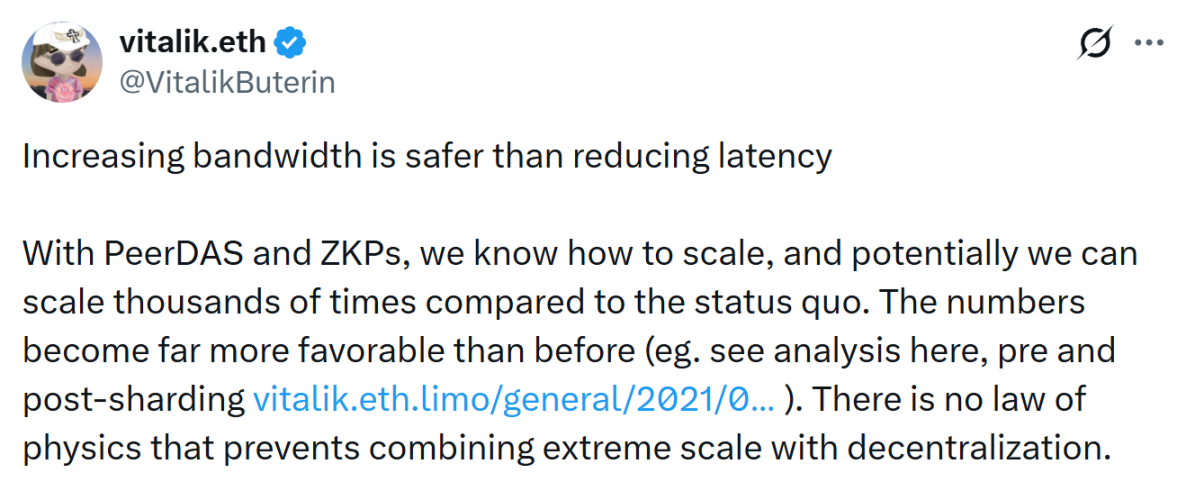
However, looking back from the vantage point of early 2026, we find it is gradually becoming a "design threshold" that can be crossed through technological evolution. As Vitalik Buterin pointed out in a disruptive statement on January 8th: "Compared to reducing latency, increasing bandwidth is safer and more reliable. With PeerDAS and ZKP, Ethereum's scalability can be improved by thousands of times, and it does not conflict with decentralization."
Could that once seemingly insurmountable "Impossible Trinity" truly dissipate today in 2026, with the maturation of PeerDAS, ZK technology, and account abstraction?
1. Why Has the "Impossible Trinity" Been So Difficult to Overcome?
We first need to revisit the concept of the "Blockchain Trilemma" proposed by Vitalik Buterin. It was specifically used to describe the dilemma faced by public blockchains in trying to achieve all three of security, scalability, and decentralization simultaneously:
- Decentralization means low node entry barriers, broad participation, and no need to trust a single entity;
- Security means the system can maintain consistency when resisting malicious actions, censorship, and attacks;
- Scalability means high throughput, low latency, and a good user experience;
The problem is that these three aspects often constrain each other under traditional architectures. For instance, increasing throughput usually means raising hardware requirements or introducing centralized coordination; reducing node burdens may weaken security assumptions; insisting on extreme decentralization inevitably sacrifices performance and user experience.
It can be said that over the past 5-10 years, from early projects like EOS to later ones like Polkadot and Cosmos, and then to performance-focused chains like Solana, Sui, and Aptos, different public chains have offered different answers. Some chose to sacrifice decentralization for performance, some improved efficiency through permissioned nodes or committee mechanisms, and others accepted limited performance to prioritize censorship resistance and verification freedom.
But the common thread is that almost all scaling solutions could only satisfy two of the three aspects, inevitably sacrificing the third.
Or, to put it another way, almost all solutions were stuck in a tug-of-war within the logic of a "monolithic blockchain"—to run faster, nodes needed to be more powerful; to have more nodes, the chain had to run slower. This seemed like an unsolvable problem.
If we temporarily set aside the debate on the pros and cons of monolithic vs. modular blockchains and seriously review Ethereum's development path since 2020—its comprehensive shift from a "monolithic chain" to a "Rollup-centric" multi-layer architecture, and the recent maturation of supporting technologies like ZK (Zero-Knowledge Proofs)—we actually find that:
The underlying logic of the "Impossible Trinity" has been slowly reconstructed over the past five years through Ethereum's incremental, modular progress.
Objectively speaking, Ethereum has decoupled the original constraints one by one through a series of engineering practices. At least from an engineering path perspective, this issue is no longer just a philosophical discussion.
2. The "Divide and Conquer" Engineering Approach
Next, we will break down these engineering details to see specifically how, in the five-year empirical period from 2020 to 2025, Ethereum has worked to dissolve this triangular constraint through the parallel advancement of multiple technical lines.
First, decoupling from data availability via PeerDAS liberates the inherent upper limit of scalability.
As is well known, within the trilemma, data availability is often the first shackle determining scalability. This is because traditional blockchains require every full node to download and verify all data, ensuring security but also limiting the expansion ceiling. This is also why in the last (or the one before that) cycle, "unorthodox" DA solutions like Celestia experienced explosive growth.
Ethereum's direction is not to make nodes more powerful, but to change how nodes verify data. The core solution here is PeerDAS (Peer Data Availability Sampling):
It no longer requires each node to download all block data. Instead, it verifies data availability through probabilistic sampling—block data is split and encoded, and nodes only need to randomly sample parts of the data. If data is withheld, the probability of sampling failure rapidly amplifies. This allows data throughput to be significantly increased while ordinary nodes can still participate in verification. This means it doesn't trade decentralization for performance, but rather optimizes the cost structure for achieving verification through mathematics and engineering design (Further reading: Is the DA War Coming to an End? Deconstructing How PeerDAS Helps Ethereum Reclaim "Data Sovereignty").
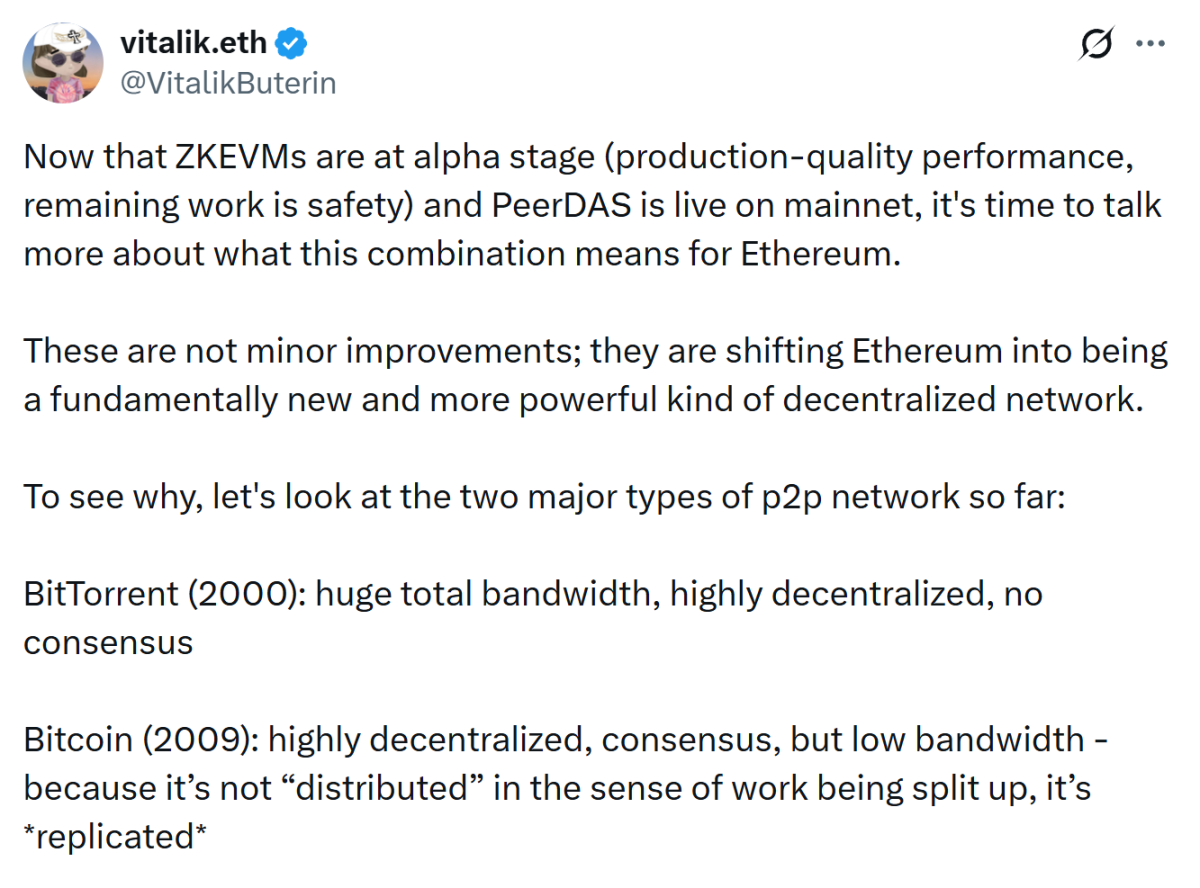
Moreover, Vitalik particularly emphasized that PeerDAS is no longer just a concept on the roadmap but a real, deployed system component. This means Ethereum has taken a substantive step on the "scalability × decentralization" front.
Second, zkEVM attempts to solve the problem of "whether every node must re-execute all computations" through a zero-knowledge proof-driven verification layer.
Its core idea is to enable the Ethereum mainnet to have the capability to generate and verify ZK proofs. In other words, after each block is executed, it can output a verifiable mathematical proof, allowing other nodes to confirm the correctness of the result without re-executing the computation. Specifically, the advantages of zkEVM are concentrated in three areas:
- Faster Verification: Nodes don't need to replay transactions; they only need to verify the zkProof to confirm block validity;
- Lighter Burden: Effectively reduces the computational and storage pressure on full nodes, making it easier for light nodes and cross-chain validators to participate;
- Stronger Security: Compared to the Optimistic Rollup (OP) approach, ZK state proofs are confirmed on-chain in real-time, offering higher tamper resistance and clearer security boundaries;
Not long ago, the Ethereum Foundation (EF) officially released the L1 zkEVM real-time proof standard, marking the first time the ZK path has been formally written into the mainnet-level technical plan. Within the next year, the Ethereum mainnet will gradually transition to an execution environment supporting zkEVM verification, achieving a structural shift from "heavy execution" to "proof verification."
Vitalik's assessment is that zkEVM has preliminarily reached a stage where it can be used in production in terms of performance and functional completeness. The real challenges lie in long-term security and implementation complexity. According to the technical roadmap published by the EF, the target for block proof latency is controlled within 10 seconds, the size of a single zk proof is less than 300 KB, and it adopts a 128-bit security level, avoids trusted setup, and plans to allow household devices to participate in proof generation to lower the barrier to decentralization (Further reading: The "Dawn Moment" for the ZK Path: Is Ethereum's Endgame Roadmap Accelerating Comprehensively?).
Finally, besides the two items above, there are also multi-dimensional developments based on Ethereum's roadmap up to 2030 (such as The Surge, The Verge, etc.), focusing on increasing throughput, restructuring the state model, raising the Gas limit, improving the execution layer, and more.
These represent the trial-and-error and accumulation paths in crossing the traditional trilemma constraints. It's more like a long-term main thread dedicated to achieving higher blob throughput, clearer Rollup division of labor, and more stable execution and settlement rhythms, laying the foundation for future multi-chain collaboration and interoperability.
Importantly, these are not isolated upgrades but are explicitly designed as modules that stack and reinforce each other. This precisely reflects Ethereum's "engineering attitude" towards the trilemma: not seeking a one-size-fits-all magical solution like monolithic blockchains, but reallocating costs and risks through multi-layer architectural adjustments.
3. The 2030 Vision: Ethereum's Endgame Form
Even so, we must remain restrained. Because elements like "decentralization" are not static technical metrics but long-term evolutionary outcomes.
Ethereum is actually using engineering practices step by step to explore the boundaries of the trilemma's constraints—as verification methods (from re-execution to sampling), data structures (from state bloat to state expiry), and execution models (from monolithic to modular) change, the original trade-off relationships are shifting. We are getting infinitely closer to that endpoint where we want "everything, and more."
In recent discussions, Vitalik also provided a relatively clear timeframe:
- 2026: With some execution layer/builder mechanism improvements and the introduction of directions like ePBS, the Gas limit can be raised first without relying on zkEVM, while also creating conditions for "more widespread operation of zkEVM nodes";
- 2026–2028: Adjustments around Gas pricing, state structure, and execution load organization methods will enable the system to operate securely under higher loads;
- 2027–2030: As zkEVM gradually becomes an important method for verifying blocks, the Gas limit may be further increased. The long-term ideal goal points towards more distributed block building;
Combined with the recent roadmap updates, we can glimpse three key characteristics of Ethereum before 2030, which together constitute the final answer to the trilemma:
- Minimalist L1: L1 becomes a stable, neutral underlying layer responsible only for providing data availability and settlement proofs. It no longer handles complex application logic, thereby maintaining extremely high security;
- Prosperous L2s and Interoperability: Through the EIL (Execution Interoperability Layer) and fast confirmation rules, fragmented L2s are stitched together into a whole. Users are unaware of the existence of chains, only perceiving hundreds of thousands of TPS;
- Extremely Low Verification Barrier: Due to the maturity of state handling and light client technology, even mobile phones can participate in verification, ensuring the cornerstone of decentralization remains as solid as a rock;
Interestingly, just as this article was being written, Vitalik emphasized an important test standard again—"The Walkaway Test"—reiterating that Ethereum must possess the ability to run autonomously. Even if all service providers disappear or are attacked, DApps should still run, and user assets should remain safe.
This statement actually shifts the evaluation scale for this "endgame form" from speed/experience back to what Ethereum cares about most—that is, whether the system remains trustworthy and non-reliant on single points of failure even in the worst-case scenarios.
In Conclusion
One must always view problems with a developmental perspective, especially in the rapidly evolving Web3/Crypto industry.
The author also believes that many years from now, when people look back on the fierce debates about the trilemma from 2020-2025, they might feel it was like seriously discussing "how a horse-drawn carriage could simultaneously balance speed, safety, and load capacity" before the invention of the automobile.
Ethereum's answer is not to make a painful choice among the three vertices, but to construct a digital infrastructure that belongs to everyone, is extremely secure, and can carry all of humanity's financial activities through PeerDAS, ZK proofs, and ingenious economic game theory design.
Objectively speaking, every step taken in this direction is a step beyond the "Impossible Trinity" of the past.


