






Daily Active Users at 8? The Truth Behind the Data in the Solana vs. Starknet PR War


- Core Viewpoint: The article points out that although Starknet was heavily mocked for user attrition after its airdrop, its All in on BTCFi strategy has led to a significant data recovery. Key metrics such as on-chain activity, TVL, and capital inflows all prove it has cultivated a high-quality user base with genuine demand.
- Key Elements:
- Significant Data Recovery: Starknet's TVL has exceeded $300 million, daily active addresses remain between 2,000-4,000, daily transactions surpass 240,000, and its 3-month net capital inflow reached $504.2 million, ranking first among blockchains.
- Successful Strategic Pivot: Starknet has shed its Ethereum L2 label and is fully committed to the BTCFi ecosystem. The value of Bitcoin staked on it has exceeded $214 million, accounting for about 70% of its total TVL.
- Improved User Quality: The current retained users have high transaction frequency, contributing the majority of the network's fee revenue, indicating a shift from "airdrop farmers" to a group with real transaction needs.
- Gradual Ecosystem Maturity: Centered around BTCFi, Starknet has built a complete ecosystem encompassing wallets, cross-chain bridges, staking, lending, and yield protocols, with proven use cases.
- Deep Technical Heritage: The founder's early research focused on using zero-knowledge proofs to improve Bitcoin, and its core STARK cryptography provides historical and technical support for this strategy.
Original | Odaily (@OdailyChina)
Author|Golem (@web3_golem)

On the evening of January 14th, the official Solana account unexpectedly posted a mocking tweet targeting Starknet, claiming it had "only 8 daily active users and 10 daily transactions, yet supports a $1 billion circulating market cap and a $15 billion max valuation," and bluntly stated Starknet should go to zero.
One hour after the post, the official Starknet account quickly responded with a picture of an ugly chimpanzee, retorting, "Who told Solana this little bro these numbers?" StarkWare CEO even resorted to personal attacks, commenting under Eli Ben-Sasson's mocking post, saying, "Solana has 8 marketing interns (all bald), posting 10 tweets a day." Solana co-founder Toly also posted, "This post is doing great, promoting the responsible marketer."
As tensions escalated, some figures in the crypto space began urging peace. He Yi posted, "Take a deep breath and relax, we're all friends, let's prioritize harmony," while simultaneously captioning it "peanuts, melon seeds, mineral water," indicating a spectator stance. The official Near account posted that Solana and Starknet should become friends again.
However, some believe this was a deliberately planned exposure event by the official accounts to warm up for potential future collaboration. Meanwhile, netizens dug up that Solana's post was not original; a user had posted an identical tweet as early as April 2024.
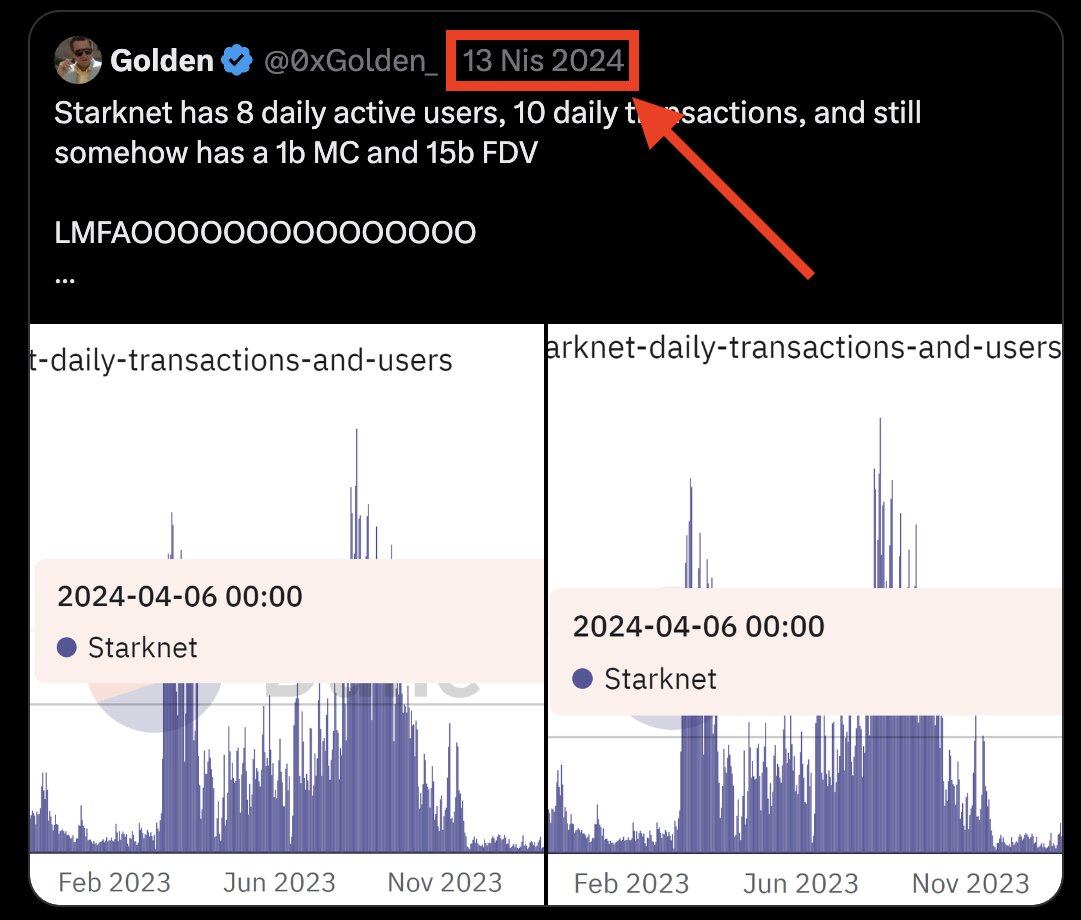
Solana's mocking tweet about Starknet was copied and pasted from a user's tweet in 2024.
Regardless of the real reason behind the Solana admin's "sudden outburst" mocking Starknet, from a data perspective, Starknet is no longer the "ghost chain" it once was.
A Sudden Clap of Thunder in the Silence
In 2024, the L2 market was fiercely competitive with strong network effects. Arbitrum and OP Mainnet had already captured a large share of common use cases. Consequently, after the Starknet airdrop concluded, user numbers plummeted, making it a prime target for criticism and mockery.
But after more than a year of perseverance, Starknet can now hold its own against most L1s. According to DeFiLlama data, Starknet's TVL began recovering in September 2025 and has now surpassed $300 million, returning to 2024 levels. It ranks 22nd among all blockchains, surpassing a host of L1s and L2s like Monad, Scroll, Linea, and Sei.
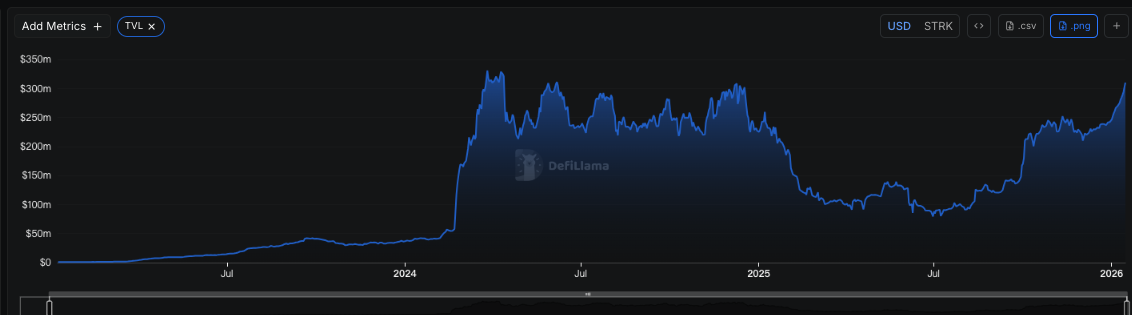
Simultaneously, its stablecoin market cap, fee revenue, and ecosystem DEX trading volume also started rebounding after September 2025. Starknet's daily fee revenue over the past four months has remained in the $5,000-$10,000 range. While this pales in comparison to its 2023-2024 daily fee revenue (averaging over $150,000 per day), it still places it among the top tier of blockchains.
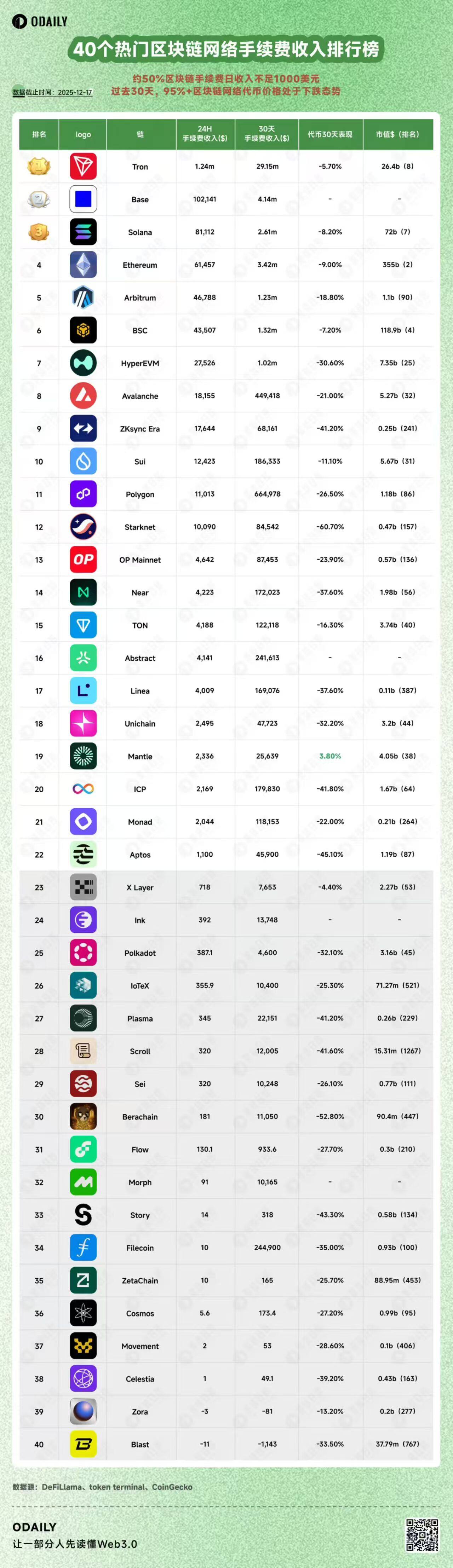
In mid-December, Odaily compiled a ranking of fee revenue for 40 mainstream blockchains, with Starknet breaking into the top 15, surpassing blockchains like Monad and TON in daily fee revenue.
In terms of on-chain activity, Starknet has finally cultivated a group of genuine loyal users (not just airdrop hunters). According to a Dune dashboard created by the Starknet Foundation, Starknet currently maintains a daily active user count of 2,000-4,000 (unique addresses), with daily transactions exceeding 240,000.
Compared to its peak of over 100,000 daily active users in 2023, Starknet's current daily active count is indeed negligible. However, in terms of transaction count, the transaction frequency of these addresses (less than 2% of the peak) has reached about one-third of the peak level (over 600,000 daily transactions in 2023). This data proves that the users remaining on Starknet are high-quality users with real transaction needs, contributing the majority of the network's fee revenue.
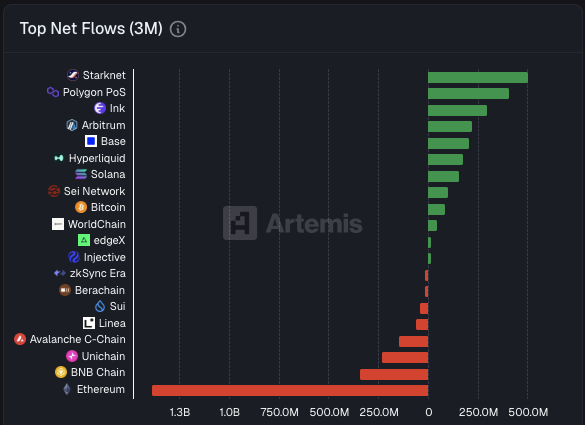
Don't simply view Starknet as a niche gathering place for blockchain "enthusiasts." In fact, Starknet has attracted external capital with high retention rates. According to Artemis data, Starknet's 3-month net capital inflow reached $504.2 million, ranking first among all blockchains. The second-place, Polygon, trailed by $100 million, far ahead of Solana and BSC.
Shedding the Ethereum L2 Label, All in on BTCFi
The reason for Starknet's comeback is quite simple: it doesn't compete with blockchains like Solana, BSC, and Base in the Meme or trending narrative frenzy. Instead, it has gone all-in on BTCFi.
Today's Starknet is shedding its Ethereum L2 label. Its official account has added the note "(BTCFi arc)" after its name. In March 2025, StarkWare, Starknet's parent company, announced the establishment of a "strategic Bitcoin reserve." The outside world initially thought it was just hype and didn't expect Starknet to be serious. By the end of September 2025, after over half a year of development, Starknet announced the launch of BTC Staking with a 100 million STRK incentive program, allowing users to stake BTC on Starknet for staking rewards and STRK incentives.
To date, BTCFi has been live on Starknet for over three months, and its launch is highly correlated with the recovery of Starknet's on-chain data.
According to Dune data, the value of Bitcoin currently staked on Starknet exceeds $214 million, accounting for about 70% of Starknet's total TVL ($300 million). Approximately 50% of the deposited assets are native BTC, with the remainder being various wrapped versions of BTC, primarily SolvBTC and WBTC.
The Bitcoin ecosystem on Starknet has also gradually matured, encompassing everything from wallets to cross-chain bridges and staking, to lending and yield protocols, with proven use cases.
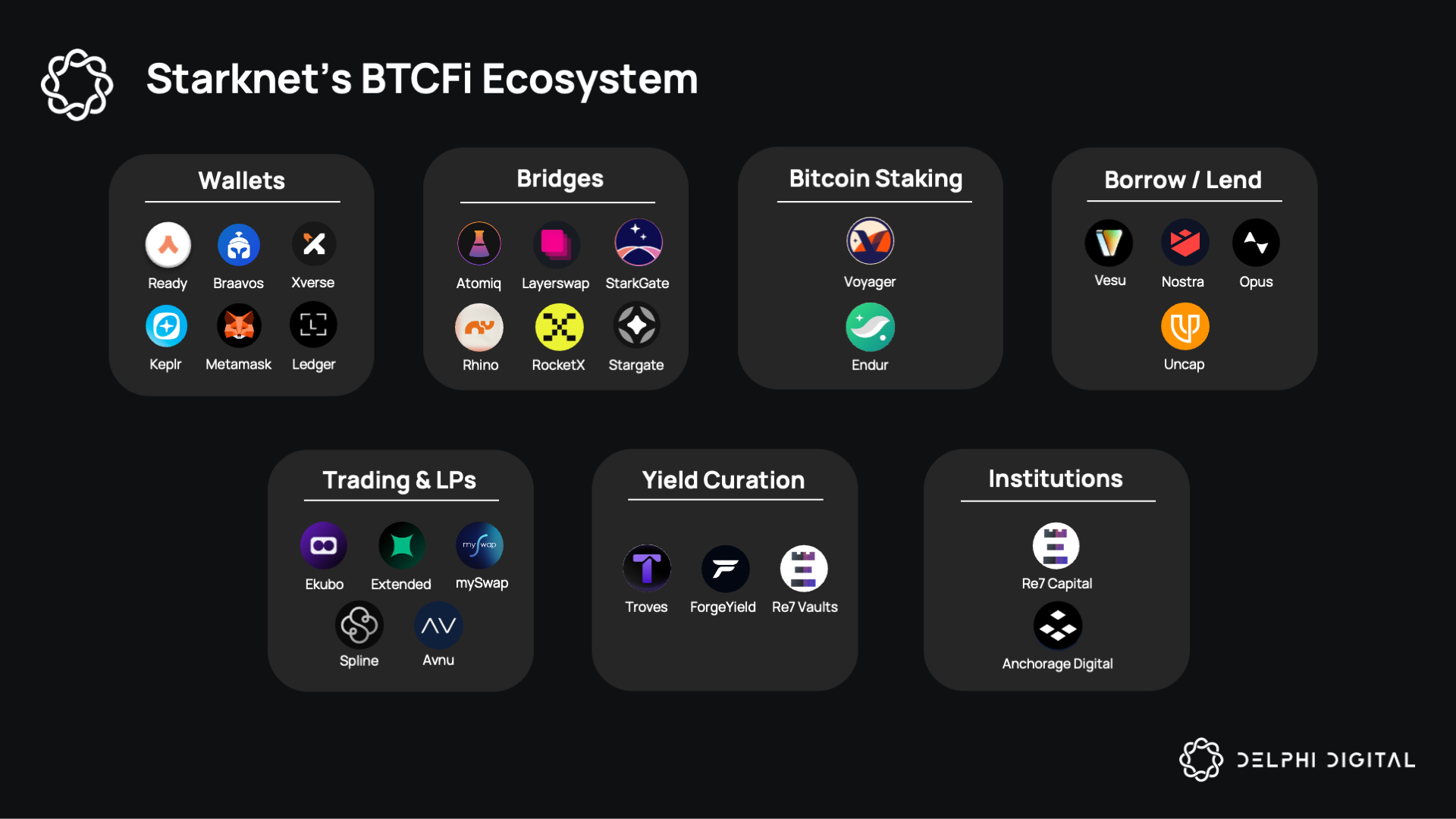
Starknet BTCFi Ecosystem Landscape
Users can stake Bitcoin on platforms like Endur and Voyager and delegate it to validators. In return, stakers receive STRK tokens (Endur's current APY in STRK is approximately 2.09%). Subsequently, the obtained LST tokens can be deposited into lending protocols like Vesu to generate additional yield. For institutional investors, Re7 Capital can also create customized yield strategies.
As for why Starknet dares to go all-in on BTCFi, it may be related to the founder's personal history. Long before Starknet's birth in 2013, Eli Ben-Sasson was already researching the use of zero-knowledge proofs to improve Bitcoin. This research eventually became one of Starknet's core technologies (STARK cryptography). Therefore, fully embracing BTCFi today is, in a way, a return to its roots.
While the blockchain world doesn't always reward idealists and those who work diligently in silence, freed from the "hostage" situation of airdrops, Starknet's steps have become lighter and more steady.


