Tether Freezes $182 Million in a Single Day: Is USDT Still a Neutral Currency?



- Core Viewpoint: Tether's large-scale freezing of USDT assets on the Tron chain, in compliance with U.S. law enforcement requests, may undermine its trust foundation as a "dollar alternative" system in sanctioned or unstable regions and redefine the market's perception of the regulatory and sovereign risks inherent in centralized stablecoins.
- Key Elements:
- Tether froze approximately $182 million worth of USDT on the Tron chain in a single day. External speculation suggests these funds may belong to the Venezuelan government, representing a seizure of sovereign assets at the request of the United States.
- Venezuela receives about 80% of its oil revenue through cryptocurrencies or stablecoins. USDT has become a crucial part of its economy, but difficulties in converting these funds have impacted domestic liquidity.
- Tether's CEO has publicly stated that the company works closely with U.S. law enforcement agencies, including the Department of Justice and FBI, and utilizes technology firms like TRM Labs to track illicit activities.
- This freezing action occurred against the backdrop of the EU's hesitation to confiscate frozen Russian assets, potentially signaling to the market that stablecoin assets carry higher risks than official assets.
- The core impact of the event lies in challenging the narrative of USDT as a "neutral" financial channel, demonstrating that it is not exempt from human-led law enforcement. This may trigger a crisis of confidence in stablecoins among international investors.
Original Title: Tether faces its Euroclear moment
Original Author: Izabella Kaminska
Original Compilation: Peggy, BlockBeats
Editor's Note: Tether's action of freezing approximately $182 million worth of USDT on the Tron chain has been viewed by some analysts as its "Euroclear moment." This signifies that when a financial infrastructure originally perceived as a neutral channel begins cooperating with law enforcement to freeze assets, it ceases to be merely a stablecoin and becomes part of the boundary of power.
This article begins with the controversy surrounding funds related to Venezuela, discussing how this event might impact USDT's narrative as an "alternative dollar" in the Global South and sanctioned regions, and how it could redefine the perception of risk associated with stablecoins.
The following is the original text:
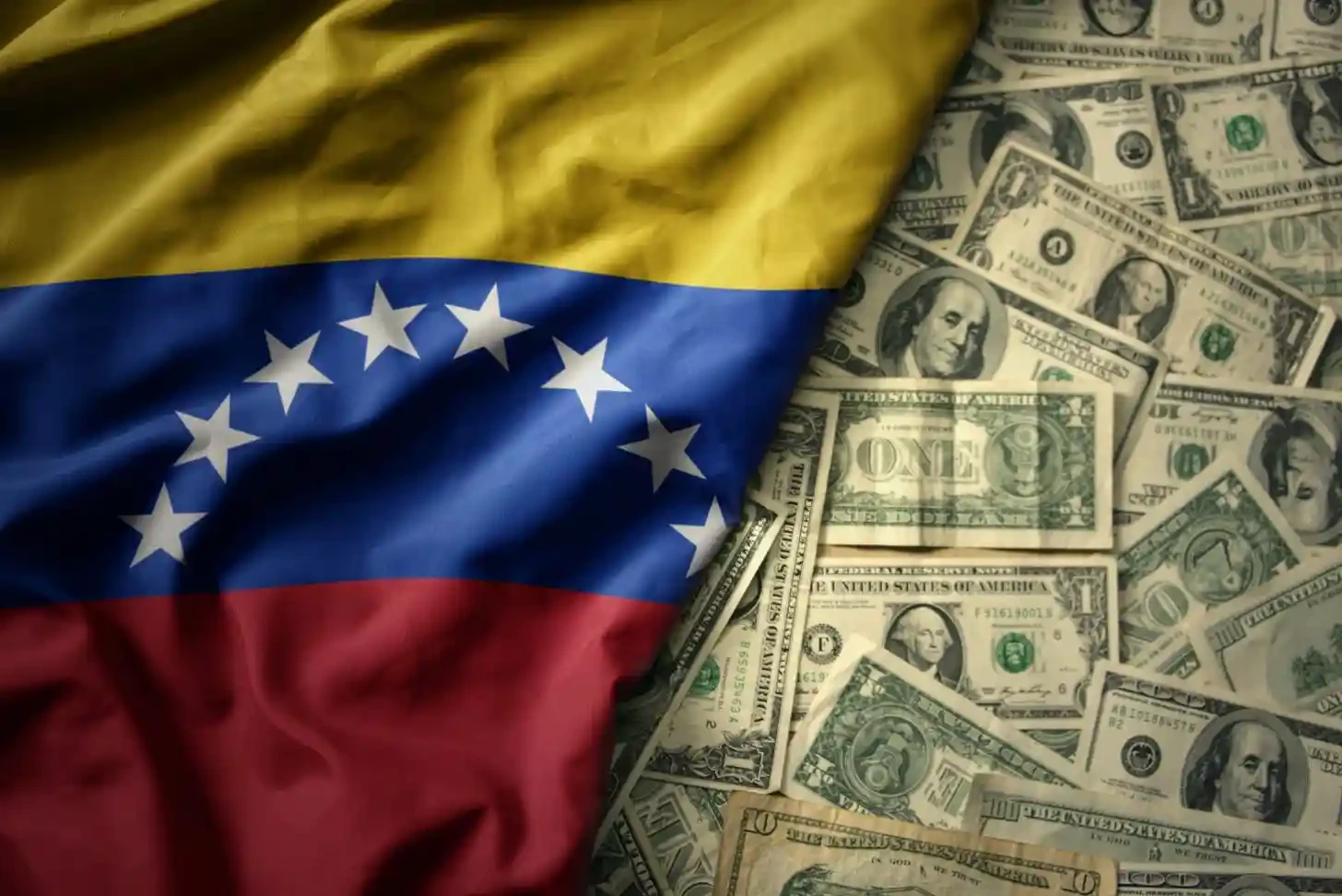
The biggest news this week is that Tether froze approximately $182 million in USDT across five wallet addresses on the Tron chain within a single day, marking one of its largest single-day actions to date.
There is external suspicion that these assets may belong to the Venezuelan government, and Tether, long seen as a "safe haven for illicit fund flows," is now seizing (or freezing) sovereign assets at the behest of the U.S. government.
What we can confirm at this point is: this operation was indeed carried out under compliance and law enforcement procedures. Although officially unconfirmed that these addresses hold "Venezuelan oil revenues," analysts and on-chain observers are widely making this connection.
Online discussions also suggest that some of the frozen funds may overlap with wallet addresses used for Venezuela-related activities. Given the country's high reliance on USDT, this speculation is not unfounded.
According to *The Wall Street Journal*, Venezuela's oil trade has become deeply entangled with Tether's stablecoin. The report cites a podcast by Venezuelan economist Asdrúbal Oliveros, which mentions that stablecoins have established a "direct channel" between Venezuela's economy and the crypto world, a connection primarily driven by the oil industry.
In the podcast, Oliveros pointed out that nearly 80% of the country's oil revenues are being received in cryptocurrency or stablecoin form. He added that it is this large-scale inflow of digital assets that has made USDT a recurring keyword in Venezuelan commercial exchanges and corporate operations.
However, Oliveros also emphasized that it is difficult for the government to convert this crypto wealth into liquidity usable by the real economy, as converting it into spendable currency requires navigating a series of compliance checks. This leaves a significant amount of funds "locked" on-chain. As a result, Venezuela's oil revenues are not flowing back into the domestic economy, affecting the official exchange rate and causing it to soar.
Oliveros also hinted that the Venezuelan government has not been professional in managing its cryptocurrency and stablecoin wealth. He mentioned that due to over-reliance on personal wallets and a lack of internal compliance processes or regular reconciliation mechanisms, the seed phrases/private keys for some wallets may have been mishandled or even lost amidst the management chaos.
An Existential Question?
If it is ultimately confirmed that the frozen funds indeed belong to Venezuela, then the question on everyone's mind is: How will this impact Tether's reputation as an "alternative monetary system" in developing countries, especially in regions with financial instability or under international sanctions?
On Tuesday, at the launch event for Bytetree's new Bitcoin+Gold combined exposure ETN product, BOLD, on the London Stock Exchange, prominent figures in London's crypto and gold investment circles speculated that this event could deliver a strong blow to stablecoins, with potential repercussions extending even further.
Bitcoin investor, advocate, and comedian Dominic Frisby (also an active supporter of digital privacy) told The Peg that he is not surprised this event, much like the discussions surrounding the "formal confiscation of Russian assets held by Euroclear," could unsettle international sovereign investors regarding euro/dollar-denominated assets, potentially triggering panic in crypto capital.
Although Tether is often externally described as "unregulated, high-risk, non-compliant," over the past year, this stablecoin giant has not concealed its increasingly close cooperation with global law enforcement agencies, even as it maintains its base in the relatively lax, crypto-friendly jurisdiction of El Salvador.
Tether CEO Paolo Ardoino told The Peg in October that Tether is the only stablecoin and crypto company that regularly cooperates with the U.S. Department of Justice (DoJ) and has already integrated the FBI and the U.S. Secret Service into its collaboration framework.
"We froze Garantex's [a Russian exchange] assets together with them," he said, confirming the action while also noting that Tether is expanding its footprint in the commodity-related supply chain finance market.
According to *The Wall Street Journal*, blockchain monitoring firm TRM Labs has a partnership with Tether, assisting in tracking illicit activities involving USDT on the Tron chain. Ari Redbord, TRM Labs' Global Head of Policy, told the media that the role of stablecoins in Venezuelan society is complex: "They [stablecoins] can be a lifeline for civilians, but can also become a tool for evasion under sanction pressure."
This statement underscores a core reality: USDT, as a financial lifeline, is deeply embedded in Venezuela's economy, helping ordinary people combat hyperinflation; but simultaneously, its technology can be used by illicit actors to move funds, raising concerns at the sanctions compliance level.
However, Tether has now demonstrated that it is willing to freeze USDT on networks like TRON when addresses are flagged for sanctions or illicit connections. In other words, even when a stablecoin serves as critical financial infrastructure locally, it does not possess immunity from "human-led law enforcement."
More importantly, this action follows a recent policy "slam on the brakes" in Brussels (EU): after years of posturing, planning, and legal preparation, the EU ultimately hesitated at the final step of "explicitly confiscating frozen Russian assets," due to concerns it would weaken the appeal of euro-denominated assets to international investors.
Therefore, the signal to markets and nations may be: parking money in stablecoins like Tether might be riskier than holding official assets.
Whether this reality poses an "existential threat" to Tether's offshore business model in the coming weeks or months remains to be seen. But within crypto circles, a strong view is spreading: international investors may never look at stablecoins the same way again.
At the very least, this incident indicates that the influence of the so-called "Donroe Doctrine" is no longer confined to geopolitics and state rivalries but is entering the core of global financial markets. And from any perspective, Tether sits right at the center of this sphere of influence.
So far, aside from minor fluctuations over the past month, Tether's peg has remained stable. The true pressure signal would be a significant slowdown in inflows—or, more dangerously, a shift from net inflows to net outflows.
Tether's next reserve attestation is expected to be released in late January or early February.
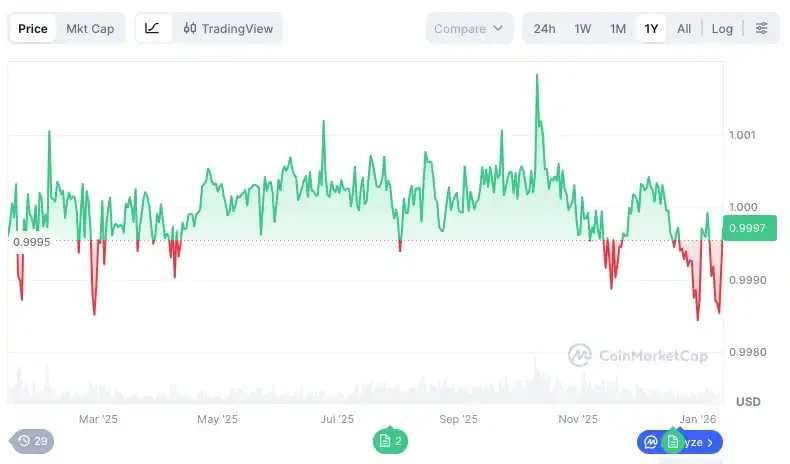
Tether (USDT) to the U.S. Dollar (USD)