






Crypto Trading Taxes Becoming Reality? In-Depth Analysis of 2026 Global Crypto Tax Regulations


- Core Viewpoint: Hong Kong plans to implement a global crypto asset tax reporting framework.
- Key Elements:
- Hong Kong launches consultation on implementing OECD's CARF and CRS amendments.
- Aims to automatically exchange crypto asset tax-related information starting from 2028.
- Compliance anchor is centralized crypto service providers.
- Market Impact: Enhances transaction transparency and promotes global tax compliance.
- Timeliness Note: Long-term impact.
Original Author: ChandlerZ, Foresight News
Recently, Hong Kong, China, announced through a government gazette that authorities are launching a consultation on implementing the Organisation for Economic Co-operation and Development's (OECD) Crypto-Asset Reporting Framework (CARF) and related amendments to the Common Reporting Standard (CRS).
It was pointed out that since 2018, Hong Kong has automatically exchanged financial account information annually with partner tax jurisdictions under the CRS developed by the OECD, enabling relevant tax authorities to use this data for tax assessments and to detect and combat tax evasion. The future goal is to automatically exchange tax-related information on crypto-asset transactions with relevant partner tax jurisdictions starting from 2028, and to implement the revised new version of CRS rules from 2029.
Furthermore, starting January 1, 2026, the United Kingdom and over 40 other countries are among the first to implement new crypto-asset tax regulatory rules, requiring local crypto service providers to begin collecting user crypto wallet and transaction data in preparation for subsequent cross-border tax information exchange.
Taking the UK as an example, crypto exchanges operating in the UK must begin collecting detailed transaction records and complete information for all UK customers. HMRC will use the collected data to cross-check users' tax returns to ensure tax compliance, with violators facing sanctions. Industry insiders point out that the relevant data may be used in the future for identity verification, anti-money laundering, and criminal investigations, having a profound impact on the anonymity and compliance environment of the crypto industry.
"Is crypto trading taxation becoming a reality?" A wide-ranging discussion has begun in the market. If Hong Kong reports, will mainland China also report? Will there be back taxes on crypto trading in the future?
What is the CARF Global Taxation Framework
The Crypto-Asset Reporting Framework (CARF) is a set of international standards for crypto-asset tax information transparency developed by the OECD under the mandate of the G20. Its core purpose is to bring crypto-asset transactions, which were previously difficult for tax authorities to penetrate and highly prone to cross-border movement, into a network of information that can be standardized, collected, and automatically exchanged between tax authorities. The OECD adopted and published the CARF rules and commentary in 2022, clarifying that its design goal is to collect taxpayer-relevant information in a unified manner and automatically exchange it annually with the taxpayer's jurisdiction of tax residence, thereby reducing the risk of cross-border crypto-asset tax evasion and underreporting.
In the context of CARF, crypto-assets are not equivalent to Bitcoin or Ethereum in the narrow sense. Any digital value carrier that can be held and transferred in a decentralized manner without the involvement of traditional financial intermediaries falls within its scope; its coverage is deliberately designed to be closer to the real market form, including stablecoins, derivatives issued in the form of crypto-assets, and even bringing some NFTs into the observation scope that may trigger similar tax risks.
Corresponding to the covered entities, CARF's reporting obligations center on market intermediaries providing key services for transactions and exchanges. The OECD's approach is to anchor compliance on the party best positioned to grasp transaction value and counterparty information. Any entity or individual that commercially facilitates or executes exchange transactions involving the relevant crypto-assets (including exchanges between crypto-assets and fiat currency, as well as swaps between crypto-assets) may in principle be identified as a Reporting Crypto-Asset Service Provider (RCASP) and bear the obligations of data collection, due diligence, and reporting.
What is the relationship between CARF and the previously discussed CRS?
Understanding CARF requires placing it within the larger global tax information exchange system for comparison. The previous wave of discussions about back taxes on Hong Kong and US stocks occurred under the mechanism of the Common Reporting Standard (CRS).
Over the past decade, cross-border tax transparency has primarily relied on the CRS standard. Countries require banks, securities firms, funds, and other financial institutions to identify account holders who are non-resident taxpayers, and annually report key information such as account balances, interest, dividends, and disposal proceeds to their domestic tax authorities, which then automatically exchange this information with the other country's authorities.
China began fully implementing CRS in September 2018, exchanging resident financial account information with over 100 countries and regions. After data reporting, tax authorities issue notices based on CRS and other data, requiring users to explain their situation and pay back taxes.
CRS operates relatively maturely within the traditional financial system. However, a significant portion of crypto-asset transactions, exchanges, and transfers occur outside the banking account system, especially forming an independent value circulation network between centralized trading platforms, custodial wallets, and on-chain transfers, making it difficult for CRS alone to achieve the same level of penetration. CARF complements the on-chain and crypto-asset market structures that CRS originally struggled to cover.
While introducing CARF, the OECD also conducted the first systematic revision of CRS. On one hand, it brought new financial products like certain electronic money products and Central Bank Digital Currencies (CBDCs) into CRS's scope. On the other hand, it adjusted the reporting approach for indirect investment in crypto-assets through derivatives or investment vehicles to prevent market participants from circumventing information reporting and exchange through product structuring. Overall, CARF is responsible for the transaction and service provider dimension of the native crypto-asset market, while the revised CRS continues to cover related risk exposures that may be carried within the financial account system. Together, they form a more complete automatic exchange puzzle.
The OECD indicated that after the technical transmission formats and supporting guidance for CARF and the revised CRS are finalized, the first batch of cross-border automatic exchanges is expected to commence in 2027. Before that, multiple jurisdictions will first implement domestic data collection and reporting requirements to prepare the data foundation for subsequent cross-border exchanges.
At the EU level, DAC8 was adopted by member states in October 2023 and published in the Official Journal in the same month. Its institutional design is based on the OECD's CARF international standard, aiming to bring crypto-asset user information into automatic exchange between member states' tax authorities.
Will Mainland China Join?
As of early December 2025, 76 countries/regions globally have committed to adopting CARF. The UK and the EU will be the first to implement this framework (collecting data from 2026, first exchange in 2027); Singapore, the UAE, and Hong Kong, China, follow closely, planning to collect data in 2027 and fully implement in 2028; Switzerland has postponed its implementation to 2027 and is still prudently assessing exchange partners; the US IRS's CARF accession proposal remains under internal review.
This means China is not on the first batch of exchange list, and CARF data will not be automatically exchanged with Chinese tax authorities through the CARF mechanism.
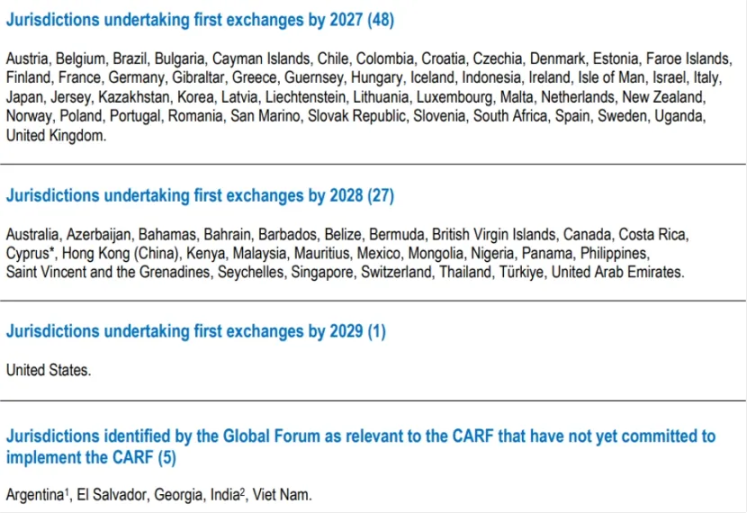
China has accumulated mature institutional and administrative experience under the CRS automatic exchange system, indicating it possesses the infrastructure in terms of legal design, due diligence standards, data exchange governance, and information security to adopt international standards.
The issue lies in the fact that CARF's compliance anchor primarily falls on regulated crypto-asset service providers. Mainland China has long adopted a strong regulatory, even prohibitive, governance approach towards virtual currency-related businesses. There is no locally licensed trading platform system that can be routinely incorporated into CARF.
Hong Kong's advancement of CARF may increase the intensity of tax residency identification and information reporting for customers by crypto service providers in Hong Kong, but this does not automatically mean the information will naturally flow back to mainland tax authorities. Whether cross-border exchange occurs still depends on whether mainland China chooses to participate and establish an exchange relationship with relevant jurisdictions, as well as arrangements between the two sides regarding data usage restrictions, privacy protection, and technical integration.
However, it is equally important to emphasize that not having joined yet does not mean it can be ignored. Even without the automatic exchange path of CARF, cross-border tax information may still flow under existing tax treaties and international administrative cooperation frameworks through case-by-case requests, joint enforcement, or other forms of cooperation. As major global jurisdictions begin systematically collecting crypto-asset transaction and transfer data, the clues available to tax authorities will become more complete, and their ability to identify cross-border risks will also improve simultaneously.
For individuals and institutions, the most realistic change is that as long as the primary operational path relies on centralized exchanges, custodial services, or fiat on/off-ramps, the traceability and auditability of transaction data will become increasingly stronger. The exposure to compliance risks will shift from a probability event to a norm.


