Is DeXe the Ultimate Solution for Decentralized Asset Management?



- Core Viewpoint: The DeXe protocol provides a decentralized, non-custodial asset management solution.
- Key Elements:
- Wallet-to-wallet copying; traders cannot access followers' funds.
- Introduces elite governance, rewarding contribution rather than just capital.
- The DEXE token is used for governance, staking, and building an insurance fund.
- Market Impact: Lowers the barrier to entry for DeFi participation and may attract institutional capital.
- Timeliness Note: Long-term impact.
In the rapidly evolving decentralized finance (DeFi) space, the quest for efficient, transparent, and autonomous asset management is still considered the industry's "holy grail." While many protocols offer pieces of the puzzle—such as swapping, lending, or yield farming—few address the core challenge: how to manage capital collectively and securely without centralized intermediaries. This brings us to the DeXe Protocol (DEXE).
As DeFi matures, investors and traders increasingly ask: Is there a way to replicate the strategies of top traders without relinquishing custody of funds? Can decentralized autonomous organizations (DAOs) be managed more effectively? DeXe aims to answer these questions by providing sophisticated infrastructure for social trading and DAO management. But is it truly the ultimate solution the market has been waiting for?
In this comprehensive deep dive, we will explore the inner workings of the DeXe Protocol, its unique value proposition, tokenomics, and how it stacks up against traditional and decentralized alternatives. Whether you're a seasoned DeFi degen or a curious investor, understanding DeXe is crucial for navigating the future of on-chain asset management.

1. What is the DeXe Protocol? How does it redefine social trading?
At its core, DeXe (Decentralized Social Trading Ecosystem) is a protocol designed to facilitate decentralized asset management. It allows users to copy the strategies of successful traders in a fully transparent and non-custodial manner. Unlike traditional social trading platforms in Web2 (like eToro), DeXe operates entirely on-chain, delivering true "what you see is what you get."
The Problem with Traditional Asset Management
In the traditional finance (TradFi) world, asset management is rife with opacity. You hand your funds to a fund manager, pay high management fees regardless of performance, and receive quarterly reports that may not reflect the real-time status of your investment. Even in the early days of crypto, centralized exchanges offered copy trading features, but these still required users to trust a centralized entity with custody of their private keys or funds.
The DeXe Solution: Wallet-to-Wallet Copying
DeXe eliminates the need for trust. It utilizes a unique architecture that allows users to copy a trader's wallet directly. Here's how it works:
- Trader: Professional traders manage their portfolios through the DeXe platform.
- Follower: Users connect their wallets and select a trader to follow.
- Smart Contract: Instead of sending funds to the trader, followers deposit funds into a smart contract. This contract automatically mirrors the trader's actions proportionally.
This mechanism ensures traders never have direct access to followers' funds. The "manager" can only execute trades; they cannot withdraw capital. This non-custodial approach is a significant leap forward in security and trustlessness.
2. The Architecture of the DAO Management Ecosystem
DeXe is not just about copy trading; it's also a comprehensive infrastructure for building and managing DAOs. The DeXe DAO Studio allows communities to create flexible, autonomous organizations with advanced governance features.
Meritocratic Governance
One of the biggest criticisms of standard DAOs is their tendency to devolve into plutocracy, where those with the most capital (tokens) hold all the power. DeXe introduces a meritocratic governance model. It rewards active participation and expertise, not just capital accumulation. This means community members who consistently contribute valuable proposals or effectively manage risk can gain higher voting weight, aligning incentives with the protocol's long-term health.
The DeXe Network
The ecosystem is powered by the DeXe Network, the underlying layer connecting various DeFi products. It facilitates seamless interaction between different liquidity pools, exchanges, and asset management tools. This interoperability ensures DeXe is not a walled garden but a hub connected to the broader DeFi liquidity landscape.
3. The DEXE Token: Utility and Tokenomics
To understand the protocol's long-term viability, we must analyze the DEXE token. It is the native utility and governance token of the ecosystem.
Governance Rights
DEXE holders are not just passive investors; they are active participants in the protocol's future. They can vote on key parameters, such as:
- Protocol fee structure.
- Launch of new pools.
- Treasury fund allocation.
- Upgrades to smart contract architecture.
Staking and Rewards
To incentivize long-term holding, DeXe offers a staking mechanism. Users who stake DEXE can share a portion of the protocol's revenue. This revenue comes from fees charged on successful trades within the ecosystem. It creates a sustainable feedback loop: as more users copy successful traders, protocol revenue increases, making staking more attractive, which in turn secures the network.
Insurance and Security
A portion of the token supply and protocol fees is contributed to an insurance fund. This fund is designed to protect users from unforeseen smart contract vulnerabilities or black swan events, adding an extra layer of security often missing in smaller DeFi projects.
4. DeXe vs. Competitors: A Comparative Analysis
How does DeXe compare to other players in the field? Let's examine the comparison between DeXe, centralized copy trading, and other decentralized competitors.
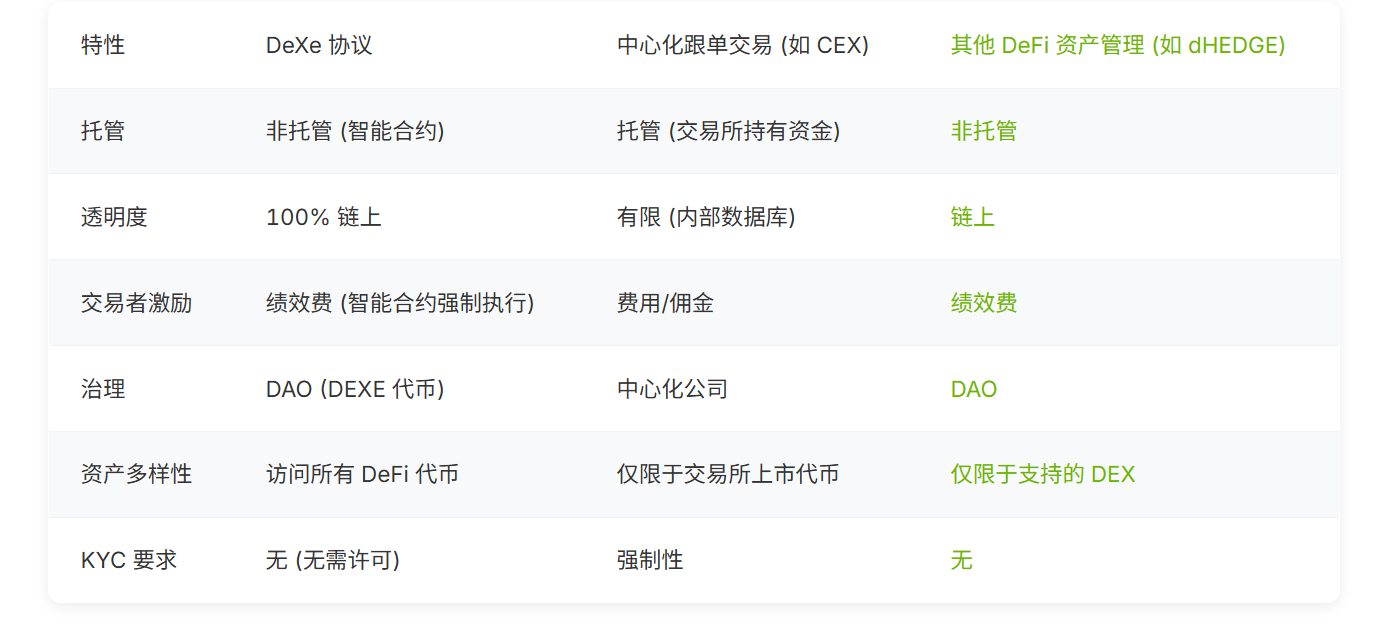
This table highlights DeXe's key advantage: permissionless access to the entire DeFi market. While centralized exchanges are limited to their listed tokens, DeXe users can theoretically access any asset available on decentralized exchanges like Uniswap or PancakeSwap, as long as liquidity exists.
5. Seamless Trading via XT.com
While DeXe operates in the decentralized realm, acquiring DEXE tokens often requires a reliable bridge between fiat and cryptocurrency. This is where robust exchanges like XT.com become essential.
For investors looking to enter the DeXe ecosystem, XT.com provides a secure and user-friendly platform. You can easily check the DeXe price to track market performance in real-time. Once you're ready to invest, the platform offers deep liquidity, allowing you to trade DEXE/USDT with minimal slippage.
XT.com offers more than simple spot trading. If you want to automate your accumulation or profit-taking, you can utilize the DEXE/USDT Spot Grid Trading feature, which automatically buys low and sells high within a set range. For more seasoned traders, the Strategy Trading options allow for executing complex order types, helping you manage risk effectively while gaining exposure to the future of decentralized asset management.
6. Future Roadmap: Expansion and Adoption
DeXe's roadmap is ambitious. The team is actively working on expanding the capabilities of its DAO Studio and integrating with more blockchains (Layer 2 solutions) to reduce gas fees.
Layer 2 Integration
High gas fees on Ethereum have historically been a barrier to entry for small investors into DeFi. By deploying on Layer 2 networks like Arbitrum or Optimism, DeXe aims to democratize professional asset management. This would allow a user with $100 to copy the trades of a whale without transaction fees eating into their principal.
Institutional Adoption
The ultimate goal is to bridge the gap between DeFi and institutional capital. DeXe creates an environment of "trustless trust." Institutions have been hesitant to enter DeFi due to compliance and security concerns. However, a transparent, audited, and non-custodial protocol like DeXe could provide the necessary infrastructure for hedge funds to safely deploy capital on-chain.
7. Conclusion: Is DeXe Worth Your Attention?
So, is DeXe the ultimate solution? It undoubtedly presents one of the strongest cases for decentralized asset management. By eliminating middlemen, ensuring transparency through smart contracts, and aligning incentives via the DEXE token, it addresses many of the structural issues present in traditional finance.
For traders, it offers a way to monetize reputation and skill without licenses or fund structures. For investors, it offers a passive way to participate in the complex world of DeFi with the safety net of non-custodial control.
Of course, risks remain. Smart contract risk is inherent to all DeFi protocols, and the success of copy trading is heavily dependent on the skill of the chosen trader. However, as the infrastructure matures and governance strengthens, DeXe is positioning itself as a cornerstone of the decentralized economy.
Frequently Asked Questions (FAQs)
Q: Is my money safe when copying a trader on DeXe? A: DeXe is non-custodial, meaning the trader you follow never touches your funds. Your funds are locked in a smart contract that mirrors their trades. However, as with all DeFi protocols, there are risks associated with smart contract vulnerabilities or market volatility.
Q: Do I need to be a professional trader to use DeXe? A: No. DeXe is designed for both professionals and beginners. Beginners can use the platform to "copy" the strategies of professionals, while professionals can use it to manage funds and earn performance fees.
Q: What is the DEXE token used for? A: The DEXE token is used for governance (voting on proposals), staking to earn rewards, and as insurance within the ecosystem. It is key to participating in the DAO.
Q: Can a trader run away with my funds? A: No. DeXe's architecture prevents fund managers from withdrawing investor capital. They can only execute trades (swaps) within the parameters allowed by the smart contract.
Q: How does DeXe handle gas fees? A: Currently, users must pay gas fees for transactions on the Ethereum network. However, DeXe is exploring and implementing Layer 2 solutions to significantly reduce these costs for users.
About XT.COM
Founded in 2018, XT.COM is a leading global digital asset trading platform, now boasting over 12 million registered users, with operations spanning over 200 countries and regions, and an ecosystem traffic exceeding 40 million. XT.COM's cryptocurrency trading platform supports 1300+ high-quality tokens and 1300+ trading pairs, offering diverse trading services such as spot trading, margin trading, futures trading, and features a secure and reliable RWA (Real World Assets) trading market. Upholding the philosophy of "Explore Crypto, Trust Trade," we are committed to providing global users with a safe, efficient, and professional one-stop digital asset trading experience.