Actual savings of 18%: Ctrip's overseas version launches stablecoin payment.



- 核心观点:Trip.com支持稳定币支付,拓展全球市场。
- 关键要素:
- 支持USDT/USDC支付,覆盖多条主流公链。
- 支付可享价格优惠,部分场景节省超15%。
- 为无国际信用卡用户提供新支付路径。
- 市场影响:推动稳定币在消费场景的普及应用。
- 时效性标注:中期影响。
Original author: Joe Zhou, Foresight News
Trip.com , the overseas version of Ctrip, is quietly entering the stablecoin payment market.
On December 25, 2025, Foresight News learned that Trip.com, the overseas version of Ctrip, has enabled stablecoin payments for global users, currently supporting USDT and USDC, two USD stablecoins. Two sources close to Trip confirmed this information to Foresight News.
After downloading and logging into Trip.com in Vietnam, I successfully booked a hotel in Nha Trang, Vietnam, in less than 10 minutes using USDT payment.
More notably, after comparing prices at multiple local hotels, it was found that some hotel prices were even lower when paying with USDT on the Trip.com App compared to using the Ctrip website or traditional payment methods.
Ctrip's overseas version now supports USDT/USDC.
On December 24, 2025, I booked a hotel in Nha Trang, Vietnam using USDT on Trip.com, the overseas version of the Ctrip app. On December 25, I purchased a flight ticket from Nha Trang to Ho Chi Minh City using USDT, and both payments were successful. I have now successfully checked into the hotel.
I found that buying airline tickets on Trip.com using USDT saved me approximately 18% compared to buying them on Ctrip. Hotel bookings made with USDT also saved me 2.35%.
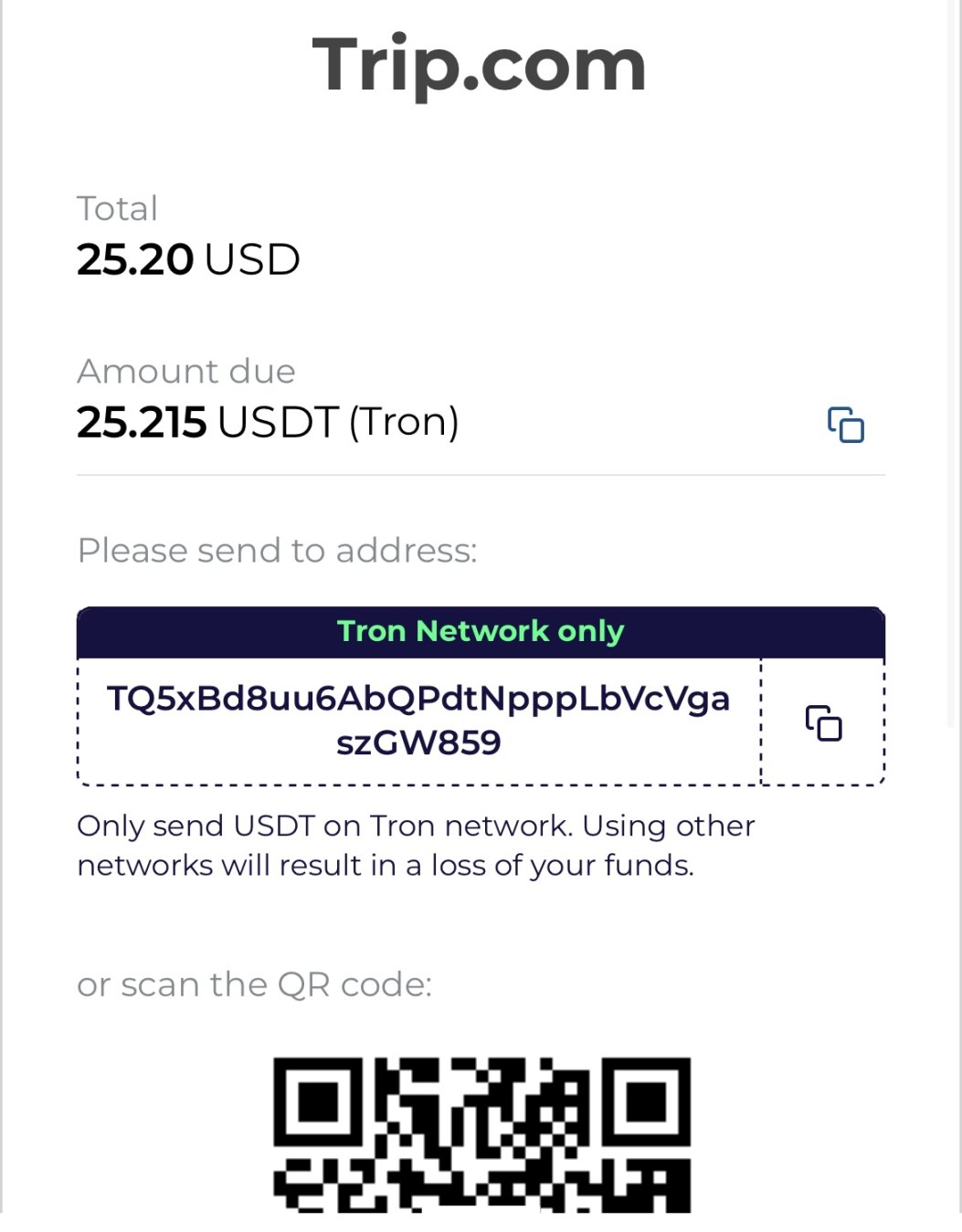
Trip now accepts USDT and USDC payments.
Currently, Trip.com's crypto payments support multiple public blockchains, including Ethereum, Tron, Polygon, Solana, Arbitrum One, and TON.
During the actual payment process, I noticed another payment company, Triple-A. This company provides crypto payment services to Trip.com. Public information shows that Triple-A is a licensed crypto payment institution headquartered in Singapore, primarily providing payment gateways and settlement services for cryptocurrencies and stablecoins.
In addition, I learned that Triple-A has also partnered with Singaporean internet giant Grab as a technology partner for encrypted payment channels, enabling GrabPay users to directly top up their wallet balances using encrypted assets within the Grab app.
In addition, I noticed a detail:
When booking hotels on Trip.com using USDT, no detailed personal information is required; a name and email address are sufficient to complete the order. This means that in hotel transactions, the platform has virtually no access to the user's complete privacy information. Of course, when purchasing airline tickets, information such as nationality, passport number, and phone number is still required—this is a compliance requirement of the airline industry itself.
Privacy and data security have become major social issues.
Just this month, Trip.com Group encountered a significant "public trust incident." In December, Trip.com Group signed a marketing cooperation agreement with the Cambodian National Tourism Authority in Shanghai. After the announcement, it sparked concerns among some users about local security, the risk of telecom fraud, and the security of their personal information. Numerous screenshots of people uninstalling the Trip.com app appeared on social media.
In many overseas regions, users are far more sensitive to privacy and information security than in the domestic market . This may be one of the important real-world reasons behind Trip.com's push for stablecoin payments.
For travelers worldwide who lack international credit cards, stablecoin payments offer a new avenue. According to publicly available information, approximately 125 million to 130 million people globally possess credit cards, with an even smaller number holding international credit cards. This means that over 80% of the global population cannot seamlessly utilize international credit card systems.
Credit cards are not merely "payment tools," but rather an entry point into the credit system, yet most people globally are not part of this system. In numerous countries and regions, such as Southeast Asia, Latin America, Africa, and India, many people are excluded from the credit system, making it impossible for them to own credit cards.
Stablecoin payments are providing these people with a global payment route that bypasses the credit system.
Of course, the real problems with stablecoins still exist: transaction fees remain relatively high and the market is unstable.
In actual payment transactions, I observed significant differences in transaction fees between different wallets. Paying via Binance to Trip.com's USDT QR code incurred a 1 USDT fee, with a minimum transfer amount of 10 USDT. However, when using Bitget Wallet, the first transaction showed a 0% fee, while the second showed a 2.39 USDT fee, with no minimum transfer amount set. These differences may be related to the different public blockchains (Tron) and their fee mechanisms used.
Why are tech giants rushing into stablecoins?
Trip.com is not the first company to enter the stablecoin market.
Previously, several global internet and payment giants had clearly stated their intention to develop stablecoins, including Ant Group, JD.com, PayPal, Stripe, Meta (Facebook), Grab, and TADA.
Several major banks, including Bank of America and Morgan Stanley, have publicly stated their intention to enter the stablecoin field.
Some manufacturing companies are also adopting stablecoin payments. Public reports indicate that some BYD dealerships in Bolivia already support USDT payments; Toyota, Yamaha, and other manufacturing companies are also accepting stablecoin settlements in overseas markets. Tether CEO Paolo Ardoino has publicly confirmed this.

Advertising featuring BYD dealers in partnership with USDT
Internet giants, manufacturing giants, and banking giants are all investing in stablecoins... and they use stablecoins in various scenarios.
A clear trend is that payment giants like PayPal and Ant Group are no longer content with merely serving as payment gateways for stablecoins, but aspire to become stablecoin issuers themselves . PayPal has already launched PYUSD; Ant Group is also pursuing a Hong Kong dollar stablecoin license, and the boundaries between payment institutions and currency issuers are being reshaped.
For manufacturing companies like BYD and Toyota, there is no ideological judgment regarding stablecoins or crypto payments; there is only one practical question: which method would users be more willing to spend money on?
With fiat currencies continuing to depreciate, stablecoins have become a "realistic solution."
In Bolivia, the official legal tender, the Boliviano (BOB), depreciated by 65%–137% against the US dollar between the end of 2024 and mid-2025. It can be said that the Bolivian legal tender was depreciating every single day.
In this environment, no company going global can afford to suffer exchange rate losses from local currency settlements in the long run, and USDT has gradually become the de facto payment tool in the local market.
Bolivia is not an isolated case, but a phenomenon that is unfolding simultaneously in many countries around the world.
This year, I visited Iran, Turkey, Egypt, and other countries and found that the currencies of these economies have generally depreciated by more than 80% against the US dollar over the past three years; and over a longer five-year period, the currencies of Iran, Turkey, and Egypt have all depreciated by more than 200% against the US dollar.
Currency devaluation is evolving from a "localized risk" in a few countries into a broader and more structural global phenomenon.
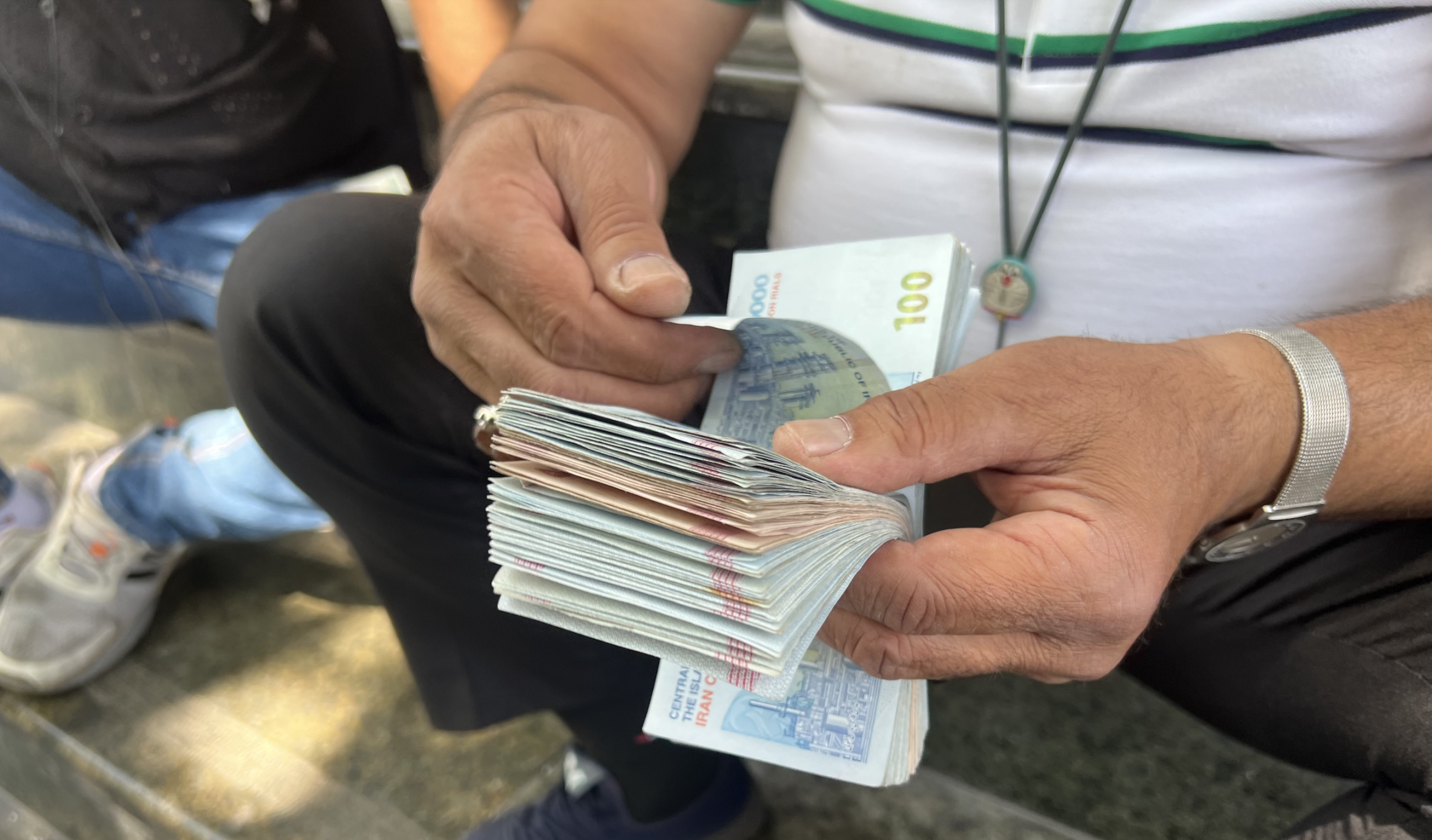
In the black market of Tehran, the capital of Iran, I am witnessing a currency transaction.
Even more devastatingly, in these countries, the rate of currency depreciation has far outpaced the growth rate of ordinary people's incomes. In real-world transactions, this monetary disorder is directly altering how people make payments.
This is precisely why consumer internet platforms such as Ctrip's overseas version and Grab; payment giants such as PayPal and Ant Group; and physical manufacturing companies such as BYD and Toyota have begun to try introducing stablecoins such as USDT in different markets.
The world is experiencing partial collapse, with some regions leading the way in imbalance.
When the existing financial system can no longer fulfill its functions of stability, settlement, and trust, a new economic system is pushed to the forefront by reality.
The new economic system is not designed, but rather "forced" out by reality where the old system fails. The proliferation of stablecoins is not because they are ideal, but because in some places they are already the least bad option.