






Ripple chiseled open a crack in the wall, but Swift simply tore down the entire wall.


- 核心观点:Swift采用以太坊L2构建区块链账本,推动金融体系转型。
- 关键要素:
- Swift选用Linea的zk-EVM技术,实现快速安全结算。
- 超30家顶级银行参与基于Linea的支付轨道试点。
- 新账本支持多资产,旨在释放沉淀资本,提升效率。
- 市场影响:加速传统金融与DeFi融合,重塑全球支付格局。
- 时效性标注:长期影响
Original author: Sanqing, Foresight News
During Sibos 2025 in Frankfurt, Thierry Chilosi, Chief Business Officer of Swift, and Michael Spiegel, Global Head of Transaction Banking at Standard Chartered Bank, discussed the major transformation in global finance. As tokenization moves from pilot to reality, Swift officially announced the addition of a blockchain-based shared ledger to its infrastructure, aiming to achieve trusted and interoperable digital finance on a global scale. This ledger will serve as a secure, real-time record of transactions between financial institutions, verifying transaction sequences and enforcing agreed-upon rules through smart contracts, complementing existing systems and seamlessly connecting traditional finance with tokenized assets.
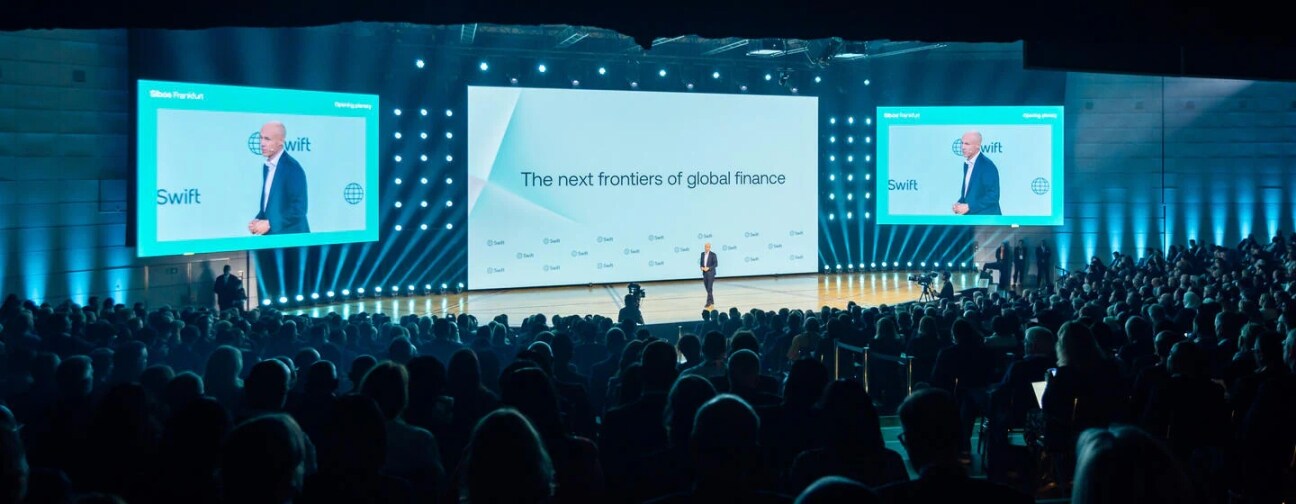
Image source: Swift official website
While Swift didn't directly disclose its technology platform when initially announcing this major news to the banking industry, Consensys CEO Joe Lubin revealed at the Token2049 conference in Singapore that Swift is leveraging the Ethereum Layer 2 network Linea to build its new payment settlement platform. By adopting Linea's zk-EVM aggregation technology, Swift is able to significantly reduce costs and latency while meeting the financial industry's stringent requirements for 24/7 real-time settlement and security. Currently, more than 30 top global financial institutions, including JPMorgan Chase, Bank of America, and Citibank, are preparing to participate in this pilot program for a new blockchain payment track based on Linea.
Ripple's Deep Cultivation and Current Status
Before discussing Swift, we must look back at the pioneer who challenged the old system for more than a decade: Ripple.
In 2012, Ripple launched the XRP Ledger (XRPL), with the core goal of replacing the inefficient SWIFT correspondent banking model. During this period, Ripple successfully built the global payments network RippleNet, connecting more than 300 financial institutions, and demonstrated XRP's ability as a bridge currency to reduce cross-border clearing time from several days to 3 to 5 seconds in fragmented markets such as Southeast Asia through On-Demand Liquidity (ODL) services.
In 2020, affected by the SEC lawsuit, Ripple faced a blockade and stagnation in the US market due to securities allegations, but its global scale continued to expand. By 2022, its business had reached more than 40 payment markets, and its total payment volume had doubled to approximately $30 billion.
In 2023, Ripple saw a turning point when the court ruled that XRP itself was not a security, bringing a milestone victory for Ripple and the industry.
In August 2025, with the SEC completely abandoning its appeal, this five-year legal tug-of-war came to an end. The complete clarification of its legal status led to the approval of the XRP spot ETF, marking its formal entry into the asset allocation list of mainstream institutions.
Today, Ripple has launched cross-border payment services in multiple real-world scenarios, ranging from retail remittances to enterprise-level payments.
In the retail sector, Japan's SBI Remit uses XRP to bridge real-time remittance channels to the Philippines, Vietnam, and Indonesia, significantly reducing the upfront costs for overseas workers; Santander Bank offers transparent real-time transfers to its customers through its OnePay FX app. Meanwhile, Southeast Asian payment platform Tranglo, supported by Ripple ODL, has significantly improved the efficiency of peso-thai baht exchange.
At the enterprise level, American Express and PNC Bank have respectively used RippleNet to optimize their B2B trade settlement and international collection experiences.
Furthermore, in national infrastructure projects, Ripple has partnered with more than 20 countries, including Palau, Montenegro, and Bhutan, to develop CBDC platforms, applying blockchain technology to the issuance and clearing systems of sovereign currencies.
Why did Swift choose Linea?
When these tech giants are building their Ethereum ecosystems, they have shown a high degree of consistency in their focus on Layer 2 technologies: Coinbase’s Base Chain is built on the OP Stack, while Robinhood also announced the launch of Robinhood Chain this year, based on Arbitrum technology, to support the tokenization of RWA and 24/7 transactions.
This preference stems from the fact that L2 can leverage Ethereum's security while meeting high-performance requirements through a modular architecture. Swift's choice of Linea over OP or Arbitrum is primarily due to differences in its underlying verification logic.
OP and Arbitrum use Optimistic Rollup, which assumes that a transaction is valid by default and only verifies it when someone questions it. Asset withdrawal usually requires a challenge period of several days, which is undoubtedly a huge time cost for financial clearing that seeks liquidity.
Linea uses zk-EVM, which provides instant validity proofs through mathematical methods. For SWIFT and its partner banks, which need to handle massive amounts of value settlements, zk-EVM not only provides final confirmation faster but also ensures compliance verification while protecting transaction privacy.
Swift's choice of Linea embodies the first principle of capital operation: maximizing the velocity of flow.
Capital will flow like a fluid from the traditional telegraph system, which is characterized by low flow rate (requiring large reserves to be deposited in Nostro/Vostro accounts), high friction (layers of commissions from agent banks), and slow settlement (settlement taking several days), to the blockchain digital system, which is characterized by high flow rate, low friction, and fast settlement.
Swift processes approximately $150 trillion in global payments annually. If it can achieve atomic reconciliation and 24/7 real-time settlement through Linea's technology stack, it means that trillions of dollars in reserves that were previously held back in the global financial system to hedge against clearing delays will be released and reinjected into the real economy.
As Consensys CEO Joe Lubin stated at the Token 2049 conference in Singapore, this is not merely a technological shift, but a true convergence of the TradFi and DeFi schools of thought, marking the official transition of global value transfer protocols from the "telegraph command era" to the "mathematical verification era."
The significance of Swift embracing blockchain
As a global financial backbone network that processes approximately $150 trillion in transactions annually, Swift's decision to build its ledger on Linea, an Ethereum Layer 2 blockchain, signifies that blockchain technology will become the heart of mainstream finance.
Swift will eliminate fragmentation between different tokenized networks through unified technical standards, break down the long-standing barriers between TradeFi and DeFi, and implant the efficiency genes of decentralized finance into the traditional clearing system.
With a real-time shared ledger operating 24/7, global financial institutions will no longer be limited by the cumbersome manual reconciliation and time zone delays of the correspondent banking model. The huge amount of capital that was originally tied up in correspondent banking accounts to hedge clearing risks will be effectively released, enabling the speed of capital flow to truly match the needs of the modern economy, thereby ushering in a new era of more transparent, lower-cost and more interoperable global value transfer.
Ripple has spent a decade trying to build a new city based on XRP Ledger outside the old system, but its current network of connected financial institutions appears weak compared to Swift's existing network of over 11,000 institutions in more than 200 countries around the world.
The core threat from Swift lies in its "asset neutrality." Unlike Ripple's ODL model, which heavily relies on XRP as a bridge currency, Swift's blockchain ledger is designed to support a variety of assets, including fiat currencies, stablecoins, and CBDCs.
Banks within the SWIFT system can achieve instant settlement by upgrading their existing tracks without bearing the volatility risk of a single asset. This combination of "existing advantages + technological compliance" is making Ripple face the most chilling challenge since its inception.


