DAT: The Evolution of Strategic Assets for Crypto Enterprises


- 核心观点:DAT正从资产持有转向战略能力竞争。
- 关键要素:
- 企业更重视资产配置与风险控制。
- 市场转向评估企业运营与风险管理能力。
- 资产持有正转化为生态参与与治理权。
- 市场影响:推动行业从资产驱动转向能力驱动。
- 时效性标注:长期影响
The Development Logic of DAT
By the end of 2025, Digital Asset Treasury (DAT) will remain one of the most noteworthy corporate activities in the crypto industry. More and more companies are choosing to include digital assets on their balance sheets, a move that transcends passive market participation and represents an attempt to transform digital assets into strategic resources for long-term utilization. As the market environment and regulatory expectations gradually change, the DAT industry is undergoing structural optimization and capability screening, with its core value shifting from simple asset holding to a test of a company's strategic execution capabilities.
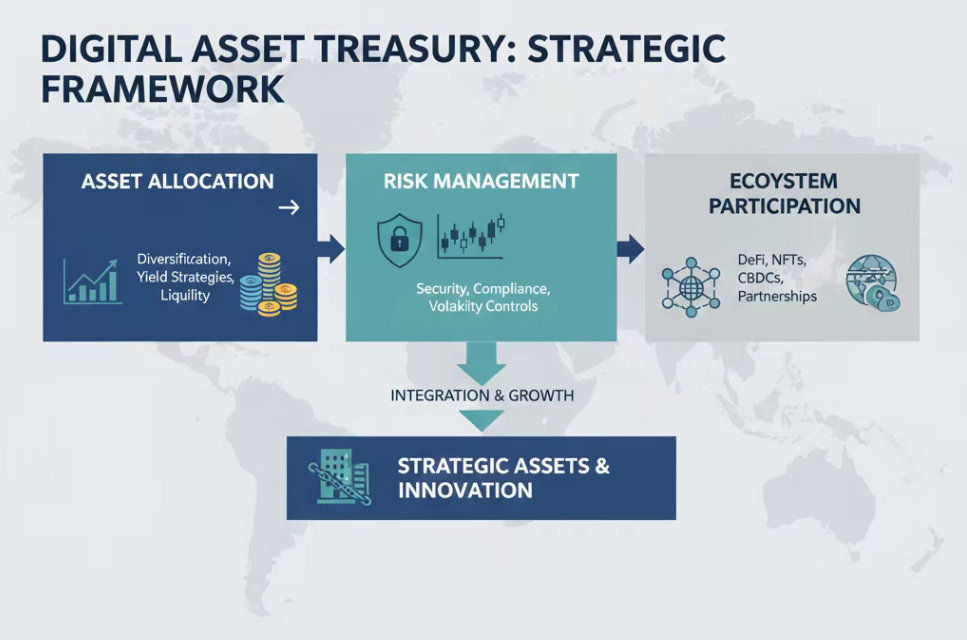
Typical DAT (Digital Assets and Technologies) companies usually raise funds through equity financing, bond issuance, or private placements, and allocate them to mainstream digital assets such as Bitcoin and Ethereum. Compared to the earlier strategy of primarily "hoarding" cryptocurrencies, companies today place greater emphasis on the rationality of asset allocation, risk control systems, and strategic synergy with the blockchain ecosystem. On the one hand, digital assets provide companies with asset diversification and long-term value potential; on the other hand, companies must simultaneously establish cash flow management and risk constraint mechanisms to ensure operational sustainability. Furthermore, holding digital assets means that companies can participate in on-chain governance, staking, and lending, thereby gaining deeper participation and influence at the ecosystem level. This change indicates that DAT is gradually becoming part of a company's strategic management system, rather than just an asset on paper.
Market Structure and Corporate Performance
Recent industry performance indicates that DAT (Digital Assets, Telecommunications, and Assets) companies are entering a phase of significant structural adjustment. Some companies are stabilizing market expectations and improving shareholder structures through share buybacks and asset portfolio optimization; others are gradually returning to a more robust operational path through strategic contraction or asset restructuring. Simultaneously, index providers like MSCI are re-evaluating their inclusion criteria for DAT-related companies, significantly increasing their focus on corporate information disclosure, governance structure, and operational stability. This signifies that the market is shifting away from reliance on asset size and short-term price performance, and instead assessing a company's operational capabilities and risk management in complex environments.
It's worth noting that some companies with Ethereum-related assets as their core holdings have demonstrated relative resilience during recent market adjustments. This doesn't necessarily reflect the advantage of a single asset, but rather highlights the crucial role of asset diversification, business synergy, and governance capabilities in a company's long-term performance. Overall, changes in market structure are driving the DAT industry's transition from an "asset-driven" to a "capability-driven" model.
Corporate Behavior and Strategic Choices
By examining specific corporate behaviors, the strategic logic behind DAT can be understood more clearly.
At the asset level, companies no longer view digital assets as isolated investment targets, but rather incorporate them into their long-term capital allocation framework to support future business expansion and ecosystem development.
In terms of risk and stability, companies balance market expectations with internal stability through asset diversification, share buybacks, and operational restructuring. The significance of these operations lies not in short-term market feedback, but in providing the company with greater strategic maneuvering space.
At the ecosystem level, holding digital assets enables enterprises to participate in on-chain governance and ecosystem building, transforming financial behavior into real influence and voice. This shift from "asset management" to "ecosystem participation" is becoming an important path for DAT (Digital Asset Management) companies to build long-term competitiveness.
In summary, DAT has evolved from a simple token holding behavior into a comprehensive practice that integrates asset strategy, risk control, and ecosystem participation.
Industry Trends and Company Differentiation
Looking at a longer timeframe, the evaluation criteria for the DAT (Digital Assets, Telecommunications, and Assets) industry are undergoing a substantial change. Market focus is gradually shifting from asset size and short-term price fluctuations to a company's operational capabilities, cash flow stability, and governance transparency. This change directly drives differentiation among companies: those with clear asset strategies, diversified asset allocations, and robust governance structures are more likely to establish an advantage in long-term competition; while companies that heavily rely on a single asset or market sentiment have significantly limited strategic flexibility and sustainability.
More importantly, some companies have begun to transform digital assets into sustainable strategic resources through a combination of business synergy, ecosystem participation, and asset management. This path does not rely on a single market stage but is built on long-term capability building, and it constitutes the core direction for the future development of the DAT industry.
in conclusion
The true value of DAT (Digital Asset Management) companies lies not in the amount of digital assets they hold, but in their ability to integrate these assets into a clear strategic framework, establish a robust operating system and governance structure, and develop sustainable participation capabilities at the ecosystem level. By observing changes in corporate behavior and industry structure, we can see that the DAT industry is moving towards a competitive phase centered on strategic capabilities and long-term execution.
Understanding DAT (Digital Assets and Technologies) essentially means understanding how digital assets have transformed from a financial instrument into a key resource within a company's strategic framework. This transformation not only reshapes how companies manage their assets but also provides new benchmarks for investors and industry participants. In the future, companies that can achieve positive synergy between asset strategy, risk management, and ecosystem participation are more likely to establish a long-term, stable competitive advantage within the DAT framework.