






Vibe Coding may also be a new narrative for Web3.


- 核心观点:Vibecoding将推动Web3应用爆发式增长。
- 关键要素:
- AI编程查询占比半年内从11%增至50%。
- AI辅助开发工具估值一年内暴增72倍。
- 当前仅17%开发者使用Vibecoding,潜力巨大。
- 市场影响:赋能非开发者快速构建应用,催生新赛道。
- 时效性标注:中期影响。
Original author: miguelrare
Original article translated by: Deep Tide TechFlow
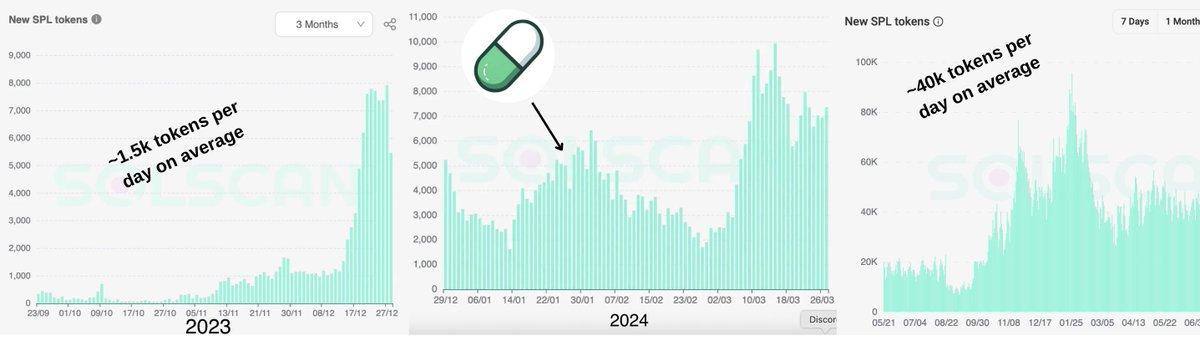
Pumpfun has brought hundreds of thousands of new tokens to the market.
Vibecoding will bring the same transformation to Web3 applications.
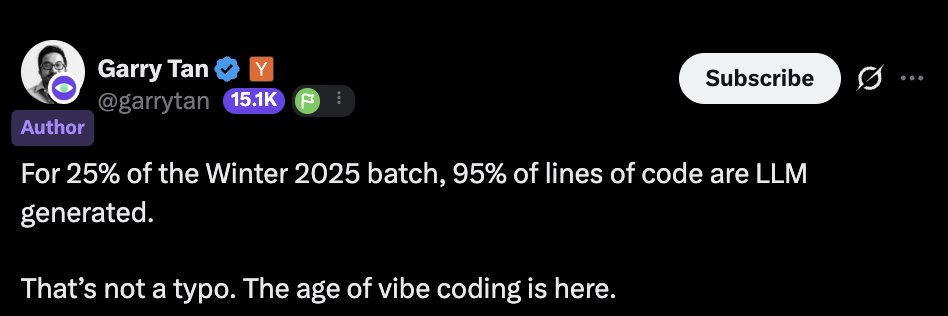
$GOAT is a pioneer in the field of AI agents.
It successfully combined two popular narratives at the time: AI agent + Meme coin, instantly making the "token value" clear to speculators (degens).
However, $GOAT did not come out of thin air; its success is inseparable from a series of important catalysts for Web2—the infrastructure provided by X and the momentum that OpenAI has been building.
If you were active in the market at the time, you might remember what happened next.
Shortly after the launch of $GOAT, everyone started talking about Virtual Protocol. This was a project that existed before the narrative exploded, and before that, its FDV (fully diluted valuation) had hovered between $20 million and $50 million for nearly a year.
Today, a very similar pattern is emerging around Vibecoding. This term is relatively recent. Some speculators are already doing Vibecoding for simple on-chain projects, but these applications have consistently failed to gain sufficient attention due to a lack of infrastructure, particularly in the Web3 space.
The following is a detailed analysis:
- The Rise of Vibecoding in Web2
- Its inevitable impact on Web3
- The formation of early on-chain infrastructure
- Positive signals from Web2
Bullish signals from Web2
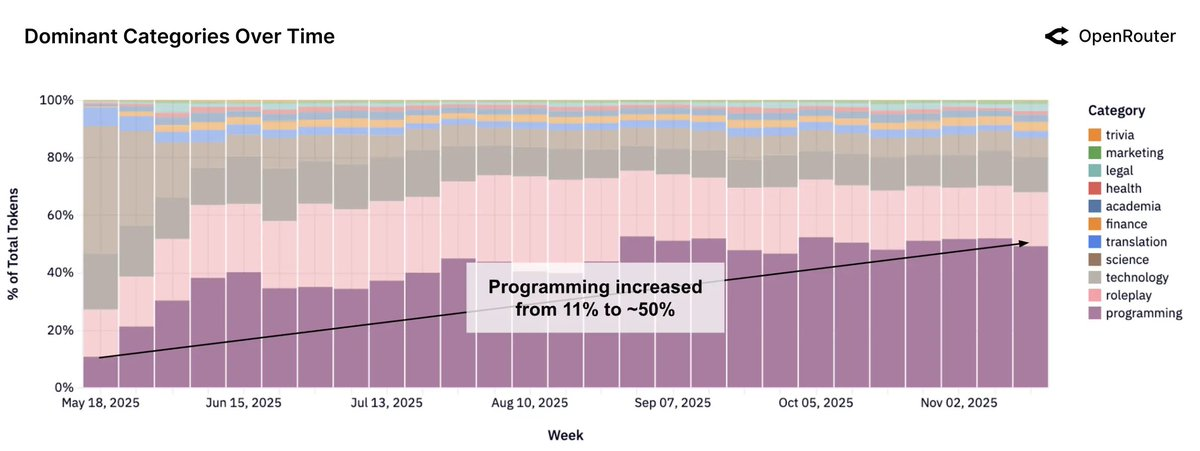
From May 2025 to December 2025, the percentage of all LLM queries related to programming will increase from 11% to 50%.
In less than a year, programming-related queries accounted for half of all LLM usage categories.
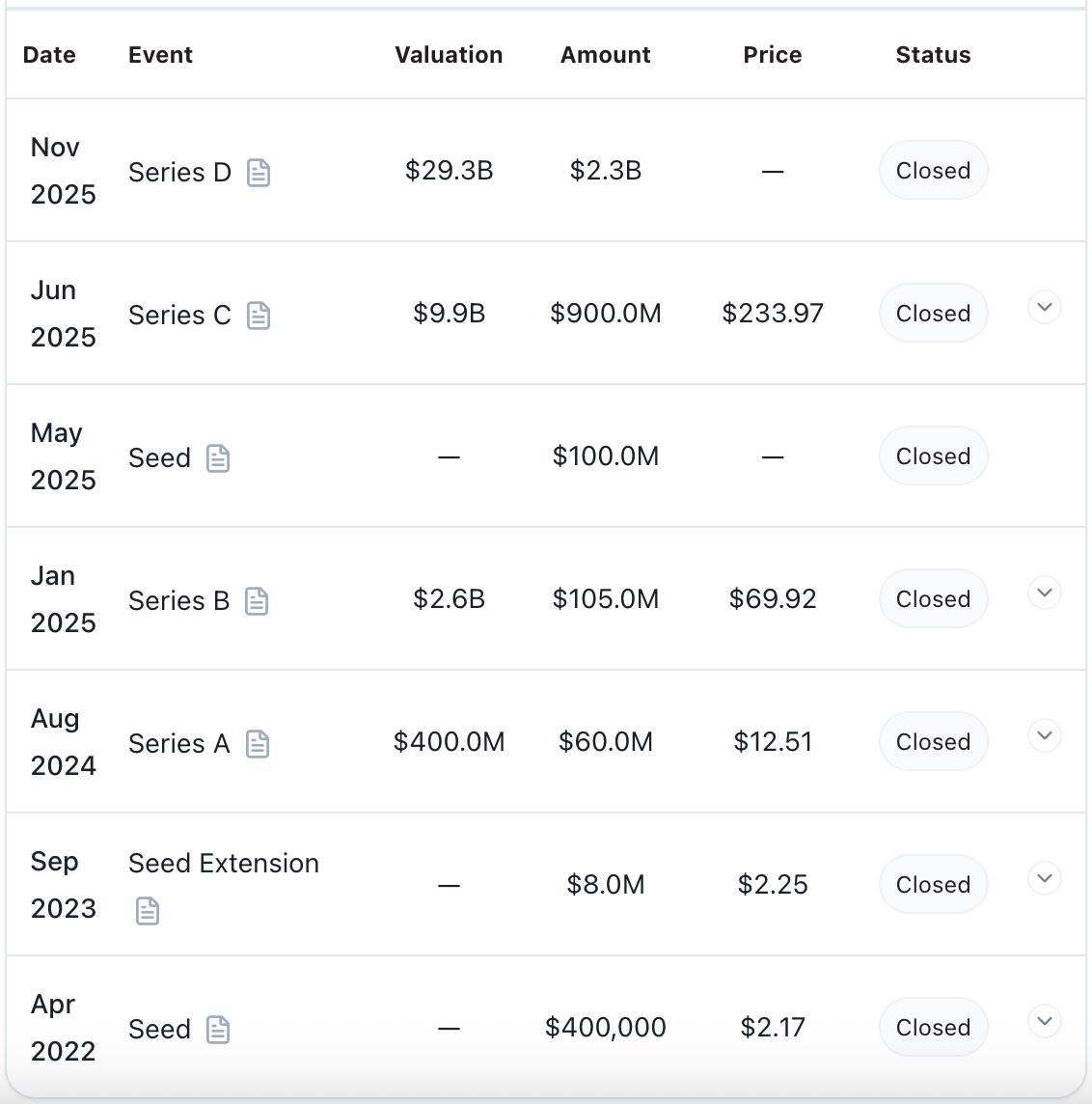
Meanwhile, the valuation of the most popular AI-driven development platform surged 72 times from $400 million to $29.3 billion in one year.
If we broaden our perspective and examine the survey data and research reports, three important signals warrant our attention:
- 84% of respondents are using or plan to use AI tools in the development process.
- 41% of the code is now generated by AI.
- Developers say that AI tools can improve productivity by an average of 10%-30%.
At the same time, it should be clarified that Vibecoding is not the same as AI-assisted development.
For complex production-level systems, relying solely on Vibecoding may pose risks. However, given the phenomenal growth rate of this field, more and more developers will begin to incorporate Vibecoding into their workflows.
(According to the 2025 Stack Overflow Developer Survey, only 17% of developers are currently using Vibecoding, which means there is still huge room for growth.)
PumpFun effect
A few years ago, issuing your own token was no easy feat. Teams experimented with various issuance mechanisms until PumpFun introduced an extremely simple model. PumpFun provided creators with a streamlined issuance process and brought a completely new trading experience to speculators (degens). So why can't we see a similar model replicated in Web3 applications?
Degens are always among the first users and early adopters of emerging narratives.
Many of them have a deep understanding of what products the market currently needs, how to launch those products, and what Crypto Twitter (CT) really cares about—because they have been watching the launch of new projects for years.
Giving Degens the ability to turn ideas into products without coding skills or high costs essentially provides fresh ideas for frontline experimentation.
Therefore, we may see hundreds of creative experiments emerge across multiple tracks:
Consumer applications, trading terminals, SocialFi, prediction markets, GameFi Ponzi schemes, and more.
This phenomenon, in turn, may accelerate the growth of specific market narratives.
Beyond the Front Lines: AI Integrated into Core Protocols
Beyond abstract concepts like "frontline narratives," there's another direction that excites me greatly—AI being directly integrated into large-scale protocols.
The simplest example is a trading terminal.
Delta-neutral strategies, point mining, and arbitrage operations—all of these can be transformed into personalized bots or functions by users entering simple prompts on the platform.
For example:
Monitor funding rates for tokenized stocks and automatically open positions when a significant price difference appears between two perpetual contract decentralized exchanges (perps DEXes).
In fact, this approach allows the platform to meet thousands of users’ small needs, which are often relatively simple but frequently overlooked by the team.
"We already have Cursor, Replit, and Lovable—why do we need a Web3 fork?"
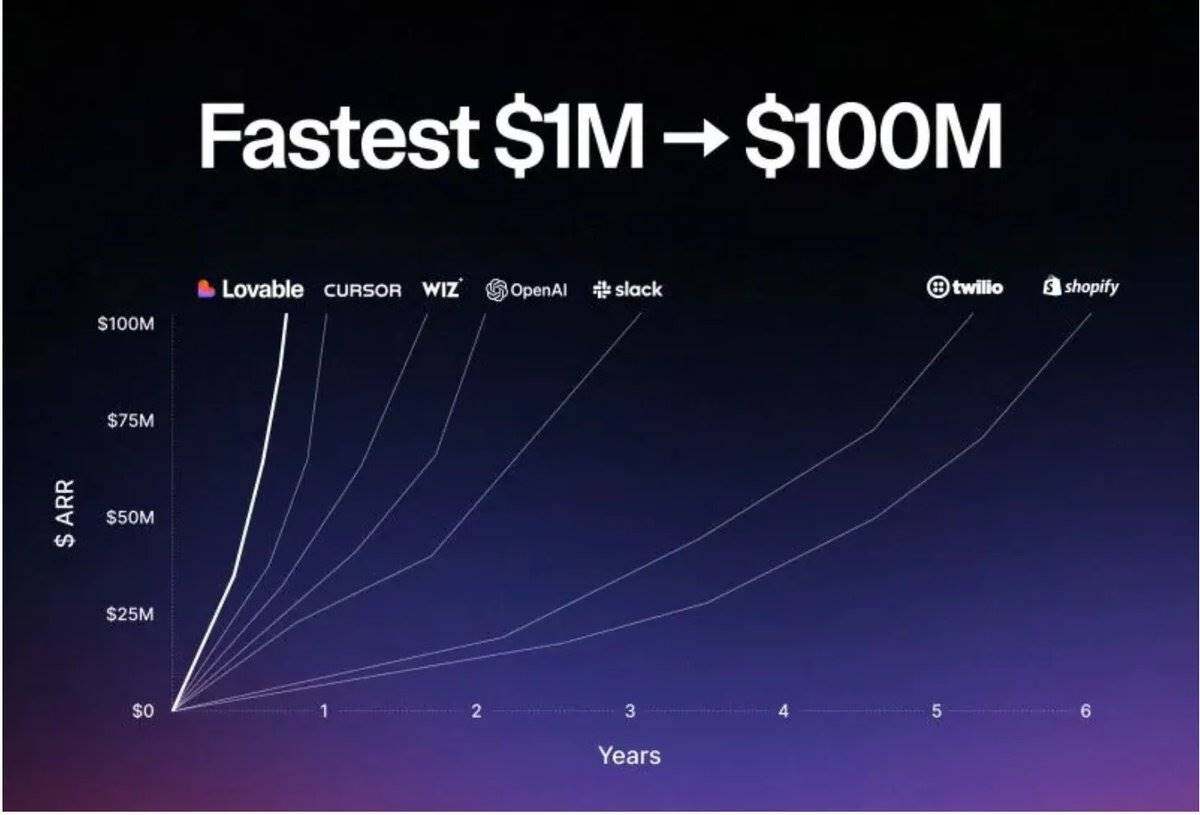
For a time, I asked myself the same question.
But after consulting a large amount of information, the answer became very clear.
Even in the realm of Web2 Vibecoding, there is no single absolute winner. Each platform has its unique characteristics, including its own focus, features, and target user group.
Some products can solve one or two specific problems exceptionally well.
Others try to do everything, but end up achieving nothing.
The Web3 Vibecoding platform will not be hampered by competition from Lovable or Replit.
Their infrastructure is built specifically for on-chain ideas, not for serving Web2 applications.
Web3 Vibe ecosystem
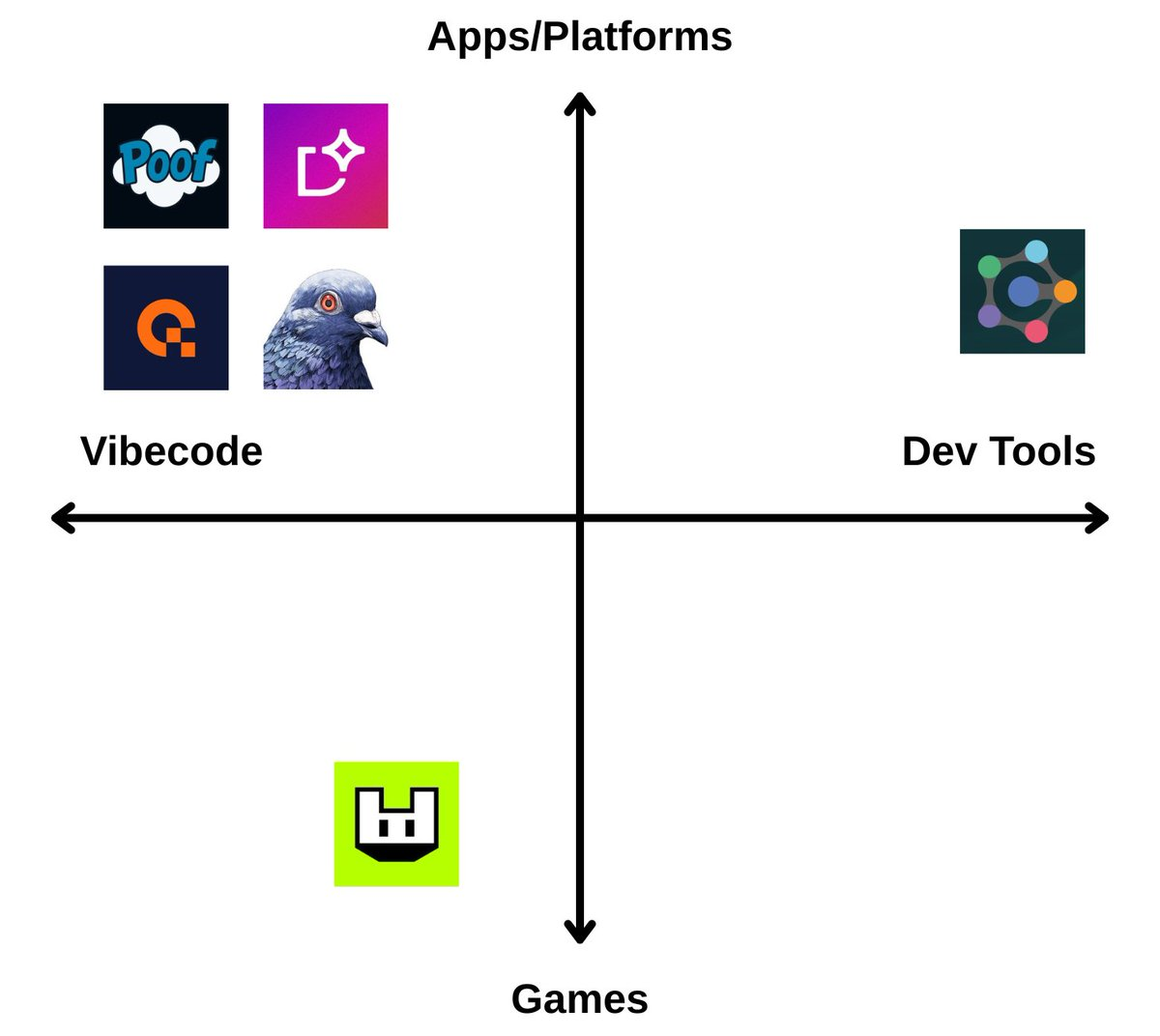
As of December 2025, there are still very few Web3 projects focused on Vibecoding or development tools, and even fewer cases of non-developers successfully launching meaningful Web3 products.
Nevertheless, I believe it is still very important to analyze the current industry landscape.
Application/Platform Overview
@dreamspaceHQ — You can create websites, platforms, and dashboards without any coding knowledge.
Dreamspace's core advantage lies in its ability to aggregate data across multiple chains, in addition to creating or connecting smart contracts via prompts: BTC, ETH, zkSync, Sei, Base, and even Stellar, WTF?
@Minidevx — A Base-based Vibecoding platform focused on building mini-applications on Farcaster.
Currently, the product is still in its early stages, and there are relatively few applications that have been launched.
Minidev launched its token $MINI about a month ago—perhaps a bit too hasty. Nevertheless, @0xjenil is actively rolling out and improving the product, so I wouldn't be surprised if high-quality applications soon emerge on Minidev.
@Poofnew — An on-chain version of Replit
Poof allows you to create on-chain websites and applications via prompts, which are passed to an agent and then distributed among three specialized agents: the UI agent, the smart contract agent, and the Actions Agent.
In July of this year, the team showcased an application built entirely with Poof, where two users could engage in duels for their "waifu" (anime character) and wager SOL (Single Rank) during the process.
This project demonstrates the flexibility of Poof as an experimental field.
game
@RemixGG_ — A Vibecoding platform where you can create games on Base with prompts, or play hundreds of games created by other users.
Some of these games are really quite good.
This app is extremely simple: download it to your phone, no wallet required, swipe to browse content, try out or create your own games.
In my opinion, this is exactly the kind of product that can attract Web2 users—who won't even realize they're using Web3 infrastructure.
Development tools
@CodigoPlatform — Codigo is an AI-driven development platform built specifically for Solana.
It combines a cloud-based IDE, specially trained AI models, and complete build and deployment tools.
However, unlike Poof, Codigo is difficult to categorize as a Vibecoding platform—you still need to have some programming skills.
Trading robots
@pigeon_trade — A trading bot with built-in AI.
In addition to spot, perpetual, and prediction market trading, you can also chat with Pigeon and Vibecode custom features, such as:
- Monitor funding rates for specific DEXs and set alerts or automatic position openings.
- Track selected wallets and copy trades.
- Find arbitrage opportunities and more on Polymarket.
Final Reflections
Currently, there are still very few high-quality Web3 Vibecoding platforms.
Most existing projects are either still in the development stage or have not yet found a product-market fit (PMF), which is perfectly normal.
As mentioned earlier, it also took a long time for the Virtual Protocol to develop a complete narrative.
Often, the product isn't bad; it's just launched too early.
I firmly believe that 2026 will be the year we begin to see real signs:
Non-developers will build profitable Web2 companies independently based on their creativity, large platforms will integrate Vibecoding tools, and the number of users and annual recurring revenue (ARR) of Cursor, Replit, and Lovable will continue to grow exponentially.
As always, Degens will be among the first users.
A few months or a year from now, we'll look back and compare the starting point of the Vibecoding narrative with the rise of PumpFun.
The only difference?
Pumpfun has brought us hundreds of thousands of new tokens -> Vibecoding will bring the same transformation to Web3 applications.


