






Sam Altman's Personal Wealth Alchemy: Investing in 400 Companies, Over Ten Deeply Tied to OpenAI


- Core Thesis: OpenAI CEO Sam Altman has built a complex personal investment network around OpenAI. Leveraging his position, he has facilitated commercial partnerships between his invested companies—such as those in nuclear fusion and biotech—and OpenAI, accelerating his personal wealth growth and creating a closed loop of potential conflicts of interest.
- Key Elements:
- Altman has personally invested in approximately 400 projects, with at least ten having collaborated or held discussions with OpenAI. These include biotech firm Retro Biosciences and chipmaker Cerebras, whose stake value surged over sixfold after its IPO.
- Altman earned approximately $4.1 billion from his investment in nuclear fusion company Helion. During this period, he facilitated a power purchase agreement between OpenAI and Helion and attempted to lobby OpenAI to invest $500 million in Helion (a move rejected by the company).
- Altman does not directly hold equity in OpenAI but profits indirectly through his personal investment network. The U.S. House Oversight Committee has launched an investigation into his potential conflicts of interest, and several state attorneys general have called for SEC intervention.
- Altman also co-founded iris-scanning company Tools for Humanity (the developer of Worldcoin), which recently sparked controversy again amid an internal investigation.
- According to the Forbes Billionaires List, Altman's net worth stands at approximately $3.4 billion, with his ranking rising from 2,692nd to 1,251st within two years.
Original article from: WSJ
Compiled by: Odaily (@OdailyChina)
Translator: Wenser (@wenser2010)
Editor's Note: Controversies surrounding OpenAI and Sam Altman have never ceased. Some view him as a leading figure in AGI, the spiritual core leading tech elites to challenge and explore the frontiers of AI, dubbing him the "Father of AI." Others see him as a complete opportunist, pointing to OpenAI's transformation from a non-profit to a commercial company, his faction-building within the OpenAI board, and his purges of rivals. In terms of personal wealth, Altman is not as conspicuous as the world's richest man, Musk, but he has meticulously constructed a "wealth closed-loop" in his own way, leveraging his position as OpenAI's CEO. He could be called a "modern master of AI wealth alchemy."
In this edition, Odaily will combine a recent investigation by the Wall Street Journal to unveil for readers the "mystery of Sam Altman's personal alchemy." Below is the main text, with some content edited. Enjoy~
Altman's "Personal Wealth Network": A Private Equity Wealth Group Built Around OpenAI
The majority of Sam Altman's personal wealth is scattered across a vast network of tech companies, including high-tech ventures like nuclear fusion company Helion, and even a startup dedicated to building a new city on the Mediterranean coast.
It is evident that many of these companies have already established various business partnerships with OpenAI, forming an intricate web of investment interests. As OpenAI prepares for its IPO and undergoes close scrutiny and review from all sides, last month, the U.S. House Oversight Committee launched an investigation into Altman's potential conflicts of interest. Several state attorneys general have also called on the SEC to step in.
Notably, he himself does not directly hold equity in OpenAI (recently valued at $852 billion), which represents a rare phenomenon—his personal interests are not directly tied to the company he leads. Against this backdrop, the Wall Street Journal reviewed dozens of his investments and analyzed the impact of certain transactions on his personal wealth.
Altman's "Investment List": Approximately 400 Investment Projects, At Least 10 Have Reached Cooperation or Potential Contact with OpenAI
Three years ago (around 2023), at an external event, Altman stated that he had invested in approximately 400 startups that were still active in the market. Based on public records and investigative reports, the Wall Street Journal identified over 80 of these investment projects, many of which can be traced back to his tenure leading the venture capital firm Y Combinator.
These investments are largely concentrated in fields highly relevant to the AI wave, including software, biotechnology, and energy.
Among the companies in his personal investment portfolio, at least 10 have entered into commercial partnerships with OpenAI, or have recently held discussions to do so.
After Altman personally invested, OpenAI established research partnerships with at least two biotech companies.
According to court testimony from last month's trial in Musk's lawsuit against OpenAI, Altman's shares in one of his portfolio companies—anti-aging startup Retro Biosciences—were already valued at $258 million as of last December.
Furthermore, Altman invested in chipmaker Cerebras nearly a decade ago, a company that recently went public under the banner of being "the next Nvidia." A key factor driving its IPO was a recent chip procurement agreement with OpenAI. Following Cerebras's IPO, the value of Altman's stake increased more than six-fold compared to its value in December last year.
As a rule, CEOs of public companies are typically cautioned by their boards against "holding significant stakes in external companies." The reason is that this creates a conflict of interest, incentivizing them to make deals that benefit their own portfolio companies or risk accusations of "self-dealing."
However, OpenAI board chairman Bret Taylor stated that Altman has always maintained a high degree of transparency regarding his involvement in other ventures, and OpenAI has prudently managed potential conflicts of interest.
Altman's "Energy Layout" Masterpiece: Earning $4.1 Billion from Nuclear Fusion Startup Helion
Mentioning Altman's largest investment, nuclear fusion startup Helion tops the list.
He first began investing in the company during his tenure as president of Y Combinator. The company claims to be close to achieving commercial power generation but never publishes its research findings, making its public statements difficult to verify by independent third parties.
On the other hand, the partnership between OpenAI and Helion, strongly pushed by Altman, also sparked significant internal controversy at the company.
Below is Altman's over-decade-long "entanglement of interests" with Helion:
2015: Altman invests in Helion and becomes its board chairman. In the same year, he co-founded OpenAI.
2021: While leading OpenAI, Altman makes an additional investment in Helion. That year, he poured a staggering $375 million into Helion, marking the largest single investment he had ever made in a startup at the time.
2024: OpenAI signs a non-binding agreement with Helion to purchase power from it in the future. During the OpenAI vs. Musk trial, former OpenAI board member Shivon Zilis (Note from Odaily: the mother of Musk's 4 children) testified, calling the deal "surprising" because nuclear fusion remains a "speculative technology" (Odaily's note: it was as if she was saying "these projects are all scams").
2025: Japanese investment firm SoftBank invests in OpenAI. Altman subsequently lobbies SoftBank to invest in Helion, and SoftBank complies. A few months later, according to the Wall Street Journal, Altman urged OpenAI to invest approximately $500 million in Helion, a move that some OpenAI employees found suspicious and unsettling. Ultimately, OpenAI's board rejected this investment proposal.
2026: In March of this year, OpenAI ultimately signed a revised agreement with Helion; in the same month, citing future collaboration with OpenAI as the reason, Altman resigned as chairman of Helion's board. OpenAI stated publicly that "the board determined the agreement is in the company's 'best interest,'" without noting any impropriety.
2026: In June, Helion announced a new funding round at a valuation of $15.5 billion, with the investment from Thrive Capital, OpenAI's strategic investor. According to sources familiar with the matter, the value of Altman's stake in Helion at least doubled as a result, reaching a value of at least $4.1 billion.
Finally, the developer behind the well-known Worldcoin project, Tools for Humanity—the iris scanning company co-founded by OpenAI CEO Altman, once valued at $2.5 billion—has recently returned to the spotlight due to an internal investigation scandal.
According to Business Insider, amid a cryptocurrency price crash, global regulatory crackdowns, business contraction, and layoffs, the company simultaneously launched two investigations led by external law firms, one targeting improper use of funds by executives and the other alleging violations in its Thailand operations.
Earlier, OpenAI faced considerable criticism for its trillion-dollar contracts with major cloud and chip manufacturers, including a $500 billion partnership with chip giant Nvidia, a $300 billion agreement with AMD, a $300 billion deal with cloud service provider Oracle, and a transaction exceeding $220 billion with data center group CoreWeave.
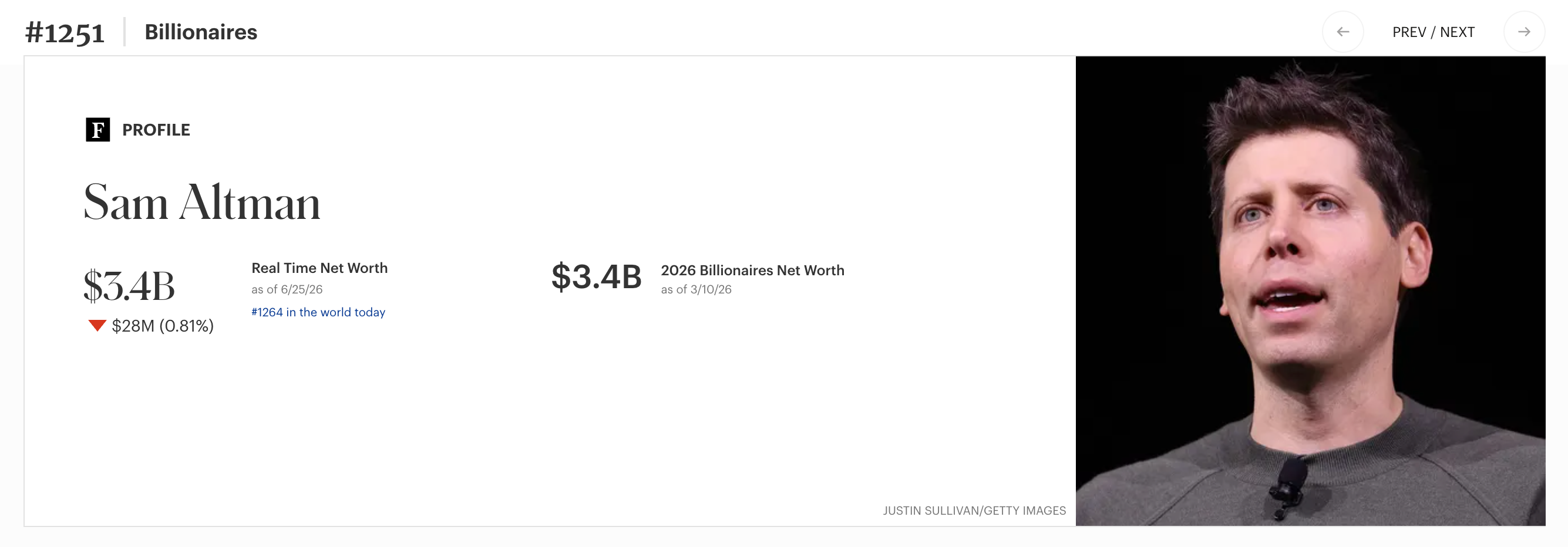
According toForbes Billionaires List data, Sam Altman currently ranks 1251st globally with a personal net worth of around $3.4 billion. Additionally, he holds investments in well-known tech companies like Stripe and Reddit. In April 2024, Altman's ranking on this list was only 2692nd. Two years later, his personal net worth ranking has risen by over 1,400 places. It's worth remembering that this ranking reflects the wealth of over 8 billion people worldwide.


