A Comprehensive Guide to WET Tokens: Solana's New Dark Horse? The Secret Behind HumidiFi's Dominance of 35% of DEX Traffic



- 核心观点:HumidiFi是Solana上专业化的主动做市AMM。
- 关键要素:
- 采用私有流动性金库与闭源报价引擎。
- 提供接近CEX的紧凑价差与低滑点体验。
- 其代币WET用于质押返佣、生态激励与治理。
- 市场影响:推动链上交易向专业化、机构化发展。
- 时效性标注:中期影响。
The crypto market has changed so rapidly over the past year that even veteran players feel like the world has been reshuffled. DeFi, which once valued openness and community, is now dominated by high-frequency bots and quantitative trading. Every pool on-chain is potentially being targeted by bots, and even the slightest fluctuation can lead to arbitrage. Many people miss the simplicity of early DeFi, but they also understand the reality: on-chain competition has become highly professionalized, and human reaction speed is increasingly unable to keep up with machines.
In this atmosphere, one question has been repeatedly raised: Is it possible to achieve near-CEX speed and depth for on-chain transactions while maintaining self-custody? This is a concern not only for retail investors, but also for institutions, wallets, and even public blockchain teams.
The emergence of HumidiFi was like a sudden ray of light. Instead of using the traditional AMM model, it built an active market-making system that is more like an "on-chain Citadel," bringing the ideas of high-frequency trading, professional risk control, and ultra-fast quotes to Solana, giving on-chain trading a near-centralized execution experience for the first time.
If HumidiFi is the engine, then WET is the fuel that truly enables ordinary users to participate. As the first token launched on the Jupiter DTF platform, WET allows traders and ecosystem users to share the value of this liquidity system for the first time. Whether participating in DTF, waiting for on-chain pools to open, or positioning yourself in advance before listing via XT's WET/USDT pre-market OTC , you can access this "on-chain high-frequency market-making engine" in your own way.
In the past, people always thought HumidiFi was a black box for institutions. Now, with the launch of WET, this black box has opened an entrance to the entire community for the first time. And so the story officially begins.

TL;DR Quick Summary
- HumidiFi is an active AMM running on Solana, also known as a "dark pool" decentralized exchange. It relies on a private liquidity vault and a self-developed pricing engine to provide tight spreads and low slippage, with all trades settled on-chain.
- It has handled a significant proportion of Solana DEX traffic and often achieves the best execution results across the entire network on core trading pairs like SOL USD.
- WET is HumidiFi's native token and the first token launched on the Jupiter DTF platform. The total supply is fixed at 1 billion, with 10 percent sold publicly.
- WET's functions include staking, transaction fee rebates, ecosystem incentives, and future governance , which bind high-frequency users, ecosystem builders, and the long-term value of the protocol together.
- WET can be obtained through various means, including claiming it after the DTF opens, the upcoming Solana on-chain trading pool, centralized exchanges that support WET/USDT, and the XT.com WET/USDT pre-market OTC channel for advanced users.
What is HumidiFi?
HumidiFi has a unique positioning. It's not an open AMM where anyone can just throw money in and become a limited partner (LP). Instead, it's more like a professional market maker's "workshop" on the blockchain . Liquidity doesn't come from retail investors, but from the protocol's own funds and partners , with buy and sell prices provided in real time through a self-developed pricing system.
You can think of it as something sandwiched between two worlds. On one hand, like a dark pool , it doesn't expose its quotes on the public order book, effectively reducing the risk of being targeted by bots or arbitrageurs. On the other hand, it's like an active AMM , with liquidity distribution driven by professional strategies, rather than a passive curve entirely dependent on community LPs.
For the average user, the experience might seem identical. You open your wallet, initiate a Jupiter-routed swap, see a good price, and confirm. A few hundred milliseconds later, you'll think it's just a normal on-chain transaction. Only those with in-depth knowledge of the system know that at that moment, the entity accepting your order is very likely HumidiFi's market-making engine.
As Solana's advantages of low fees and fast execution speed become increasingly apparent, a new trend is emerging. The trading volume of proactive AMMs is beginning to surpass that of traditional AMMs , and on-chain market making is transitioning from an era of "passive order placement" to an era of "professional traders." In this new landscape, HumidiFi has become one of the most important sources of liquidity.
On the current Solana network, HumidiFi is often behind most large orders with better liquidity and lower slippage . Instead of competing for TVL or developing a cumbersome front-end UI, it chooses to become the "professional liquidity foundation" of the entire ecosystem, focusing on making every transaction more stable, deeper, and more professional.
That's where the story begins. HumidiFi isn't trying to win the attention of every retail investor; it wants to win the future of the entire on-chain market structure.
The operating logic behind HumidiFi: How does it "make markets"?
If we imagine Solana as a highway, then HumidiFi is like an intelligent transportation system hidden underground. Cars whiz past you, but you don't know who's managing the traffic or diverting it; you just know the journey is smooth. HumidiFi follows the same philosophy: keeping fund custody and settlement on-chain, while placing the crucial "pricing brain" off-chain , handling liquidity in a more flexible and professional way.
 humidifi.xyz
I. Prop AMM and Undercurrent Liquidity
Traditional AMMs operate very openly.
It reveals its pricing curve to the world, showing the amount of inventory in the pool, making it easily detectable by arbitrage bots. Anyone can be a limited partner (LP), anyone can become part of the pool. While this is fair, it also makes AMMs (Asset-Based MMs) vulnerable.
HumidiFi takes a completely different approach.
It doesn't disclose its market-making strategy, but instead provides liquidity through its own treasury and partnered professional market makers. Its pricing model is closed-source , monitoring global market changes in real time and deciding when to buy and sell. Transactions are processed by this "black box engine" before entering the pool, leaving no trace of your orders and making it much harder for pre-emptive attacks.
This is what people often refer to as the "dark pool effect." It's unassuming and doesn't attract attention, but it provides a cleaner trading experience.
II. Predictive pricing and active liquidity
Traditional AMMs rely on a single formula. HumidiFi relies on a set of judgments.
Its system dynamically adjusts based on factors such as real-time price, volatility, and risk exposure , always maintaining a state of proactive management . For example, if SOLUSD volatility increases at a certain moment, it will automatically tighten the quote, and vice versa; if the risk exposure of BTC or ETH is too large, it will also adjust the inventory in a timely manner to maintain healthy overall liquidity.
Even more interestingly, it can even distinguish between a "real user" and a "pure arbitrage bot." The system tends to give better quotes to genuine traders, rather than arbitrageurs who just want to profit from loopholes.
This model made many people realize for the first time that it is possible to achieve price spreads and slippage close to those on CEXs on the blockchain.
III. On-chain settlement, off-chain intelligence, and deep integration with the entire Solana ecosystem.
Although pricing and risk control operate off-chain, all balance changes and transaction settlements are firmly locked on the Solana chain, making them transparent and verifiable.
HumidiFi pushes off-chain data onto the blockchain with extremely lightweight price updates. This method is fast and inexpensive, allowing for simultaneous price updates across multiple markets without burdening the blockchain. More importantly, it doesn't build its own front-end; instead, it integrates into the entire Solana ecosystem. It connects to Jupiter , the largest aggregator, and also interfaces with other wallets, routers, and institutional systems that require depth and speed.
So when you casually click "Swap" in Phantom or Backpack, it may seem like the same as usual, but in reality, you may have already used HumidiFi's liquidity. Many users still don't know they've used it, but the trading experience is definitely smoother.
HumidiFi Token Economics: Entering the Value System of WET
Allocation Breakdown
WET is a core link connecting heavy traders, ecosystem partners, and HumidiFi's long-term development. It serves as both a participation credential and an incentive tool, enabling more people to truly join this professional-grade liquidity network.
Total Amount and Design Concept
WET's basic parameters are very intuitive:
- The total supply of tokens is fixed at 1 billion.
- It belongs to the Solana (SPL standard) blockchain.
- The issuing platform is Jupiter's DTF, and WET is the initial token issued by DTF.
- The public offering of DTF accounts for 10% of the total supply, and all of them will be unlocked during TGE.
The remaining 90% will be allocated to the foundation, ecosystem incentives, and team labs, and will be gradually released over approximately two years through an on-chain lock-up mechanism.
Token Allocation Table
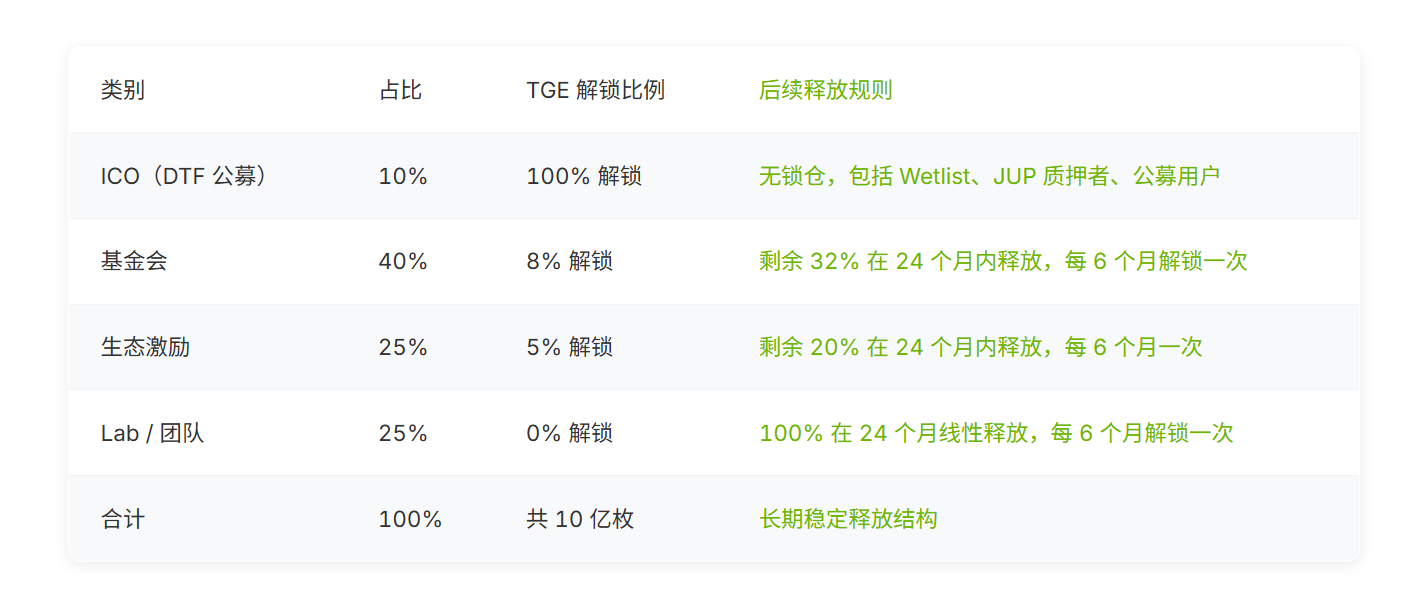
The advantages of this allocation design are obvious. A portion of the tokens enters circulation directly on TGE, ensuring liquidity for early trading. The remaining tokens are released gradually over two years, reducing selling pressure and providing impetus for medium- to long-term ecosystem development.
What is the core purpose of WET?
WET is not simply a governance token or reward token, but rather a "passport" to the entire HumidiFi ecosystem. Its roles include:
- 1. Staking and Fee Reduction: Staking WET will earn you lower fees on transactions routed through HumidiFi. The higher the trading volume, the greater the benefit, making it ideal for high-frequency or heavy traders.
- 2. Ecosystem Incentives: A portion of WET is used to reward routers, integrators, partner organizations, and those who drive ecosystem expansion. In other words, whoever brings more liquidity or users to HumidiFi will receive incentives.
- 3. Governance: As the protocol gradually becomes more community-based in the future, WET holders will participate in key parameter updates, incentive design, and directional voting.
- 4. Marketing and Growth: The foundation and team will use a portion of WET to drive marketing, new product launches, partnerships, and further integration.
For most users, WET can be understood as a participation token. It reduces costs and allows you to share in the potential benefits of HumidiFi as it scales. If you consider HumidiFi as the "engine" of Solana trading, then WET is the key that allows you to participate more deeply in the operation of this machine.
Market performance and trading activity
Even before WET was officially launched, HumidiFi's data had already astonished many. In just a few months, its cumulative transaction volume reached tens of billions of dollars, with daily transaction volume consistently exceeding $1 billion. At its peak, it even captured approximately 35 to 40% of the DEX share on the Solana network . This means that for every three on-chain transactions on Solana, one might actually go through HumidiFi.
Following the successful DTF public offering of Jupiter , millions of dollars were raised through three rounds of funding: Wetlist, JUP stakers, and the public round, demonstrating very high community engagement. The ecosystem will now enter several important phases:
- Open DTF users can claim WET
- Launch WET-related liquidity pools on Solana
- Major centralized exchanges have listed WET for trading, allowing users to buy WET/USDT spot and futures contracts.
These entry points work together to allow different types of users to smoothly enter the WET ecosystem. Whether you are a DeFi veteran, a Solana heavy user, or a trader who is only used to CEXs, you can now easily find your way to participate.
Where can I buy and trade WET?
There are currently three main ways to get in touch with WET, each suitable for different types of users.
Jupiter DTF Claim
If you participated in Wetlist, JUP staker allocations, or public sales, you can claim your WET directly on Jupiter's DTF page once the claiming channel opens. The whole process is very simple; you don't even need to switch wallets.
Solana DEX trading (routed via Jupiter)
If you prefer to operate on-chain, you can follow these steps:
- Connect your wallet to Jupiter
- Choose WET and pair it with a trading pair like WET/USDC or WET/SOL.
- Confirm route and complete Swap
Jupiter automatically finds the optimal path for you, often directly routing to HumidiFi liquidity, which is one of the reasons it can offer good prices.
XT.com WET/USDT Pre-Market OTC Trading
XT offers pre-market OTC trading services for WET/USDT .
- These types of transactions are more like over-the-counter quotes, suitable for users who want to gain exposure to WET before its official launch. Once spot trading and exchange trading begin, the relevant positions will be automatically settled.
This is an attractive option for those who want to plan ahead or don't want to wait for the on-chain pool to open.

Key risks and areas requiring attention
HumidiFi and WET are indeed very popular, but they also come with considerable risks, especially for users who are new to this active market-making model, who need to remain vigilant.
- 1. Volatility Risk: WET's early circulating supply is relatively small, and the prop AMM track has attracted a lot of attention. Once there are events such as launch, unlocking, or announcements, the price may fluctuate very sharply.
- 2. Opacity due to proprietary mechanisms: HumidiFi's pricing engine is not open source. This means that its risk model cannot be fully verified externally; users can only trust the core team's capabilities and management. For heavy on-chain users, this represents an additional trust cost.
- 3. Over-concentration of traffic: If a large number of DEX transactions on Solana rely on HumidiFi, then any system failure, delay, or anomaly could affect the trading experience of the entire ecosystem. This type of concentration risk is also common in traditional finance.
- 4. Contract and Oracle Risks: HumidiFi employs a hybrid model combining on-chain settlement and off-chain algorithms. This structure relies on the stability of smart contracts and the accuracy of oracle data. Problems in any of these areas can affect the system's pricing or execution.
- 5. Token Distribution Structure: Although 10% of WET was allocated to the public, the majority remains with the foundation, ecosystem incentives, and the team. The unlocking pace over the next two years may cause some users to worry about the long-term degree of decentralization and potential selling pressure.
Overall, WET is more like a high-risk, high-innovation infrastructure token, suitable for users who are willing to research and take risks.
What's next? A possible roadmap for HumidiFi and WET
HumidiFi has proven that an active market-making model can gain a decisive advantage on a mainstream public chain . The emergence of WET allows more people to truly connect with this "on-chain market-making engine."
Several things that may happen in the future are very crucial.
First, heavy users and ecosystem integrators can be deeply integrated with the protocol. Whether it's high-volume traders, wallets, routers, or institutions, they can all achieve closer relationships through WET.
Second, the foundation can use WET to drive more collaboration and incentives, including deeper liquidity, faster integration, and a richer ecosystem of projects.
Third, governance will gradually become decentralized. As WET becomes more widely distributed, the community will gradually have more say in incentives, parameters, and policy direction.
If HumidiFi continues to execute its roadmap steadily, and Solana maintains its leading position in the prop AMM sector, then WET is likely to become an important "infrastructure token" for traders . Whether trading directly on-chain or on centralized exchanges, those who truly care about the quality of trades are likely to become increasingly reliant on this ecosystem.
HumidiFi and WET Frequently Asked Questions
1. Explain what HumidiFi is in one sentence?
HumidiFi is a Solana-based active market maker AMM, similar to an on-chain dark pool. It provides tighter and more stable quotes through liquidity managed by a professional team, while maintaining on-chain settlement.
2. Why is it called a dark pool or subjective AMM?
Because liquidity comes from private pools controlled by professional market makers, and quotes are generated by proprietary models rather than publicly available AMM curves, most trades are routed through routers like Jupiter, rather than through public order books.
3. What is the total supply of WET tokens?
The total supply of WET tokens is fixed at 1 billion.
4. Where can I buy WET?
If you've participated in the DTF, you can claim it on the Jupiter DTF page. Alternatively, you can trade it on the Solana DEX, which is routed through Jupiter, or purchase it on centralized exchanges that have listed the WET/USDT trading pair.
5. Is WET a governance token or just a fee token?
WET is a multi-functional token. It can be used for staking to earn transaction fee rebates, as an ecosystem incentive, and will also assume governance functions in the future, becoming more important as HumidiFi's decentralization gradually unfolds.
6. Is HumidiFi beginner-friendly?
Yes. Ordinary users won't even notice the complexity, because you primarily use HumidiFi liquidity through familiar wallets and routers. The underlying logic is all handled automatically in the background.
7. Where can I follow official news?
You can check the HumidiFi website , X account , and Jupiter DTF launch page, where you'll find contract addresses, launch announcements, claim times, and more information.
Quick Links
- November 2025 Market Outlook: From FOMC to x402 Agreement, a Comprehensive Analysis of Global Hot Topics
- XT.com and Dash discuss: Instant settlement, blockchain mechanisms, and privacy innovation.
- How to invest 100,000 USDT? XT Simple Earn helps you achieve a stable passive income of 10%+.
About XT.COM
Founded in 2018, XT.COM is a leading global digital asset trading platform with over 12 million registered users, operating in more than 200 countries and regions, and boasting an ecosystem traffic exceeding 40 million. The XT.COM cryptocurrency trading platform supports over 1300 high-quality cryptocurrencies and over 1300 trading pairs, offering diverse trading services including spot trading , leveraged trading , and contract trading , and is equipped with a secure and reliable RWA (Real World Asset) trading market. We are committed to the philosophy of "Explore Crypto, Trust Trading," dedicated to providing global users with a safe, efficient, and professional one-stop digital asset trading experience.