






Telegram Cocoon is now online; your graphics card can now mine TON!


- 核心观点:Telegram推出去中心化AI计算网络Cocoon。
- 关键要素:
- 网络由客户端、代理、工作节点三部分组成。
- 利用TEE技术保护隐私,节点贡献算力赚取TON。
- 已有Telegram翻译等内部功能作为实际应用支撑。
- 市场影响:探索去中心化AI计算与数据隐私保护新路径。
- 时效性标注:长期影响。
Yesterday, Telegram founder Pavel Durov announced on Twitter that their decentralized privacy computing network, Cocoon, has officially launched.

The Cocoon network consists of three parts:
Client: Sends a work request to the agent and pays the agent a fee after the request is completed.
Proxy: Routes work requests to worker nodes. Protected by a TEE, the proxy selects suitable nodes based on the worker node's device model, load, and reputation, and pays the fees collected from clients to the nodes. The nodes also take a commission. Telegram plans to allow anyone to run their own proxy in the future, making the Cocoon network completely decentralized.
Worker node: Executes AI inference requests in a TEE-protected virtual machine, and the agent pays the request fee from the client after execution.
In other words, anyone can earn $TON by using their own GPU as a worker node. Cocoon allows GPU owners to contribute AI computing power to the decentralized network on TON. By simply running the Cocoon protocol stack on a GPU server that supports TEE, they can provide private, verifiable AI model execution and transparently receive $TON payments for each processed request.
Pavel Durov stated that some AI-related features of Telegram, such as message translation, are already partially supported by Cocoon. He also mentioned Telegram's features such as speech-to-text and summarization, indicating that Cocoon did not lack practical applications from the outset, and believes that Telegram mini-programs will bring more usage demand to the Cocoon network in the future.
Compared to Telegram gift NFTs that previously generated hype in the cryptocurrency world, Cocoon is more like a decentralized AI computing network built by Telegram, combining blockchain and $TON as a payment method, starting from the built-in functionalities of Telegram. It's unlikely to issue its own token, limiting its potential for speculation. However, this project may reflect a long-term trend: increasing concern about privacy when directly exposing data to centralized AI companies during AI usage. In the cryptocurrency space, we've already seen more and more privacy-focused projects touting "protecting data sovereignty." (Related reading: 12 New Projects, a List of Privacy Projects Officially Mentioned by Solana )
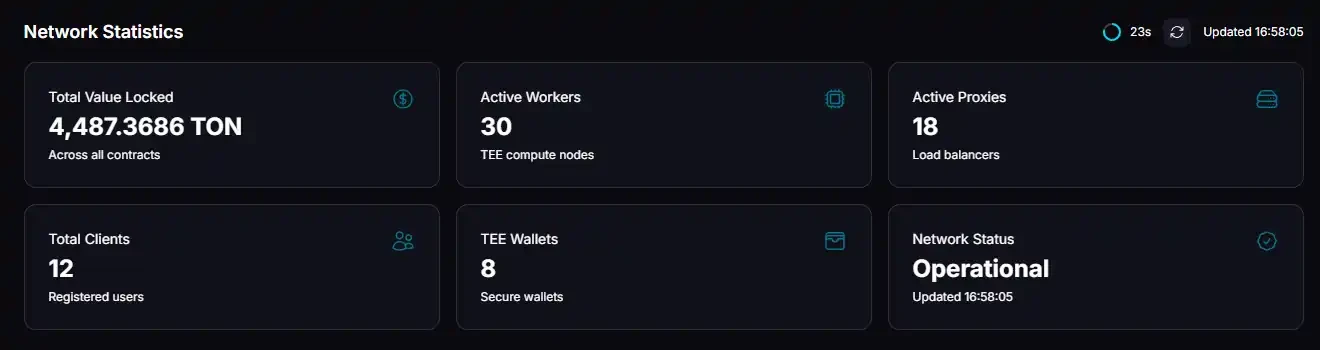
Currently, the Cocoon network has a total TVL of approximately 4487 TON, with 30 worker nodes, 18 agents, and 12 customers. This data is from just over a day after its official launch, and it is still in its very early stages.
Supported by the practical application needs of Telegram's built-in functions and the TON incentive, the existence of the TON incentive also reduces the expectation of issuing tokens. Whether the Cocoon network can develop at a different pace from other crypto computing projects in the cryptocurrency circle still needs to be tested over time.


