Understanding REPPO Tokens in One Article: A Triple Fusion Model of AI × DePIN × Prediction Markets



- 核心观点:Reppo构建去中心化AI资源协调网络。
- 关键要素:
- Subnet预测市场激励高质量数据贡献。
- Solver Nodes自动响应AI资源请求。
- REPPO代币驱动经济循环与治理。
- 市场影响:或成为AI Agent经济关键基础设施。
- 时效性标注:长期影响。
If you've been following the intersection of cryptography, AI agents, and decentralized infrastructure lately, you've likely seen the name Reppo (REPPO) appearing more and more frequently. As the AI era continues to advance, the industry is beginning to realize one thing: the future is no longer a competition of individual models, but a full-chain competition involving data, computing power, task collaboration, incentive mechanisms, and governance systems.
Reppo was born against this backdrop. The team proposed a very interesting goal: Could we use a new approach to unify AI training data, computing resources, and economic incentives into a single protocol, enabling AI and humans to collaborate automatically, driving content quality through market prediction, allowing Solver Nodes to deliver tasks automatically, and allowing the Subnet ecosystem to grow automatically?
It sounds cutting-edge, but it's actually based on a very simple question.
- If the future belongs to agents, then simple AI calls will no longer be enough. A truly open AI economy needs a decentralized "coordination layer".
- So what Reppo wants to do is put both the "personal relationships" and "value measurement" aspects of AI collaboration on the blockchain, so that every participant can receive fair incentives.
- So what exactly is Reppo? How do its AI Subnets, Solver Nodes, and veREPPO governance mechanisms work? Where do users purchase Reppo and participate in the ecosystem?
This article will guide you through Reppo's mission, technology, incentives, and ecosystem story in the easiest-to-understand way. After reading it, you'll understand why more and more people believe that Reppo will become a key player in the world of AI agents.

TL;DR Quick Summary
- Reppo is a decentralized AI resource coordination network that integrates training data marketplaces, AI-human collaboration, and intent-driven data/infra transactions into a single protocol.
- Subnets (also called Pods) allow creators to publish content, which is then scored by the community using a predictive market model, with higher-quality content receiving more incentives.
- Solver Nodes automatically process AI's "delivery requests," retrieving data, computing power, or DePIN information sources from the network to complete the task.
- The REPPO token is responsible for incentives, Subnet emissions, governance (via veREPPO), and the burning of fees from future Solver nodes.
- The protocol draws on Anoma's intent architecture, EigenLayer AVS's verifiable service model, and zkVM's verifiable computation, with the goal of becoming the coordination foundation layer for Agentic AI.
- REPPO is now available on the Base L2 mainnet and listed on XT Exchange, Aerodrome, and Uniswap, and can be traded at any time.
What is Reppo?
If we imagine the future AI world as a bustling digital city, then Reppo is like the transportation hub in this city responsible for "resource allocation." Data is flowing, computing power is running, and tasks are collaborating with each other. What Reppo aims to do is to ensure that all these resources can be seamlessly connected at the time and place when they are most needed.
In the past, AI model training typically relied on centralized providers like Scale AI. You needed training data, you paid for it, and they provided you with a batch of labeled content. But the limitations of this approach are obvious. Once the AI ecosystem becomes massive, with tens of thousands of new pieces of content and new models emerging every day, a centralized team simply cannot handle it, let alone allow global developers to participate fairly.
Reppo aims to answer this question: How can we ensure that AI obtains high-quality training data, developers can access computing power at reasonable prices, and AI agents can readily find the resources they need without a centralized company?
Their answer was predicting the market and collaborative incentives.
Reppo breaks the entire system down into two main entry points, allowing both humans and AI to find their place.
How Reppo Works: Core Mechanism Analysis
If we imagine Reppo as a growing AI city, then the operation of this city relies on the collaboration of three systems. They are responsible for data, intent scheduling, and capital incentives, respectively. These three systems mesh together like gears, making the entire ecosystem truly dynamic.
First layer: Data and alignment layer Reppo.ai
The story begins here.
On Reppo.ai, creators can submit a variety of content, including models, training data, prompt word outputs, and even complete datasets. Voters in the community evaluate these submissions, and the entire process resembles a continuously running prediction market. Those who make correct predictions and accurate judgments are rewarded, and content quality is constantly repriced as rankings change.
To ensure the system is both fair and cheat-proof, Reppo designed three roles.
- First, there are the publishers. When they submit content, they need to stake REPPO, which is equivalent to endorsing their own work.
- Secondly, there are the voters. They lock up their REPPO tokens to gain veREPPO voting rights, which they use to rate the content.
- Thirdly, reward distribution. After each epoch, the system will distribute rewards to winning content and outstanding voters based on verifiable rankings.
All votes will use a commit-reveal process. This means that everyone submits a hidden vote first, and it will be revealed during the reveal phase. This method can effectively prevent vote rigging and ensure that the voting results cannot be manipulated in advance.
The mission of this layer is actually quite simple: let the market determine the quality of content, and let AI obtain truly reliable data alignment sources.
Second layer: Intent scheduling layer Reppo.Exchange
If Reppo.ai solves the problem of "where does the content come from", then Reppo.Exchange solves the problem of "who helps AI find resources when it needs them".
This system is inspired by Anoma's Resource Machine. Its core idea is to translate the AI Agent's needs into an executable "intent" and then hand it over to Solver Nodes to complete.
The operational process can be described as follows.
The first step is for AI to generate demands.
It will publish an RFD request in Reppo.Exchange. For example:
- I need 10,000 labeled images
- I need 100 hours of GPU time
- I need real-time sensor data from a DePIN network.
The second step is for Solver Nodes to execute tasks.
These nodes will search for resources among data warehouses, DePIN networks, or computing power providers to find the one that best meets their needs before delivering it.
The third step is security verification.
The entire delivery process generates verifiable proofs through zkVM (from Nexus), clearly showing the source of the task, the processing steps, and the data used in the end.
In this way, AI Agents can autonomously acquire data, computing power, and infrastructure resources without any centralized intermediaries.
Third layer: Capital coordination layer
This layer is responsible for Reppo's "economic cycle".
Contributors earn REPPO rewards by submitting content, voting, or running Solver Nodes, which can then be used directly in the Data Infrastructure Marketplace. This creates a complete closed loop within the ecosystem.
This cycle includes three directions.
- Data contributors receive rewards and can also receive a share of the profits.
- AI developers use REPPO to purchase resources in the marketplace.
- veREPPO holders have governance rights and can adjust emissions and future agreement logic.
In other words, Reppo is not just an AI collaboration network, but a native AI economic system.
Official reference: https://x.com/Repponetwork/status/1995213233578557542
Reppo Subnets: AI Alignment for Everyone
Reppo's Subnets are somewhat like "never-ending prediction markets," specifically designed to filter high-quality data. Each Subnet targets a specific vertical domain, for example:
- Alignment of legal texts or medical corpora
- Programming code quality assessment
- DePIN Infrastructure Audit
- Industry-specific RLHF datasets
The creators of the Subnet need to lock up REPPO to initiate the emission. Over time, the best-performing content will be given higher weight, forming a continuously iterating "decentralized quality ranking engine".
 Reppo.ai Subnets
Future upgrade plans will utilize EigenLayer's AVS service to bind each piece of content to a cryptographically verified real contributor, achieving a complete traceable link from contributor to dataset to model.
Reppo.Exchange: A resource trading hall for AI-driven autonomous economies
Future AI will increasingly focus on automatically finding resources, rather than relying on manual business development (BD) connections or API integration. Reppo.Exchange provides this entry point for them. The process is very clear.
- AI publishes RFD
- Solver nodes seek solutions among data warehouses, Depin, or computing power providers.
- Settlement is completed on-chain, including REPPO payments, fee burning, and IP revenue sharing encoding.
This design effectively fills the gap in "coordination logic" that has been missing between AI, DePIN, and enterprise data.
A Comprehensive Analysis of the REPPO Token Economy: Understanding the REPPO Value System
Remark:
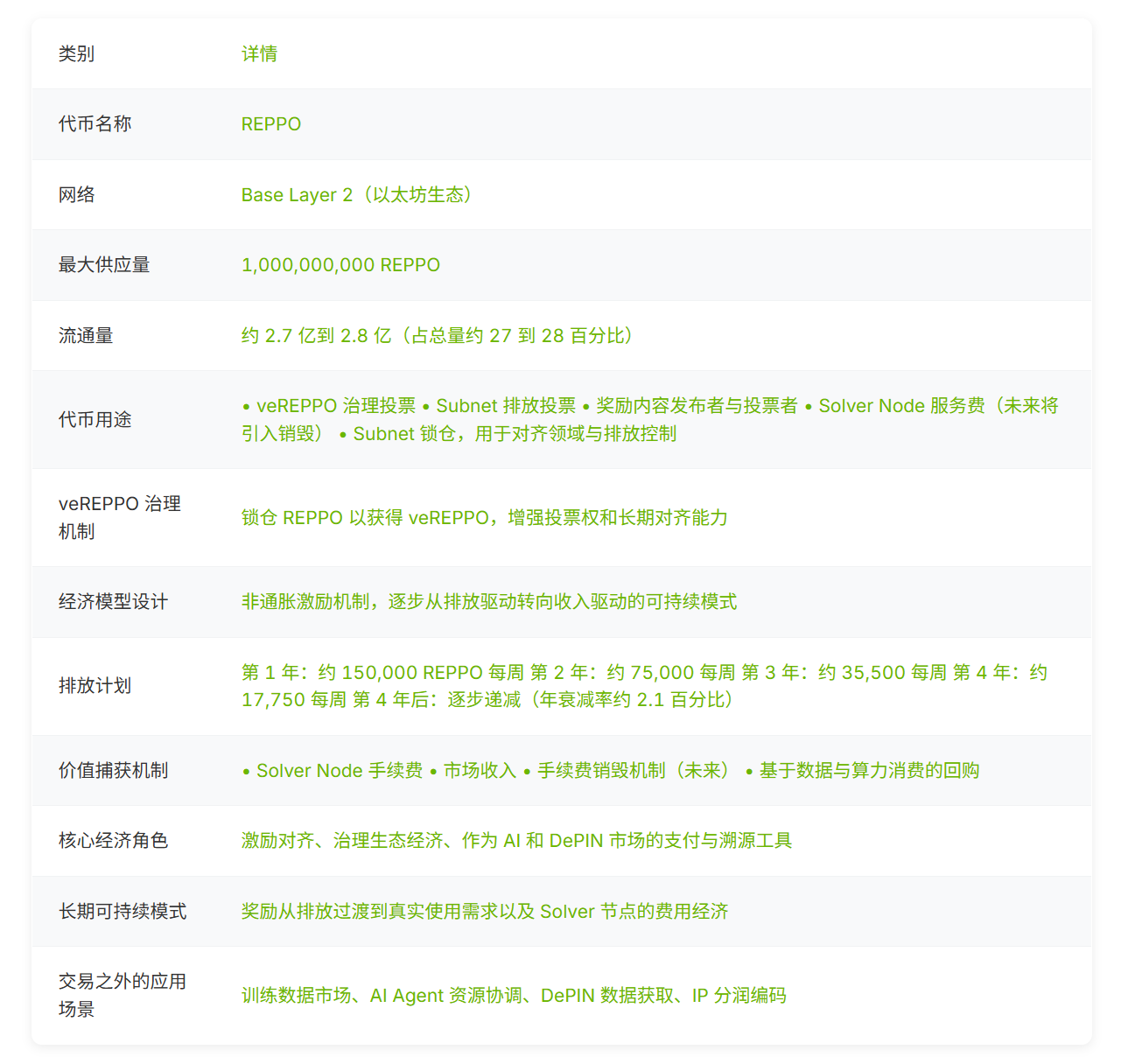
REPPO is a token deployed on Base L2, with a fixed total supply of 1 billion. Currently, approximately 25% (about 254 million) is in circulation. Its main uses include:
- veREPPO governance
- Subnet Emissions Voting
- Incentivize content publishers and voters
- Solver Node service fees will be subject to a future burn mechanism.
- Subnet locks are used for domain alignment and emissions management.
Reppo initially emphasized a non-inflationary economic structure. Emissions were to gradually decrease from approximately 150,000 per week in the first year to approximately 17,000 per week after the fourth year.
In the long run, incentives will gradually transition from emission-based models to buybacks and fee distributions supported by ecological revenue, thereby achieving sustainable development.
How to efficiently trade REPPO on the XT exchange
With the increasing attention given to decentralized AI infrastructure, how to trade REPPO more efficiently has become a concern for both holders and active traders. XT exchange offers a variety of tools suitable for different trading styles, so whether you are bullish on the long term or a short-term trader, you can find a suitable approach.
1. Spot trading: Simple and direct
If you believe in the long-term value of Reppo and want to participate steadily, the simplest way is to trade REPPO/USDT directly on XT.
- View price: https://www.xt.com/zh-CN/price/reppo
- Trade now: https://www.xt.com/zh-CN/trade/reppo_usdt
This approach is suitable for investors who want to hold their investments long-term and don't want to trade frequently; after buying, they simply need to wait for the project to develop.
2. Use spot grid trading to automatically buy low and sell high.
If REPPO's price is in a range-bound market, or if you prefer to profit from price fluctuations, then XT's REPPO/USDT spot grid strategy is perfect for you. The spot grid robot automatically buys when prices fall and automatically sells when prices rise.

The entire process doesn't require you to monitor the market, making it ideal for the 24/7 cryptocurrency market. Simply set the trading range, and the system will continuously buy low and sell high for you, turning even volatile markets into profit opportunities.
Key Risks and Challenges
First, there is the inherent complexity of the three-tier architecture itself.
Reppo's overall design spans the data, intent, and capital layers, requiring seamless collaboration between the Subnet, Solver nodes, and settlement layers. Enabling encrypted workflows, AI task pipelines, and market economics to operate simultaneously in real time demands extremely high levels of technological stability and execution quality.
Secondly, it faces competition from centralized RLHF giants.
Companies like Scale AI and OpenAI have substantial funding, established business contracts, and brand advantages. Reppo must prove that decentralized collaboration methods can achieve or even surpass the efficiency of centralized systems.
Third, there is regulatory uncertainty regarding the sharing of programmable intellectual property rights.
Issues such as dynamic IP ownership, data licensing, and cross-border privacy compliance may pose regulatory challenges in regions such as the United States, Europe, and Asia.
Fourthly, anti-Syllabus attack measures and data quality verification.
To ensure the credibility of Subnet, the system must simultaneously guard against malicious content and low-quality data, and also ensure that the ranking mechanism of the prediction market is not manipulated.
Fifth, long-term sustainability depends on genuine AI demand.
Reppo's long-term value cannot rely on emissions, but on real business revenue. Ultimately, it must generate sustainable benefits from Solver node services, data marketplaces, and AI workloads.
Looking to the future: Reppo's development roadmap
Reppo's goal is not to become just another so-called "AI chain," but rather to address three real industry pain points:
- The long-term scarcity of high-quality, niche training data
- Lack of a neutral AI agent resource market
- The long-standing imbalance in incentive mechanisms for data and intellectual property rights
Reppo is currently in its first phase (2025-2026) and is already live.
- REPPO token
- veREPPO governance mechanism
- Public Subnet
- Early versions of the data and infrastructure exchange layer
Next, Reppo will move into the second phase:
- Larger Subnet ecosystem
- Cross-chain integration
- Deep integration of enterprise cooperation and DePIN
- A more mature governance market
- Solver node fee burning and revenue sharing
If Reppo ultimately succeeds in this path, it has the potential to become the infrastructure for next-generation Agentic AI—a neutral, verifiable coordination layer that allows data, resources, and capital to flow freely. By integrating traceability, predictive markets, and intent collaboration, Reppo is positioning itself as a "resource router" in the AI world, connecting blockchain, DePIN networks, and enterprise data environments to make the entire AI economy more transparent and intelligent.
Reppo Frequently Asked Questions (FAQ)
1. What problem does Reppo primarily solve?
Reppo 's goal is to enable AI agents to autonomously acquire high-quality training data and computing resources without centralized intermediaries. The entire process relies on prediction market incentives and intent-driven coordination mechanisms to make resource allocation more transparent and efficient.
2. How does a Subnet work?
Creators submit data or model outputs, which are then ranked by voters holding veREPPO tokens. High-quality content is rewarded, while low-quality content may be eliminated due to insufficient staking.
3. What is veREPPO?
veREPPO is governance rights obtained by locking up REPPO, which can be used to determine emissions allocation, Subnet reward ratios, and protocol upgrade directions.
4. What are Solver Nodes?
Solver nodes are off-chain agents that are responsible for finding data, computing power, or DePIN information sources based on the resource requests (RFDs) issued by the AI Agent, and completing the final settlement using REPPO.
5. What are the main risks facing Reppo?
These include the technical implementation difficulties, the pressure to verify data quality, competition with centralized RLHF service providers, intellectual property and privacy compliance risks, and whether the ecosystem can achieve long-term sustainable development based on real AI needs.
6. Where can I buy REPPO?
You can purchase REPPO at XT.com .
XT Spot Trading Portal: https://www.xt.com/zh-CN/trade/reppo_usdt
7. Where can I follow the latest news about Reppo?
Twitter X: @Repponetwork
Official website: REPPO.AI
Quick Links
- November 2025 Market Outlook: From FOMC to x402 Agreement, a Comprehensive Analysis of Global Hot Topics
- XT.com and Dash discuss: Instant settlement, blockchain mechanisms, and privacy innovation.
- How to invest 100,000 USDT? XT Simple Earn helps you achieve a stable passive income of 10%+.
About XT.COM
Founded in 2018, XT.COM is a leading global digital asset trading platform with over 12 million registered users, operating in more than 200 countries and regions, and boasting an ecosystem traffic exceeding 40 million. The XT.COM cryptocurrency trading platform supports over 1300 high-quality cryptocurrencies and over 1300 trading pairs, offering diverse trading services including spot trading , leveraged trading , and contract trading , and is equipped with a secure and reliable RWA (Real World Asset) trading market. We are committed to the philosophy of "Explore Crypto, Trust Trading," dedicated to providing global users with a safe, efficient, and professional one-stop digital asset trading experience.