






ERC-8004 Explained: The Machine Economy Enters the "Era of Trust"


- 核心观点:ERC-8004为AI代理构建链上信任机制。
- 关键要素:
- 提供ERC-721链上身份代币。
- 建立代理声誉与验证系统。
- 支持x402支付证明关联。
- 市场影响:推动机器经济去中介化发展。
- 时效性标注:长期影响
Original Title: DIGITAL ASSETS: ERC-8004 and the Rise of the Machine Economy
Originally Posted by Laurence Smith, Fintech Blueprint
Original translation: Peggy, BlockBeats
Editor's Note: Amid the convergence of AI and blockchain, the release of ERC-8004 marks the entry of the machine economy into the "Era of Trust." Led by the Ethereum Foundation's dAI team and ConsenSys, and in collaboration with leading organizations such as MetaMask, Google, and Coinbase, this protocol provides on-chain identity, reputation, and verification mechanisms for AI agents for the first time, breaking the long-standing isolation of autonomous software.
This article delves into how ERC-8004 builds an open agent discovery and collaboration infrastructure, and explores its potential in emerging AI crypto ecosystems like Tempo and Thinking Machines. With over a hundred teams already building on ERC-8004, it's becoming not only a technical standard but also the foundation of trust for the machine economy.
The following is the original content:
ERC-8004: A protocol standard for establishing trust in AI agents
Last week, the Ethereum Foundation’s DAI team and Consensys released the ERC-8004 protocol, a protocol that allows AI agents to discover, verify, and transact with each other. Signatories include MetaMask, the Ethereum Foundation, Google, Coinbase, EigenLayer, ENS, and The Graph.
Until now, autonomous software, including robots, models, or smart contracts, has operated independently. The emergence of frameworks such as A2A (Agent-to-Agent) and MCP (Model Context Protocol) has enabled communication between agents.
A2A provides a shared language for software agents to send structured messages, while MCP, launched by Anthropic, allows AI models to exchange context and coordinate tasks. Both facilitate interoperability but still lack a "trust" mechanism. That is, they cannot determine an agent's true identity, the reliability of its record, or the verifiability of its output.
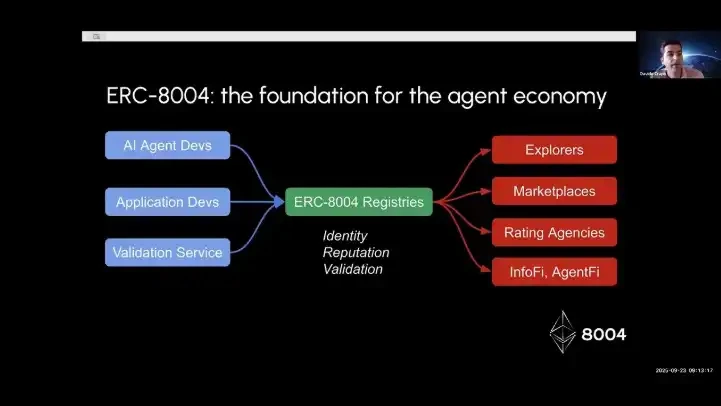
ERC-8004 introduces a set of neutral on-chain registries that solves this problem through on-chain identity, reputation, and verification mechanisms.
Each agent receives a portable on-chain identity: an ERC-721 token, an NFT representing the machine. This token points to a registry file that describes the agent's name, skills, wallet, and endpoints. Because it's standardized and based on neutral infrastructure, any marketplace or browser can index it.
Agents can leave feedback for each other, tagged by task, and link it to an economic proof of payment (x402 – short for EIP-402, a cryptographic receipt that ties on-chain payments to off-chain interactions). For higher-trust use cases, validators can confirm outputs through hardware zones, proof-of-stake mechanisms, or zkML verification. In short, it's an open rating and auditing layer for autonomous agents.
This standard lays the foundation for machine-to-machine economic activity. It builds a world without human intermediaries, enabling agents to trust each other in negotiations, transactions, and collaboration. This is a continuation of the blockchain's disintermediation logic in the fields of currency and contracts—removing the platform middleman between AI agents.
So far, more than a hundred teams are reportedly building to the specification.
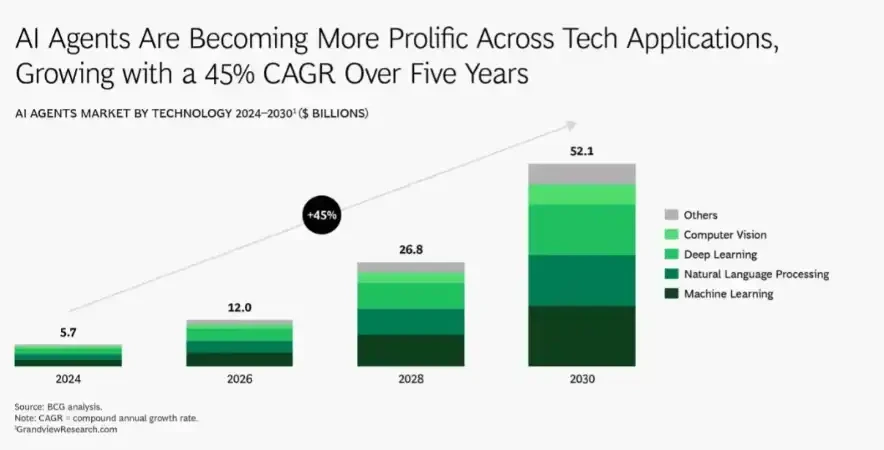
Huge investments in AI and crypto infrastructure
The release of ERC-8004 comes at a time of significant investment in AI economic infrastructure. Tempo, a payment-focused layer 1 blockchain, recently raised $500 million at a $5 billion valuation, while Thinking Machines, an AI startup founded by former OpenAI executives, secured $2 billion at a $12 billion valuation.
We are witnessing the largest funding rounds ever in the AI and crypto sectors.
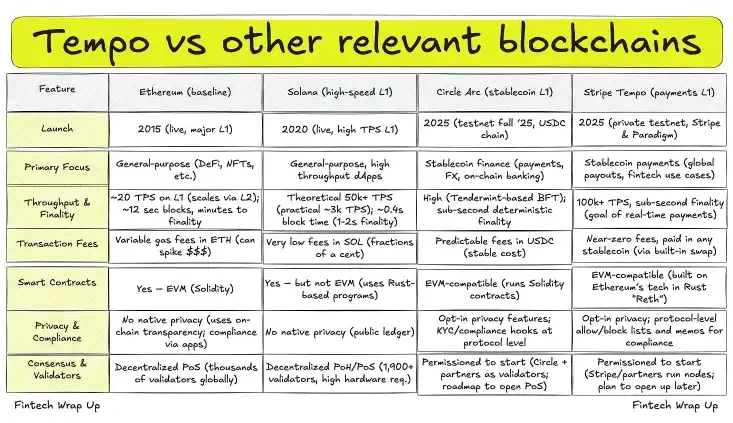
Tempo is building a closed payment network optimized for stablecoins and real-world finance. It's essentially the enterprise version of Ethereum's vision: a high-throughput, low-fee global transaction settlement channel. In Tempo's world, agents can process payments at machine speeds, but within a private ecosystem governed by its validators and fee model.
ERC-8004 can provide an open discovery and reputation layer for this ecosystem. Instead of defining which agents or merchants can transact with, Tempo can integrate an ERC-8004 registry so that any verified agent with a public on-chain identity can access its payment network. This will transform Tempo from a closed settlement layer to a programmable one, interoperable with the broader Ethereum agent economy.
Thinking Machines is positioned at a higher level. While its goals are still unclear, its existing products focus on training models to enhance their resilience and flexibility. This will help deploy autonomous agents capable of reasoning, collaborating, and transacting on the internet. Currently, these agents exist in closed, vertically integrated environments.
By adopting ERC-8004, Thinking Machines can build training tools for the open economy: each model or agent is discoverable and verifiable on-chain, has an ERC-721 identity token, and establishes a real-world reputation through x402-verified interactions. In practice, this means that a Thinking Machines agent can contract with a data provider agent on Ethereum, pay via Tempo or other chains, and send results back to the chain without human intervention.
In short, ERC-8004 unlocks programmable markets. It empowers autonomous agents to sign contracts, settle transactions, and build reputations on-chain, which is exactly what makes DeFi useful to humanity.
For fintech, the short-term impact is smaller; few businesses will replace APIs with proxies overnight. But once proxies can prove identity, creditworthiness, and payment, they can handle tasks ranging from credit scoring to transaction execution without the need for a platform middleman.


