Countdown to the fourth halving, witness the new era of Bitcoin with OKX



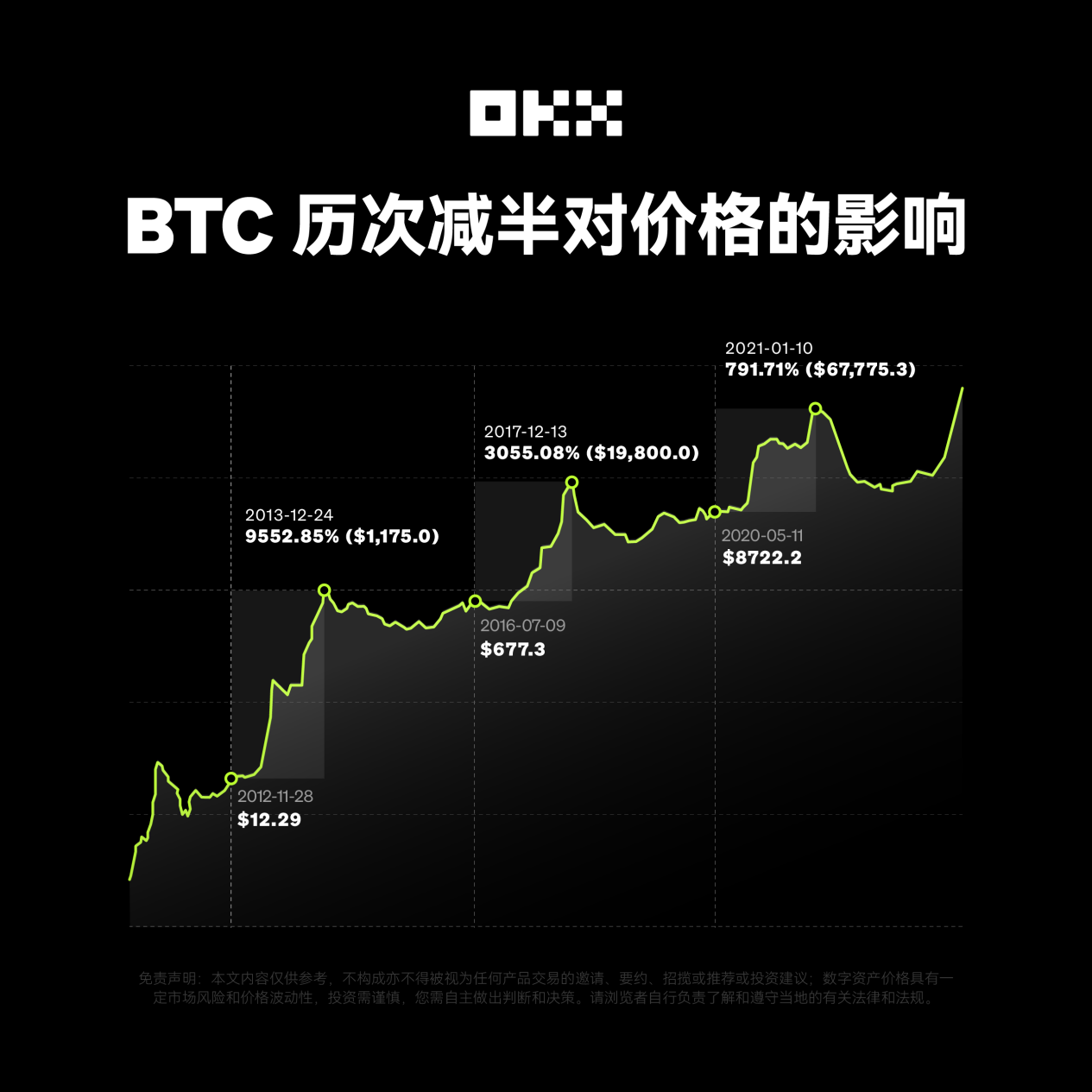
Looking back, Bitcoin has experienced three halving events since its birth in 2009. The first halving occurred in November 2012, when the reward for mining a block was reduced from 50 BTC to 25 BTC. The second halving occurred in July 2016, and the block reward was further reduced to 12.5 Bitcoins. Since then, Bitcoin has begun to gain more mainstream recognition and adoption, and the price of Bitcoin has risen sharply after the second halving due to factors such as supply and demand. Although there is no evidence that halving will lead to price changes, the expectation of the halving effect is beginning to gain popularity.
In May 2020, Bitcoin ushered in the third halving, and the mining reward was reduced to 6.25 Bitcoins. This was the most special halving cycle. It coincided with the global epidemic and macroeconomic adjustment cycle, which affected the market trend. The factors are many and complex. Now, the fourth halving is approaching.
Historical data shows that the price of Bitcoin has achieved relatively substantial growth after the first two halvings of Bitcoin. Past data provides a reference for people to observe and predict future market trends to a certain extent.
How is this halving different from previous ones?
The rise in Bitcoin prices has always been related to macroeconomic cycles, supply and demand relationships, policies and regulations, and ecological innovation. The halving is mainly a change in the relationship between supply and demand, which is not much different from previous halvings. However, what needs to be paid attention to is that the passage of Bitcoin spot ETFs and the emergence of inscription-related innovations are driving structural changes in the Bitcoin market.
According to SoSoValue data, the Bitcoin spot ETF had a total net inflow of US$179 million on March 28. Yesterday, Grayscales GBTC had a single-day net outflow of US$104 million, and the current historical net outflow of GBTC is US$14.77 billion. The Bitcoin spot ETF with the largest single-day net inflow yesterday was BlackRock IBIT, with a single-day net inflow of approximately US$95.12 million. The current total historical net inflow of IBIT has reached US$13.96 billion. As of press time, the total net asset value of Bitcoin spot ETFs is US$59.1 billion, the ETF net asset ratio (market value to the total market value of Bitcoin) reaches 4.25%, and the historical cumulative net inflow has reached US$12.12 billion. Continued adoption of Bitcoin ETFs could significantly absorb selling pressure, potentially reshaping Bitcoins market structure and providing a new source of stable demand.
In fact, you might as well refer to the development trend of gold ETFs to get a glimpse of the future of Bitcoin spot ETFs. In November 2004, the first gold ETF in the United States, SPDR Gold Shares (GLD), was born, accumulating more than US$1 billion in assets in just three days. In its first year, GLD’s assets under management (AUM) quickly climbed to over $3 billion. Global gold ETF assets under management have reached approximately $150 billion by 2023, demonstrating the profound and lasting impact these investment vehicles have on the gold market.
Additionally, the emergence of inscriptions has revitalized on-chain activity, with more than 59 million NFT-like collectibles having been inscribed as of February 2024, generating over $200 million in transaction fees for miners. With the successive launch of innovative Bitcoin ecological protocols such as Runes, the vitality of the Bitcoin ecological ecosystem is likely to continue to be stimulated.
Of course, more importantly, Bitcoin, as the cornerstone of Crypto, already has a strong value consensus around the world.
Currently, the cumulative number of Bitcoin addresses exceeds 1.2 billion. According to tokenterminal, the number of monthly active users of Bitcoin is about 13.7m, and the number of on-chain transfers is 17.5m. Regarding the growth of on-chain data, Bitcoin’s blockchain size is approximately 507 GB, an increase of 70% from three years ago. These reflect the explosive growth in usage of crypto assets, especially Bitcoin
Entering a new era of Bitcoin ecosystem with long-term builder OKX
As an active builder of the ecological development of Bitcoin, the OKX RD team has always been inspired by the origin of Bitcoin and its geek spirit, and this is also the core reason why OKX was able to enter the market at the first time to carry out ecological construction support work.
Since last year, the birth of the Oridinals protocol and the BRC-20 token standard has brought about the craze of inscriptions, which has made people turn their attention to the asset issuance protocol on Bitcoin again, and emerging projects such as Atomics, Runes, BTC Stamps, and Taproot Assets have emerged. Other diversified asset issuance protocols have also produced ARC-20, SRC-20, ORC-20, etc. In essence, Inscription Track has brought a new model of fair launch to the market, which has brought huge attention to the Bitcoin ecosystem. At the same time, it has also attracted renewed attention to the Bitcoin ecosystem.
In addition to asset issuance protocols and expansion plans, more and more projects are beginning to emerge in the infrastructure field, such as wallets that support inscriptions, decentralized indexers, cross-chain bridges, launchpad, etc., which are all flourishing. The OKX Web3 team has been continuously working on the first-level asset issuance protocol and application layer infrastructure construction. It was the first to support the Ordinals market and achieve great results.
As early as July last year, the OKX Web3 Ordinals market has become the Marketplace with the largest trading volume of BRC 20 tokens. Now with the continuous development of the Bitcoin ecosystem, the OKX Web3 team has developed almost everything from wallet tools, browsers, trading markets, protocol standards, and cross-border Chain Bridge and Bitcoin Layer 2 are continuing to build the Bitcoin ecosystem in all aspects. On the one hand, OKX DEX has supported Bitcoin cross-chain transactions in its early days. In terms of the second-layer expansion plan, OKX Web3 is also gradually supporting the access of related projects, such as Babylon, Merlin, B², etc. In addition, it is worth noting recently that the OKX Web3 wallet has been launched on the Runes market page and will support the protocol as soon as possible. By then, users can mint and trade Runes protocol assets.
Currently, OKX Web3 provides users with a one-stop Bitcoin ecological exploration experience. Users can easily acquire and trade assets through the Web3 wallet; discover and participate in popular projects in the Bitcoin ecosystem; and directly access the DeFi sector to realize on-chain pledge of Bitcoin assets and enjoy on-chain benefits with low gas fees.
In addition, as an investment fund under OKX, OKX Ventures is committed to funding the innovative development of the Bitcoin ecosystem. It has currently invested in ALEX, B^2 Network, Bitmap Tech, Babylon, bitSmiley, BounceBit, Nubit, Portal DeFi, Zeus Network and other projects. According to previous reports, OKX Ventures will continue to invest US$10 million in supporting new entrepreneurs in the BTC ecosystem, accelerating the improvement of blockchain technology, while providing services and resources to help partners develop together.
Looking back at the development of Bitcoin over the past ten years, every cycle is an evolution, and the same is true for OKX, which has accompanied the growth of Bitcoin and provided strong support for its ecological construction. The chief innovation officer of OKX once said in an interview that some of the OKX team’s RD personnel came into contact with the Bitcoin white paper around 2012. At that time, Bitcoin was still only popular in geek circles, and every innovative idea was exciting. All innovations at OKX since then will be inspired by those original spirits. Now, with the arrival of the fourth halving, Bitcoin has entered a new development cycle. For OKX, whether it is Web3 business, exchange business or funding innovation, it will continue to interact with Bitcoin through innovation. and even the crypto industry for the next 10 years.
Disclaimer
The content of this article is for reference only and does not constitute and shall not be regarded as an invitation, offer, solicitation or recommendation for any product transaction or investment advice; investment needs to be cautious, the price of digital assets has certain market risks and price volatility, especially transactions such as contract options. You are more susceptible to market risks and price fluctuations. Investing in digital assets is risky and may even cause you to lose the entire investment amount; therefore, digital asset trading may not be suitable for all investors. You need to understand the operating mode of the product and make your own judgment. and investment decisions. Visitors are responsible for understanding and complying with local laws and regulations.