






The Cancun upgrade is finally here, which stocks will benefit?


Original - Odaily
Author - Azuma
later today,Ethereum is expected to officially activate the Dencun hard fork upgrade at the Beacon chain (Slot) height 8626176.
The so-called Dencun upgrade is actually the collective name for the two upgrades Deneb and Cancun. The former is oriented to the consensus layer, and the latter is oriented to the execution layer. The Chinese translation of Cancun is the Cancun Upgrade that the Ethereum community has long awaited.
Before the official launch of the main network, Ethereum core developers and major client teams have deployed the Dencun upgrade on Devnet, Goerli test network, Sepolia test network, and Holesky test network in the past few months to test and observe the upgrade. and subsequent network health.
Upgrade content: Nine major EIPs in total, focusing on EIP-4844
According to the Ethereum Foundation, a total of nine EIPs (Ethereum Improvement Proposals) will be implemented for this Dencun upgrade, specifically:
EIP-1153: About transient storage opcodes;
EIP-4788: About beacon block roots in EVM;
EIP-4844: About sharded blob transactions;
EIP-5656: About MCOPY, the memory copy instruction;
EIP-6780: Regarding SELFDESTRUCT in the same transaction;
EIP-7044: Regarding permanently valid voluntary opt-out signatures;
EIP-7045: Regarding adding the maximum timeslot included in the proof;
EIP-7514: About adding maximum Epoch churn limit;
EIP-7516: Regarding the BLOBBASEFEE opcode.
For readers who are not familiar with Ethereum development terminology, you do not need to understand the specific content of each EIP mentioned above. You only need to focus on the most important update of Dencun this time - EIP-4844.
EIP-4844, also known as Proto-Danksharding, is the front-end solution of Danksharding, the current mainstream sharding idea in the Ethereum community.The main content of EIP-4844 (Proto-Danksharding) is to introduce a new transaction type Blob transaction to Ethereum, by adding an additional temporary data space Blob to the block on the Ethereum main network, specifically for Process Layer 2 related transactions, thereby significantly reducing Layer 2 transaction fees.
Micro-analysis: How do blobs affect Layer 2 transaction costs?
Earlier this week, Ethereum core developer eric.eth posted on the It is suspected of stealing the concept, and what it wants to express is that the gas cost of Ethereum-based Layer 2 transactions will be reduced to about $0.01.
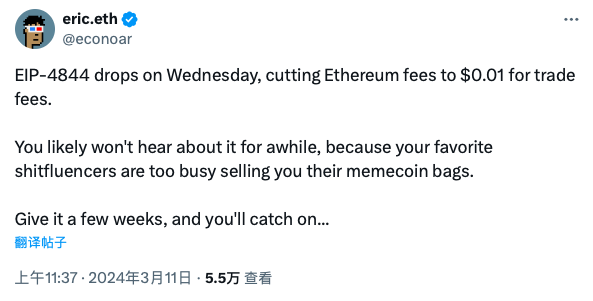
So, how does “Blob trading” help Layer 2 reduce costs and increase efficiency? After the upgrade, can the transaction cost of the Layer 2 network really be reduced to an extremely low level of $0.01?
To answer these questions, we first need to focus on the operating mechanism of Layer 2.Whether it is Optimistic Rollup or ZK Rollup, as long as it is Layer 2 that relies on the Ethereum main network as the DA layer in a narrow sense, it will follow the following operating model - Layer 2 needs to write its transactions, proofs and execution results to the Ethereum main network. calldata data space in the calldata space, thereby passing its history to Ethereum, relying on the latter to ensure the decentralization and security of the network.
This data synchronization mode that relies on calldate has been running stably for a long time, but there has always been a serious problem——The calldate write transaction submitted by Layer 2 needs to compete in the same fee market with all transactions on the Ethereum main network. This will cause the transaction cost of Layer 2 to be significantly affected by the gas status of the Ethereum main network.
In order to ensure that the calldate write transaction can be executed smoothly on the Ethereum main network,Layer 2 will pass on this part of the cost to users who execute transactions on Layer 2.Currently, the cost of calldate writing transactions accounts for the vast majority of Layer 2 transaction costs, which is why users generally feel that the current Layer 2 transaction costs are still too expensive.
After EIP-4844 is implemented, Ethereum will add an additional data space Blob to the block specifically for processing Layer 2 related transactions.At that time, Layer 2 will no longer need to write data to the calldate space. Instead, it will use the Blob space to complete data synchronization operations. In addition, Layer 2 related transactions will be separated from other Ethereum main network transactions as two independent fee markets. Come, no longer interfere with each other.
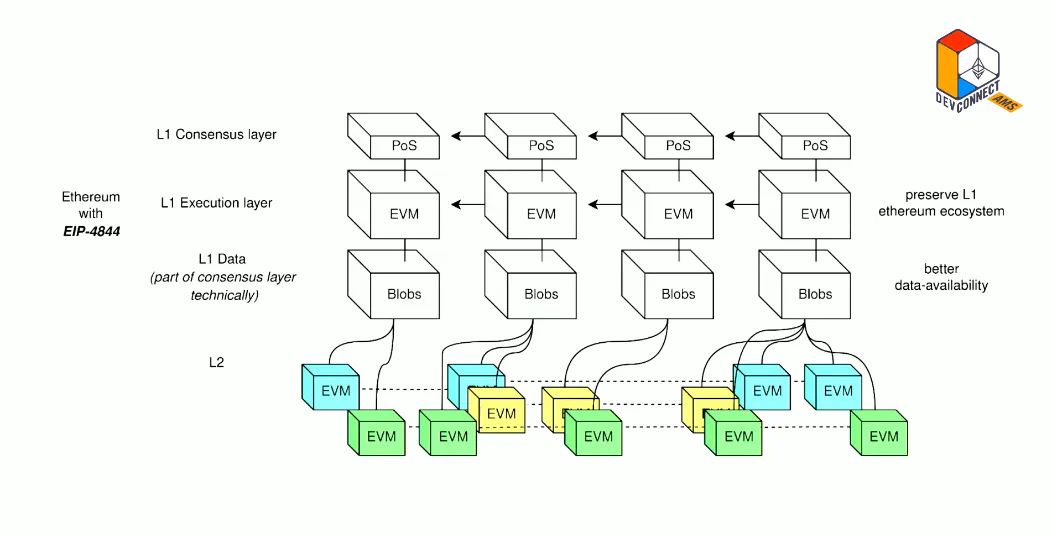
It is worth mentioning that in order to prevent the additional Blob data space from causing too much burden on the Ethereum main network nodes, the data in the Blob will be cleared regularly, which also means that the historical data storage mechanism of Layer 2 will undergo some new changes in the future. .
Combined with the above analysis, it can be expected that after the implementation of EIP-4844, the data synchronization cost of the Layer 2 network will drop significantly, thereby indirectly reducing the user transaction costs on the Layer 2 network; in addition,As the block space originally occupied by Layer 2 is released (transferred to Blob), the fee competition pressure faced by other Ethereum mainnet transactions will also be relieved. Therefore, EIP-4844 will also reduce the transaction fees of the Ethereum mainnet to a certain extent. cost.
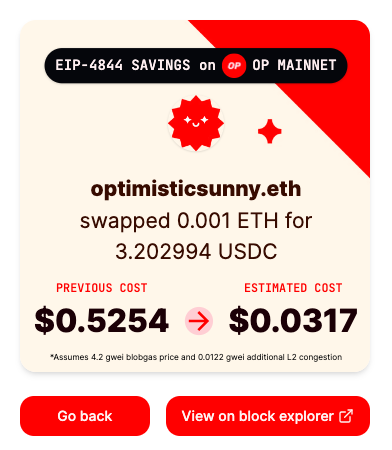
As for how far the transaction costs on major Layer 2 will be reduced after the upgrade is completed, Optimism has launched awelovetheblobsThe website is used to intuitively check the cost changes of various operations. For example, the transaction cost of executing a swap on Velodrome will be reduced from US$0.52 to US$0.03 in real time.
Positive targets: What else besides Layer 2?
For investors, in addition to understanding the content and functions of the Dencun upgrade, the most interesting topic is which potential targets this upgrade will benefit.
first,Dencuns upgrade will naturally directly benefit the entire Layer 2 sector.L2 BEAT data shows that the number of Layer 2 currently in operation is as high as 45, and the number of Layer 2 to be launched on the main network is also 34, which includes Optimism (OP), Arbitrum (ARB), and Starknet that we are already quite familiar with. (STRK), Metis (METIS), Manta Pacific (MANTA) and other issued currency projects, as well as unissued currency projects such as zkSync, Blast, Linea, Scroll and so on.
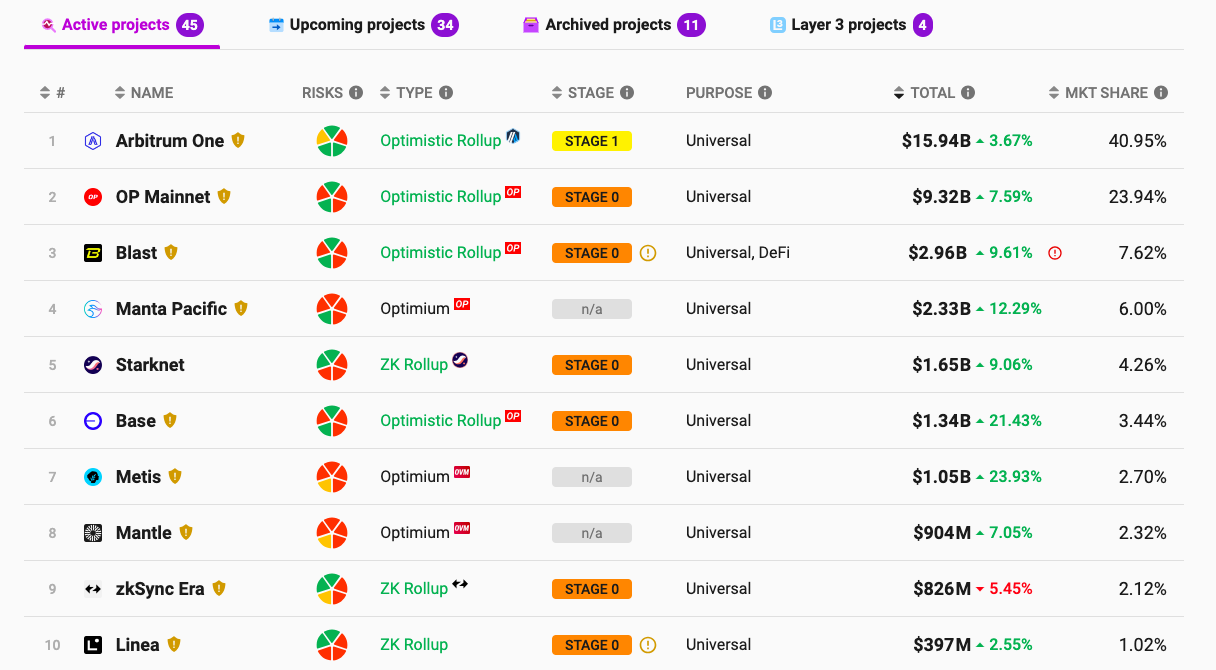
With the Dencun upgrade, especially the implementation of EIP-4844, the above-mentioned projects and more Layer 2 not mentioned will achieve obvious cost reduction and efficiency increase, allowing the Layer 2 network to eliminate the transaction costs that were once expected to be compared with Disadvantages of low-cost Layer 1 such as Solana.In the long run, reduced transaction attrition will help major Layer 2 attract and retain more users, and will also help attract more developers to conduct multi-faceted development attempts, thereby continuously improving ecological vitality.
Among the many Layer 2s, zkSync may need special mention, because zkSync founder Alex Gluchowski once mentioned that the new expansion solution zkPorter will be launched after the implementation of EIP-4844, and zkPorter needs to rely on zkSyncs native token to ensure data availability,This may mean that zkSync should not be too far away from issuing coins.
In addition to directly benefiting Layer 2, the Dencun upgrade will also indirectly benefit other related fields and tracks.
for example,Projects with high concurrency requirements and low unit value attributes such as games and social networking on Layer 2 may usher in a window of accelerated growth.Currently, due to the problem of still high costs, the mainstream application types above Layer 2 are still low concurrency requirements and high unit value projects represented by DeFi, because only such projects can achieve higher level of success. Achieve ideal economic effects at a low cost, and with the advent of Dencun upgrade, this situation may also usher in a change.
Furthermore,Storage concept projects may also usher in certain development opportunities due to changes in Layer 2s storage requirements for transaction history.Since Blob does not store data permanently like calldate, this means that Layer 2 needs to find other ways to store historical transaction data for a long time. New needs are new opportunities.
also,If Layer 2 can further win market consensus after reducing transaction costs, RaaS-type water delivery services may also see more demand for utilization., but this is a relatively long-term topic.
All in all, as the Dencun upgrade gradually becomes a reality,The overall fundamentals of the Ethereum ecosystem will surely improve significantly, and this benefit will also radiate to all components within the Ethereum ecosystem.
In the short term after the upgrade is completed, users may not have any other obvious perceptions except the reduction in Layer 2 fees, but in the long term,The potential ecological vitality that the Dencun upgrade itself can bring and its role as a foundation for subsequent upgrades will undoubtedly push Ethereum to a new stage of development.


