






详解Berachain:模块化EVM框架+流动性证明机制,会成为流动性困境破局者吗?


On January 11, Berachain officially announced the launch of its public test network Artio. Although the testnet has been rumored to be launched soon since November last year, even the delay has not affected market attention. In less than ten days, ArtioattractIt has more than 1 million testnet users and more than 70 ecological DApps. This has to make people wonder, from the initial NFT project of community members to the cutting-edge public chain, what is unique about Berachain?
origin
Berachain originated from the Bong Bears NFT project, which was jointly launched by several old OHM OGs, and subsequently attracted a number of OHM OG investors to join. Bera is a typo deliberately made by Bear, in order to pay tribute to the old crypto-meme Hodl.
Berachain has now developed into a high-performance EVM-compatible blockchain, built based on the Proof-of-Liquidity (PoL) consensus mechanism, with the goal of strengthening the synergy between Berachain validators and the project ecosystem. Adjust network incentive mechanisms. In addition, Berachain’s technology is based on Polaris, a high-performance modular framework for building EVM-compatible chains on top of the CometBFT consensus engine.
Berachain completed a US$42 million Series A round of financing in April 2023, with a valuation reaching US$420.69 million. Polychain Capital led the investment, and OKX Ventures, Hack VC, former Dragonfly Capital partner, Celestia founder Mustafa Al-Bassam and Tendermint jointly Founder Zaki Manian and others participated in the investment.
Berachain Token Model
Berachain uses a three-token mechanism, namely BERA, BGT (governance token) and HONEY stable currency. Each token plays a specific role in the network:
BERA: As a typical Layer 1 native token, it is mainly used to pay gas fees and block rewards. Advantages: Maintain the health and vitality of the network through the gas fee mechanism.
BGT: As the governance token of Berachain, this token is non-transferable and there are currently three ways to obtain it: providing liquidity on BEX, lending HONEY, and providing HONEY in Berps’ bHONEY vault. Holders can participate in on-chain decision-making processes, such as voting on block rewards for staked assets and the selection of stakeable tokens. Advantages: Separating the governance token from the base Gas token allows for more efficient allocation of network resources and rewards. This model improves the fairness and transparency of governance so that the most active users will not lose governance rights by paying transaction fees.
HONEY: Berachain’s native consensus-collateralized stablecoin. Users can mint HONEY by staking other assets on the Berachain platform. Advantages: HONEY, as a stable currency within the chain, provides a stable trading medium for decentralized applications, increasing the usability and attractiveness of the platform.
In addition to the three tokens, there is a concept that needs to be understood - BCV (block capture value). Certain transactions in the three DApps of BEX, Honey, and Perps will generate a fee, which is passed on by BCV. thismeanThus, as long as a validator includes one of these fee-generating transactions in their block, they are rewarded with that fee. Validators collect their portion of BCV through commissions and then transfer the remainder to BGT delegators. The implication is that staking BGT will be profitable, because you can earn BERA, BGT, and HONEY.
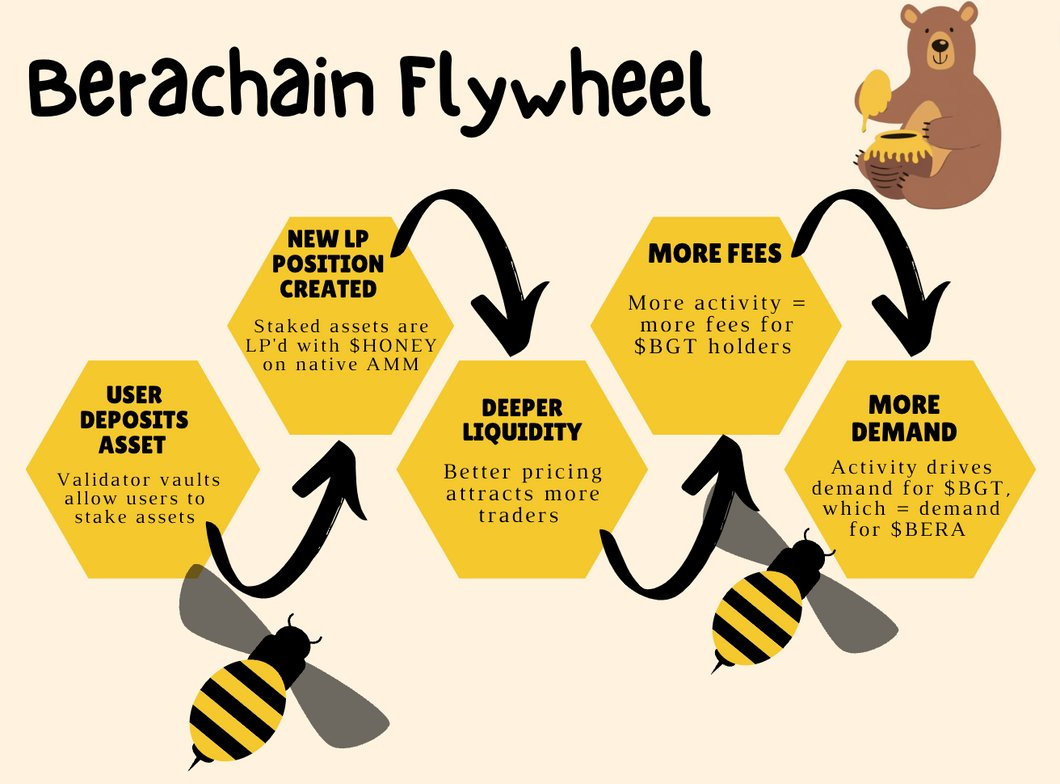
In summary, users deposit assets (such as ETH, BTC, USDC, etc.) into the system to obtain Bera tokens. The system then uses these assets to pair with Honey to provide liquidity for protocols such as AMM. This enhanced liquidity in turn attracts more traders and project participation, thereby bringing more transaction fees to BGT. Since BGT can only be obtained by staking Bera, this mechanism attracts more users to stake Bera to generate BGT. In this way, the system continues to attract more assets to join in order to obtain Bera, forming a flywheel, as follows:
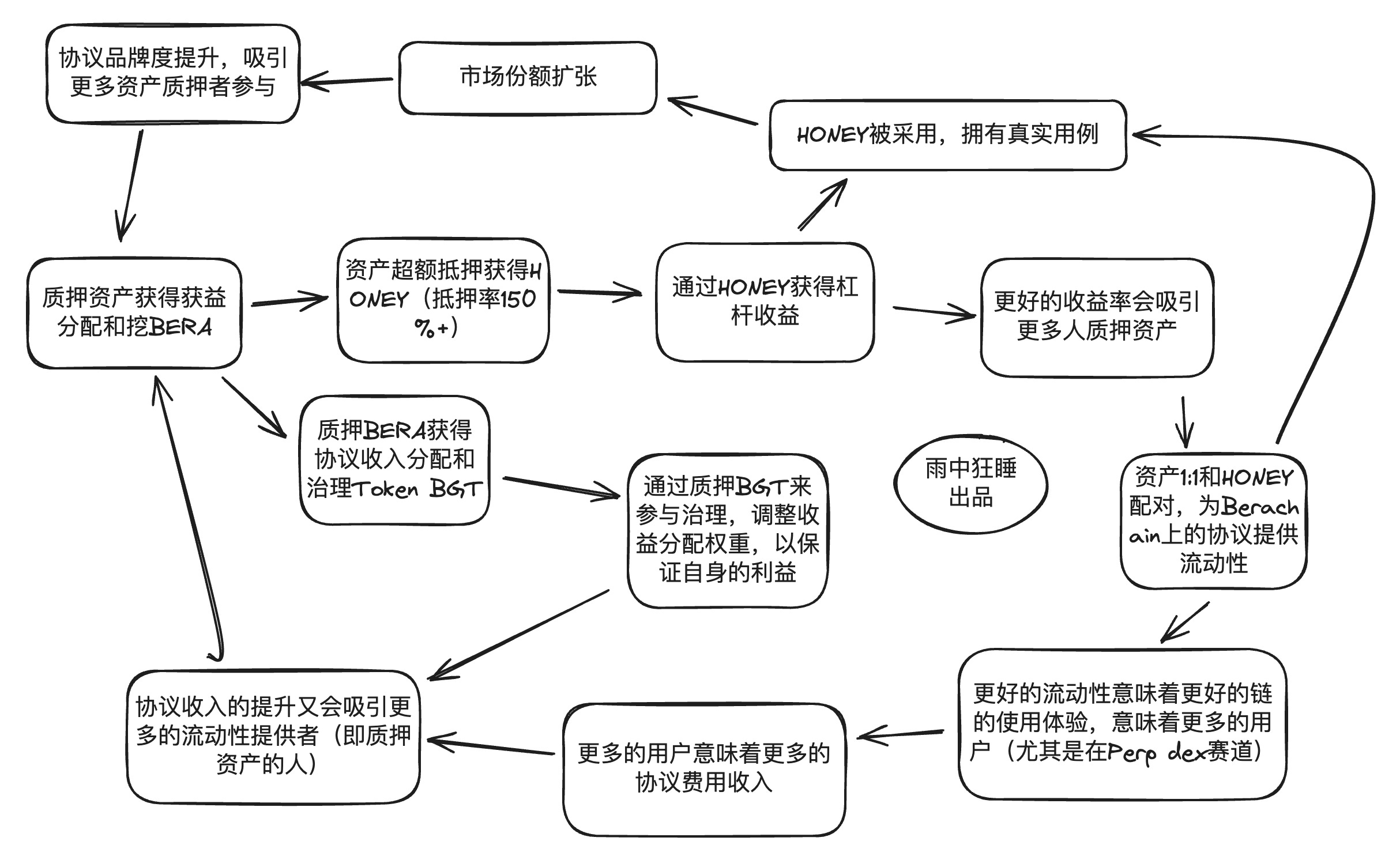
(The picturefrom(Yu Encryption Researcher Sleeps in the Rain)
Proof of Liquidity Consensus Mechanism (POL)
PoL differs from traditional PoS systems in that it requires users to contribute to network security by providing liquidity for DeFi primitives within the chain, such as AMM DEX, perpetual exchanges, and stablecoin lending platforms. This mechanism directly links the act of providing liquidity with enhanced network security, promoting incentive alignment between network security and liquidity.
The operation of this mechanism can be broken down into several key links:
Multi-asset pledge:
Different from the traditional consensus mechanism that only uses native tokens for staking, PoL allows users to stake various assets, such as ETH, BTC, etc., and the pledges are allocated to validators to participate in DPoS.
This diversified staking method helps reduce reliance on a single asset and enhances the health and stability of the entire network through the liquidity support of multiple assets.
Coordinate the relationship between validators and liquidity providers:
In the PoL system, validators can incentivize specific LP pools through BGT, and the protocol can help validators accumulate BGT pledges through mechanisms such as bribery.
Users provide liquidity to certain pools to earn BGT, which is then used to delegate to validators. Validators produce blocks based on the proportion of BGT delegated to them, and delegators and validators in turn receive rewards from the chain.
Integration of liquidity and governance:
The PoL mechanism integrates the concept of liquidity into the governance structure of the blockchain. Validators can vote to determine the allocation of BGT among different liquidity pools, further enhancing the overall liquidity and governance efficiency of the network.
Long-term impact on cyber health:
In this way, PoL aims to systematically build liquidity and promote efficient trading, price stability, network growth, user adoption, and successful operation of decentralized applications.
PoL also helps solve the staking centralization problem that exists in PoS systems, helping to maintain the integrity of the chain and prevent manipulation.

Berachain’s modular EVM framework “Polaris”
Polaris provides an execution environment for smart contracts on Berachain. It is a feature-rich, highly modular framework that is seamlessly integrated with the Cosmos ecosystem. Its core features include:
Enhanced EVM experience: Polaris EVM provides an improved EVM experience beyond the base implementation of Ethereum. It allows developers to create stateful precompiled and custom modules, making smart contract creation more efficient and powerful.
Modular implementation: Polaris is a modular implementation of EVM that can be easily integrated into any consensus engine or application, including Cosmos-SDK. This modular approach simplifies the EVM integration process and reduces the time and cost for developers to implement EVM integration solutions on their own.
Application of stateful precompiles: Stateful precompiles are precompiled contracts that can change the state on the chain, achieving more efficient state operations with lower gas costs. These precompiled contracts provide additional functionality to the Polaris EVM, making it more efficient and powerful when executing smart contracts.
Custom opcodes: Custom opcodes have been added to the Polaris EVM implementation to support more complex smart contracts.
Full interoperability with the Cosmos ecosystem: Polaris Ethereum is a blockchain framework built on the Cosmos SDK. It not only provides a full-featured EVM, but also achieves full interoperability with the Cosmos ecosystem. By integrating multiple state precompilations on the chain, EVM users are able to perform native operations of Cosmos, such as governance voting, validator delegation, and interact with other chains through IBC. This design enables true interoperability between Cosmos and EVM while retaining the native EVM experience.
Summarize
After understanding this, you can find that Berachain is not a meme chain with weak technology. In fact, Berachains three-token model and PoL consensus mechanism are very cleverly designed in an efficient market, ensuring that the value stream continues to flow back to users. In addition, on Berachain, users are not only investors, but also active participants in the ecosystem. This combination of in-depth participation and incentive mechanism is the core advantage that distinguishes Berachain from traditional Meme chains.
But its worth noting that both OHM and Luna were known for their unique economic models, but both ended up suffering major slumps, resulting in significant losses in market value. The collapse of these two projects was mainly attributed to the unsustainability of their token issuance and staking mechanisms, as well as their over-reliance on liquidity. For Berachain, although it attempts to create a more robust and sustainable economy through a three-token model and a proof-of-liquidity consensus mechanism, it remains to be seen whether it can truly avoid the risks that emerged in the OHM and Luna cases.
Ref:
https://docs.berachain.com/learn/
https://docs.berachain.com/learn/protocol/bgt-token
https://medium.com/berachain-foundation/the-bera-era-has-begun-49a18c6d77c0
https://polaris.berachain.dev/docs/evm-on-polaris
https://github.com/berachain/polaris





