Arthur Hayes: Cryptocurrencies may face a sharp decline in March this year


Original author: ARTHUR HAYES
Original compilation: Deep Chao TechFlow
Arthur Hayes published his new article on January 5. The article mainly expresses his views on the early market conditions in 2024 and his trading strategies. Shenchao compiled the full article.
(The views expressed below are the personal views of the author and should not be used as the basis for investment decisions, nor should they be understood as recommendations or recommendations to participate in investment transactions.)
Trees provided me with direction to navigate during a snowstorm in Hokkaido, while central bankers and politicians also provided me with direction when investing in global capital markets. While no trader can predict the future, we can observe the market and assign a probability to the outcome of each event. If the markets probability of a certain event does not match our own calculations, there is a certain trading opportunity.
The cryptocurrency bull market is in its early stages and we must keep our enthusiasm in check. Just as Bitcoin produces a block every 10 minutes, the current filthy fiat financial system will meet its predetermined ignominious end. However, while I am certain of this end result, the path to this future is unknown. We must remain vigilant and invest our bets accordingly.
In short, I have deployed enough capital for this phase of the cycle, selling fiat and buying crypto. I was preparing for a sharp drop in all cryptocurrencies this March, and there were various events that made me foresee that this was going to happen. I will lay out my rationale, and the inflection points I will observe that will give me the confidence to aggressively short the cryptocurrency market using Bitcoin puts, then sell U.S. Treasury Bills (T-bills), and acquire more Bitcoin and Other cryptocurrencies.
variable
There are three conflicting variables in the form of questions in March.
When does the Reverse Repurchase Program (RRP) balance approach zero?
By lowering the RRP balance, liquidity is injected into the financial markets. As that number approaches zero, which I define as $200 billion in liquidity, the market will be wondering whats next and will need to have another source of dollar liquidity to sustain the markets frenzy.
To learn more about the mechanism of how RRP balance drops inject liquidity into the system, read my article“Bad Gurl”。
Here is a chart of RRP balances since inception. The horizontal white line is $200 billion.
I believe reverse repo balances will hit $200 billion in early March. This estimate is based on the rate of decline from different starting points in 2023.
Will the Bank Term Funding Plan (BTFP) continue?
On March 12, bankrupt banks must find cash to swap with Treasuries and other eligible bonds they buy back to the Fed. Ultimately, this is Yellens decision. Markets will start wondering a few weeks ago whether the Bank Term Funding Program (BTFP) can be sustained.
The original BTFP process was for the bank to offer $80 worth of Treasury securities on the open market but receive $100 in cash. When the program ends, the bank must repay the $100 before receiving the original Treasury note. If the cash is given to fleeing depositors, how will the bank get the cash without selling more equity or issuing high-yield bonds?
To understand why BTFP was created and its impact on the speed and volume of fiat currency devaluation, read my article《Kaiseki》。
Will the Fed cut interest rates?
The Fed’s March meeting will end on the 20th of this month. Currently, markets expect the Federal Reserve to cut interest rates for the first time since it began raising rates in March 2021, by at least 0.25%.
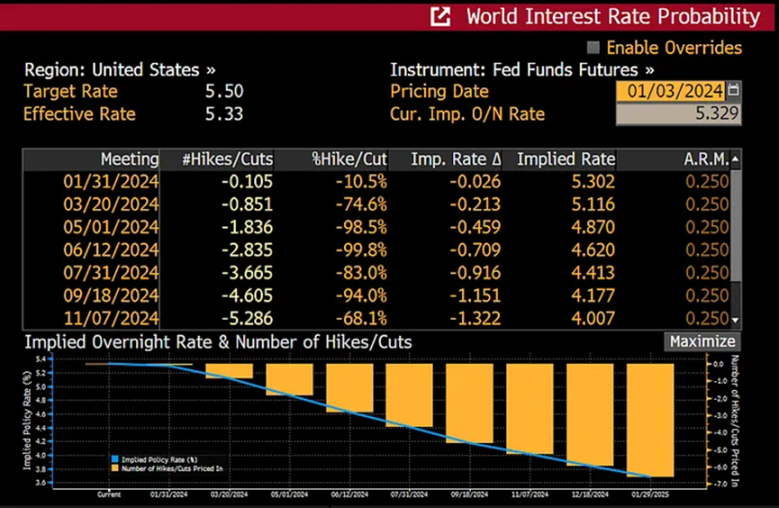
This is a table of Fed fund futures suggesting the probability of raising interest rates at future Fed meetings. As you can see, as of January 3, the market was pricing in a 75% chance of a 0.25% rate cut.
These variables above are interdependent. The sequence of events is important because it will affect market assumptions about how much U.S. dollar liquidity the Fed and U.S. Treasury will or will not provide going forward.
If my prediction is correct
Now we have to assign probabilities to different event paths and predict how the market will react.
The speed at which reverse repos are reduced
If reverse repos approach zero in early March, financial markets will begin to decline. Remember the surge in Treasury yields that coincided with the stock market crash? The only reason the Treasuries rebounded sharply starting on November 1st is because the quarterly Treasury Department Debt Management Report was released that day (Note: The purpose of these documents is to provide transparency about the governments borrowing needs and strategies and to inform investors and The markets upcoming auctions, the types and sizes of securities being issued, and any changes in debt management policies. They are critical to financial markets because they affect interest rates and investment strategies.)
The report confirms that the U.S. Treasury will shift borrowing more toward the short end of the yield curve. As the supply of Treasury bills increases and yields increase, money market funds (MMFs) will be financially incentivized to purchase Treasury bills using cash parked in RRPs. All else being equal, a decline in RRP balances increases liquidity in the system; this is why global bond and stock markets have surged.
The white line is the 10-year Treasury note and the yellow line is the difference between the 10-year and 2-year Treasury yields. As you can see, yields peaked at the end of October in an intensifying bearish trend, meaning the white and yellow lines rose simultaneously. A violent bond short squeeze began in early November, sending yields plummeting.
Without other new sources of USD liquidity, I believe bonds, stocks, and even cryptocurrencies will take a hit as well. I’ll elaborate on this later in the tactical trading section, but I would buy a large put option position on Bitcoin at this time.
We have no way of knowing in advance how quickly reverse repos will decline. So Ill be keeping a close eye on the rate of change. If it deviates materially from my prediction, I will adjust my trading strategy accordingly. Regardless, I bought a lot of cryptocurrencies in the second half of 2023 and I don’t think between now and April is a good time to be long on cryptocurrencies.
Bank Term Financing Plan (BTFP)
2024 is an election year in the United States, and ordinary Americans are tired of bailouts from bankers. Therefore, I believe Yellen will not renew the BTFP in order to demonstrate the strength of the US banking system. However, once a few large enough non-TBTF banks (TBTF meaning too big to fail) were forced to take over due to near-zero equity, the necessary regulatory capital disappeared. U.S. Treasury Secretary Yellen is bound to inject more liquidity into banks in the form of a new version of BTFP.
Global financial markets will be devastated due to the lack of liquidity flowing from reverse repos and the inability of printed money to cover bond losses on non-TBTF bank balance sheets. The market will cause severe damage to financial asset holders, forcing the Federal Reserve and the Treasury to release funds again. This is relevant. All assets, including cryptocurrencies, will fall together as markets jitter at the prospect of free markets once again kicking in and clearing the system of insolvent banking institutions.
March FOMC meeting
BTFP will expire on March 12, and the Feds interest rate decision will be announced on March 20. There are six trading days between these two key decision points. If my forecast is correct, market conditions during this period will bankrupt some banks, forcing the Fed to cut interest rates and announce a return to BTFP.
Technically, the U.S. Treasury cant lend to banks, thats the Feds job. But assuming the Fed incurs losses by accepting collateral worth less than the dollars provided, those losses would flow to the Treasury, and ultimately to U.S. taxpayers, because the Treasury would have to borrow more money to fund the Feds losses.
Bitcoin will initially fall sharply along with broader financial markets, but will rebound ahead of the Fed meeting. This is because Bitcoin is the only neutral reserve hard currency that does not become a liability to the banking system and is traded globally. Bitcoin knows that when things go bad, the Fed will always respond by injecting liquidity. It may be called something new to confuse those who get their news from TikTok, but rest assured, Bitcoin knows that printed money is always printed money, no matter what guise it takes. Therefore, Bitcoin will rise significantly before and after the Fed finally gives in and restarts the money printing presses.
if my prediction is wrong
If my prediction is wrong, the following will happen:
Reverse repurchase program (RRP) will slowly decline and liquidity will continue to support financial markets through the end of the second quarter
Yellen will make it clear by March 12 that the Bank Term Funding Program will be extended
The Feds decision at its March meeting becomes irrelevant. Whether they cut rates, leave them unchanged, or raise rates, based on any of these outcomes, combined with the Fed and Treasury adding dollar liquidity to the market in other ways, the net effect would still be stimulative.
If RRP declines more slowly than expected, I will not enter my put option position in early March. Additionally, the date Yellen communicates that BTFP will be renewed is the moment I exit the no-trade zone. I will resume selling US Treasuries and buying Bitcoin and other cryptocurrencies.
Trading straregy
Lets get back to my predictions: RRP depleted in early March, BTFP was canceled on the 12th, but restored by the 20th, and the Fed cut rates. Now I will talk about my trading plan.
Bitcoin Put Options
As many of you know, I have a diversified cryptocurrency portfolio. My largest positions are in Bitcoin and Ethereum, accounting for ~70% of my portfolio. Other cryptocurrencies I hold are much less liquid, especially these crypto derivatives are very illiquid. So if I want a liquid macro cryptocurrency hedge, I have to use Bitcoin derivatives. I use the word hedge; this is a trading position and the trade setup I describe takes only two weeks to resolve. Since this is a trade, I will be using options, which allows me to know in advance my maximum loss: the premium paid for the put. An added benefit is that I dont have to monitor liquidation levels like I do when trading perpetual swaps or futures contracts.
I expect that whatever price Bitcoin reaches in early March, it will experience a 20% to 30% correction. If U.S.-listed spot Bitcoin ETFs had begun trading, the wash could have been more severe. Just imagine, if hundreds of billions of dollars in fiat currencies flow into these ETFs in the future, Bitcoin will break through $60,000, close to the historical high of $70,000 in 2021. I could easily see a 30% to 40% pullback due to the sudden withdrawal of USD liquidity. This is why I can’t buy Bitcoin until these March decision dates pass.
I think I am a dedicated trader. I will try to top-trace the market in late February and then buy a sizable bearish position. I will be buying puts expiring on June 28th. I didnt want to choose the March 29th expiration because I entered the position in early March. High negative theta may overwhelm any delta, gamma and vega gains and losses. Longer maturities will be more expensive, but since the maturity lasts longer than a quarter, the premiums wont decay as quickly.
I would set my maximum loss, which would be quite large relative to my standard trading position, and then buy the put. To get some nice gains on these puts, I would choose a strike price that is 20% to 25% out of the money based on the current June quarter futures contract price.
Exit a position
Many traders, especially options traders, are good at entering but make mistakes when exiting. Because option returns are path dependent, you may call the market correctly but still lose money if you wait too long to close your position. Every day I held these puts, I lost money. If my prediction is correct, the market will begin to correct significantly around March 12th. Between the 12th and 20th I need to try to exit the position at the market low and hopefully make a profit. If I am right about policy but Bitcoin holds or rises, I must close my put option position immediately.
Bull market continues
By the end of March we will be back on track. Yellen and Powell reaffirmed that they will spare no effort to maintain the legal solvency of the peaceful financial system under American rule. With this brief market turmoil behind us, cryptocurrencies can once again surge in anticipation of the upcoming Bitcoin block reward halving. Therefore, I will resume selling Treasuries and buying Bitcoin and other cryptocurrencies.
unexpected variables
This article focuses entirely on the decisions of two managers of the American-style financial system. However, there are other key players in the fiat financial system that cannot be ignored.
China
The Taiwan election could result in a pro-China candidate winning, and then the Chinese government would turn on the yuan printing presses. A steady stream of renminbi credit poured into global markets, overwhelming any problems with the U.S. banking system. Even if RRP dries up and BTFP does not renew, the cryptocurrency will move higher. Therefore, I may choose not to buy puts and instead switch to buying more crypto.
Japan
The Bank of Japan is currently allowing Japanese government bond (JGB) yields to rise slowly. If JGB yields continue to rise, this will provide a financial incentive for Japanese companies, pension and insurance funds, and households to repatriate capital. They will sell Treasuries and buy JGBs because the yields are better domestically. If this trend increases, I will definitely write an article detailing this phenomenon for my readers. Given that Japan is the largest holder of U.S. Treasuries and the largest international creditor (in terms of its net international investment position), actions by the Japanese private sector could put significant upward pressure on U.S. Treasury yields beyond 10 years.
Thats according to the International Monetary Fund, which estimates Japans net international investment position at a positive $3.3 trillion.
This pressure may manifest itself before early March and force the United States to take more money-printing measures. If so, I might not even get a chance to do this trade since Yellen had already renewed BTFP by mid-March and introduced a novel way of releasing money. One candidate is the Treasury Departments new plan to purchase existing long-term Treasury securities by issuing more short-term bonds. Its a mild form of yield curve control that she calls a buyback program. There was an explanatory article about this last year,If you are interested you can click here to read.
at last
With the new year dawning, central banks printing money in various forms, and the expected listing of spot Bitcoin ETFs in the U.S. and Hong Kong, risks are moving to the downside. It’s not hard to be bullish now. I like to buy stocks that do well when things the market thinks are impossible are seen as possible. From a trading perspective, the risk reward is better by taking a non-consensus view using these signposts representing binary outcomes. I may end up being wrong. But if Im right on the basis of expected value, my gains will be much greater than if I just follow the herd.