






Revisiting the application layer: The era of reflexivity is finally over


Original author: Trace, Figment Capital
Original compilation: Luffy, Foresight News
A universal blockchain stores state and provides the logic for that state. We usually call the state an asset and the logic an application. For example, Ethereum stores assets such as Ether and Dai (state), which can be used in applications such as Uniswap and Aave (logic). State and logic together form what we call the application layer.
Application layer
The crypto economy began with the advent of Bitcoin in 2009. Bitcoin is a functionally simple blockchain whose limited state, inflexible logic, and low-performance infrastructure limit its applications.
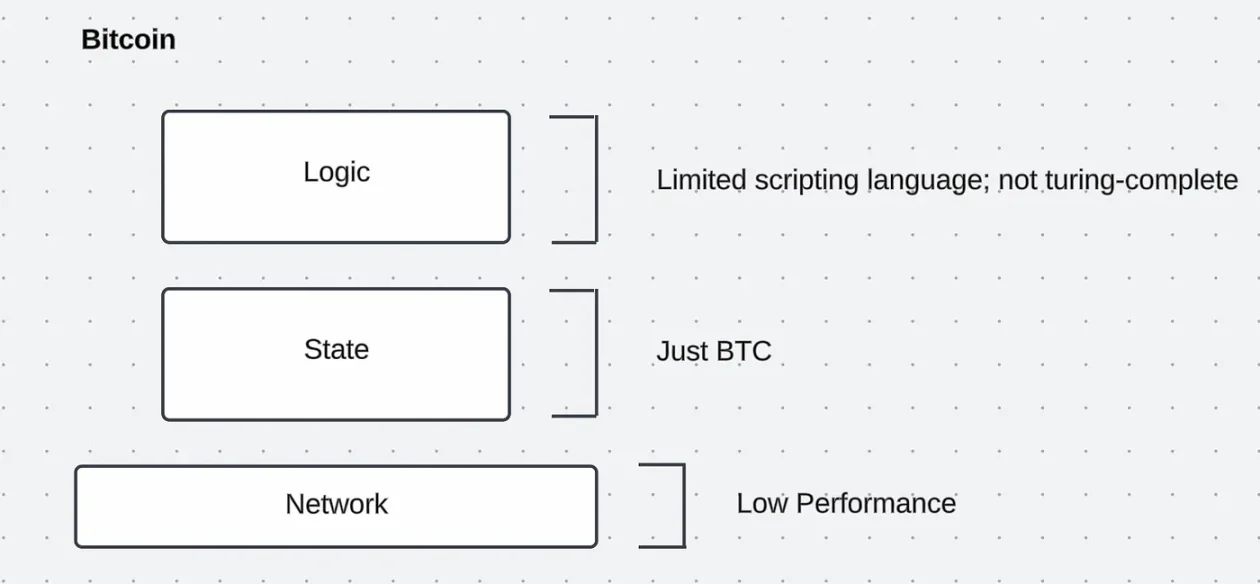
Bitcoin
Then there’s Ethereum, which introduces a flexible logic layer via a new blockchain-native virtual machine. It also allows anyone to create their own crypto assets on the same network. Ethereum therefore extends the state layer and logic layer.
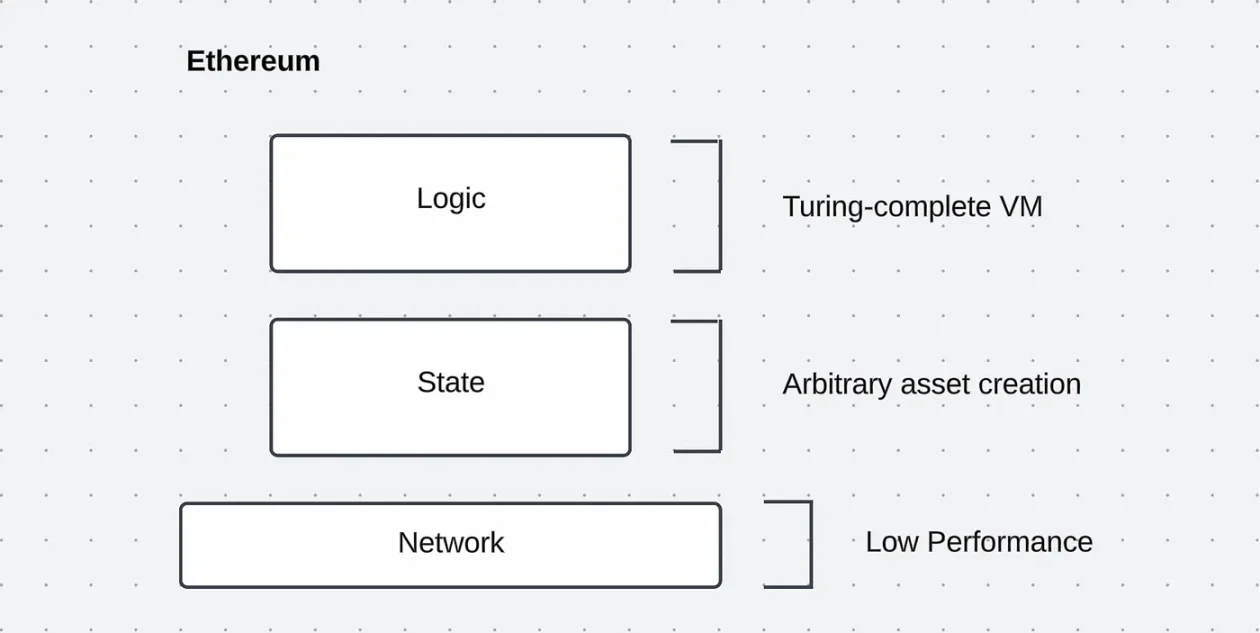
Ethereum
However, Ethereum’s infrastructure is still limited. Since its inception in 2015, much of the Ethereum research community has focused on improving its infrastructure to support the application layer. Rollup and Danksharding improve throughput, and account abstraction enhances user experience. MEV infrastructure can provide better price execution. Yet 8 years later, many people are overwhelmed by what we are building on top of the application layer. Of course, we can trade AAVE on Uniswap and lend UNI on Aave. But where is the real exogenous demand? Where are the use cases?
Today, blockchain is already very reflexive. There are walls between the crypto economy and the real world, and it’s difficult for cryptocurrencies to appeal to the real world except for speculation. Past bull markets, such as the 2020-2021 DeFi boom, were driven by speculation. The explosion of new crypto-native tokens and protocols triggered a reflexive rally: speculation drove activity, which drove more speculation.
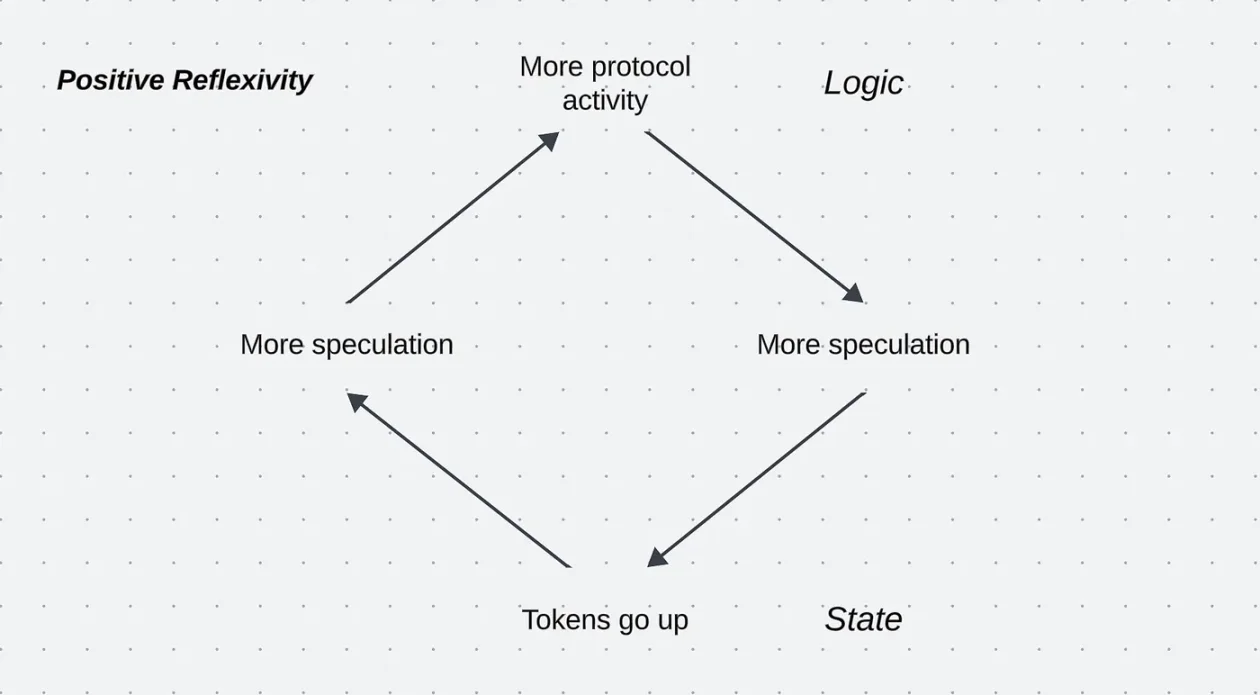
active reflexivity
Predictably, this cycle did not continue. Eventually, the party must end and positive reflexivity turns into negative reflexivity. Speculation is mistaken for product-market fit, while exploration of real use cases remains. Two years later, many are still looking for ways to scale on-chain activity. In order to understand how to evolve the application layer, we need to look at it more closely.
Split the application layer
The application layer has two components: state and logic. State is data; logic is calculation. Both state and logic can be on-chain or off-chain. We are given a four-quadrant matrix:
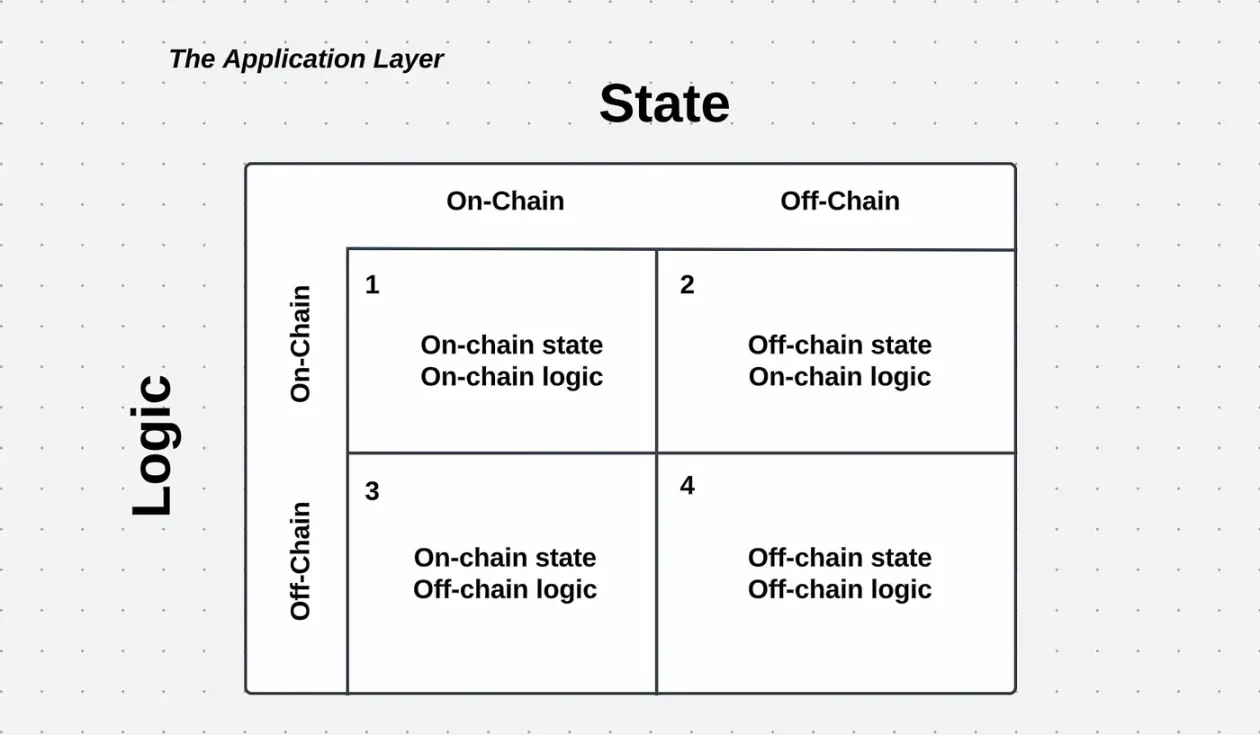
application matrix
Each quadrant has different applications. To date, most blockchain applications are in the first quadrant, which represents our use of crypto-native assets in on-chain protocols. The second quadrant involves bringing real-world assets on-chain and using them within the protocol. The third quadrant covers situations where we use crypto-native assets off-chain. Everything else falls into Quadrant Four. If the state and logic are not on-chain, then it is not a blockchain application.
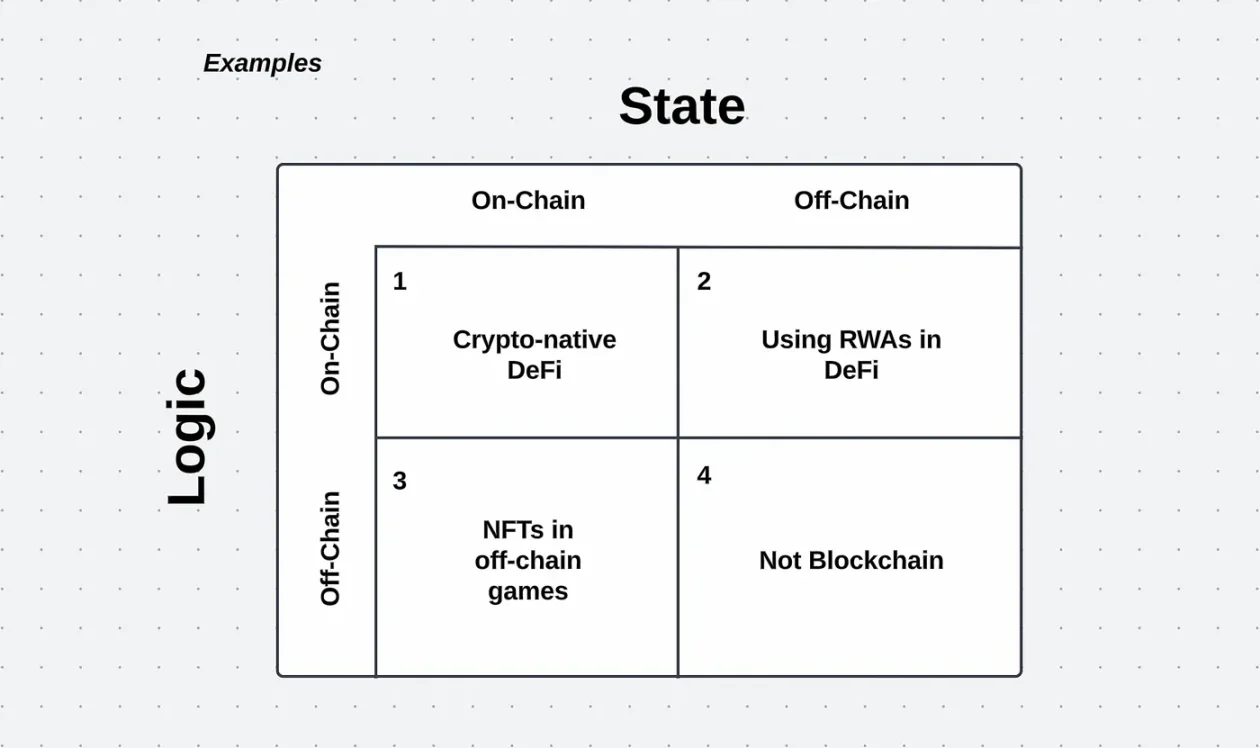
Blockchain use cases are in the first 3 quadrants.
The first quadrant: Complete on-chain economy
A full on-chain economy around crypto-native applications. Most on-chain activity currently falls into this quadrant. These endogenous applications are reflexive in nature, which is one of the reasons why cryptocurrency markets are so volatile and speculative.
On the positive side, this incentivizes users and developers to enter the crypto economy. Furthermore, although these applications are circular, they do contain some real value.
Speculation and gambling, while controversial, are real use cases. Nonetheless, we all want the cryptoeconomy to be more than just an on-chain casino. Peer-to-peer payments can also be done using crypto-native assets, but with less stability and scalability.
To move beyond speculation and inefficient financial services, we need to move beyond Quadrant 1.
Quadrant II: Programmable Finance
Another type of blockchain application is to bring real world assets (RWA) onto the chain. These assets can benefit from a global, programmable and composable cryptocurrency market. Those who question the value of crypto-native assets often understand this quadrant, as summarized by the “blockchain, not crypto” mantra or the “tokenization” meme.
We call this quadrant programmable finance. It involves developers bringing bonds, stocks, commodities, or other traditional financial instruments to programmable markets, unlocking greater accessibility, expressiveness, and efficiency.
The most successful RWA to date is the centralized stablecoin. Stablecoins provide global, cheap access to U.S. dollars and have been described as the “killer app” for cryptocurrencies. The total market capitalization of USDC and USDT has reached US$114 billion.
Programmable finance has been widely discussed in other fields. These applications have generated institutional interest in blockchain technology and will be a major driver of its growth. But we believe they are just one part of a much richer crypto economy.
The third quadrant: off-chain applications
The final category of applications are those with on-chain state and off-chain logic. These digitally native assets with off-chain applications are the most overlooked crypto asset class.
The simplest example is social assets. In the last NFT craze, many NFTs were used as representatives of identity. Bored Apes, Punks, and other well-known NFTs allow their owners to show off their status or indicate that they are part of an exclusive community. The challenge with these NFTs is that their social value is closely tied to price and novelty, which can quickly be eroded. Fortunately, this flaw is characteristic of those NFTs and is not an inevitable property of all social assets. A more mature crypto economy will provide more robust social assets.
The off-chain logic of social assets is how we behave off-chain. In this way, social assets are coordination tools. Since everyone agrees on the state of the Ethereum blockchain, we can align our real-world actions around this state. For example, we can use social assets to provide access to physical events such as concerts, or to prove someones membership in a community such as Zuzalu. The value of storing these social assets on a blockchain rather than a centralized database depends on the specific circumstances, but it may benefit from blockchains trusted neutrality, sovereignty, permanence, censorship resistance, financialization, or Interoperability with the rest of the crypto economy.
Applications in the third quadrant can also offer the benefits of encryption technology. Think about games, traditional games can support some on-chain state while keeping most of the game logic off-chain. These assets then have exogenous demand through their in-game utility or social value.
Token gating unlocks more use cases. Friend.tech, despite its flaws, has been a directional success in demonstrating new possibilities at the intersection of social assets and token gating. We suspect many exciting applications can be built in this category. Another recent example is Orb Land. Orbs are NFTs that provide exclusive access to certain celebrities. Orb owners gain the right to ask questions to the corresponding celebrity at a certain pace (for example, every 7 days). Orbs have an additional feature, the Orb Market is an aggressive market that allows anyone to buy any Orb from another person at any time for a fixed price.
The Decentralized Physical Infrastructure (dePIN) project is also in the third quadrant. These tokens incentivize real-world activities such as mapping roads or installing hotspots, thereby solving the cold start problem.
Develop application layer
Not everything happens to fall into one of these quadrants. Every application has an exogenous purpose to some extent. Again, there must be some real-world use cases (some off-chain logic) for it to be useful. In practice, most application logic is partly on-chain and partly off-chain. Nonetheless, as a mental model, we find this framework helpful for reasoning about the application layer.
Based on the latest developments in the ecosystem, we have formed two contrarian views on how to develop the application layer.
Our first contrarian perspective is that, for now, asset innovation is more important than application innovation. Yes, we need better decentralized exchanges. But more importantly, we need to create assets that are truly worth exchanging. The latter is a more tractable way to sustainably scale on-chain activity. We encourage more teams to put novel assets on the chain.
Our second contrarian view is that in the short to medium term, Quadrant 3 is more important than Quadrant 2. RWA holds great promise in the crypto-economy. But for now, we believe that bringing crypto-native assets into the real world is more important than bringing RWA onto the chain. The former are their own type of real world assets and have more unexplored, unrestricted design space.
Ending the era of reflexivity
As Quadrants 2 and 3 take up an ever-larger share of the cryptoeconomy, the market will become less reflexive. Once we develop exogenous demand for crypto assets and protocols, Quadrant 1 becomes less cyclical. Suddenly, Uniswap was no longer just an engine to facilitate speculation, it was a decentralized business with relatively stable demand.
Real-world use cases undercut the reflexive nature of the cryptoeconomics. Over time, markets will become more acausal. By “acausal,” we mean that the demand for blockchain applications does not come from an endogenous need for the blockchain itself—which we believe is the closest word we can find to an antonym of “reflexive.”
The end state of the application layer will be far less reflexive than it is today and will yield tremendous real-world value. Well get there eventually.
At the same time, our team will work hand-in-hand with founders to build the infrastructure for the future crypto economy.
Acknowledgments: Special thanks to VelvetMilkman, Dougie, Krane, Khushi, and Sanat for their comments and suggestions on drafts of this article.


