Detailed explanation of sFRAX’s operating model: Can it help FRAX open the “stable currency endgame”?


Original author: Frank, Foresight News
Stable currency, annualized 10%? Dont leave yet, this is not UST/Terra.
Frax Finance, the stable giant that was once as famous as Terra, launched sFRAX, a pledge vault that introduced the U.S. Treasury bond yield, allowing users to deposit FRAX into the vault and pledge it as sFRAX, and obtain an annualized rate of return of up to 10%.
sFRAX: up to 10% annualized, tracking IORB interest rate
sFRAX mainly cooperates with Lead Bank in Kansas City to open a brokerage account to purchase assets such as U.S. Treasury bonds, with the ultimate goal of tracking the Federal Reserves IORB interest rate (currently around 5.4%).
IORB is the interest paid by the Federal Reserve to commercial banks’ funds deposited overnight in the main account of the Federal Reserve System. sFRAX tracks it through the IORB oracle. This is essentially in line with FRAX’s long-term development thinking. You must know that Frax Finance has always been a DeFi project. Among the projects most actively moving closer to the Fed:
Actively apply for the Federal Reserve Master Account (FMA) (Foresight News notes that the Federal Reserve Master Account allows holding U.S. dollars and trading directly with the Federal Reserve), thereby getting rid of the limitations of using USDC as collateral and the risk of bank failure, making FRAX the closest to being without Risky dollar stuff.
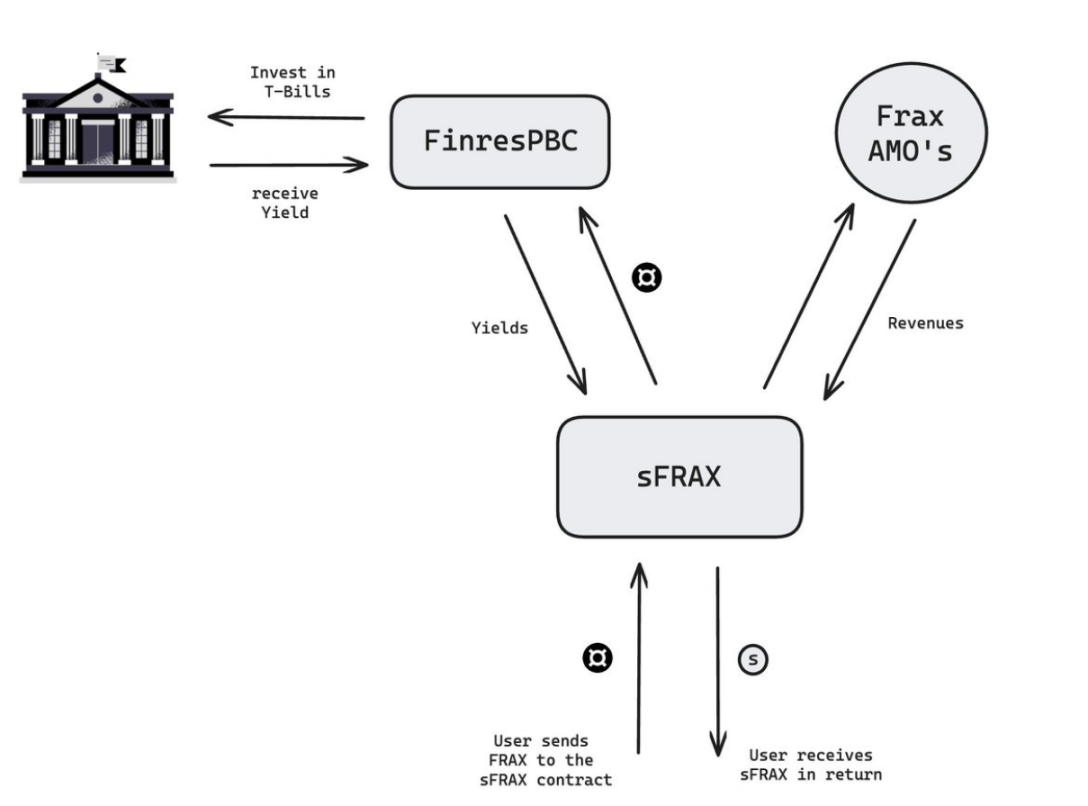
Among them, sFRAX uses treasury funds and authorizes its off-chain partner FinresPBC to invest treasury funds in short-term assets such as short-term treasury bonds, repurchase agreements, U.S. dollar deposits in the Federal Reserves main account, and selected money market mutual funds.
And since the rate of return of sFRAX fluctuates with the IORB interest rate and market conditions, an AMO contract was developed to dynamically manage the asset allocation of the sFRAX treasury:
If IORB increases, the AMO strategy will heavily collateralize FRAX to obtain RWA assets (short-term U.S. Treasuries, reverse repurchase contracts, or depositing dollars with the Federal Reserve Bank that pays the IORB interest rate);
If IORB decreases, RWA assets will be reconverted into on-chain decentralized assets and over-collateralized loans in Fraxlend to obtain higher returns as possible;
The initial high interest rate of 10% is the initial setting (as described in the community proposal, it is similar to the initial setting of sDAI, with part of the income obtained from the balance sheet deployment of the AMO and RWA strategies being subsidized and distributed), along with the growth of the treasury size , the corresponding yield will gradually decrease and move closer to the Feds IORB interest rate.
As of the time of publication, the total pledged amount of sFRAX, which was launched about half a month ago, is nearly 40 million, and the annualized interest rate has dropped to 6.86%.
Of course, this also means that if a user unstakes, the rate of return for all participants will increase and may rise to 10% again.
How sFRAX works
Frax will use FinResPBC as an intermediary to transfer the necessary RWA amount every week based on the amount of FRAX mortgaged in sFRAX and the IORB interest rate. Once a week, the proceeds earned by Finres are transferred back to DAO control and then queued into the sFRAX contract for linear deployment during the next weeks cycle.
Users only need to deposit FRAX into the sFRAX contract to earn stablecoin income, which is also distributed weekly (every Wednesday at 8:00 Beijing time).
Generally speaking, the operating model of sFRAX is similar to other income-based stablecoin projects that “tokenize” U.S. debt. They raise U.S. dollars from users, then buy U.S. Treasury bonds, and share (part of) the interest generated with user.
It’s just that there is an additional FRAX-USDC/USDP conversion process in the sFRAX processing flow:
When a user deposits FRAX into sFRAXs ERC-4626 treasury contract, the DAO will authorize the transfer of the same amount of USDC or USDP in the treasury to FinresPBCs Circle or Paxos account, and then FinresPBC will convert the stable currency into cash and invest in the economy. Approved short-term assets.
And the short-term assets here are short-term Treasury bills, repurchase agreements, U.S. dollar deposits in the Feds master account, and select money market mutual funds.
As TVL in sFRAX grows, the higher initial yield will gradually decrease to the final yield, that is, stabilize around the IORB interest rate.
sFRAX, the new redemption of FRAX?
It is necessary for us to review the great changes in the stablecoin market since last year and the multiple turns of Frax.
In May 2022, the collapse of UST led to the destruction of the entire stable industry, and FRAX was severely affected. In just one month, the total circulating market value halved from US$3 billion to US$1.5 billion, and then gradually fell to around US$1 billion. Once on the verge of life and death.
Therefore, Frax v2 has made two strategic business adjustments:
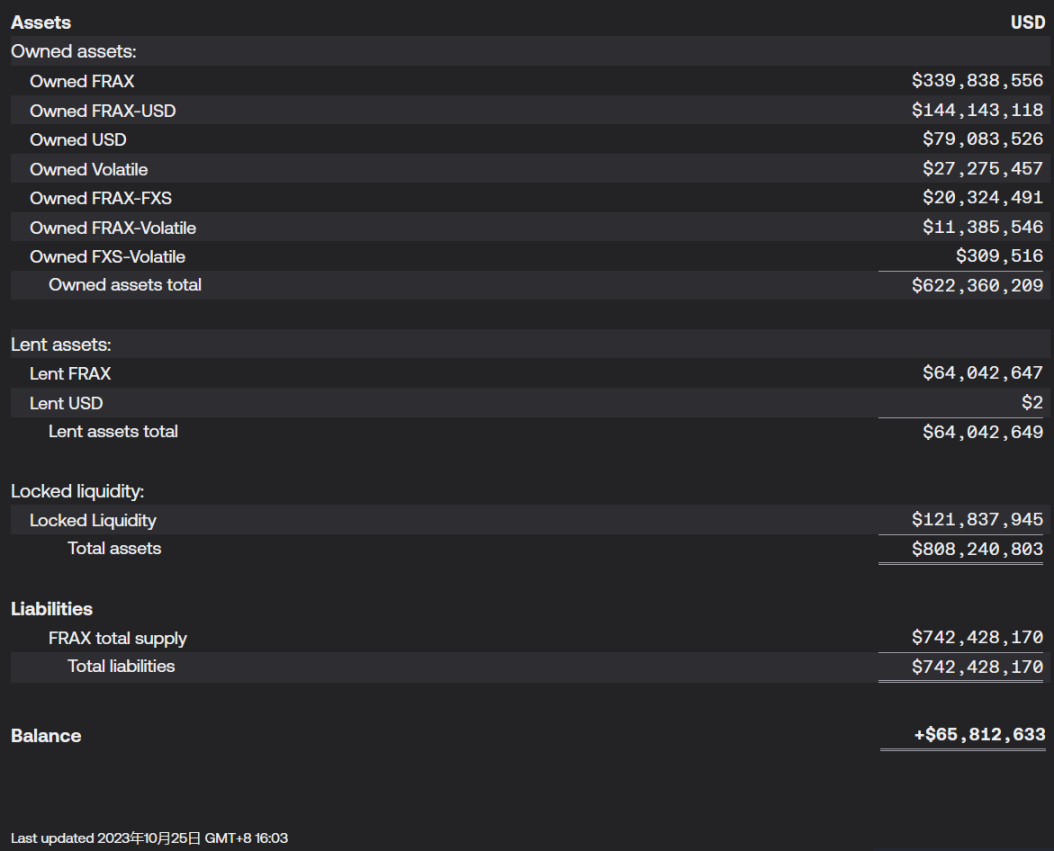
On the one hand, it chose to abandon the algorithmic stablecoin attribute and gradually increase its mortgage ratio (CR) to 100%, approaching the full mortgage or even over-collateralization model of MakerDAO and DAI.
As of the time of publication (October 25, 2023), FRAXs CR has gradually recovered and stabilized at around 91.85% (but mortgage assets), and has begun to shift to fully mortgaged stablecoins.
On the other hand, Frax also expanded its focus from stablecoins to the Liquidity Staking (LSD) track, and used the voting weights such as CVX and CRV accumulated by supporting the stablecoin FRAX to tilt it to its own LSD product frxETH, with fruitful results. .
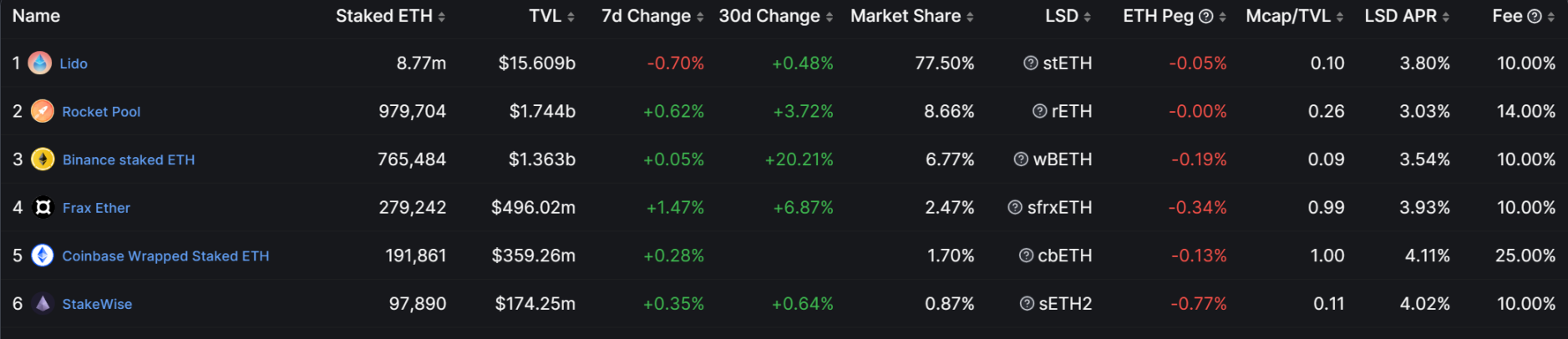
As of the time of publication (October 25, 2023), frxETH has issued a total of nearly 280,000 pieces. DefiLlama data shows that its current volume is second only to Lido, Rocket Pool, and Binance, with a market share of 2.47%.
Now that v2 has basically reached or even exceeded its expected goals, Fraxs latest v3 version has also turned its attention to RWA assets, aiming to introduce real-world assets RWA and continue to use AMO to provide on-chain and off-chain liquidity.
sFRAX is the core component of Frax v3 to realize this vision, and the real-world assets it selects are currently the highest quality traditional financial assets - U.S. bonds.
Therefore, the continuous expansion of the sFRAX treasury can essentially be understood as the process of gradually replacing FRAXs reserve assets from USDC and other U.S. bonds.
In a word, Frax does not want to repeat the mistakes of the Silicon Valley Bank incident in March this year when USDC was detached and passively de-anchored:
It wants to use sFRAX to gradually wean FRAX away from dependence on other mainstream stablecoins such as USDC, and eventually achieve complete anchoring to U.S. debt (USD).
summary
Frax founder Sam Kazemian once said that Frax v3’s FRAX will be “The Final Stablecoin”.
Objectively speaking, if FRAX can eventually expand to billions of dollars in size with the help of sFRAX and other anchors, and most of the reserve assets behind it are converted into U.S. debt, completely anchored to the U.S. dollar, it will undoubtedly become the leader in the DeFi field. The furthest among stablecoin projects.
However, income stablecoin projects involving the tokenization of U.S. debt all face the same hidden worries, which can be expected in the short term. As for the long term, whether sFRAX and FRAX can truly usher in the stablecoin endgame requires continued observation.