






Intent Centers: The New Fairy Tale for Institutions? A new chapter for Web3?


Original | Odaily
Author |
whenParadigm expresses intent-centricAfter the attention of the (intention center) field, many encryption projects on the market are like ships that have been drifting for a long time, sailing to the lighthouse. It is undeniable that intent-centric, as a new narrative direction of the blockchain, does have a huge room for imagination, and it has a strong role in promoting Web3 to acquire new users.
However, judging from the current development of intent-centric, it is not enough to exist as a single track. It is more like a design concept adopted by the project for large-scale application.Most projects at this stage just quickly put on the cloak of intent and add their own narrative chips, without incorporating intent-centric into protocols and applications as a complete solution logic.
Is intent-centric a pie drawn by the organization, or can it really be implemented? What projects currently fall into this category? Odaily will be developed layer by layer from the perspectives of its definition, representative project introduction, and application scenario thinking.
The definition of intent in Web3
In the Web3 world,Intent-centric is a design concept that emphasizes putting user intentions at the core and realizing automated execution of user intentions through smart contracts or protocols.
Traditional blockchain applications mainly focus on the storage and exchange of data, while the intention-centered design idea focuses more on the users intentions and goals. It encodes the users intentions into executable instructions through smart contracts or protocols, thereby realizing automated execution and interaction.
Intent-centric design can make blockchain applications more flexible and intelligent. It can help users realize various complex transactions and operations. By encoding the users intent into a smart contract, the reliability of the transaction and the consistency of execution can be ensured without trusting a third party.
Intent-centered design can also improve the user experience of blockchain applications. It can simplify the interaction process between users and applications, so that users do not need to understand complex protocols and processes, and only need to clearly express their intentions. At the same time, the design of the intent center can also provide higher scalability and interoperability, enabling different blockchains and smart contracts to work better together to achieve more complex functions and scenarios.
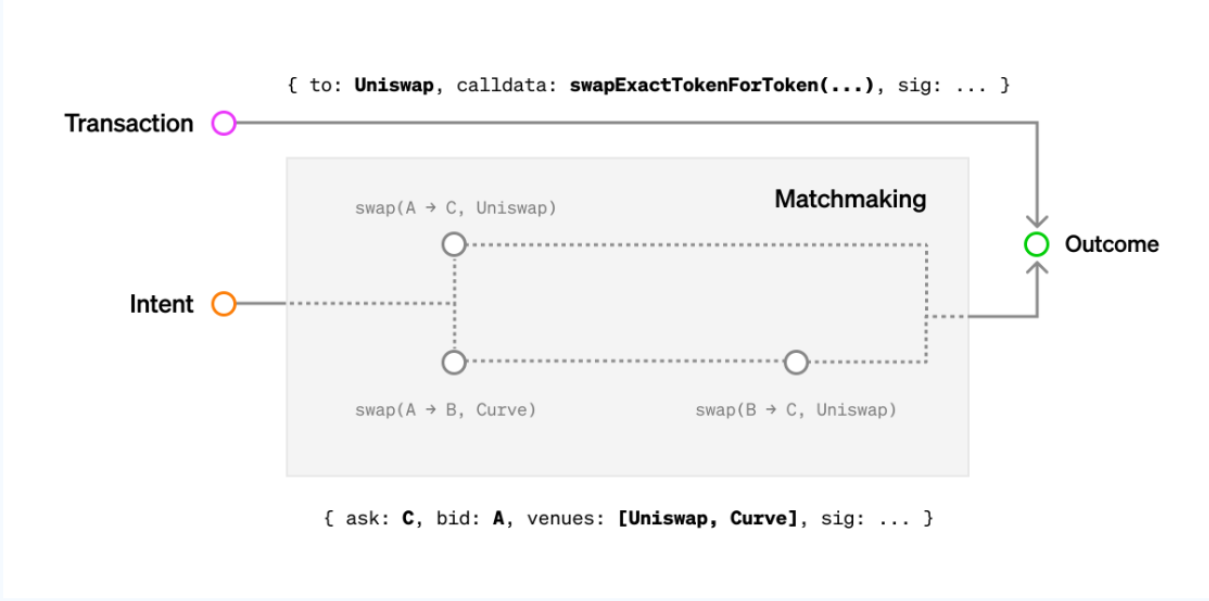
The above picture is an example, the user trades tokens through Uniswap and wants to exchange Token A for Token B. The user only needs to provide this intention. As for the direct path in the process, the user does not need to consider which specific liquidity pool to use. As long as The final result is achieved.
Therefore, the intent-centric design concept should have the following characteristics:
decentralized: Although users can achieve their final intended goals, the process is in a black box. If centralized operations are used, the possibility of doing evil will be greatly increased.
Programmability: For the same transaction model, different users may have different requirements, such as privacy, anti-MEV and low Gas fee, etc. Only with programmability can the complex needs of more users be met.
Verifiable/traceable: So that users can verify execution results and transaction history. Users should be able to track the execution process of their intentions and verify the legality and correctness of their execution results.
Ownership remains unchanged: During the transaction process, the user’s ownership of the assets does not change.
Intent Center Project Status
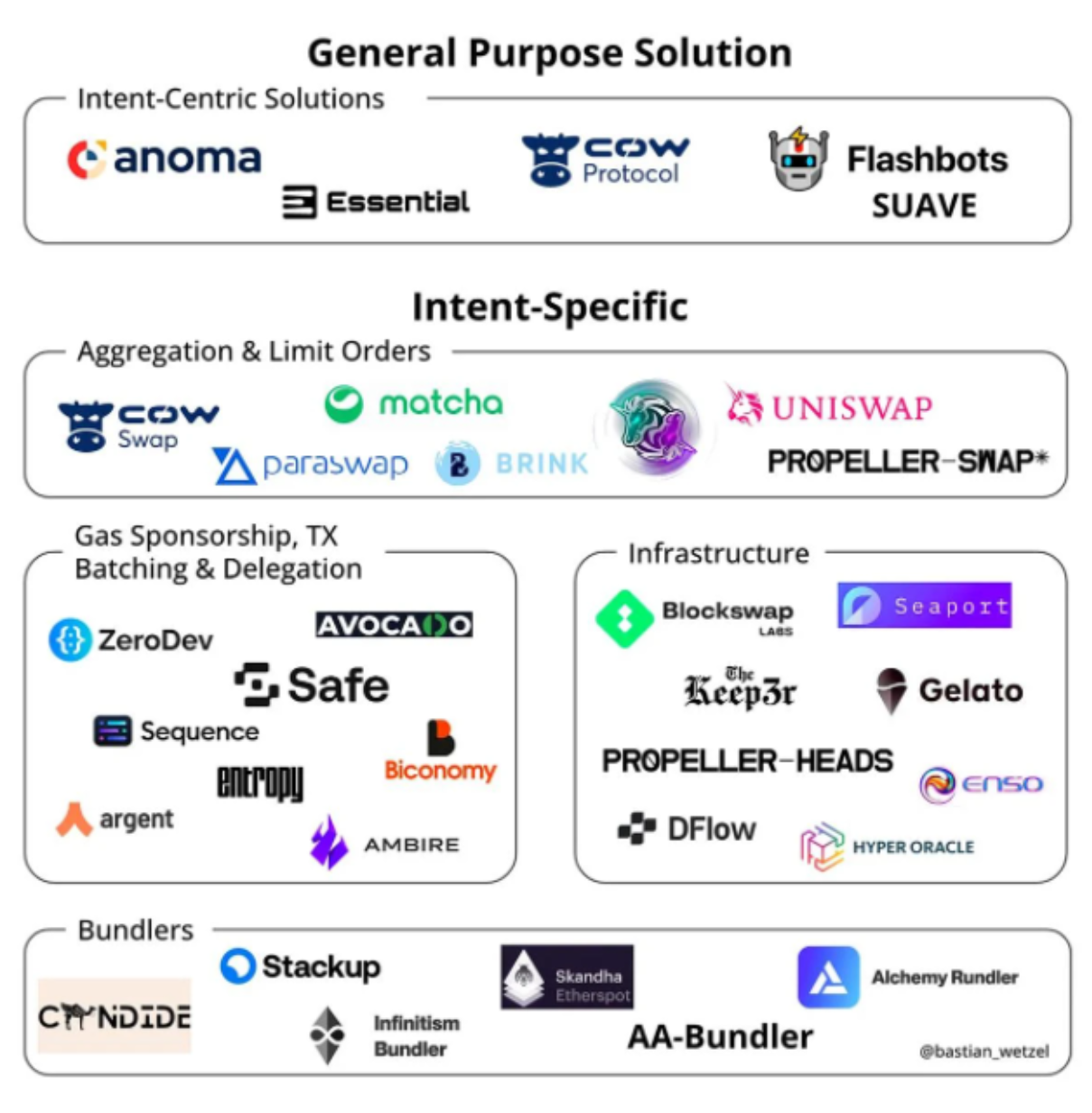
From the image above by Bastian Wetzel of CV Labs, Odaily selected some representative projects to further introduce the current application status of intent.
Anoma
AnomaIn August 2022, the concept of intent-centric was proposed. Anoma regards the intent-centric as the new public chain of the core architecture, and aggregates user intents (privacy intent, transaction intent, security intent, etc.) in a modular manner. Pack and wind up.
This move breaks the traditional blockchain model of designing architecture with transactions as the most basic unit. However, the implementation time cannot yet be estimated, the development difficulty is relatively high, and the degree of innovation is high, so it is worth looking forward to.
dappOS
dappOSAs a multi-chain resource integration platform, it is divided into the following two parts:
● dappOS Account: Implement user account abstraction through AA wallet, with the goal of achieving account recovery and automated operations.
● dappOS network: Through the decentralized network, multi-chain data resources are connected in series to form a chain abstraction concept to help users use dappOS accounts.
dappOS is an early participant in the AA wallet field, especially after the launch of ERC 4337, the development of AA wallet is getting closer and closer to the intent-centric design concept.
Bob the solver
Bob the SolverIt is a middleware for intent-based transactions that is integrated into wallets and applications to achieve an intent-centered user experience.
Bob the Solver consists of two parts:
● Solver is responsible for creating transactions based on user intent: Solver utilizes machine learning models to classify user intent and optimize transaction paths.
● The AA wallet is responsible for executing these transactions: the AA wallet collects and manages transactions and pays the related Gas Fees. This combination provides a seamless and efficient trading experience without users having to pay attention to technical details.
Bob the Solver attracted much attention at the EthCC conference because of its intent-centricity. He uses AI as an intent-centric third-party collaborator to enlarge the future development space of Solver and demonstrate a new paradigm of AI+blockchain cooperation.
Flashbots SUAVE
Flashbots SuaveCan act as a plug-and-play memory pool and decentralized block builder for any blockchain, forming an abstract network to solve the MEV problem.
In other words, Flashbots Suave provides a venue for MEVbot to arbitrage through MEV without causing network congestion and Gas War problems. This provides a new direction for the intent of MEV arbitrage.
UniswapX
UniswapXDutch auction-based trading across AMMs and other liquidity sources. In essence, the routing line is handed over to a third party, thereby lowering the users usage threshold and improving usage efficiency.
UniswapX introduces the role of fillers and adopts the bidding model to help users route a better trading experience. Users do not need to understand the entire routing process, and the final intention is the result. This also embodies the concept of intent from a certain perspective.
Cow Protocol
Cow ProtocolAs an earlier project in the industry that focuses on user experience, it provides optimal quotations, matches requirements, and prevents MEV attacks by routing appropriate paths.
Cow Protocol adopts a peer-to-peer method with traditional aggregation mode to help users simplify the process and find the optimal solution.
The intent-centric implementation logic adopted by the above projects is not the same. I personally think that the projects worthy of attention are Anoma and Bob the solver. The former is transformed from the public chain architecture, adopts a distributed intent-centric solution, and has a narrative at the bottom level. The latter combines AI and blockchain, uses AI to identify user intentions, and improves the imagination of AI+blockchain.
More Intent application scenarios in the future
● Cross-chain intent: Realize cross-domain operations between different blockchains, including asset transfer, asset management, voting, identity verification, and smart contract calls. These operations are enabled and ensure security and consistency through the coordination of intent and executors across chains.
● Governance intent: Users only need to express which on-chain governance conditions they resist, and take this as an intent, and then the subsequent governance content can be managed by a third-party intent application.
● Airdrop intent: The user only needs to express the corresponding intent, such as the target item, interaction frequency, amount involved, etc., and the third-party intent application can automatically execute the interaction behavior with the greatest chance of obtaining the airdrop.
● Large-value transaction intent: Large-value orders often cause huge fluctuations in the market. Users can use third-party intent applications to split huge orders and find the right time to trade.
some thoughts
Intent-centric is a design concept that can be adopted for project development or upgrade. It does not yet have the conditions to become an independent track. Before the concept of intent-centric emerged, the project party was also working hard to lower the user threshold and move towards large-scale applications, but at that time User intent is not widely discussed on the table.
Recently, the intent-centric new trend brought by Paradigm and EthCC has begun to use AI as productivity to understand user intentions and execute them automatically in a decentralized manner.In a sense, the intent based on AI participation is a deep combination of AI and blockchain, which is expected to open a new window of opportunity for Web3, rather than just staying in the hypothesis of institutions.


