






Web3 Wallet "iPhone Moment": Understanding OuiAA Smart Contract Wallet in One Article


The current global Web 2 user base is nearly 5 billion people, while Web 3 users are only 400 million, making Web 3 still a niche industry. As an entry-level application, the popularity of Web 3 wallets contributes to the widespread adoption of Web 3 applications.
On August 2nd, Okex announced the first release of the AA smart contract wallet, which may fundamentally change the blockchain industry and lower the barrier for internet users to enter Web 3.
Ethereum founder Vitalik Buterin has emphasized multiple times that smart contract wallets are the future of Web 3 wallets. Additionally, in his concluding speech at the EthCC conference, Buterin highlighted that future Account Abstraction (AA) will make crypto wallets as simple as emails. In Ethereum's 2.0 roadmap, Account Abstraction (AA) is placed in the same directory level as merge and sharding, indicating its significant role in the Ethereum ecosystem.
Introduction to Web 3 Wallets
Setting aside the concept of Web 3, in reality, Web 3 wallets are no different from WeChat and Alipay in terms of their attributes; they are payment tools. With this basic understanding, it becomes easy to grasp what Web 3 wallets are. Web 3 wallets are mainly used for receiving, storing, managing, and transferring digital assets, as well as exploring DApps.
If we reintroduce concepts such as decentralization to Web 3, the most significant change that Web 3 wallets bring compared to traditional payment tools is that they allow users to control their private keys and assets completely, eliminating the reliance on third-party intermediaries like banks and financial institutions. In other words, even in the event of black swan events or doomsday scenarios, your assets will remain in your Web 3 wallet, controlled by your private key.
A Web 3 wallet corresponds to a unique private key and cannot be modified. The private key is a 64-character hexadecimal string composed of letters and numbers, simplified into a mnemonic phrase consisting of 12 words for ease of user memory and record keeping. Therefore, the private key is crucial as whoever controls it, controls the assets. The control over the private key gives rise to three types of wallets: custodial wallets, hybrid custodial wallets, and non-custodial wallets, where the private key is respectively controlled by the user themselves, the user and a custodian, or neither. Currently, popular wallets like Metamask and OKX Web 3 Wallet belong to the non-custodial wallet category (also known as self-custodial wallets).
Although non-custodial wallets restore asset control to the user, they face several pain points such as difficulty in remembering mnemonic phrases, limited gas payment options, and complex operation processes, which pose significant obstacles for new users. To address these issues, wallets like OKX Web 3 Wallet, representative of the wallets, are constantly exploring new technologies and methods, accelerating product updates and iterations, with the aim of creating a leading user-friendly and secure digital wallet. The launch of OKX AA Smart Contract Wallet provides additional customizations and extended functionalities, such as batch transactions, gas delegation, private key recovery, etc., while ensuring asset security. It not only enhances security by freeing users from the constraints of mnemonic phrases/private keys but also simplifies the process of on-chain interactions. Additionally, it can automatically subsidize gas fees, thus reducing the barriers to using Web 3 wallets and potentially initiating an "iPhone moment" for Web 3 wallets, facilitating the realization of large-scale Web 3 applications and opening up vast realms of imagination.
Opportunity
Why does OKX introduce the AA Smart Contract Wallet?
The "AA" in the AA Smart Contract Wallet stands for "Account Abstract," so the AA Smart Contract Wallet is also known as a smart account or account abstraction.
To understand what an account abstraction is, we can divide it into two parts: "account" and "abstraction." First, let's become familiar with some background knowledge about Ethereum accounts.
Almost everyone now has an account on financial platforms. Ethereum accounts, like regular financial accounts such as bank cards, Alipay, and WeChat, allow users to intuitively see their account balances. What makes Ethereum accounts special?
Unlike the Bitcoin network, Ethereum accounts not only support simple token transactions, but also support complex smart contracts. Therefore, Ethereum has two types of accounts: Externally Owned Accounts (EOA) and Contract Accounts (CA). Currently, all wallets are built based on these two types of account types. Here is a direct comparison of the differences between the two with an image.
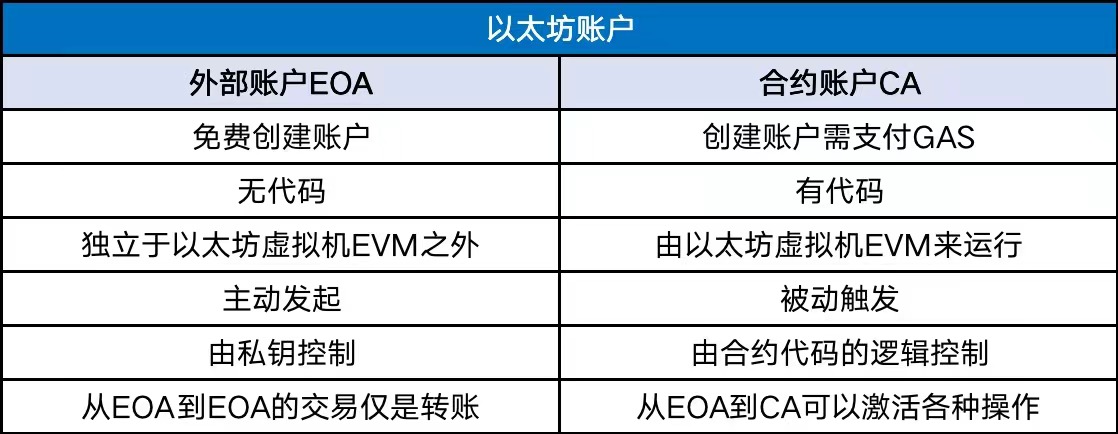
How do Ethereum accounts work? For example, let's say Xiao Ming creates EOA account A and Xiao Li creates EOA account B. Now, if Xiao Ming wants to buy 1 ETH worth of apples from Xiao Li, can he directly transfer money from account A to account B? No, he can't. He needs to use a CA account C.
Why? Because what if Xiao Li refuses to pay after Xiao Ming transfers the money? Or what if Xiao Li delivers the goods but Xiao Ming doesn't pay? In such cases, a smart contract can be deployed to create CA account C. At this point, both account A and account B transfer 2 ETH to account C. After Xiao Li delivers the goods, account C is triggered to transfer 1 ETH to account A and 3 ETH to account B.
That's the basic explanation of Ethereum accounts. Next, let's talk about "abstraction." To help everyone understand the abstraction of accounts in a simple way, let's take an example. Just like in summer, we don't need to know how the air conditioner works internally. We can control the temperature and fan speed through a remote control. The remote control abstracts the internal operation of the air conditioner to the surface. With this basic concept, it is easier to understand the "abstraction" of accounts.
Currently, EOAs serve as wallets, and CAs serve as the logic for smart contracts. Each has its own advantages and disadvantages.
Unlike traditional bank accounts, for an EOA account, various problems arise because its "ownership" and "signing authority" are inseparable and controlled by a unique private key. Why is that? "Ownership" is the person who owns the account, and "signing authority" is the person who can control the account. For traditional bank users, even if the password "signing authority" is stolen or lost, others cannot transfer your assets "ownership" from the bank. However, for Ethereum EOA accounts, as long as you hold the private key, you have complete control over the assets in the account. Therefore, EOA accounts currently face difficulties in preserving private keys, high signing authority, and losing all assets if lost. Imagine a scenario where the money is still in the wallet, but the private key is lost and cannot be recovered. It's hard for anyone to hold on. In addition, they lack programmability and require ETH as gas fees to operate, among other pain points.
CA accounts also have their share of problems. Although they can customize logic to enable more functionalities, they cannot initiate transactions actively and must be called by an EOA account. Additionally, because they are deployed on the chain, they require additional gas and waiting time.
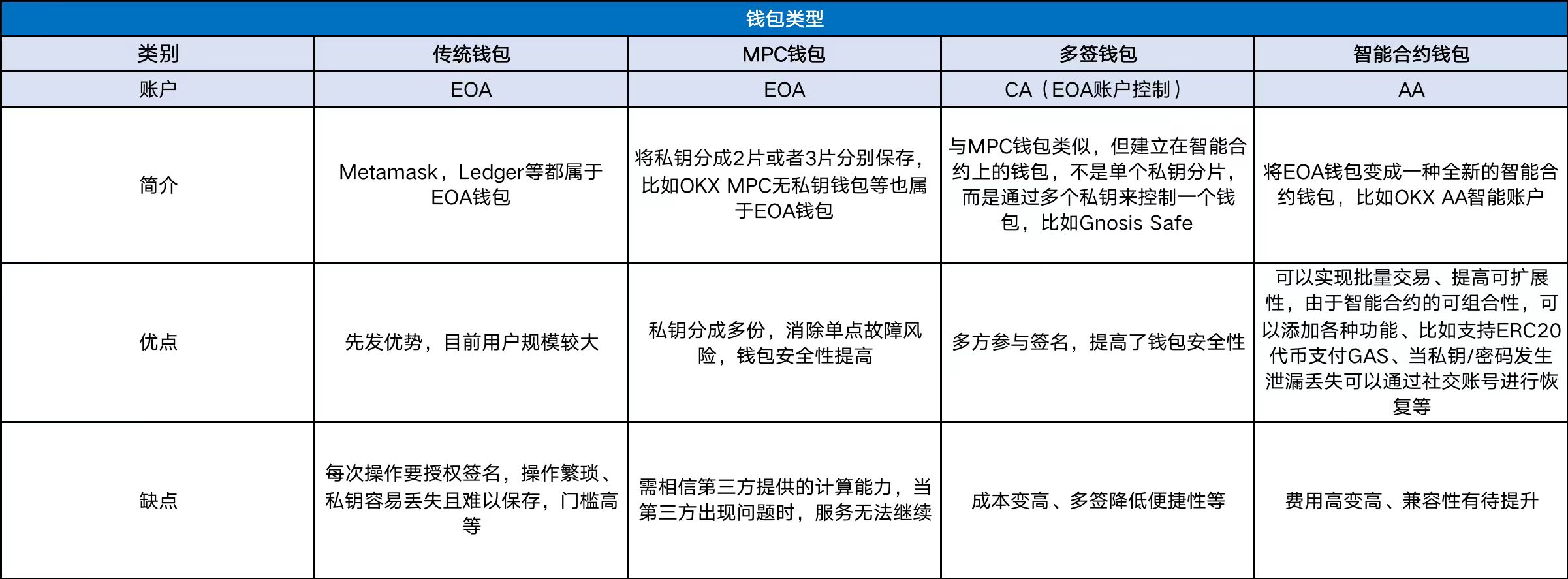
It is not difficult to see that these two account types currently fail to solve the complex user experience and security issues of wallets. Therefore, the AA smart account is a way to "abstract" the complex operational logic of CA and EOA, simplifying the two types of Ethereum accounts into one. This account type will be able to support both cryptocurrency transactions and smart contracts. It combines the programmability of CA with the ability to initiate transactions independently of EOA, separates "ownership" and "signing authority," and combines their advantages. It can achieve various new features such as multi-signature, batch transactions, gas delegation, and social recovery, eliminating the need to distinguish between account types.
In other words, a wallet is also a contract, allowing the AA smart contract wallet to expand its functionality.
The development of account abstraction is closely tied to the Ethereum ecosystem. It was proposed early on in Ethereum's launch, but most solutions were immature or difficult to implement and were shelved. From the earliest EIP-101 to EIP-3074, several versions have been iterated. The real achievement was made possible by the proposal of ERC-4337, which aims to achieve wallet flexibility and upgradability without modifying the underlying native protocol. It includes features such as multi-signature and social recovery, as well as more efficient and simplified signature algorithms.
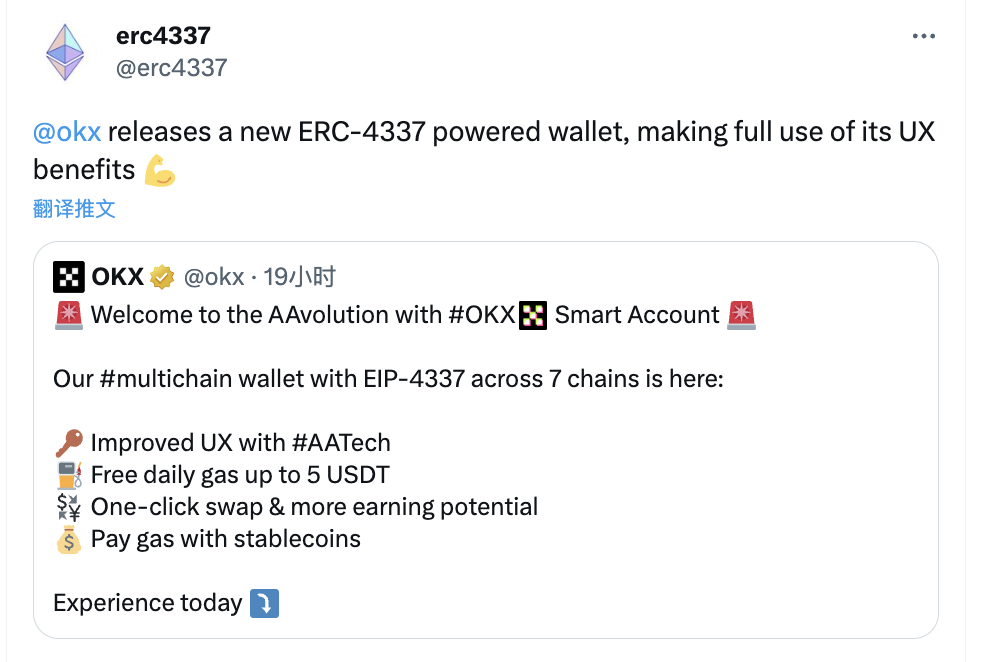
Image: ERC-4337 official repost and like, OKX AA smart contract wallet
Proposal EIP is Ethereum Improvement Proposal, a way to publicly solicit and discuss measures to improve Ethereum, and promote close cooperation in the community to make Ethereum more efficient. The content of any Ethereum update comes from EIP. Anyone can create an EIP, but it needs to go through several stages of review, including preliminary discussion, feedback, and revision. ERC is the formal standard, such as ERC-20, ERC-721, ERC-1155, etc.Ethereum founder Vitalik Buterin has said that the implementation of the ERC-4337 proposal will "open the door to creativity" in wallet design. If successfully implemented, it could be the key to realizing the dreams of "account abstraction" and "social recovery".
It is worth mentioning that since Layer 2 public chains such as StarkNet and ZkSync Era already natively support abstract accounts at the underlying chain level, they can support the construction of abstract accounts without the need for the implementation of the 4337 standard, such as Argent and Braavos wallets.
In summary, account abstraction has demonstrated excellent performance in various aspects such as signature algorithms, functional implementation, and user experience, and has become a "must-have" for the large-scale application of Web 3 wallets, worth the anticipation of everyone. Based on the above background, Europe Easy OKX has taken the lead in developing and launching the AA smart contract wallet. It should be noted that the AA smart contract wallet involves a large number of smart contracts and has high difficulty and requirements for contract-side stress testing. Without unified security standards, the efforts behind Europe Easy OKX can be imagined, but we will not elaborate on this here.
Use Cases
After explaining the principles and background in a long section, next, we will use the use cases of Europe Easy AA smart contract wallet to help users understand its innovation and the new experiences it provides.
Stablecoin pays Gas. When using a regular Web 3 wallet for transactions, you need to use the mainnet token (ETH) as Gas fee. If the wallet doesn't have enough token, the transaction cannot be completed. However, the Easy AA smart contract wallet not only supports the use of the mainnet token (ETH), but also supports stablecoin USDT/USDC for paying Gas. In the future, it will also support other ERC-20 tokens for paying Gas. This removes the dependence of Gas on the main chain token, making it more user-friendly and convenient.
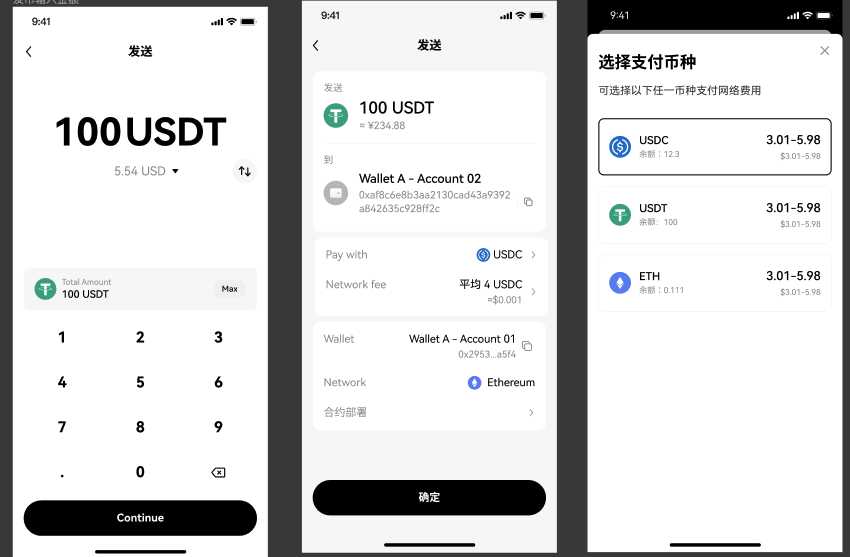
Support multiple chains. Currently, Easy supports users to create AA smart contract wallets on seven mainstream public chains: Ethereum, OKTC, Arbitrum, Polygon, Optimism, BNB Chain, and Avalanche.
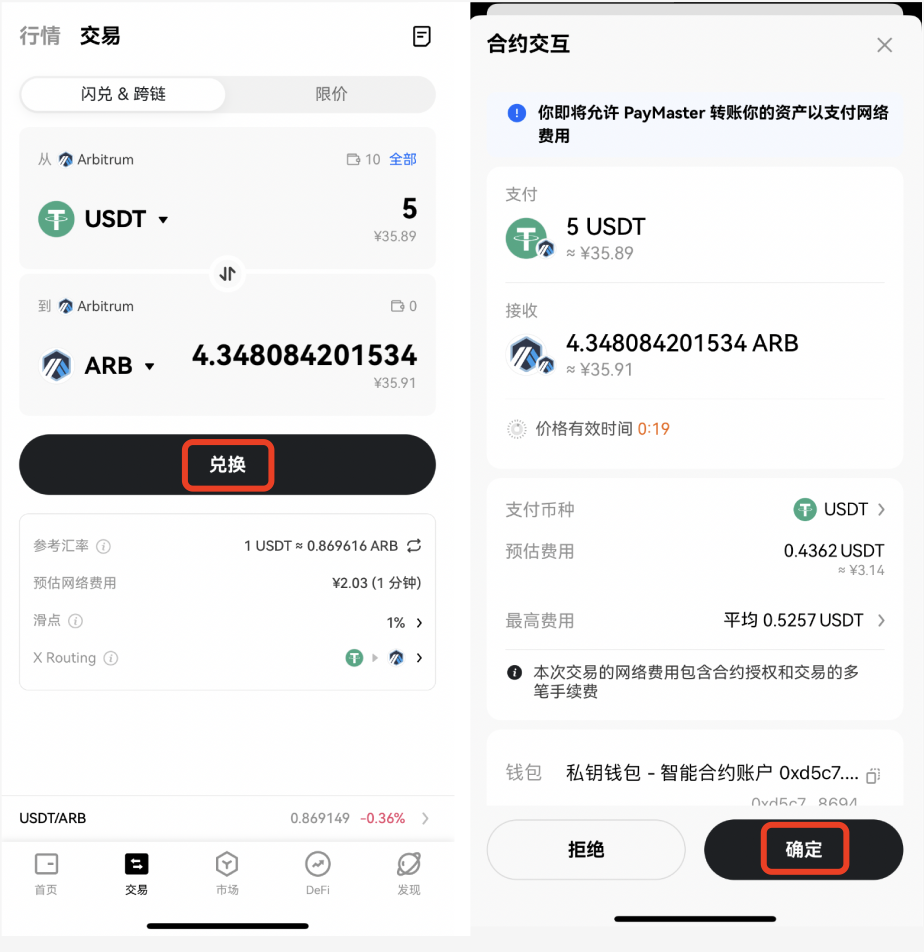
One-click DEX exchange. The Easy AA smart contract wallet combines multiple steps of interaction that regular accounts used to require into one-click completion. For example, it combines the previous DEX authorization (Approve) and transaction (swap) steps into one call data, allowing users to complete the operation in one step. This enables one-click exchanges on decentralized exchanges (DEX).
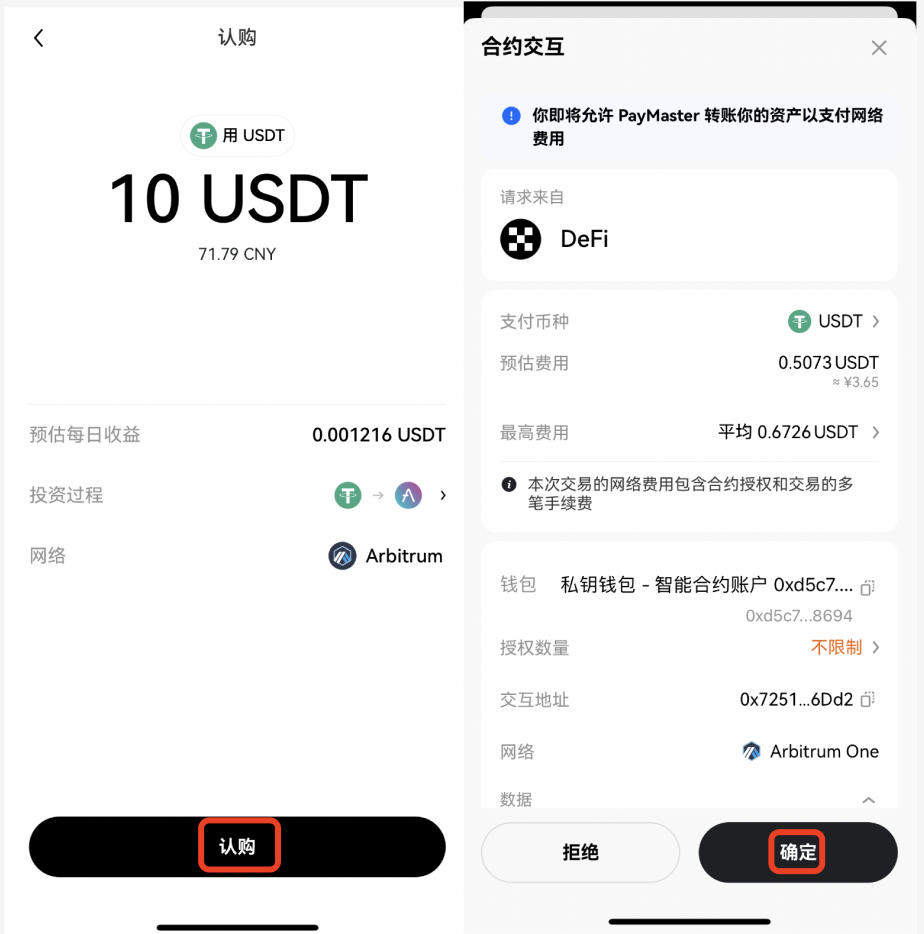
One-click DeFi mining. Similar to Easy OKX DEX one-click exchange, the AA smart contract account can combine various investment operations, allowing users to execute multiple investment and portfolio adjustments with just one click, greatly improving efficiency.
Besides the highlighted features mentioned above, Ouyi AA Smart Contract Wallet also launched a Gas subsidy activity. Users can enjoy a no-feel reduction in Gas once a day when transferring or trading, with a maximum reduction of 5 U. In the future, Ouyi AA Smart Contract Wallet will also support social recovery, provide wallet mini-program components, realize friend and family payment of Gas, on-chain copy trading with multi-signature function, composable operations, and other advanced on-chain financial strategy functions.
Imagine, once the social recovery function is online, we will bid farewell to the era where losing the mnemonic phrase is equivalent to losing the account. Users no longer need to write down 12 words or private keys on paper. Even if they lose the mnemonic phrase, their assets will be safe, and they can access the account again through multi-factor authentication, enjoying a silky smooth Web 2 experience. If the automatic execution function is launched, transactions will run automatically after meeting user-defined conditions. It's similar to Alipay's password-free payment. This means that in future blockchain games, Web 3 social interactions, and high-frequency on-chain transactions, once the requirements are met, authorization signatures will be automatically granted, greatly improving the user experience.
However, the abstract wallet is not "perfect" and still has areas for improvement. For example, since all the logic of the abstract wallet runs on the chain, it increases Gas costs, it is not compatible with other chains when deployed on the chain due to its dependence on smart contracts, and there is an increased risk of contract vulnerabilities, and more.
Creation
How to create Ouyi AA Smart Contract Wallet?
Users can add the corresponding AA Smart Contract account to their existing account in the different wallet types (mnemonic wallet, private key wallet, keyless wallet, hardware wallet) provided by OKX Web 3 Wallet. Each AA Smart Contract account is generated by a regular account and is used to control on-chain behavior and account recovery.
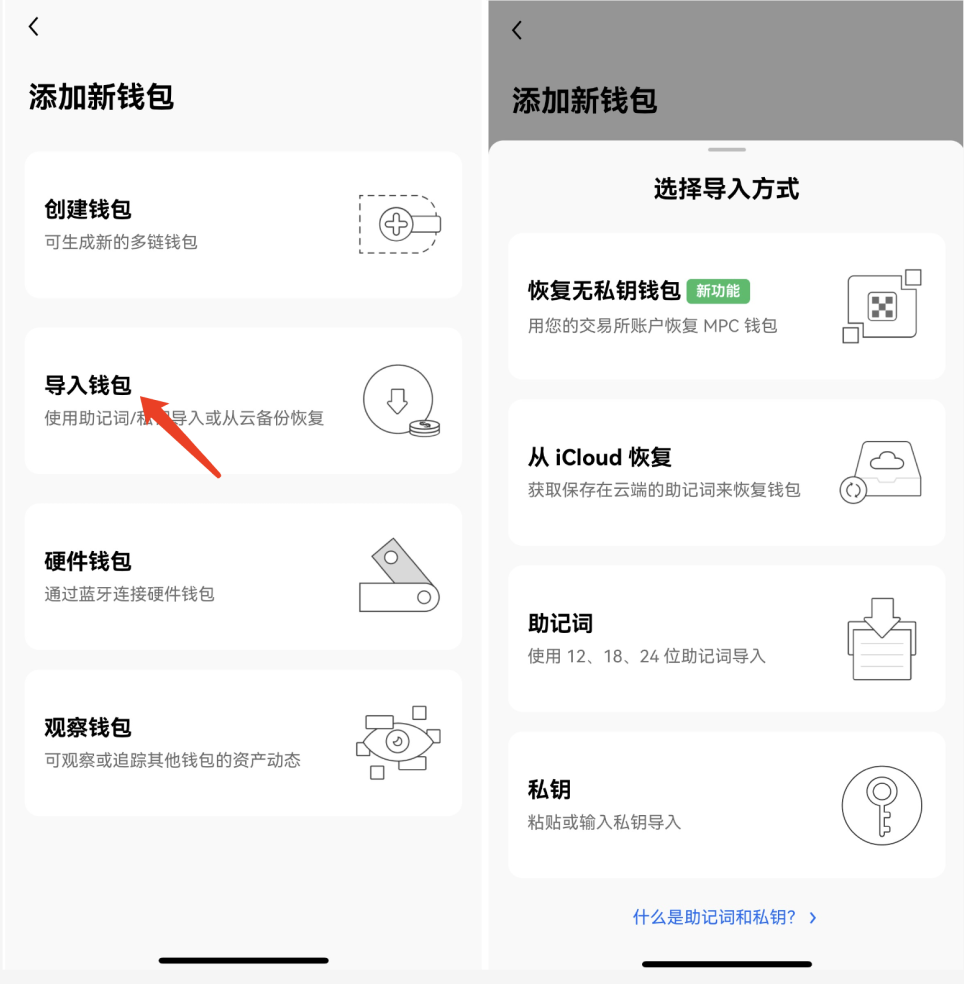
For new users who are using the wallet for the first time, OKX Web 3 Wallet offers two ways to create a wallet: keyless wallet and mnemonic phrase. For existing wallet users, they can import their wallets through the recovery of keyless wallets, recovery from the cloud (iCloud, Google Drive, Huawei Cloud), mnemonic phrase, and private key.
After completing the wallet creation or import, click on the ▼ > Add Account > Smart Contract Account in the wallet home page to successfully create an AA smart contract account.
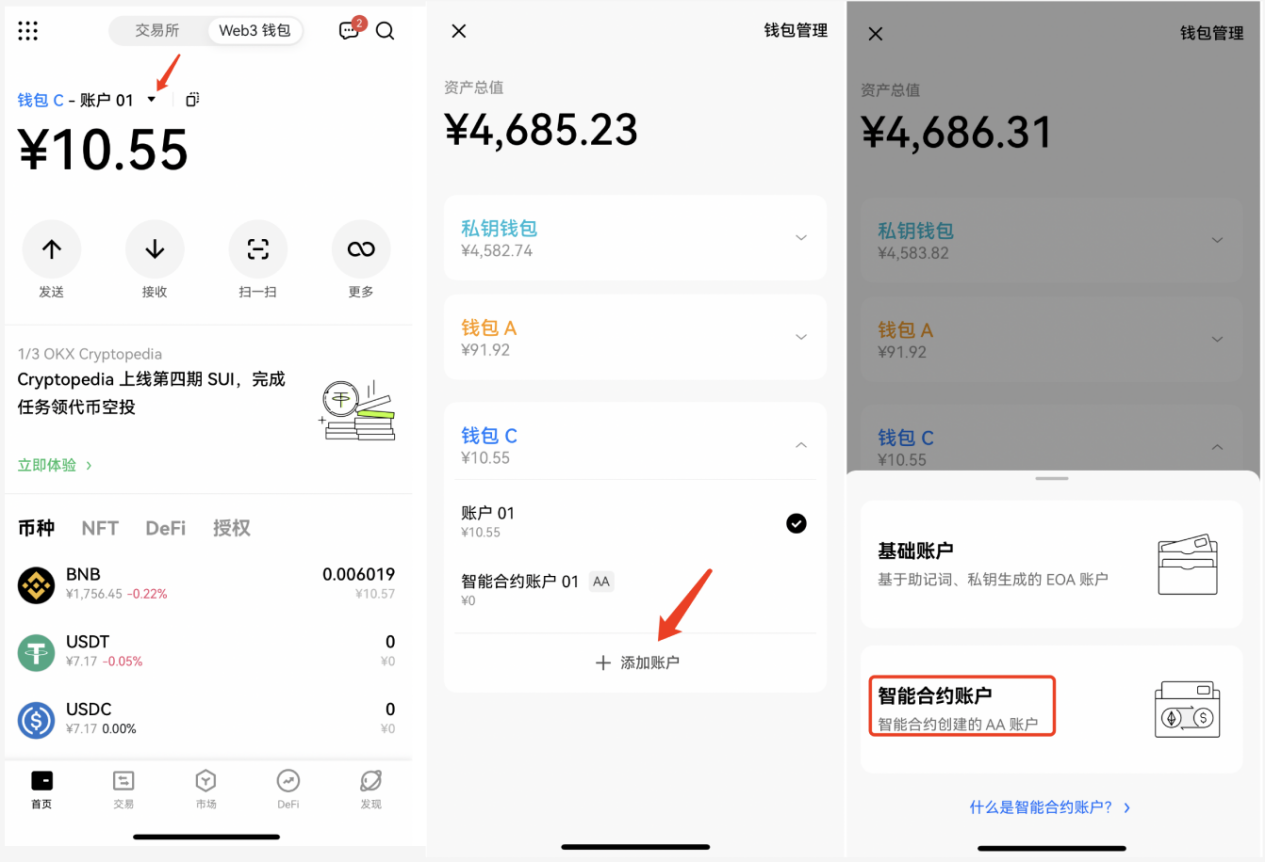
In the OKX Web 3 Wallet, each non-private key wallet or private key wallet can only create one AA smart contract account, while each account under the mnemonic wallet can create a corresponding AA smart contract account. For example, Wallet A - Account 01 corresponds to Wallet A - Smart 01.
Future
The past is cognition, but the future is the trend. The perception and grasp of future trends is crucial for enterprises.
Although the current EIP-4337 proposal is not mature, it is not easy to develop an account abstract wallet based on it. However, the ultimate goal of Ethereum is to remove EOA accounts from the Ethereum network, and AA smart accounts are undoubtedly the future choice, bringing developers a high degree of freedom and helping users reduce barriers to participation. It also brings more gameplay and opens up huge imaginations for Web 3 wallets.
Currently, only a few technological companies like OKX with early accumulation of encrypted wallet technology have the foresight and grasp of the trend, and have started to lead and promote the development of AA smart contract wallets, constantly exploring and enhancing the value and experience of daily use for users.
In recent years, OKX, as the world's second largest cryptocurrency exchange, is not eager to climb to the top, but has returned to "First Principles," rethinking the original intention of the enterprise and the path to be taken in the future, and timely and accurately grasping user needs. It is actively exploring decentralized businesses and focusing on Web 3 wallets.
Just as the greatness of iPhone is not in pioneering smartphones, but in making smartphones a mainstream product. As a product that users use frequently every day, EuYi OKX is starting to think like a "newbie" user when it comes to Web 3 wallet products, continuously lowering the threshold for its use. As Steve Jobs said, "Simplicity is harder than complexity. You have to work hard to make things simple." And EuYi OKX AA smart contract wallet is all about "making things simple", pursuing the ultimate user-friendly experience. Although it is not possible to immediately convert existing EOA users into AA smart contract wallet users, it brings possibilities for the large-scale application of Web 3 wallets.
According to a survey in 2022, there are even up to 1.7 billion people in the world who do not have bank accounts, excluded from the modern financial system. However, Web 3 tools built by platforms like EuYi OKX can allow these people to enjoy inclusive and equal financial services, bringing greater liquidity and more users to Web 3.


