Currency Perspective on MakerDAO: Buying $1.2 billion worth of US debt, what does MakerDAO intend to do?


Original author: DrSamo (Twitter: @BirkSamo), Spinach Spinach (Twitter: @@wzxznl)
As the leader of the DeFi (Decentralized Finance) industry, MakerDAO has always been obsessed with US Treasury bonds. Since 2020, when MakerDAO officially incorporated Real World Assets (RWA) into its strategic development direction, MakerDAO has purchased nearly $1.2 billion worth of US Treasury bonds. Why does a decentralized world DeFi protocol introduce real-world assets? What is the significance behind this? Does introducing US Treasury bonds create DAI (the token launched by MakerDAO) with the same monetary properties as the US Federal Reserve creates currency?
To answer these questions, we need to start with the nature of money.
This article will start from the perspective of currency and introduce the dual structure of central banks and commercial banks into the balance sheet structure of MakerDAO, helping readers explore and understand the significance behind the introduction of US debt assets by MakerDAO.
What is currency? What is the essence of currency?
There is a widely spread saying that "the essence of currency is credit," but many people may know the fact but not the reason behind it.
We would like to quote Professor Zhai Dongsheng's book "Currency, Power and People" to explain: "Currency is a set of social collaboration system and public product composed of three basic elements."
An abstract unit of value supported by national law:
As an abstract unit of value, the value of currency does not come from itself (for example, the production cost of a banknote is much lower than the value it represents), but from the trust people place in it. This trust is largely conferred and protected by national law.
Therefore, when we say that currency is an abstract unit of value supported by national law, we are actually emphasizing the legal status of currency and how this status helps maintain the value and credit of currency.
A bookkeeping system for tracking and recording credit or debt balances in transactions among members of society:
In ancient trading systems, when there was no currency, people may have conducted transactions through barter, such as me giving you a chicken and you giving me a bag of rice.
However, this method of exchange has some obvious problems. First, we need to find trading partners with mutual needs, which can be very difficult in many cases. Secondly, we need to determine the exchange rate, i.e., how many bags of rice is a chicken worth? This is also a complex issue.
To solve these problems, people invented currency. Currency can be seen as a bookkeeping system that helps us track and record credit or debt balances. For example, if you provide me with a service, but you may not immediately demand an equivalent service from me. Instead, I may give you a debt certificate, which is currency, indicating that I owe you a service. At some point in the future, you can use this debt certificate to have me or someone else who accepts this certificate (currency) provide you with an equivalent service.
In this way, the entire transaction becomes simpler and more efficient, and the measurement and transfer of value also become easier.
Transfer of specific creditor's rights to a third party
Standardized Representation (Token):
To understand this, we can use a simple analogy.
Imagine we are on a small island and today you helped me plant crops. I may owe you a debt, such as promising to help you fish in the future. However, managing this debt relationship can be difficult because we need to remember who owes who and when this debt can be repaid.
To solve this problem, we can introduce a standardized representation or token to represent this debt relationship, and that is currency. For example, I can give you a seashell, which represents the debt I owe you. You can use this seashell anytime to demand the fishing service I owe you, or you can also pass this seashell to other people on the island to let them demand services from me. In this way, the seashell becomes a standardized representation for transferring specific debt relationships to a third party.
In modern society, the currency we use works on the same principle. When you hold a $100 bill, you actually possess a type of debt (cash is a liability for the central bank that issued it), which allows you to demand a certain value of goods or services from the society. You can also pass this bill to others and transfer this debt claim to them.
This allows us to manage and transfer debt relationships more efficiently. So when we understand that the nature of money is credit, we can see money as a transferable debt or transferable credit.
If we further understand the process of money creation, you will gain a deeper understanding of the statement "the nature of money is credit."
How is Currency Created?
Types of Currency: Base Money and Credit Money
Currency is generally divided into two main types: Base money and Credit money:
Base money, also known as central bank money or base currency, is directly issued by the central bank and has the ultimate payment capability. This includes the coins and banknotes we use in our daily lives, as well as the commercial bank reserves stored in central bank accounts. Due to its final payment capability, it is usually considered the foundation of the money supply.
Credit money, this form of currency is mainly created by commercial banks through loan and deposit activities. When a bank grants a loan to a customer, it is actually creating new money.
In modern monetary systems, the majority of money is credit money. In other words, the majority of money in the real world is created by commercial banks rather than central banks.
For example, when a person deposits $1000 into a commercial bank, the bank needs to reserve 10% of it in the central bank as a reserve (assuming a reserve requirement ratio of 10%), and then lend out the remaining $900 as a loan. When this $900 is eventually deposited into another commercial bank, that bank can once again reserve $90 as a reserve based on a 10% reserve requirement ratio, and lend out $810 as a loan.
This process can be repeated, and each round will create new money. However, the total amount is limited because the amount of each loan in each round gradually decreases.
Central Bank - Dual Structure of Commercial Banks
In modern monetary systems, the central bank and commercial banks together form a dual structure aimed at balancing the issuance and circulation of currency.
The central bank plays an extremely crucial role in the monetary system. It is responsible for formulating and implementing monetary policy, controlling the supply of base currency, regulating interest rates in the economy, and maintaining the stability of financial markets. The central bank influences the money supply through open market operations, such as buying or selling government bonds.
When the central bank purchases government bonds, it injects base currency into the market, increasing the money supply. Conversely, when the central bank sells government bonds, it absorbs base currency from the market, reducing the money supply. Additionally, the central bank sets reserve deposit ratios, which are the proportions of deposits that commercial banks must hold either with the central bank or with themselves, to influence the money creation ability of commercial banks.
Commercial banks, on the other hand, are the primary source of money creation. They maintain their operations by accepting deposits and granting loans. When commercial banks grant loans, they actually create new money as the loan amount is added to the borrower's bank account, thereby increasing the money supply in the economy.
This dual structure of the central bank and commercial banks allows the monetary system to maintain flexibility and stability. The central bank, through adjusting monetary policy, can control the supply of base currency, thereby influencing the overall interest rate levels in the economy, and helping the economy respond to risks such as inflation or deflation.
Commercial banks, through lending activities, can adjust the supply of credit currency to meet the funding needs in economic activities. However, due to multiple factors such as the central bank's monetary policy and Basel agreements, the ability of commercial banks to create money is not unlimited. This also avoids the risk of excessive expansion of the money supply, which could lead to inflation or financial bubbles.
The Process of Currency Creation
To better illustrate the process of currency creation, using a balance sheet is a very useful tool. Observing the changes in the balance sheet provides us with a magnifying glass into financial behavior (the charts below are simplified models for easier understanding).
Central Bank Currency Creation: Taking the Federal Reserve as an example, the Federal Reserve typically creates dollars through open market operations. Open market operations can be understood as the Federal Reserve buying assets (such as government bonds) from market participants, and then dollars are "created out of thin air." During the COVID-19 pandemic, the Federal Reserve engaged in massive quantitative easing, which means they aggressively bought various assets and injected dollars into the market.
Let's assume the Federal Reserve purchases $5000 of government bonds from commercial banks. The change in the balance sheet would be as follows:
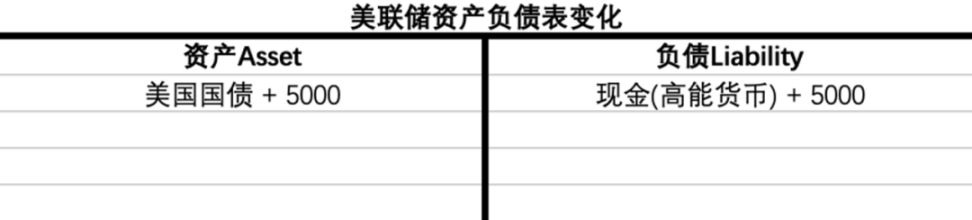
When the Federal Reserve purchases $5000 of government bonds, the asset side of their balance sheet increases by $5000 in bonds, and the liability side increases by $5000 in high-powered money. At this point, high-powered money is created out of thin air, and the market has an additional $5000 in liquidity.
From the Federal Reserve's balance sheet, we can see the process of dollar creation. This process expands the Federal Reserve's balance sheet and increases the liquidity in the market. This is called "expanding the balance sheet." You may have also heard the term "shrinking the balance sheet." In this context, the "balance sheet" refers to the central bank's balance sheet.
Recently, you may have heard about interest rate hikes and balance sheet reduction. This actually means that the Federal Reserve wants to withdraw liquidity from the market. If the Federal Reserve can create dollars by buying assets, then it follows that selling assets can "destroy" dollars. This will result in a reduction in the balance sheet and a decrease in the supply of dollars.
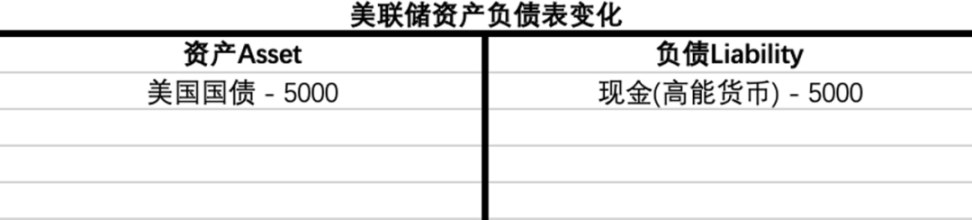
Commercial Bank Currency Creation: For commercial banks, currency creation occurs through the process of lending. Let's say a depositor deposits $5000 into a commercial bank. This $5000 deposit is considered an asset for the depositor and a liability for the commercial bank.To put it simply, commercial banks create money by lending out more money than they actually have in deposits. This is known as fractional reserve banking. When a bank receives a deposit from a customer, it only needs to keep a fraction of that deposit as reserves and can lend out the rest. This allows the bank to earn interest on the loans it makes, which is how it generates profits. For example, let's say a bank receives a $5,000 deposit. The bank is required to keep a certain percentage of that deposit, known as the reserve requirement, as reserves. The remaining amount can be loaned out to borrowers. The bank creates new money by simply adding the loan amount to its balance sheet as an asset, while also crediting the borrower's account with the loan amount. This new money is essentially created out of thin air and is referred to as credit money. The bank can repeat this process multiple times, creating new money with each round of lending. This is known as the money multiplier effect. For instance, if the reserve requirement is 10%, the $5,000 deposit can eventually lead to $50,000 of new money being created. It's important to note that this process of money creation is facilitated by the central bank, which sets the reserve requirement and provides the necessary liquidity to the banking system. Additionally, the creation of new money is tied to the issuance of government debt. Each unit of new money created is backed by an equivalent amount of government debt, which earns interest. This helps ensure that the creation of money comes at a cost and helps prevent excessive money creation by the government. In conclusion, commercial banks create money by lending out more money than they have in deposits. This process, known as fractional reserve banking, allows banks to generate profits and expand the money supply. However, it is regulated by central banks and anchored to government debt to prevent excessive money creation.
But when it comes to the fact that the Federal Reserve creates money by buying government bonds, you will find that if the US Treasury continues to issue new bonds to pay off the old ones, the Federal Reserve will continuously use fresh dollars to buy them and pay interest. Isn't this allowing the US government to still print as much money as it wants?
In the modern credit monetary system, a system of checks and balances is actually implemented. The Federal Reserve has the power to print unlimited amounts of money, but it does not have the right to spend this money arbitrarily. The US Treasury does not have the power to print money, but it has the right to issue government bonds. The Treasury still needs to borrow funds at market interest rates, and excessive issuance of government bonds can lead to an increase in borrowing costs. At the same time, the US Treasury issuing government bonds also has a legal debt limit.
However, although the modern monetary system has made some institutional designs to prevent sovereign governments from printing money excessively, there is still a loophole in practice where governments continually borrow to pay off old debts in order to avoid the cost of issuing new debt. And in the history of the United States, whenever the debt limit was reached, it always ended with raising the debt limit at the last minute.
The entire modern monetary system is essentially a game of passing the buck, and government bonds need to pay interest. What happens if they can't be repaid? What if there's a need for more money? They continue to print money to pay interest and keep spending. Of course, if you are a small country like Venezuela, such continual borrowing and excessive money printing can only lead to currency devaluation and cannot solve foreign currency debt.
But if your currency is the world's strongest hard currency and continually borrowing and paying off old debts will not incur any additional costs from a greater superpower, then you can keep borrowing money without any consequences. Seeing this, you will realize that the anchor behind modern currency is actually debt, and debt can be understood as a form of credit. This further deepens the understanding of the phrase "the essence of money is credit."
Does MakerDAO have the ability to create currency?
Introduction to MakerDAO
As we know, MakerDAO is a project that operates on the Ethereum blockchain, integrating features such as over-collateralized stablecoins, lending, storage, user governance, and development. The core element of MakerDAO is the Maker protocol, also known as the Multi-Collateral DAI (MCD) system, which allows users to generate decentralized stablecoin DAI by using approved assets as collateral. For example, by collateralizing $10,000 worth of ETH, one can generate $6,500 worth of DAI.
In 2022, MakerDAO passed a proposal to utilize funds in the Peg Stability Module (PSM) to purchase US government bonds, which holds significant importance for MakerDAO.
Let's first introduce the PSM (Peg Stability Module), an important component of the MakerDAO project. Its main function is to assist DAI in maintaining a 1:1 peg to the US dollar.
To elaborate, the working principle of the PSM is as follows: when the market price of DAI is higher than $1, arbitrageurs can use the PSM to exchange stablecoins (currently only supporting USDC) for DAI at a 1:1 exchange rate, effectively obtaining DAI at a discounted price. They can then sell it on the market at a price higher than $1 and make a profit. Conversely, when the market price of DAI falls below $1, users can use the PSM to exchange DAI for dollar-pegged stablecoins at a 1:1 exchange rate, reducing the circulation of DAI and causing the exchange rate to rise back to $1. This mechanism adjusts the supply of DAI automatically through market forces, ensuring price stability.
If we observe the MakerDAO balance sheet for 2022, we can see that the PSM assets account for over half of MakerDAO's overall assets, and the PSM primarily consists of centralized stablecoin USDC. This implies that DAI, to some extent, is a shell for USDC.
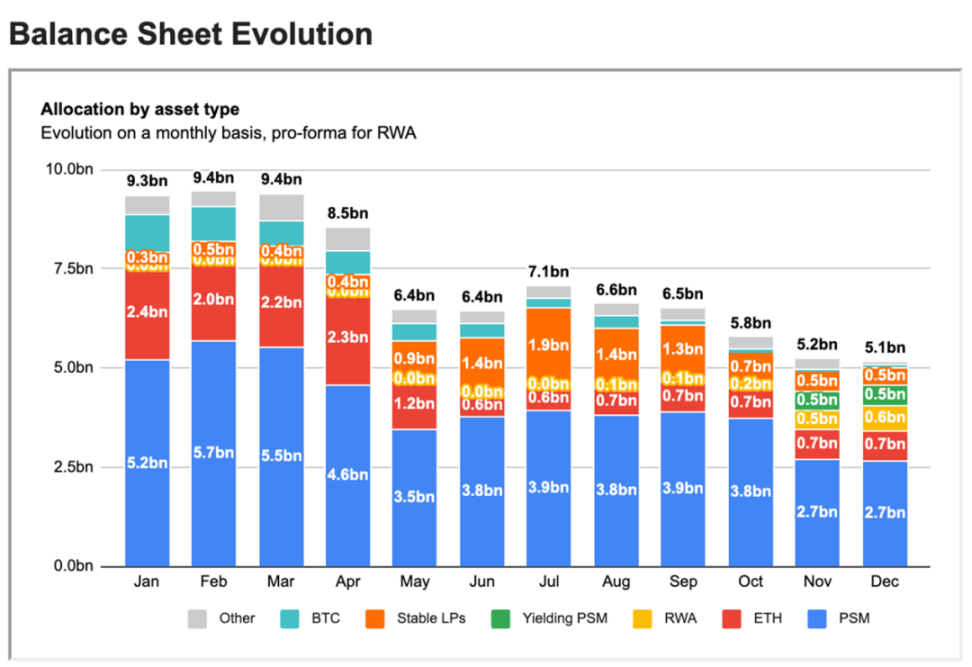
Source: https://forum.makerdao.com/t/makerdao-2022-financial-results-and-retrospective/19636
However, when MakerDAO started buying US Treasury bonds, we discovered an interesting phenomenon, which is that the asset and liability sides of MakerDAO's balance sheet are almost the same as those of the Federal Reserve's balance sheet (US Treasury bonds: US dollars vs US Treasury bonds: DAI stablecoin):
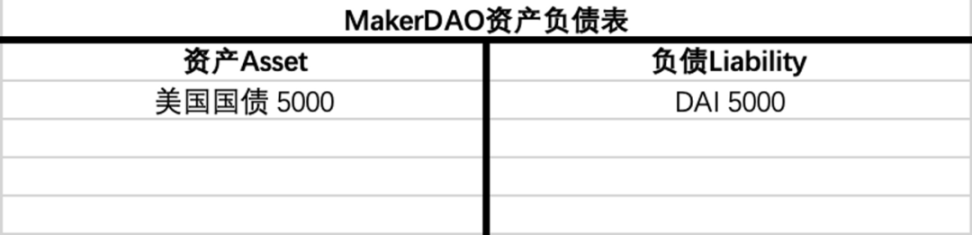
So the question is: Does this mean that MakerDAO is sharing the monopoly of the "currency creation based on US Treasury bonds" that used to only belong to the Federal Reserve? What does it mean for MakerDAO to buy Treasury bonds?
Is MakerDAO creating currency?
First, let's address the question: MakerDAO does not create currency, so where is the mistake?
To understand the issue, we need to consider three concepts:
Central Banks: represented by the Federal Reserve (Fed), they have the strongest ability to create currency, and the newly issued currency will be high-powered money.
In the simplest model, the Fed can create money out of thin air. However, in practice, it cannot directly enter the market. The US Treasury has the authority to issue US government bonds but not to print money. On the other hand, the Fed has the power to print money but not the authority to spend it freely. This division of powers aims to anchor fiat currency issuance to a sovereign nation's debt, and to curb the urge of sovereign governments to excessively print money.Commercial Banks: they have the ability to create money through credit expansion, and the money created is credit money.
As mentioned earlier, when a loan is approved, there isn't actually a "transfer of funds" as we usually understand it. Instead, the bank simply adds an asset and a corresponding liability to its balance sheet. The bank only needs to maintain its "core capital adequacy ratio" at a safe level on a macro scale, typically requiring a minimum of 8%.Stablecoin Issuers: they have the simplest business model. They collect customers' US dollars and issue stablecoins in a 1:1 ratio, taking responsibility for redemption.
For example, Circle issues USDC and Tether issues USDT. In theory, they do not have the ability to expand credit; they only hold customers' US dollars and issue corresponding USD-backed stablecoins. MakerDAO's issuance of DAI is also very similar to them, especially with its PSM module offering a 1:1 exchange between DAI and USDC. If USDC can be seen as "USD vouchers," then the DAI in the PSM module can be considered "USDC vouchers."
The PSM module can be very confusing when there is good liquidity. It continuously provides stable liquidity between DAI and USDC. However, fundamentally, it functions as a "reserve pool." When everyone wants to exchange their DAI for USDC at a 1:1 ratio through the PSM module, it becomes apparent that this reserve pool can be depleted.
The USDC in this reserve pool belongs to MakerDAO, but MakerDAO does not have loan agreements or the ability to expand credit. It should not and cannot lend out this pool of USDC. Instead, it should lock these USDC tokens. They should only be used when providing 1:1 exchanges between DAI and USDC, just as Circle cannot easily use customers' US dollars.
So where does MakerDAO get the money to buy US Treasury bonds?
You can't just use DAI to buy US Treasury bonds, they don't accept it. MakerDAO exchanges the USDC reserves belonging to the DAO treasury for dollars, and then uses them to buy US Treasury bonds.
Understanding the modern credit currency system based on the "central bank - commercial bank" relationship, we can see that the process of issuing currency by stablecoin issuers is very different. Compared to the central bank's ability to create high-energy currency out of thin air and the commercial banks' ability to create currency through lending, the stablecoin issuer's ability to create currency is very limited. It's like a delivery person for money, much like a farmer's spring — we don't produce money, we just transport it.
Even when looking at currency issuance from a broader perspective, the way stablecoin issuers supply currency is completely different. In the era of the Bretton Woods system, the US issued the dollar backed by gold reserves, but gradually the dollar had more bottles than caps. As the dollar was issued and the gold reserves were depleted, the number of caps decreased.
Of course, if stablecoin issuers only focused on creating stablecoins, they would go hungry. So we also accept Circle's conversion of a portion of their customers' dollar deposits into short-term US Treasury bonds. Essentially, this is the swapping of more liquid, demandable dollar savings deposits for less liquid, but higher-yielding, US Treasury bonds, to pay for the company's operational costs. MakerDAO is doing something similar, by swapping interest-free USDC reserves for interest-bearing US Treasury bonds, to generate revenue and sustain the protocol.
This behavior makes it impossible for USDC to withstand a 100% run (which, in theory, would have been possible when it was only earning interest on demand deposits) and weakens the anchoring of DAI to USDC. Essentially, it's an exchange of liquidity for profit. But instead of having more bottles than caps, it's like having 100 bottles and 99 caps.
From a balance sheet perspective
Furthermore, from a balance sheet perspective, DAI is a liability for MakerDAO, while the USDC in the PSM module is an asset. Essentially, MakerDAO has exchanged part of its asset, USDC, on its balance sheet for another asset, US Treasury bonds. This is a normal asset swap process for any company or DAO, without creating new DAI out of thin air or using DAI as high-energy currency to amplify the money multiplier.
In summary, MakerDAO does not possess the ability to create money like the Federal Reserve. Especially for a strong, valuable currency like the USD stablecoin, it is extremely difficult to create.
This is also the original ideal of BTC, to make decentralized currency the anchor of all economies, eliminating the exploitation of people by sovereign governments' excessive issuance of currency. Even though BTC still has a long way to go in replacing fiat currency, DAI also has a long way to go in replacing fiat currency (or centralized stablecoins).What does MakerDAO's purchase of US Treasury Bonds mean?
We point out that MakerDAO's addition of US Treasury Bonds to its asset side does not increase the corresponding DAI on the liability side, it is merely an asset swap.
However, from a different perspective, can we also consider that the previous endorsement of some DAI was backed by USDC reserves, and after the swap, some DAI endorsement has become backed by US Treasury Bonds issued by the US Department of Treasury, thus enjoying the credit endorsement of the sovereign nation of the United States?
This endorsement switch is valid, and similar events have occurred multiple times in the real world.
Other fiat currencies with the inclusion of US dollar endorsement
In history, it is not uncommon for countries with smaller economies to increase their credit using the US dollar as an anchor for their currency.
European countries after World War II
After World War II, all European countries were devastated, with insufficient gold reserves in their treasuries and governments lacking enough credit to issue bonds. This made it very difficult to stabilize their own currencies, and there was a risk of competitive depreciation and a lose-lose situation.
At that time, the US dollar stepped up as a stable bridge for the world economy. The United States had gold reserves, and countries held reserves of US dollars. In essence, countries borrowed the endorsement of the US dollar to increase the creditworthiness of their weak fiat currencies.
In this Web3 story, the US gold reserves can be likened to MakerDAO's overcollateralization of core assets like ETH to mint DAI, and the countries' reserves of US dollars can be likened to DAI reserves of USDC.
China after the reform and opening up
Economic development requires capital, and at that time, capital was scarce in China. However, printing money without control could lead to inflation. How to stabilize the new issuance of the renminbi (RMB) with an anchor?
Similarly, China also increased the creditworthiness of the RMB by holding reserves of US dollars. China began to promote the introduction of foreign investment, and foreign capital (mainly US dollars) entering China could not circulate directly. The actual process was that the State Administration of Foreign Exchange accepted the US dollars and then increased the issuance of RMB based on the exchange rate, which was then given to foreign investors for investment. After China's accession to the WTO, this trend grew rapidly, so a large part of the newly issued RMB was essentially backed by US dollars. Of course, the State Administration of Foreign Exchange cannot wait for the depreciation of the US dollar. They bought a large amount of US bonds to earn interest and indirectly introduced the creditworthiness of the US government through the US dollar and US bonds.
In this Web3 story, can't we understand the targeted issuance of RMB as a packaged US dollar (Wrapped USD++++++++++++++++++)? The RMB issued through reserves of US dollars borrows the creditworthiness of the US dollar.
Countries and regions that implement a linked exchange rate system
The most typical example is Hong Kong, which has implemented a linked exchange rate system since 1983. It maintains the stability of the Hong Kong dollar exchange rate within the range of 7.75 to 7.85 Hong Kong dollars per 1 US dollar, with a 100% foreign exchange reserve guarantee. The Hong Kong dollar has become a voucher for the US dollar, just not at a 1:1 ratio.
Under normal circumstances, the Hong Kong Monetary Authority does not intervene in exchange rate fluctuations. The three note-issuing banks (Bank of China (Hong Kong), Hongkong and Shanghai Banking Corporation, Standard Chartered Bank) engage in arbitrage activities to stabilize the exchange rate. When the Hong Kong dollar is about to exceed the narrow range of 7.75 to 7.85, the Monetary Authority will use its US dollar reserves to buy Hong Kong dollars or sell Hong Kong dollars for US dollars, forcibly fixing the exchange rate of the two currencies using these two methods.
This story can be Web3-ized. The pre-1983 existing stock of Hong Kong dollars was like a gold standard, similar to the previously issued DAI with overcollateralization. The arbitrage behavior of the three note-issuing banks is akin to on-chain arbitrage robots trying to equalize the price difference between DAI and other stablecoins. And the role of the Hong Kong Monetary Authority is equivalent to MakerDAO's PSM module.
Two Forms of Currency Endorsement
From the examples above, we can abstract two sources of endorsement:
The endorsement of hard currency (mainly USD) and precious metals (mainly gold) is referred to as "hard endorsement".
The endorsement relying on the credit of small countries is relatively weaker and can be called "soft endorsement".
Almost all small countries' currencies rely on leveraging the "hard" portion of their reserves to enhance the quality of their own currency, while discreetly diluting it with the relatively "soft" credit of their own country and collecting "seigniorage".
If a country is irresponsible, like Venezuela, it may have a certain amount of hard currency foreign reserves. However, after wildly inflating the face value of the currency by adding a few zeros, that tiny hard component becomes meaningless. Such rampant inflation cannot solve the problem of foreign debt and can only exploit the country's population.
For responsible countries, they can fully enjoy the benefits of the "hard endorsement" in their currency and gradually incorporate their own "soft" component to expand their credit progressively. Just like the Roman Empire during the era of the gold standard, continuously diluting the purity of gold and silver coins and collecting seigniorage for over a hundred years.
DAI is like the currency of a small country
For DAI, if we consider USDC and the US bond as the foreign hard endorsement, what is its "soft endorsement"? Obviously, it is the portion generated through over-collateralization, which is not really "soft". It is the only issuing method in decentralized stablecoins that withstands long-term testing. It is more like a "hard with hard" approach that replaces the "soft" portion of continuously increasing the currency supply through dilution, seen in small countries, with a publicly transparent issuing rule of over-collateralization and full reserves.
The problem with generating stablecoins through over-collateralization is that in cases where the price of underlying assets fluctuates rapidly, massive liquidation activities may cause fluctuations in the exchange rate and supply of DAI, and the rate of currency supply growth is relatively slow. For DAI, the significance of this "hard with hard" approach is to leverage the massive inflow of USD into the world of decentralization, rapidly increasing the supply of DAI (through the PSM module's 100% reserve issuance), and increasing the stability of DAI's exchange rate.
Relying on foreign credit to achieve rapid growth in currency supply is of great significance. One of the reasons why gold gradually lost its position as an international trade settlement currency is the explosive growth of productivity in modern society after the Industrial Revolution. Relative to the rapid increase in goods and services, the supply of gold as a currency cannot keep up, resulting in a deflationary trend. Both deflation and rampant inflation are detrimental to the economy. Besides maintaining its own anchor stability, it is also crucial for DAI to be able to increase its supply to match the demand as the entire cryptocurrency market grows in scale.
Significance of Reserve Diversity
Understanding the examples above, we can see that the process of creating currency by MakerDAO is actually a process of exchanging the reserve components in its own balance sheet.
Increasing USDC reserves: When real-world dollars flow into the crypto world through stablecoins, DAI also gains the ability to rapidly increase its supply. It is no longer limited to the previous situation where the expansion of supply was slower when using mainstream cryptocurrencies such as ETH as overcollateralization.
Increasing US Treasury reserves: bypassing the intermediary Circle and directly enjoying the endorsement of US Treasury-issued Treasury bonds. If more US Treasury bonds were exchanged for DAI endorsement at the beginning, then in the crisis of the last USDC run, the impact on DAI would have been smaller. This is the positive role that reserve diversification plays in stabilizing exchange rates.
In MakerDAO's asset types, we can also see that the proportion of real-world assets RWA (such as US Treasury bonds and other assets) is continuously increasing, and the reliance on stablecoin assets is decreasing.
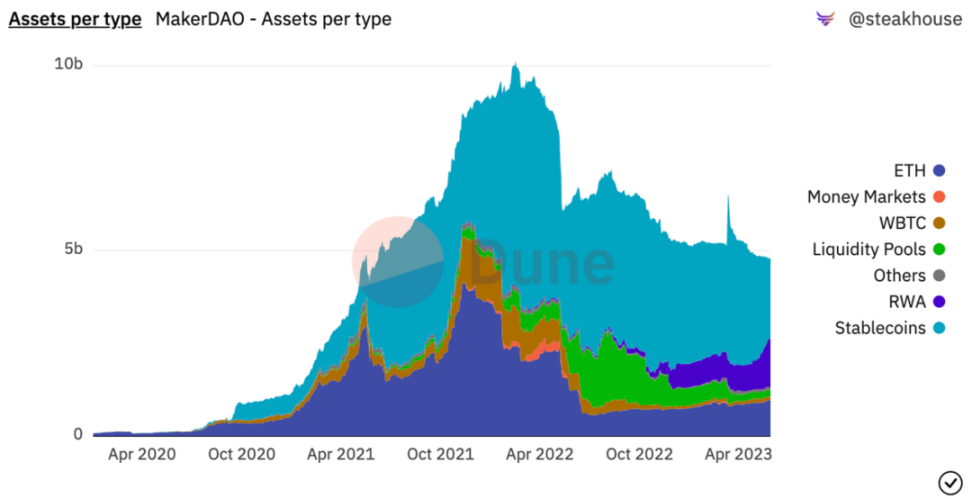
Source: https://dune.com/SebVentures/maker---accounting_1
Summary
After analyzing the question "Does MakerDAO share the ability of the Federal Reserve to create currency" from two perspectives, we can see that the answer is no longer important. The act of MakerDAO purchasing US Treasury bonds is a substitution of assets on its balance sheet by acting as the "central bank" of DAI, and this substitution ability is the key.
In the real world, central banks of various countries also have the ability to choose the assets they allocate. For example, in order to save the subprime mortgage crisis in 2008, the Federal Reserve started accepting mortgage-backed securities (MBS) into its asset portfolio. The Bank of Japan, in a very magical way, holds a large amount of Japanese corporate stocks as assets through trust funds, to the extent that it became the largest single shareholder of many large enterprises in Japan.
In summary, the significance of MakerDAO purchasing US Treasury bonds lies in the ability of DAI to diversify the assets backed by external credit. Additionally, the long-term additional income brought by US Treasury bonds can help stabilize the exchange rate of DAI, increase its circulation supply flexibility, reduce DAI's reliance on USDC, and mitigate single-point risks by incorporating US Treasury bonds into its balance sheet. Overall, this is beneficial for its development, and we look forward to its greater achievements in the development of decentralized stablecoins.
References
[2] https://mirror.xyz/bocaibocai.eth/_66d8wRKfs7ZYBfqgMOHH4Lm3GWrRfWg-7fkzU-hMPQ
[3] https://zh.wikipedia.org/zh-hans/Hong Kong Linked Exchange Rate System
[4] https://myantokengeek.medium.com/copewen-web3-balance sheet-fc41440b3e1c
[5] https://forum.makerdao.com/t/makerdao-2022-financial-results-and-retrospective/19636