






Interview with the founder of Starknet: look up to the stars, keep your feet on the ground


At the recent Ethereum EDCON conference in Montenegro, ZK became the hottest topic. During the five days from the 19th to the 23rd, whether it was a personal speech or a round table panel, the topics of the guests mostly revolved around vocabulary such as ZK Rollup, zkEVM and ZKML. In the eyes of the "Ethereum core circle", ZK has become the ultimate new narrative that is comparable to the DeFi innovation in 2019 and can leverage the next round of industry explosion.
For a long time, technical implementation has been the main problem faced by ZK, which also makes it a "future solution" in most people's minds. However, this year, the Arbitrum ecology has not yet been fully developed, and ZK Rollups, as technology substitutes, have already knocked on the door. One of the most obvious feelings this year is that all kinds of "ZK projects" have suddenly increased. Developers started to FOMO ZK technology, ZK transfers, ZK identities, and ZK board games. As long as they can be related to privacy, the word "ZK" must be included in the project name. Such a prosperous scene, of course, benefits from the concentrated efforts of ZK Rollup such as Starknet and zkSync, and zkEVM projects such as Scroll and Polygon. And behind these mainstays is an Israeli man named Eli Ben-Ssason.
Eli(@EliBenSassonfirst level title
About Optimistic Fraud Proofs, zk-STARKs, and SNARKs
image description
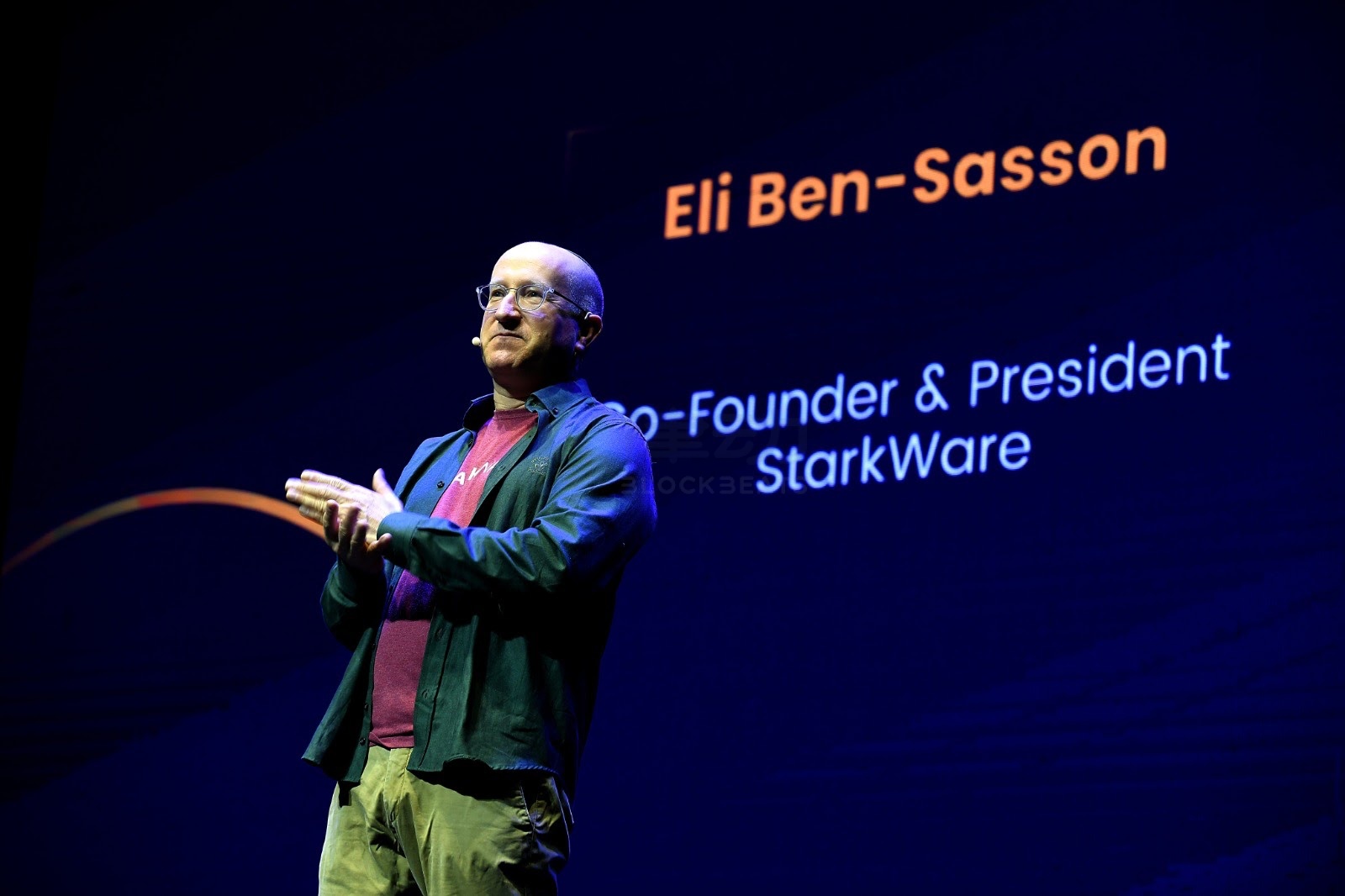
Eli Ben-Sasson gave a speech at the StarkWare Sessions 2023 conference, the source of the picture is from StarkWare
As a technology-driven entrepreneur, Eli has absolute confidence in ZK technology and the mathematical principles behind it. So how does he view the "ZK rival" Optimistic Rollup? What do you think about the future of zk-STARK and zk-SNARK?
BlockBeats: Hello Eli, first of all, please briefly introduce to the readers why you entered the field of cryptocurrency and why you founded Zcash and StarkWare?
Eli:I was a computer science professor doing theoretical computer science research. People in mainland China may have heard of Yao Qizhi from Tsinghua University. He is an important promoter of theoretical computer science, a Turing Award winner, and the inventor of secure multi-party computing. I entered this research field many years later than him.
In 2008, I started to do some research related to zero-knowledge proof (hereinafter referred to as ZKP). In May 2013, that is, ten years ago, I participated in the Bitcoin Conference held in San Jose, and I realized that the field of blockchain is the best application scenario for my theoretical research and mathematics. I'm pretty sure I'm the first person to realize that Proof of General Computing and blockchains can go very well together. Ten years ago, Ethereum did not exist. When I first met Vitalik, he was not the founder of Ethereum, but a content writer for Bitcoin Magazine. We talked a lot about proofs, validity proofs, and zero-knowledge proofs.
One of my early co-authored papers was called "Zerocash: Decentralized Anonymous Payments from Bitcoin, about how to use zero-knowledge proofs to secure payments on Bitcoin. That's what became the Zcash project, and we've been developing the technology. Around 2018, we proposed a better technical improvement and called it STARK, which helps to expand the scale of Ethereum or the general blockchain. In 2018 we co-founded StarkWare with me, Uri Kolodny, Alessandro Chiesa and Michael Riabzev. Today it is widely accepted that our proof of validity is the best way to scale Ethereum.
BlockBeats: You mentioned that you had contact with Vitalik very early, and I remember him investing and supporting StarkWare very early.
Eli:Yes, Vitalik was one of StarkWare's early investors. This is one of his few investments to date and we are very proud of it.
I remember that Vitalik became a core investor around the fall of 2018. He and I attended a meeting that seemed to be organized by Tsinghua University, but it must have been in Shenzhen. I remember we were walking around a really nice fish market talking about things like StarkWare and his investments and a whole bunch of things. So the details of the decision were made in China.
BlockBeats: Before Ethereum, you began to consider using ZK proofs as a scaling solution. How did you see that the blockchain will definitely have scalability problems?
Eli:I believe that readers in the Chinese community must be familiar with Alipay and WeChat Pay, and their transaction speed may have reached one million transactions per second. Right now, the blockchain needs to do NFTs, games, voting, elections, and governance. For all of this to happen, the current technology is not good enough. On Bitcoin and Ethereum, there are probably 10 to 20 transactions per second. This requires other technologies, technologies that do not reduce the security of the blockchain, but can expand the scope or reach of the blockchain, which is what Starknet has done.
BlockBeats: Professor Ed Felten, the founder of Arbitrum, also began to solve the scalability problem around 2014, but he decisively chose interactive fraud proofs, which were later generally considered to be more feasible optimistic fraud proofs. Why did you decide to use ZK as a solution from the start?
Eli:This is a better technique, and it works. In fact, in the Ethereum core team, everyone knows that Optimistic Rollups has not opened their core technology. Neither Arbitrum nor Optimistic are fraud proof. The reason they didn't start it was because it simply didn't work.
In contrast, we have never submitted a state update without proof of STARK validity. Even with 10x the performance of our system, we use less than 1% of Ethereum's resources. Optimistic Rollups is a great idea, but it doesn't work, and because it doesn't work, it's not turned on. There's a big difference between something that should work but doesn't work, isn't even turned on, and another technology that does work and can be proven.
BlockBeats: But while Vitalik invested in StarkWare, he then backed Optimism. There seems to be a growing consensus in the encryption field that scalability issues should start with Optimistic first, and then turn to ZK, because ZKP or ZK Rollup is technically much more difficult to implement than Optimistic. What do you think about this matter?
Eli:I like the Optimism team, they are great members of the community, but the technology is not good. Like, why can't we attach feathers to people and make them flap their wings to build airplanes? It does make more sense, which is why Leonardo da Vinci drew men with wings. But it doesn't work in mathematics and economics. I love and appreciate their ingenuity and really great community members, but that doesn't change the fact that it's a technology that doesn't work very well.
BlockBeats: But as a general user, Optimism and Arbitrum are indeed practical solutions for now.
Eli:Of course, but the thing to realize is that your asset security is trusting a single operator, and then it works pretty well. Here's another possibility that works pretty well. You can bridge your assets to any computer you really trust. It could be a centralized exchange or anything like that, and you get incredible TPS throughput, but you're entrusting all your funds to that computer controlled by that one person. If it malfunctions, goes offline, or does something evil, all your funds are gone.
Arbitrum, Optimism have the same security assumptions as Binance, Binance is a great product for users, probably even better than Arbitrum, but it is important for users that they should not be fooled into thinking they are moving assets higher security level. If someone says I won't use Binance because Binance is controlled by a centralized process, I'm going to de-centralize, I'm going to put assets on Arbitrum or Optimism, but in fact it's the same thing.
BlockBeats: So when users use Optimism or Arbitrum, they are actually using a centralized trading platform?
Eli:What they are using is a centralized system, and even worse, based on a code base that was not designed from the ground up to be operated by a single operator. So I don't think it gives you as much legal protection as Binance.
BlockBeats: Speaking of ZKP, you created zk-STARK in addition to the widely recognized zk-SNARK. Why do you want to set two different technical standards for ZK technology? And why did StarkWare choose zk-STARK in the end?
Eli:SNARKs technology, Groth-16 type of preprocessing SNARKs, which uses elliptic curves, could be ready for production earlier, but I think it is an inferior technology in terms of efficiency and security. This is like a technology that is not so good, but it appeared first, just like the steam engine is not as good as the gasoline engine, but it appeared first, I think it is a bit similar to this situation.
image description
Comparison chart of zk-STARK and zk-SNARK technical details, source from Horizon Acadamy
BlockBeats: Many ZK Rollup and zkEVM projects currently use zk-SNARK. What do you think about the future of zk-SNARK?
Eli:first level title
About Starknet, Cairo, and zkEVM
What many people find difficult to understand is that, as an L2 of Ethereum, Starknet itself is not compatible with Ethereum EVM, and developers need to use Cairo, a new language for contract development. This seems to make Starknet lose many of the advantages of EVM compatibility with L1 and Ethereum's equivalent L2, that is, to minimize development costs to quickly start the ecology in a short period of time. But in Eli's view, these issues are irrelevant in the face of the huge potential that Cairo brings. More importantly, the Starknet ecosystem already has its own solution for this.
BlockBeats: Why did StarkWare create two different projects, StarkEx and Starknet? Why can't the two be combined?
Eli:StarkEx and Starknet serve two different purposes. When you talk about a high-throughput transaction of a very definite nature, like minting and trading NFTs, then you can get better performance and throughput from a system that was purpose-built for that, which is StarkEx. We're very proud of the fact that we've battle-tested the entire technology, starting with a very specific use case.
Starknet, on the other hand, was more complex built first, so of course it came later, and it serves a different purpose, allowing you to do general-purpose computing, like Ethereum, but this general-purpose computing means that, unlike It's not going to perform that well compared to specific performance dedicated to one use case. Therefore, this is a trade-off between versatility and efficiency.
BlockBeats: So it is very important for the StarkWare team to achieve high transaction TPS in specific application scenarios?
Eli:Yes, it is very important for us to reach this goal. A lot of teams "run their own projects on Twitter" where they post some pretty numbers and hope people will be fooled into thinking it's a working system. But we are proud of our high TPS system that has been running for many years. It's all about increasing throughput and reducing transaction costs.
What I want to say is that until now, our system has processed nearly 1 trillion US dollars in transactions, more than 450 million transactions, and more than 100 million NFTs have been issued. No other L2 can do this. Our daily TPS is 50% higher than Ethereum, and our weekly TPS is 30% higher than Ethereum for a whole week. No other system has achieved this level, and we have never used more than 1% of Ethereum Gas, even though our TPS increased by 30%.
BlockBeats: StarkEx is a very specific use case. As a technology-driven project, StarkWare seems to have a very clear positioning of its business model from the beginning.
Eli:image description
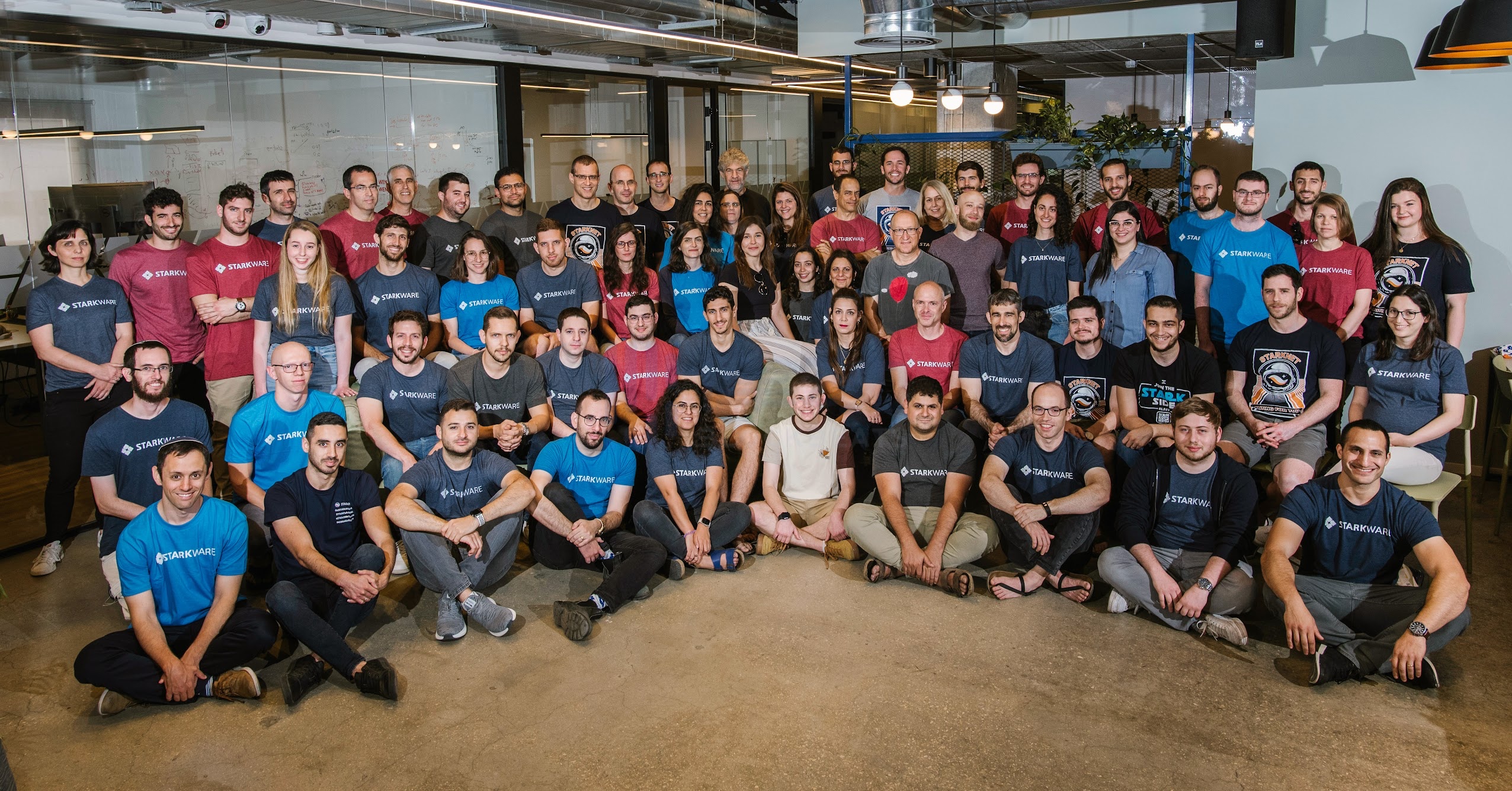
StarkWare team members, image source from StarkWare
BlockBeats: Next I want to talk about the Cairo language. As an Ethereum L2, Starknet is not compatible with Ethereum EVM, and developers must use the Cairo language to build applications. This seems to make Starknet lose many advantages of "EVM compatible ecology". Why choose to build your own language?
Eli:Yes, there are a few things I want to say about Cairo. First, it is an advanced, next-generation smart contract programming language. It supports some new features from the beginning, such as smart wallets, or account abstractions, which are built into the Cairo language. It's a Rust-inspired programming language, and many developers who try Solidity and use it, especially those who know Rust, will say they prefer programming in Cairo to Solidity. So it's a very, very good programming language in its own right.
The second thing I would say is that the reasons for using a dedicated language to create STARK proofs, or validity proofs in general, are very similar to why you would want to write smart contracts in Solidity. You need to use Solidity not because it has a better developer experience than Python, Rust or C++. Instead it has a worse developer experience, but when you move to a new framework with blockchain infrastructure, you have to use a different programming language, Solidity is good because it compiles efficiently to the Ethereum Virtual Machine . I will give another example. If you want to write really good graphics to take advantage of the GPU, you should write in CUDA, because it's a language that takes maximum advantage of the GPU's performance.
The same is true for STARK proofs. With a different virtual machine, there is a different set of constraints on what makes something valid or invalid. If you want to achieve the performance that STARK proofs can achieve, such as putting a million NFTs in a block in Ethereum, you have to use programming languages more effectively. We can mint 10 million NFTs in one proof on Immutable X, I can't imagine anything based on EVM or any zkEVM coming close to what we can put into a single proof on the blockchain. I can challenge the zkEVM of the world, they won't do it. That's why you need a different computing model and a different programming language.
BlockBeats: However, many ecological projects that have used Rust language in Polkadot generally give me feedback on the issue of operating costs, because it is very expensive to hire or train an engineer who knows how to develop contracts in Rust language. On the other hand, if the team develops the project on Ethereum or on an EVM-compatible L1, it is very cheap. How do you feel about this situation? Is this a problem for the Starknet ecosystem?
Eli:That might be a problem, but developers are flocking to Cairo and STARK. The number of developers and teams is increasing every day, and I think they see the potential. A lot of people understand the problem of scale and ask themselves what is the best and most forward-looking solution, what really opens up the scalability of global demand, and I think a lot of them have come to the right conclusion, that It is to follow the path of Starknet and Cairo 1.0.
There is an analogy here, usually you will write the first version of your software in Python, but when you want to achieve scale, you need to write it in some other very efficient language such as C++, WASM, Rust, etc. I think the exact same thing happens with Cairo, you might take Solidity code and deploy it to Kakarot, but that's like writing a high frequency trading engine in Python, it shouldn't be. You need to write in another language, and that other language will be Cairo.
BlockBeats: There are also some projects developing zkEVM based on Starknet.
Eli:Yes, there are very good projects building ZK-EVMs on StarNet. The first one is called Warp, and it's made by the NetherMine team, which is really good. The second is called Kakarot, which is a community that is forming.
first level title
ZK Rollup's track competition and Starknet's ecological development
In the interview, BlockBeats also mentioned the competition between ZK Rollups and the ecological development of Starknet itself. As the most technical and demanding field in the entire encryption industry, it seems difficult for ordinary users to distinguish the pros and cons between zkSync and Starknet. For most people, the reality is that whoever is more likely to "come to trouble" is optimistic about whoever is. From this perspective, StarkWare's concept driven by technological innovation seems to have caused problems for Starknet. How does Eli himself view the competition between ZK Rollups? What are his expectations for the development of Starknet ecology?
BlockBeats: In the current ZK Rollup track, Starknet and zkSync are the absolute leaders, and there seems to be a strong competitive relationship between the two. In your opinion, what is the difference between Starknet and zkSync, and where is the advantage of Starknet?
Eli:You have to ask yourself, where is the best technical step? Where is the most likely place to gather the most developers and provide the best and most secure technology? We demonstrated our capabilities before zkSync, they were great storytellers, but there was a big mismatch between the stories they told and the developer experience. I have a suggestion, I encourage developers who are reading this to try to develop or deploy something on zkSync, and try to develop and deploy something on Starknet, you will feel a stark difference.
Let me tell you a story. Someone asked someone on Reddit to make a thing that can carry out 300,000 transactions. We did it on the main network, and the TPS is about 3,000. A week or two later, the zkSync team came out and said, we have 3000 TPS, but this 3000 TPS has never been measured, proven or demonstrated, but it is a good story. In an industry where there are many people who enjoy telling stories, there are also those who present facts, and we pride ourselves on our ability to present facts.
BlockBeats: There are also user feedbacks. Currently, the Gas for transferring assets or interacting on ZK Rollup is very high. Why is this?
Eli:Starknet is currently experiencing congestion due to high demand. We will release version 12 within two weeks, which will greatly improve TPS and solve most of the needs. Then in the next release, when we fully integrate Volition for off-chain data processing, the price will be significantly reduced, which may happen in a month or two.
BlockBeats: When it comes to ecological developers, some people have indeed reported that Starknet is more balanced than zkSync in terms of ecological development.
Eli:image description
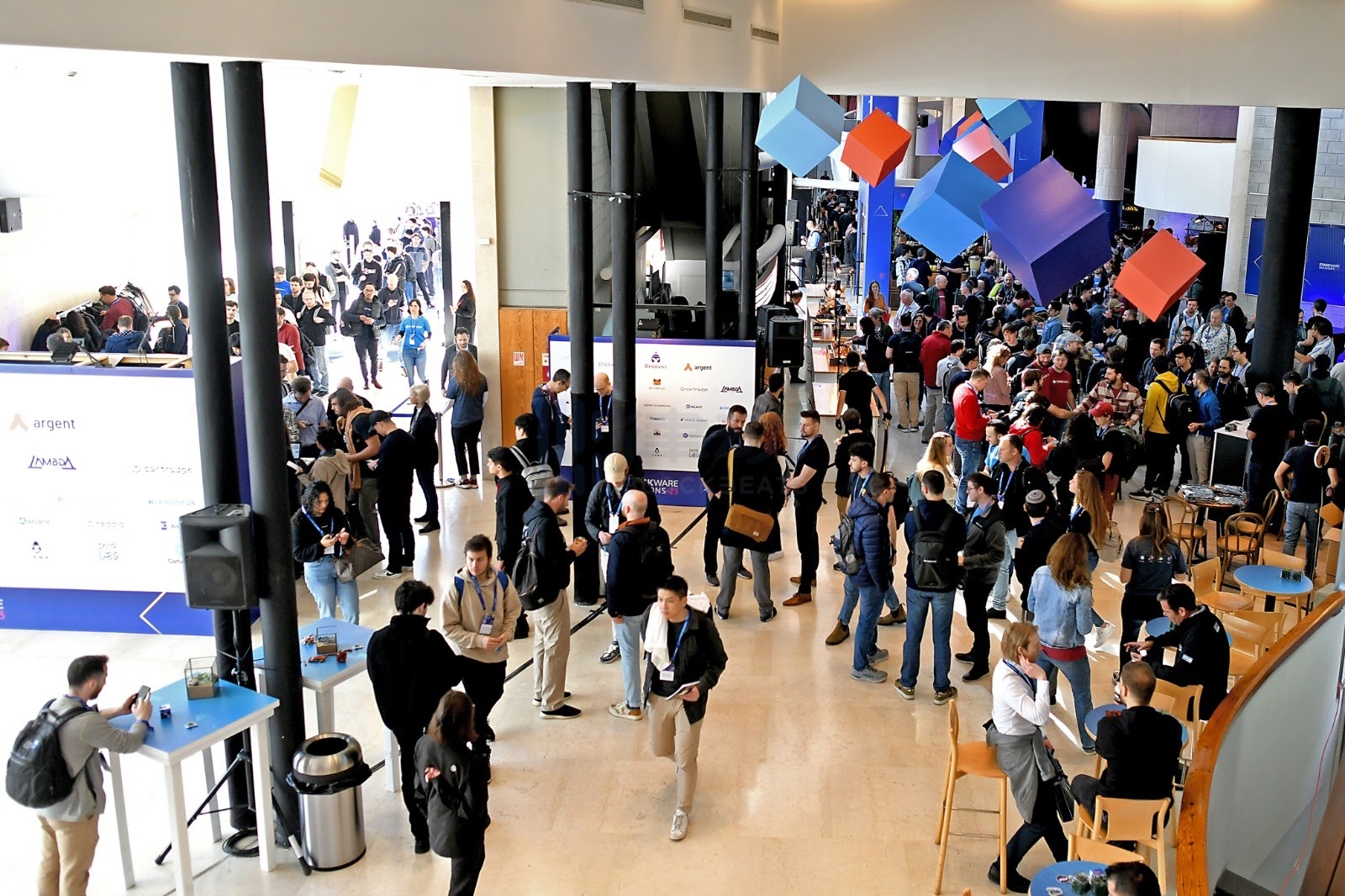
The scene of StarkWare Sessions 2023 conference, the source of the picture is from StarkWare
BlockBeats: But in the field of Web3, teams who understand marketing seem to be more popular. Many technology-driven projects have problems in ecological development, don't they?
Eli:No, I don't think that's what's going to happen next. The reason I think so is because that's how Ethereum was developed. One day, a very successful app will realize what Starknet is capable of. What is that App, I don't know now. If I had to guess, I don't think it's a product that already exists in L1 and can be easily copied and pasted to L2.
So I think it's something that everybody will see and talk about because it's a completely new application that's not possible at L1 or even at other L2s. This will be the tipping point, and developers will flock to it. Because of this, we put most of our attention here. We come to EDCON this time to get in touch with more developers and invite them to join our ecosystem. For some of them will create wonderful things that I cannot predict.
BlockBeats: Do you have any advice for developers who are planning to develop in the Starknet ecosystem? What can Starknet offer them?
Eli:I can't answer this question for them, and even if I give an answer, they shouldn't listen to me, they should decide for themselves. I think some of the stuff is amazing, building database infrastructure on Starknet, like advanced oracle services, Proof of Humanity, social networking, etc. There are a lot of really amazing things that can be done, they should look into it and find out what they think is missing , or what they think is the most interesting thing.
Starknet is the next step in blockchain evolution, and it's a very important one. If you're a developer, Starknet will be user-ready, and we're building it for end-users. I think we have a very clear path forward, more developers and there's a lot of tooling to be built, a lot of things to do. There are many opportunities for you to stand out and make a name for yourself through hard work.
BlockBeats: In the end, what else do you want to say to readers?
Eli:If you had a time machine, you might want to go back to the early days of Ethereum and build almost anything you wanted to build would be very successful, like the first prediction market, the first wallet, etc. But the game is not over, there is a next generation opportunity, and the winner of this generation I think will be Starknet. So now, in addition to having a time machine, you can also learn about Starknet, now is the time.


