Interview with the founder of Arbitrum: "DAO Funding Gate" and the new narrative of Stylus



Interview & Writing: Jack, BlockBeats
As an expansion player on the Optimistic Rollup track, Arbitrum was not favored at the beginning. On one side is the Optimism team created by the core members of the Ethereum Foundation, and on the other side is the ZK Rollup track, which Vitalik called the "final solution". There will be a close relationship, and there is no condition for investors to "draw a big pie". From this perspective, Arbitrum can indeed be regarded as a dark horse in the Ethereum expansion track.
Since last year, although OP has the advantage of "Token first launch", Arbitrum's TVL and on-chain activity have surpassed OP in the following period of time, and distanced itself from it after the Odyssey. In February of this year, the Arbitrum ecology became even more lively with the anticipation of airdrops. Explosive models such as GMX, Camelot, and Radiant continued to emerge, making Arbitrum the actual "L2 King". What is even more surprising is that even after the airdrop, its ecological development has not stopped, and even with the emergence of AIDOGE, it has ushered in a new round of meme frenzy for the encryption market.
The sustainable growth of the ecology is inseparable from the team's efforts and path selection. From Arbitrum One to Nitro, the team is constantly looking for and solving potential challenges they face. Of course, Arbitrum didn't get everything right. The "DAO Funding Gate" in early April had a very negative impact on the entire encryption industry. Some people even declared that "DAO governance has existed in name only." Amid the industry spotlight and controversy, Arbitrum has recently launched a new narrative for expansion — Stylus.
first level title
From the White House to Web3
Like many Web3 "first echelon" projects, Ed Felten, the founder of Arbitrum, also comes from the campus. The difference is that Ed's experience before entering Web3 is more legendary. In 2003, 40-year-old Ed Felten became a professor in the Department of Computer Science at Princeton University, and two years later, he became the director of the school's Center for Information and Technology Policy (CIPT). From 2006 to 2010, he was elected to the Board of Directors of the Electronic Frontier Foundation (EFF) and subsequently appointed Chief Technology Officer of the US Federal Trade Commission. One day in early 2015, Ed suddenly received a call from the White House and was invited to serve as the White House's deputy chief technology officer.
Working in the White House changed Ed's definition of many things. During his tenure, he no longer has enough time to study his favorite blockchain technology, but has to spend more time and energy on policy research on AI education, AI military use, and information security. After resigning from the White House, Ed has become an AI expert. At a summit of the Computing Power Research Association in 2018, Ed also commented that "blockchain is not as important as AI". But in the same year, Ed founded Offchain Labs, officially entering the world of blockchain and Web3.
BlockBeats: Can Ed briefly describe his experience?
Ed:I have spent most of my career as an academic, a professor of computer science at Princeton University and later a professor at the School of Public Policy. I worked in the U.S. government three times, and during the last two years of the Obama administration, I was the deputy chief technology officer for the U.S. government and served as a policy advisor to the president, working on a variety of technology policy issues. Around 2012, I started doing academic research in the field of cryptocurrency blockchain. And in 2014, I started doing research on blockchain scaling, which was the work that initially led me to Arbitrum. The initial birth of the idea behind Arbitrum happened in 2014 when I developed the idea of interactive fraud proofs during a conversation about scaling issues.
image description
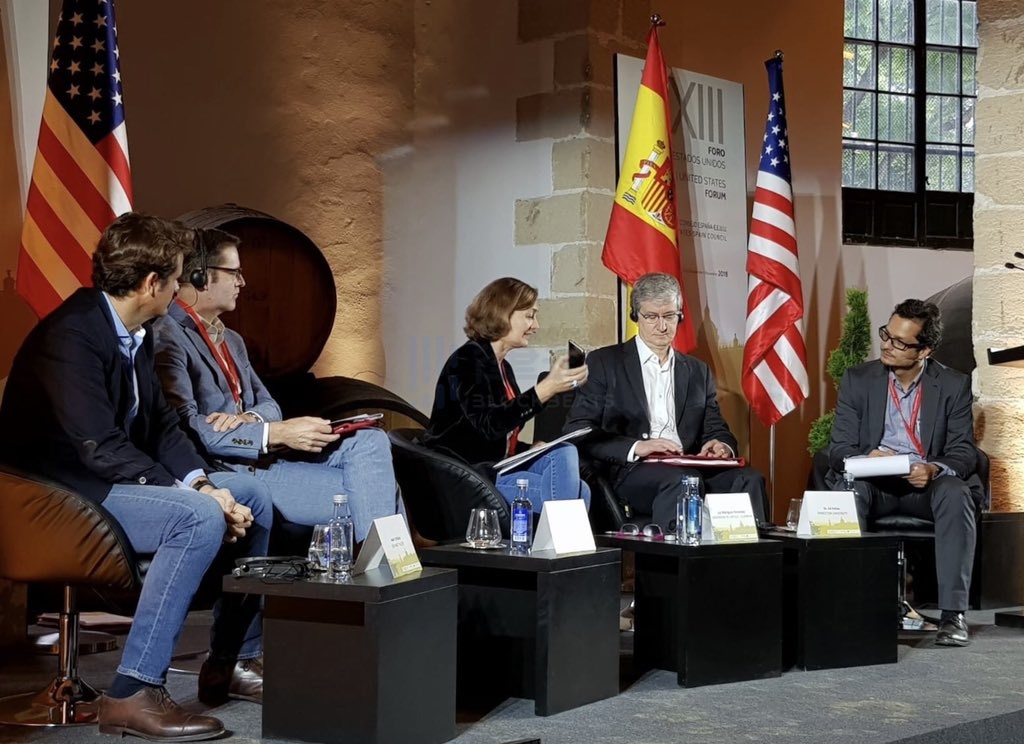
Ed Felten (second from right), the deputy chief technology officer at the White House, the source of the picture comes from the Internet
It took us about a year, and in the summer of 2018, we published a peer-reviewed paper on Arbitrum, which was the first publication on Arbitrum. At that time we realized: we know how to build something with commercial value, it solves the pain points of Ethereum users, that is, Ethereum’s transaction fees and limited throughput, which are actually two sides of the same coin, so we decided to set up a company. This is how the Offchain Labs journey began, and by the time we launched our first product on mainnet, it would have been three years since that academic paper was published.
BlockBeats: During your tenure in the White House, did you still have time to think about blockchain technology?
Ed:There are still. I work across all areas of technology and policy, and probably my biggest project is advancing the policy process on artificial intelligence and machine learning. Of course, I also try to promote discussions on blockchain technology among different government departments, and I have indeed done some work on blockchain technology, although it is a very early thing. At that time the technology hadn't developed enough to get a lot of attention from people at the top of the government, and that has changed to some extent, I think the current government's attention to blockchain technology is much higher than it was in 2015 to 2016. There are a lot more children.
BlockBeats: You are one of the early scholars who paid attention to the blockchain in the academic world, but at an academic summit, you mentioned that the blockchain as a technological innovation may not be as important as AI. Why did you finally choose blockchain as your entrepreneurial direction?
Ed:image description
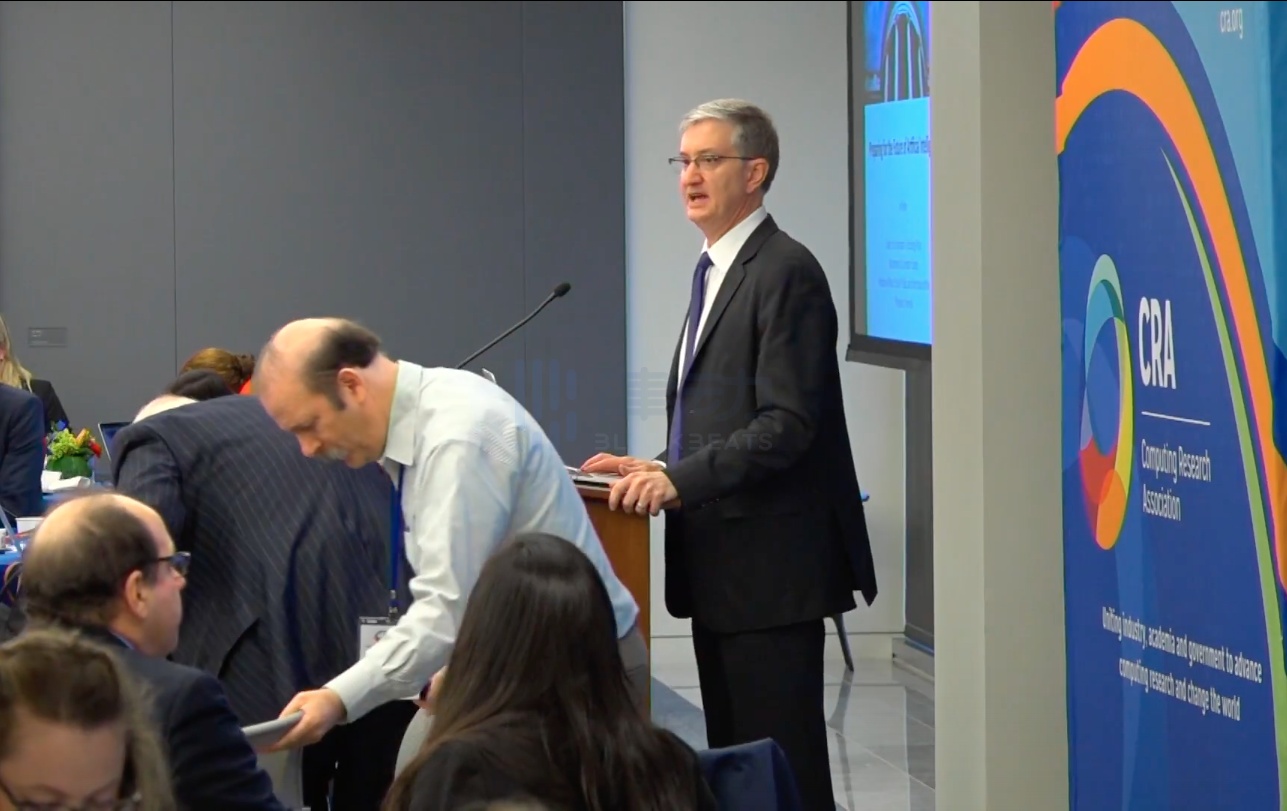
In 2018, Ed Felten delivered a speech on AI technology at the Summit of the Computing Power Research Association. The source of the picture is from the Internet
first level title
"Remember that idea called Arbitrum?"
Like Ed himself, the idea for Arbitrum came from school. In 2014, Ed proposed the idea of interactive fraud proofs. In the era when Ethereum was still uninterested, Ed had already started to study the expansion of the blockchain. In September, several students were recommended by their teachers to design a blockchain project based on Ed's research. In the end-of-course work presentation class, three students in sweaters stood in front of the stage with their hands on their hips, explaining to the students what "Arbitrum" was written on the whiteboard, and Arbitrum was born in this way. Of course, it was four years later that Ed actually decided to make Arbitrum a product and commercialize it.
BlockBeats: Interestingly, you started working on scaling solutions before Ethereum was known. Why did you choose the capacity expansion solution as your research direction?
Ed:I've worked on a few other research topics related to Bitcoin, specifically on Bitcoin's economics and incentives and consensus issues. But in early 2014, I became interested in the idea of smart contracts, where you could turn a tool that used to just own and transfer tokens into a platform on which people could build new types of services and products. I realized that this brought together a range of different ideas that I had been focusing on in my academic work. On the one hand, it is the blockchain and this public, permissionless, and trustworthy system; on the other hand, it is around provable and accountable computing, which comes from my thinking in public policy In my work, I have been trying to understand how public processes mediated by technology can be done in an open and accountable way.
I realized that smart contracts are the intersection of these things, so in early 2014 I had a lot of exciting ideas about smart contracts. Although I can't foresee what the future of the Ethereum ecosystem will look like, I have an idea that combining the idea of general computing and blockchain will bring about explosive innovation. But, as a computer systems researcher, it's clear to me that scaling is going to be a problem. Because the obvious way to do smart contracts is to let every node in your blockchain system execute every step of each smart contract, this will be a big performance bottleneck, and it is also what made me think about extending smart contracts at the beginning of 2014. The reason for the contract's interest.
At the time, it was not clear whether Ethereum would be the "ultimate blockchain" supporting smart contracts, but among the many candidates, Ethereum seemed to be the leading contender at the time, the best bet. And no matter which one of them wins, they will face scaling problems. So, as an academic researcher, my goal is to identify important real-world problems early on and try to develop solutions for them.
BlockBeats: How did the specific idea of Arbitrum itself come about?
Ed:Actually this idea first came up, the core idea of what we now call "Interactive Fraud Proofs", which came to me around February or March 2014. At the time my academic group at Princeton hosted a conference on Bitcoin and cryptocurrency technology. It was during this time that I had the idea for Arbitrum. For most of 2014, I had a diagram illustrating an interactive fraud proof hanging on a whiteboard in my Princeton University office.
Arbitrum's end-of-course display, the source of the picture comes from the Internet
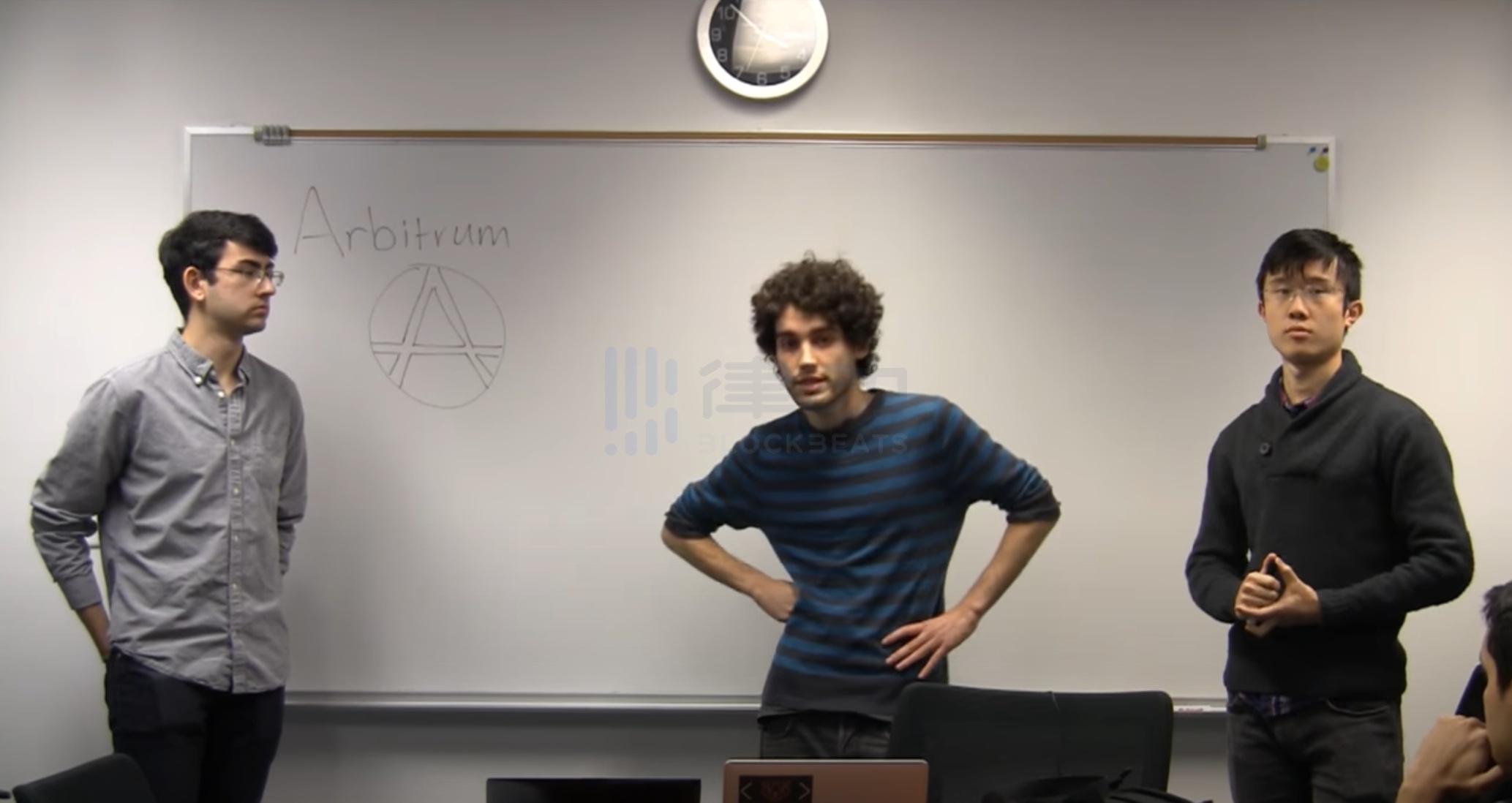
Arbitrum's end-of-course display, the source of the picture comes from the Internet
Not long after that I went to work at the White House, and when I came back to campus two years later, two PhD students, Harry and Steven, came up to me and said, "Hey, you remember Arbitrum from before? Let's make it Let’s make a product!” After that, we formed the company, and after a few iterations of the technology, we ended up with what we have today. Have to say, it's been a long journey.
BlockBeats: What did Harry and Steven see in the Arbitrum idea?
Ed:I think they have also seen what I have seen, that is, the expansion of the smart contract system will be an important issue, and the limited scale of Ethereum will become a growing pain point for users, which is number one.
Second, in our understanding of Arbitrum, there are confluences of ideas that can be built into something larger and more valuable. So almost from the first day they came into my office, the three of us had a pretty consistent understanding not only of the potential of the technology, but of the problems we needed to solve in order to go from an idea to a complete The system becomes a bridge to solve people's problems. So I think we have that vision together. It was just having the three of us who shared this vision and were willing to invest time and effort into it, that really changed my mind from a great idea that I hoped would one day turn into a project, to what we are now Projects that are being worked on together.
image description
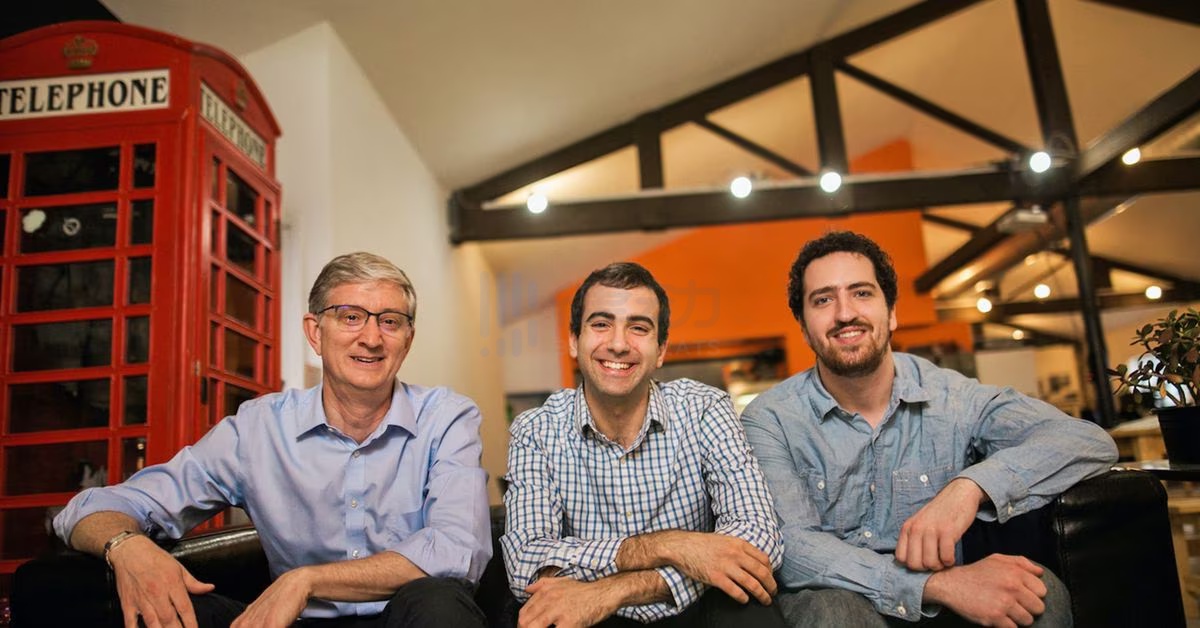
Founding members of Arbitrum (from left to right): Ed Felten, Steven Goldfeder, Harry Kalodner, the source of the picture comes from the Internet
BlockBeats: From the beginning of building Arbitrum to the founding of Offchain Labs, how have the roles of the three founders changed?
Ed:It was just the three of us in the early days, and we would discuss ideas to make progress, and we didn't have clear roles for each other. Each of us is just seriously doing development because we're a small team and each of us is trying to find ways to move things forward. We have a single codebase that everyone works on. And we often meet together to review the progress of the work together. Everyone is thinking about every question or making an open suggestion, and it's pretty much going on all the time.
In 2018, we established a company and began to grow in scale. Only then did we have more detailed divisions of labor, and our roles became more differentiated. Now, each of us fills a unique role, and while we still have a lot of things discussed together and a lot of important decisions made together, it's now more professional. In his role as CEO, Stephen is very much the public face of the company, and he has a very broad focus on everything we do. Harry is the CTO, so he's more focused on making sure we build and deliver the technology we need. And my role as chief scientist on the research side is to think about what needs to be developed at Arbitrum so that we can continue to make progress. So the questions I think about are more about what difficulties we will encounter six months or one year from now, what we should prepare and develop, and what are the core technical challenges we need to solve.
BlockBeats: This also leads to the question I have been wanting to ask just now, why did you choose Ethereum as your base layer?
Ed:first level title
Ethereum Foundation, OP, and zkEVM
As mentioned at the beginning of the article, Arbitrum, which chose the Optimistic technology path, is actually in a relatively embarrassing situation. On the one hand, it has to deal with the competitive pressure of the OP team, and on the other hand, it has to fight against the path doubts of the ZK narrative. However, the team's choice of Optimistic seems to be particularly firm. This was the case at the beginning of Offchain's establishment, and it will still be the case in 2023 when the ZK track is collectively working hard. Where does Ed's confidence in Optimistic Rollup come from? How do you view the upcoming ZK track?
BlockBeats: Offchain Labs was officially established in 2018. At this time, the "expansion Prince" Optimism team of Ethereum has appeared, and it seems to have a closer relationship with the Ethereum Foundation. How did Arbitrum see itself competing with the Optimism team at this time?
Ed:I think in the early days, a lot of people in the Ethereum space assumed that Optimism would win the competition in the Layer 2 space, if not, at least think they were a dark horse in the field. But we feel that we have the technology and the team to effectively solve the scaling problem, so I believe from the beginning that what we are doing at Arbitrum will bring great value. From now on, I think this has been proven.
I personally think that it is unhealthy for Ethereum to have only a single Layer 2, and it is valuable for Ethereum to have a diversified Layer 2. In my opinion, the Ethereum Foundation also sees it this way, and the Foundation is also working hard to promote the development of the Ethereum ecosystem in this direction. This is what I really like and appreciate about Ethereum. The foundation and the community determine the direction of Ethereum through an open and cooperative process. This reminds me of the early development of the Internet. technical process to do something, such as the Internet Engineering Task Force. I think they do a great job of being open and listening and incorporating many perspectives, whether it's people from different technical approaches, people from different countries, people from different companies, people with different types of interests and perspectives. In conclusion, I take this very seriously and I really appreciate and appreciate the efforts of the Ethereum community and leadership to move this forward.
BlockBeats: During the development of Arbitrum, what kind of support did the Ethereum Foundation give Arbitrum?
Ed:I think the Foundation and Vitalik have always been open to conversations, to give us a fair "hearing" when we advocate for something. In terms of financial support, the foundation has been trying to remain neutral and will not provide financial support to different Layer 2 teams. But in terms of being an honest middleman, negotiating with us, talking to us, working with us, trying to move things forward, I think they've done a good job.
Arbitrum has a good relationship with the Ethereum Foundation and their leadership, which has developed over time. Overall, I think the Ethereum Foundation has done a good job building a strong Layer 2 ecosystem. We certainly take the Ethereum Foundation and what they do very seriously, and we see ourselves as part of the Ethereum community, and when Ethereum succeeds, we will succeed.
Offchain Labs and the wider Arbitrum community have worked hard to be "good citizens" of the Ethereum community. We brought into the company Prism, the leading client that helped Ethereum build consensus, on the one hand to contribute and help the Ethereum ecosystem, and on the other hand because we believe in understanding what is happening at the Ethereum level, and where The discussions and communications that take place are valuable.
BlockBeats: Do you still think that Optimistic Rollup is a more ideal technical path in the Layer 2 field?
Ed:Of course, I think Optimistic Rollup is still the best choice. If the Arbitrum team restarts Layer 2 from now on, I will still choose this technical path. Compared with other alternatives, Optimistic Rollup actually has many advantages, such as ZK Rollup, the biggest advantage of which is simplicity and lower cost. Optimistic Rollup is launched much earlier than ZK Rollup on the mainnet. This is no accident, because Optimistic Rollup is simpler and more flexible. A lot of value.
A particularly good example is data compression. The biggest cost of Rollup is publishing call data on the Ethereum mainnet, so compressing data as efficiently as possible is very important to reduce costs. In an Optimistic Rollup proof system, we can choose almost any compression method we want, which means we can achieve better compression at a lower cost. If we switched the Optimistic Rollup proof system in Arbitrum to a zero-knowledge fraud proof system today, users would not notice any difference other than slightly higher fees.
BlockBeats: You said in an interview that zero-knowledge fraud proofs are “the solution of the future” and always will be. Do you still maintain this point of view?
Ed:I think I'm right, but I want to be a little cautious on this issue, and I was referring to the idea of an EVM solution using zero-knowledge fraud proofs as the only fraud proof mechanism. Zero-knowledge proof is indeed very valuable as an integral part of the entire protocol, such as EIP-4844, a new type of data availability system that Ethereum is promoting. This data availability system relies on KZG commitments, which include a zero-knowledge proof-type proof system. So I think that as a tool, zero-knowledge proof makes sense to use it locally in the protocol, but if you want to use zero-knowledge to prove the idea of the entire Rollup protocol from beginning to end, there is not much advantage in practice, and It does raise costs.
BlockBeats: But this year, the mainnets of many ZK Rollup projects have been launched one after another, and the enthusiasm and competition of the zkEVM track are also very high. Compared with the technical path of zero-knowledge proof, does Optimistic Rollup proof have any advantages?
Ed:First, I think competition in this space is healthy, which is good for users. We welcome competition and we also believe that we have the best solution, we believe users will continue to choose Arbitrum, but we have to prove it every day, by continuously providing better service, I believe we can do it.
In fact, zkEVM is really user-oriented, which has a huge advantage for Arbitrum, that is, users can now make a real and fair comparison between the services provided by us and the ZK system, instead of using the actual performance of Arbitrum and ZK The expected performance of the system for comparison. In my opinion, Optimistic Rollup has obvious advantages in areas such as data compression. Users can not only see that Arbitrum's fees are lower than ZK systems, but these fees are enough to cover the cost of operating the network. Obviously, in the long run, this means better economic benefits for users.
BlockBeats: However, during the period of receiving the ARB airdrop, the Arbitrum network also seemed to be congested, causing many people to question the performance of the network.
Ed:Yes, just like Ethereum, Arbitrum also has a certain capacity, if the demand exceeds this capacity, then the gas fee will rise. However, the congestion that occurred on the ARB claim day was not actually the congestion of the Arbitrum network itself, but the congestion of the airdrop website. This is just an old-fashioned website congestion problem. On the day of claiming the ARB airdrop, the traffic to the web server reached an unprecedented level. As a result, the web-side infrastructure became congested, but the Arbitrum network itself performed well.
first level title
The New Narrative of "DAO Funding Gates" and Stylus
In April of this year, the Arbitrum Foundation was accused of transferring nearly US$1 billion in ARB Token to the Foundation’s wallet address before the adoption of the community governance proposal AIP-1, which triggered a violent reaction from the community. There is no decentralization at all” and other remarks quickly spread on social media. However, the "DAO funding gate" does not seem to have had much impact on Arbitrum's progress. In the first two months, the team launched a new product, Stylus, after Nitro, and gave it a new narrative.
BlockBeats: There was also a lot of discussion about the Arbitrum team seemingly transferring tokens before the DAO governance vote was passed. Can Ed elaborate on what happened?
Ed:There are actually some misunderstandings in this matter. The communication with the community was not good when the Token was released. This is the problem of the Arbitrum team. But I want to clarify that these tokens have not been transferred, there is no transaction to transfer these tokens anywhere. The 750 million ARB Tokens (approximately $1 billion) that people are complaining about will be allocated to the Arbitrum Foundation in the Genesis event from the very beginning. We set up multiple accounts for the airdrop, a team account, an investor account, an Arbitrum Foundation account, a personal airdrop account, and a DAO airdrop and DAO treasury account. The $750 million Token allocated to the Arbitrum Foundation during the Genesis event has been in the foundation's account from the very beginning.
The reason for the misunderstanding is that there is a Token allocation chart in the Genesis announcement on the Arbitrum official website, and there is a section called Arbitrum DAO, which includes the Token quota of the DAO treasury and the Token quota of the foundation. However, this chart does not distinguish the 750 million Tokens of the Arbitrum Foundation from the 360 million Tokens of the Arbitrum DAO treasury, leading the community to think that the Tokens in the Arbitrum Foundation address were transferred, but in fact these Tokens were not was transferred. To be fair, the DAO community would have been justifiably upset about this if tokens had indeed been transferred, but they didn't. People weren't happy, so they voted against the original AIP-1.
BlockBeats: Why is there a governance vote to "approve" this decision when the initial distribution has already been given to the foundation?
Ed:Regarding the AIP-1 initial vote, it has to be admitted that this is another mistake the team made, which is not to let the community vote to approve something that has happened, or that it is good to let the community agree to a thing that has happened.
Even in Web3, some things need to happen in a centralized way initially. For example, if there is no initial distribution of Tokens or a foundation as a legal entity, there will be no community airdrops. And in order for a foundation to be a legal entity, it needs to have a board of directors, a constitution, all these things, just like any legal organization needs to have a structure. But the team thinks it's good to have the DAO community ratify what's necessary and what has happened, because those decisions are fine.
But of course, the community later got angry about the "750 million Token incident" and voted down the proposal. That's when the Arbitrum Foundation realized it was better to do it all over again, and do it better. That's why there areAIP-1.1 and AIP-1.2The reason, this is the team's second attempt, is also well done, 98% up votes if I remember correctly. At present, the code writing of these chain operation proposals has been completed and passed the security audit.
All in all my opinion is that the actions taken by the team were reasonable and fair, but due to poor communication the DAO community expected a difference from the actual situation. But from another perspective, this also reflects a very good point, that is, it shows that the DAO does have control. If anyone thinks that the Arbitrum Foundation is just doing what it wants and the opinion of the DAO is irrelevant, I believe this incident has shown them that the DAO has actual control. My hope is that once AIP-1.1 and 1.2 pass the DAO's on-chain vote, it will be clear that the Foundation is moving forward with the DAO's wishes, and it will also be clear that the Foundation is indeed accountable to the DAO.
BlockBeats: "DAO Funding Gate" had a great impact in the Arbitrum community, but after AIP-1.1 and 1.2, things are gradually developing in a good direction. We have also noticed that Arbitrum has not stalled due to this incident. The team is currently vigorously promoting the development of the new product Stylus. Can Ed explain the narrative of Stylus?
Ed:Stylus is a new feature that we are currently developing and we are very excited about. This is an "EVM+" approach, meaning Arbitrum will continue to be compatible with Ethereum, and anything that runs on Ethereum should run on Arbitrum.
What Stylus brings is the ability to write smart contracts in any programming language. Stylus will compile it to WebAssembly, which you can then run as a smart contract on the Arbitrum chain. You can call it like an EVM contract, in fact, people interacting with a Stylus contract don't even need to know that it is a Stylus contract. Despite being written in a different language, the contract will seamlessly interact with the EVM chain.
So what is the advantage of this? There are two main advantages. One is to let developers write smart contracts in any programming language they like, which allows more programmers to enter the field of Layer 2 programming or blockchain programming. Those who want to write in Rust, C++, or any other language with a standard compiler toolchain can now write smart contracts and have them run on the Arbitrum chain as real smart contracts. That's exciting in itself.
Another exciting point is that since the core of the Nitro stack is this WebAssembly execution engine, Stylus contracts should run more efficiently than EVM contracts. We have done a lot of work to speed up the execution of EVM contracts, but Stylus contracts will be another huge improvement, which means that you can do the same calculation with less gas, or use the same gas. In the case of more calculations.
BlockBeats: Will Stylus be a new independent chain?
Ed: Stylus is not a new independent chain, it is a thing for developers, users can interact with the Stylus chain. This is a single chain. Everything can work together seamlessly, this is "EVM+".
We are working hard to get Stylus ready, and when it has some experience on the testnet and has undergone a full security review, Stylus will be offered to the Arbitrum DAO, who will have the option to deploy it on the mainnet Arbitrum One. This is the DAO's decision, and I'm sure the DAO will support it. Of course, this technology will also be open to anyone else using Arbitrum Orbit to launch an L3 chain.
BlockBeats: In your opinion, can "EVM+" or "enhanced EVM" become the new mainstream narrative for future Ethereum expansion?
Ed: I hope so, I think this is the right way to do it. EVM brings many benefits. The EVM model provides a safe and consistent way for contracts to interact with each other, so the idea of the EVM as an international language for different types of contracts to communicate with each other is very important. I think the EVM will become the standard for this, but I also think there needs to be a lot of room for innovation in terms of creating new smart contracts and creating Layer 3.
We want to open up all of these innovations, but do so in a way that increases EVM, not decreases it. That's why we call it "EVM+", because we think of it as adding functionality to EVM, rather than reducing the benefits of EVM. To me, this approach makes perfect sense as a way to continue to evolve the technology. I hope other ecosystems take a similar approach, but obviously it depends on whether they go this route.
BlockBeats: Thank you so much for your time, is there anything Ed would like to add before closing?
Ed:First of all, I would like to thank BlockBeats for the interview, it is very important to communicate openly between the team and the community. I also want to emphasize that the Chinese Arbitrum community is very important to what we do. We know that we have many friends in the Chinese community, many users and developers, this is very important to us, we are very grateful for everything you do, and we hope to build a deeper and more meaningful relationship with the Chinese community in the future.