30 trading tips from Crypto short seller GCR



Original Author: VIKTOR
Original compilation: Peng SUN, Foresight News
GCR is an anonymous trader who became popular in the 2021 bull market because he seems to know the trading trend like the back of his hand. As a well-known short seller with huge transaction size, his trading case is impressive, for example, he publicly shorted the top of DOGE in May 2021, and publicly shorted SHIB and metaverse tokens in November 2021 (peak bull market) , and openly shorted LUNA before its collapse in 2022 (he made a $10 million bet with Do Kwon). Although he speaks much less frequently on social media than in the last round of bull market, we can still read his past tweets. This article has made some arrangements, and many of them are worthy of collection and repeated reading.
Before reading GCR tweets, I first summarized and extracted some points worth learning from GCR's views:
Round numbers are Schelling points, points of either potential support or resistance, especially if there is no reason for valuation.
Low unit bias attracts retail investors: why would you buy less than a tenth of a Bitcorne when you have millions of dogcoins (... 10,000 times $1)?
Don't short low-cap projects: If GCR follows this rule, so should you.
The strong are always strong, and vice versa. Reducing winners and increasing losers is a bad strategy, and you're better off doing the opposite.
Going by SNL and Musk's show, shorting every DOGE pull is one of the most successful trades you can take.
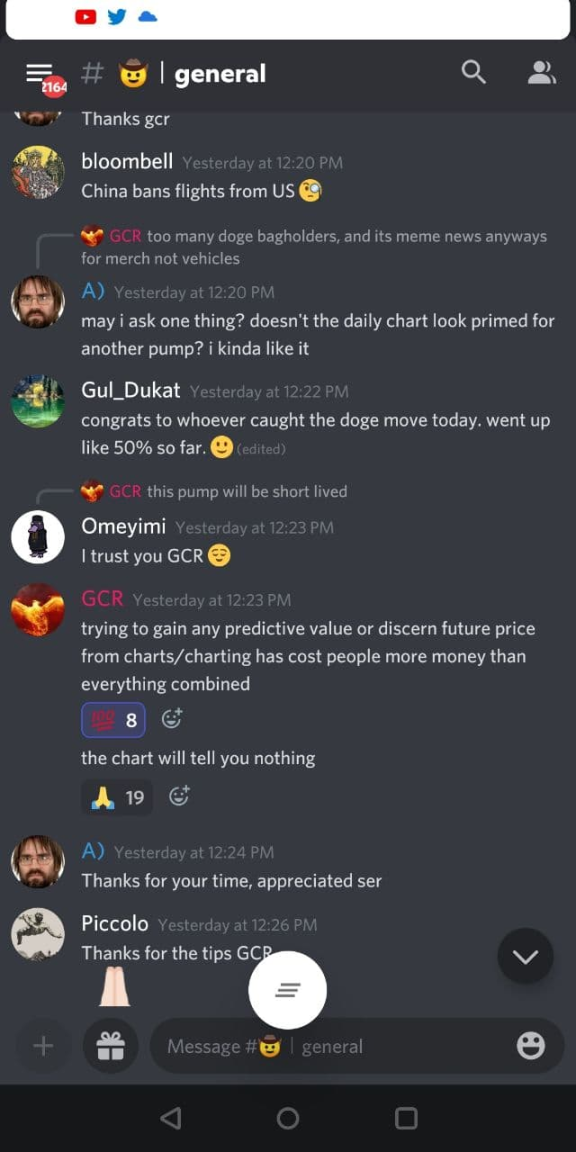
GCR's advantage has nothing to do with K-line analysis or any complicated strategy, it's just intuition.
New tokens have one advantage over older tokens: they are full of promise and lack holders.
The way the market reacts to the news tells a lot about the bias (bullish or bearish) and sentiment of market participants, which is more important than the truth of the news.
Don't think about anything other than making money.
In a copycat cycle, you're supposed to start out maximizing your risk and slowly reduce it over time, but most people do just the opposite.
Asia/China will drive the next bull market.
Both BTC and ETH are at the bottom. After the FTX crash, GCR turned bullish.
Most people with long-term convictions are better off holding BTC and ETH than trading.
ETH will hit $10,000.
Note: GCR originally tweeted from the @GiganticRebirth account, now using @GCRClassic, and several tweets from the GCR temporary account "MingXMecca".
for a long time,Panic Selling Every Time Due to DeFi Bugs, because the market really never cares about more than a few hours.
When news affects prices, market participants often struggle with whether it is true or not. More often than not, the actual truth of the headlines doesn't matter. How the market reacts to the news, and over how long, makes more sense.
When 95% of traders expect to "sell the news" (sell the news), I almost always buy, as I have said in the past, "inverse sell the news". Many people who were forced to leave because they were afraid of an event were forced to rejoin. "Selling the News" happens in unexpected circumstances.
This is why we have never, ever, shorted low-cap projects. This is one of the hard and fast rules I teach everyone, especially when supply is cornered after four years of exhausted sellers.
The best traders will always prioritize intuition over apophenia. You don't like this answer? Intuition is not enough to satisfy your curiosity? This is the truth and there is no other truth. I can't teach it to you, but you can find an edge.
No matter how many times they see it, people still underestimate the appeal of low unit bias effects to retail investors. This is the strongest magnet in cryptocurrencies. Why would anyone in their right mind buy 100 CONEs when retail investors would own 1 million? This is the cheapest coin on Coinbase.
Get completely out of this short and you'll find DOGE to be the easiest coin to trade. April 20th DOGE day, Musk on comedy show Saturday Night Live (SNL), TSLA accepts DOGE payments, I short all the tops, rising enthusiasm can never live up to expectations (a meme token shouldn't be chasing hard Fundamentals), most likely no cycle lows.
The third most common question I get is: Why take profits on the shorts if you still think they are going lower for the long term? If you get 70-90% downside when shorting an altcoin and still hold the extra 10%, reevaluate your heuristics. This is what will happen to you if you imitate months after my short thesis.
There are two ways to be short: trading and contrarian investing. If the confidence interval for the 1-year price is > 95% (95% probability that the price will be lower in one year than it is now), "invest" and not focus on short-term fluctuations. I chose to "invest" in PEOPLE at 0.09 USDT; squeezing to ATH is possible, but my investment is in a great company.
Compare the market cap of NFT projects with some well-known meme tokens: SHIBA reached a market cap of 60 billion at its peak; none of the NFTs had a cap of $1 billion (except BAYC). Altcoin 2.0 seems overvalued relative to NFT growth; I predict NFT tokenization will cannibalize Altcoin 2.0 volume.
Bounce off 10 meme support as expected, but not quite a meme; hard rounds are an obvious convergence point for reflexive assets with vague valuations; respect for Schelling points.
I've been telling you for weeks that the greatest threat to any successful project is its own success. Success breeds imitation, and this is a mercenary industry that will relentlessly migrate to the original derivatives in pursuit of higher yields (from VCs to traders to ultimately retail investors).
DeFi Summer, Food Farms, Original seigniorage [ESD, DSD], OHM (Olympus DAO), and countless other fads in rotation.
In the past year, was there any easier, higher hit rate (>100%?) and less complicated transaction than shorting Elon Musk to stimulate DOGE's rise? A trade that requires less upside, better foreknowledge, less talent, but always works? SNL, Dog Day, TSLA payouts, Super Bowl commercials, space missions, and more.
If I've helped you in the past, take my advice: don't try to buy the bottom. You can lose money thinking you can buy cheap and recover some of your losses. This is almost impossible, and you are likely to panic sell because of losses, or the currency price will go to zero.
Capturing high volatility (on both ends) is where you can get the best returns, but markets have gradually become more effective at pricing these events. However, airdrops still often follow predictable chart patterns that the market has yet to fully grasp; study every single one of them over 18 years.
Mastering the timing of airdrop "bottoms" is actually a very critical art form to learn in this field; After UNI, I really started working on this problem. Sometimes on-chain metrics help, but this is on exchanges; once prices flatten out and start consolidating, sellers usually “burn out”.
If you're not good at trading, try to go all in on networking. Be present at every meeting. Show up at every party. In a bear market, humans are more accessible. You wouldn't believe how many of the people I know made it through meeting the right people.
Just like "digital gold" became the winning narrative and use case for Bitcoin in the last cycle, the "decentralized casino" argument is becoming the consensus of the entire crypto industry (filling the gap left by "Web3").
Flying to Macau or Las Vegas is too expensive for the average person. When we have windfalls and macro risks,Decentralized Casinos and/or Decentralized Ponzi Schemes Always Run Fastest. I've always thought of humans as hopeless, greedy, depraved, lonely, and trapped in the metaverse.
If you find yourself marginalized, I would recommend trading news rather than getting information from others. News deals are getting more and more competitive, so you have to build a quick-response infrastructure to watch for projects that have been delayed for months.
It's imperative that if you're trading meme coins, you cut your loser portfolio quickly when the market shows you that they don't care about meme "news". Any trader with an intuitive feel for the markets is clearly aware of feeling this catalyzing emotion and should take some profits on the first impulse.
I am often contacted by traders asking why cryptocurrencies are showing relative strength or weakness relative to stocks. I usually tell them to wait before jumping to conclusions; more often than not, we're just witnessing a lag effect.
Openly short SHIB, DOGE, GAL, SAND, MANA, original Luna, LUNC, and more broadly, the entire 2020-2021 cryptocurrency bubble, the 10-year macro asset bubble in Q4 2021, etc.
Truth be told, tokens heavily held by retail investors tend to be hyped for months due to some “future catalyst,” leading to an explosive buying frenzy as the event horizon approaches. Just when retail investors imagine the meme will make them millionaires, market makers use the ripple effect of eventual liquidity to distribute.
What drove XRP to $3? Most importantly, low unit bias. Bitcoin is already $10,000, ETH is $1,000. Retail Investors Think They're Too Late, But Can 10 Cents of XRP Go to $1? 10 USD? What about $100? Lots of speculation (incorrectly) that a Coinbase listing is imminent, betting on unit bias in the next cycle.
What is really driving retail investors at the start of the altcoin cycle? (1) I'm too late with the "legitimate asset class" (BTC/ETH); (2) Other coins also seem to be institutional (XRP will be used by banks, Garling seems to be certified, ADA is being created by ETH "co-founder "Created, Musk endorsed DOGE).
In the middle to late cycle, they start chasing more depraved games that don't require as much social proof (as the pool of retail investors opens up). These cycles only start after the major asset has rallied a lot, leading to (1) a wealth effect and (2) people chasing altcoins as they feel they are missing out.
For most people,It’s too early to think about the next “institutional” coin. Doing research in a bear market will give you an edge, but the real time to invest is after a major market rally. There will also be a shift in sentiment, from cryptocurrency is a scam to "I need to buy an ETH, ETH is too high".
Full of hope; lack of currency holders; the team is not very rich and has no motivation to hype.
I believe China (and all of Asia) will power the next bull run, and it will take quite some time to digest the Western cynicism about the space, but the East is on the rise and eager to show itself. You should be on WeChat, many future high growth will be on tokens that are unknown in your circle.
Mighty Hengqiang (MingXMecca):
During the narrative cycle, we have a cognitive bias towards buying tokens that have not yet grown; but more often than not, the strong stay strong and the weak tend to lag behind. Until the dance was over; then the force of manufacture quickly collapsed.
"Low floating theory" (MingXMecca):
Thinking about incentives, some projects have huge outstanding float / in the future, that can be hedged. Let the market maker deliberately pull up, let the traders think that they should join this "narrative"-allocation; instead of selling at 0 price in the deep bear later. They've been waiting for an echo from the GCR.
Reverse Super Cycle (MingXMecca):
Nothing really changes in Web3, people talk about their own narratives at the top and bottom. I keep telling people that the idea of all tokens going to zero is just a reverse supercycle and “this time is different”. It's always the same game, and people love tokens.
Some of the best performing tokens have the worst token economics and come from the most predatory teams. Many teams that launched at the height of the bear market have been desperately waiting for more favorable conditions so they can deploy tricks and manipulate the market.
Try to think of your Ponzi scheme as professional boxers rather than tokens; Instead of going to therapy, people actually trim their winners and increase their losers.
Our general trading principle when watching meme coins pull higher: During an altcoin cycle, you should increase your risk at the first reversal of the trend and start to gradually protect capital over time. People lose money because they do the exact opposite; slow early on and greedy over time.
I continue to hold large positions in spot BTC and ETH as I believe we bottomed out in November and remain optimistic about the future; looking at the goal of $10k ETH by 2030. 90% of holders would be better off. This advice is only for Degen traders who play crapcoins.
Having been trading alt season for years, one of the best indicators of how much juice is left is: how is the altcoin reacting to news, announcements, listings, scams? When the knockoff season is about to rug, traders are still long the news, but sell immediately.
I'm buying around 16,000-18,000 tokens in 2022, and I don't have much interest in trading. I plan to dump it into institutional/TradFi funds late in the next cycle. I've scaled up some contrarian investments, picking some select crap coins whose narrative/rotation has dried up.
Don't expect too much, the entire banking system will not collapse overnight, leading to hyperbitcoinization and pushing BTC to $1 million overnight. Don't expect too much either; when we get the correction, it's not a scam by CZ to exit liquidity, but back to 0. maintain balance. Study 2019 vs. 2020.
This may be my last tweet about cryptocurrencies. As I always say, if you have a long-term belief in BTC and ETH, then you just need to hold and not trade, and you will have good returns. They just keep printing more money; you're less likely to time every partial move. ETH will reach $10,000 someday.