This article explores the market impact and liquidity status after the Shapella upgrade


Compilation of the original text: Mary Liu, Bitui BitpushNews
Compilation of the original text: Mary Liu, Bitui BitpushNews
After the Shapella upgrade, ETH hit an 11-month high, and some people expected that there would be huge selling pressure after more than 1 million pledged ETH was unlocked. BTC surged above $30,000 for the first time since last June, up more than 80% year-to-date. This article will explore through data and charts:
ETH’s Upgraded Rally and Bullish On-Chain Derivatives Trend
TUSD’s market share soars on Binance
Trading activity shifts to Asia Pacific session
ETH Soars After Shapella Upgrade
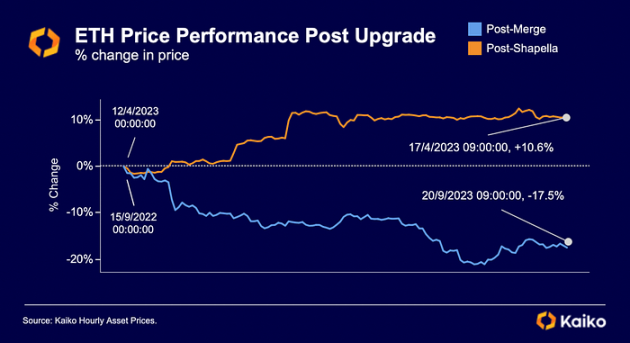
Last week, the Shapella upgrade went live, allowing millions of staked ETH to be withdrawn. While Ethereum’s Merge upgrade last September was more of a “buy the rumour, sell the news” type event, Shapella appears to have had the opposite effect on price. ETH spot prices are down nearly 18% after the merger, and are up 11% since Shapella, despite fears of a massive sell-off.
Interestingly, there were more sell orders than buy orders on the Coinbase ETH-USD trading pair despite the rise in ETH. Coinbase is ahead of its rival Binance in allowing withdrawals of ETH collateralized with centralized exchanges, and early analysis of buy/sell volumes shows traders cashing out their ETH for USD.
With the possibility of redeeming staked ETH with ETH on Coinbase, quote trade data shows ETH sells outstripped buys by more than $30 million. As of the morning of US trading hours on April 17th, the figure was a net sell of $28 million, but it is still an interesting development to watch, especially before Binance enables withdrawals on April 19th, which may give ETH Bring more selling pressure.
Derivatives markets saw massive inflows last week, suggesting overall market sentiment is turning bullish. ETH options volume on Deribit, the largest options market, topped $1 billion for the first time since the FTX crash, driven by bullish bets.
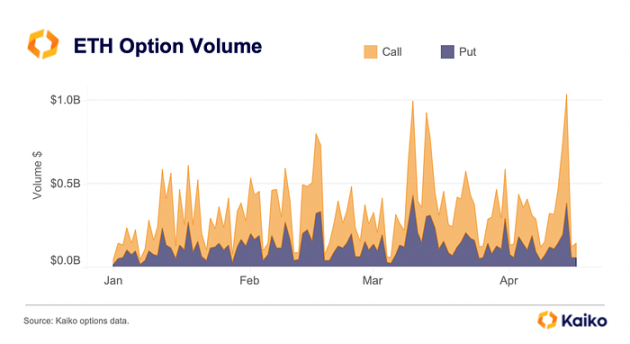
In the days following the Shapella upgrade, call option volume rose to a yearly high of $700 million, outpacing put options (bearish bets) by a wide margin. ETH open interest in the perpetual futures market hit multi-year highs of over $6 billion and funding rates have remained positive.
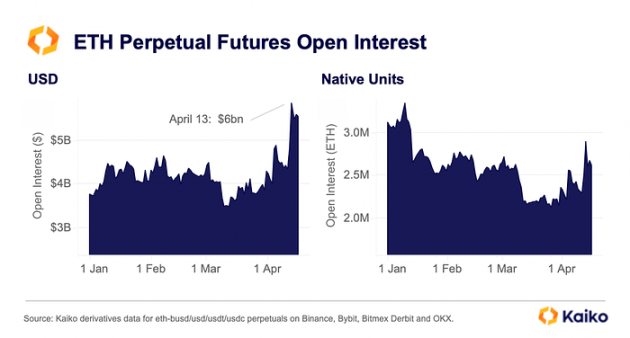
While the increase in open interest was driven in part by rising ETH prices, the amount of open interest in dollar units also jumped by double digits, up more than 20% last week, though still below levels seen in early March.
price
Rocketpool shines ahead of Atlas update
Since the Shapella update, Rocketpool (RPL) has not only significantly outperformed BTC and ETH, but also its closest competitor and market leader in liquidity staking protocols, Lido (LDO). Rocketpool is currently relatively small in the ethereum staking industry, with just 2% of the depositor market share, compared to Lido’s 31% and Coinbase’s 12%.
However, since Shapella, RPL is up nearly 40% on potentially bullish catalysts. Rocketpool also got its own update this week – Atlas, which will reduce the amount of ETH required to become a protocol validator from 16 ETH to 8 ETH. It normally takes 32 ETH to become a validator on the Ethereum network, so this upgrade should give Rocketpool a competitive advantage over other protocols in the form of more validators and a more decentralized network, and possibly gain it market share share.
ETH-BTC correlation hits 3-month low
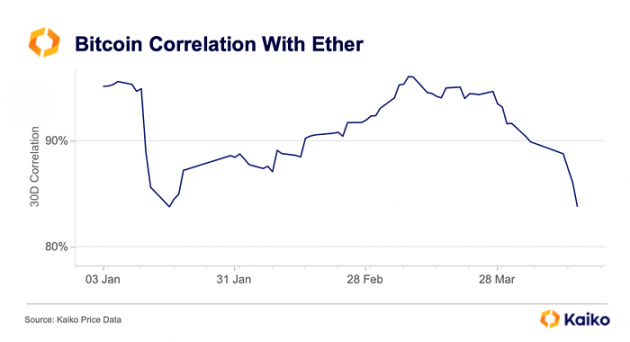
BTC’s correlation with ETH (calculated using a 30-day moving average) has fallen to its lowest level since January, after BTC’s double-digit rally in March. While ETH gained some traction last week, it has underperformed in March as investors exercised caution amid heightened regulatory scrutiny. The correlation between the two assets has been particularly volatile over the past seven months after hovering around 90% for most of the past year.
This trend may indicate that investors are increasingly viewing BTC and ETH as conceptually distinct assets rather than grouping them together. Two successful ETH major upgrades in just 8 months may have prompted this shift.
fluidity
TUSD captures 50% market share on Binance
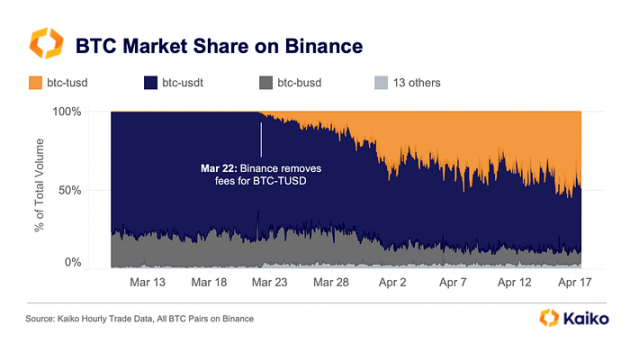
It took less than a month for Binance’s BTC-TUSD trading pair to become the largest Bitcoin market on the exchange (and globally). On March 22, Binance stopped the zero-fee trading program for 13 BTC trading pairs. The exchange also relisted its BTC-TUSD market and removed transaction fees for the pair, making it the only free pair on the exchange. Last week, for the first time, the pair’s trading volume officially exceeded 50% of all other BTC pairs, including BTC-USDT.
When looking at the volume of the top three BTC trading pairs on Binance, we can see a sharp drop since Binance changed its fee policy. TUSD has grown from zero to around $60 million per hour, but that's insignificant compared to USDT's average of almost $1 billion per hour before fees were re-implemented.
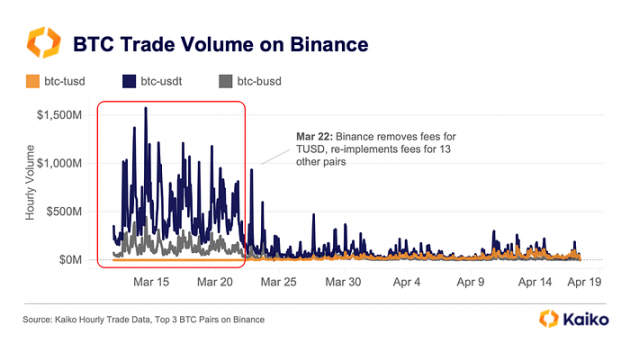
While TUSD now dominates on Binance, data suggests that most traders are still reluctant to start trading the relatively niche stablecoin. Ultimately, Binance is still down 10% of its market share since the fee change, and it looks like a pair of small stablecoins with zero fees won’t be enough to recover the losses (for now).
Explore Altcoin Trading on the Korean Market
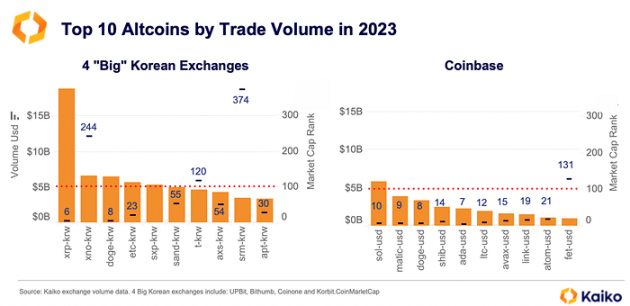
Last week, we found that more than 90% of the trading volume of the "big four" exchanges in South Korea was for altcoins, which is in stark contrast to the average trading volume of other exchanges between 40-60%. To better understand the market structure of South Korean exchanges, we looked at the top 10 altcoins by cumulative trading volume in 2023, compared them to Coinbase, and included a market cap ranking for each coin.
We found that XRP is by far the most traded altcoin in the Korean market, and after Ripple’s legal dispute with the US Securities and Exchange Commission (SEC) at the end of 2020 and XRP’s delisting from Coinbase, Binance became the main trading market for this token. South Korean markets have played a role in the recent XRP rally, with trading volumes of XRP/KRW rising to multi-month highs in late March.
The second-most-traded altcoin in terms of trading volume — peer-to-peer network Nano’s token XNO, which ranks 244th by market capitalization — surged in early April after Bithumb’s sell-off. As a result, its price has moved away from the USD market, down 40% in April, compared to a 1.3% gain on Binance.US.
Notably, the most traded altcoins on Korean exchanges by market capitalization are ranked between 6 and 374, while the top altcoins on Coinbase fell below the top 100. An interesting exception is the token of the Fetch.ai Network (FET), which provides the infrastructure for intelligent autonomous services. FET-USD is the 10th most traded altcoin on Coinbase this year, even though it ranks 134th by market capitalization. This trend reflects growing interest in AI-related projects.
Curve processed 85,000 stETH volume in three days
Curve facilitates the vast majority of stETH volume on centralized or decentralized exchanges, as nearly 85,000 stETH (over $150 million) were traded between April 11-13, with April 12 being the upgrade day. During this period, Uniswap V2 and V3 processed a combined volume of less than 500 stETH. Also, on Curve, buying and selling volumes are almost perfectly balanced these days; selling volumes exceeded buying volumes for the entire week leading up to the upgrade. Buying dominated over the weekend, accounting for 11,500 ETH of the pair's 15,000 ETH volume.
Asia Pacific is gaining market share as Hong Kong recommits to cryptocurrencies.
Hong Kong hosted the Web3 Carnival last week, where a number of government officials confirmed the region’s new openness to cryptocurrencies while hinting at new regulations for DeFi. A representative of the SFC said, “The SFC looks at DeFi activities through the same regulatory framework that applies to financial activities...As long as DeFi activities fall within the scope of securities and futures, it will be subject to the same regulatory requirements.”
Despite the potential for strict DeFi regulations, Hong Kong’s revised regulations have created excitement in the community. Two exchanges, Huobi and OKX, have confirmed that they will apply for a license to operate in China in June. The two exchanges also saw an increase in trading activity, with Huobi jumping from 16% in January to 25% of April’s BTC trading volume share during Hong Kong trading hours; OKX’s increase was more modest, from 19% to 23% .
Derivatives
After the lawsuit, Binance’s trading volumes in the U.S. declined.
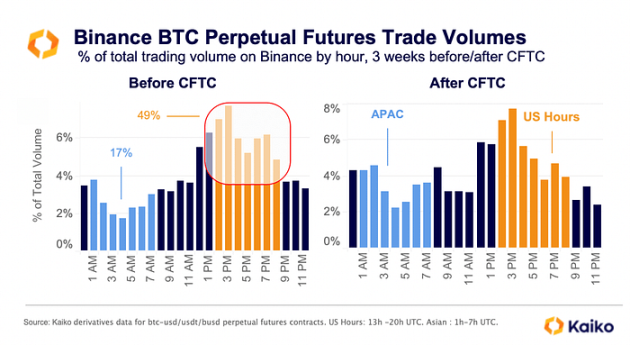
Over the past year, BTC perpetual futures trading volume on Binance has increasingly shifted to U.S. trading hours. However, we have seen a reversal of this trend in the three weeks since the CFTC filed a lawsuit accusing the exchange of allowing U.S. customers to trade derivatives on its international platform.
Since March 27, the share of transactions between 1:00 pm UTC and 8:00 pm UTC (9:00 am and 4:00 pm ET) has dropped from 49.1% to 43.5%. In contrast, the Asia-Pacific region's share of transactions during the opening hours (1pm to 7pm UTC) increased from 17.6% to 24%. The overall share of deals traded during the EU open hours decreased, although volumes increased slightly during the overlap between EU and APAC trading sessions. This shift, which occurred relatively quickly after the litigation began, may indicate a decline in US deal activity and a migration of deals to the Asia-Pacific region.
BTC derivatives are gaining traction after months of stagnation.
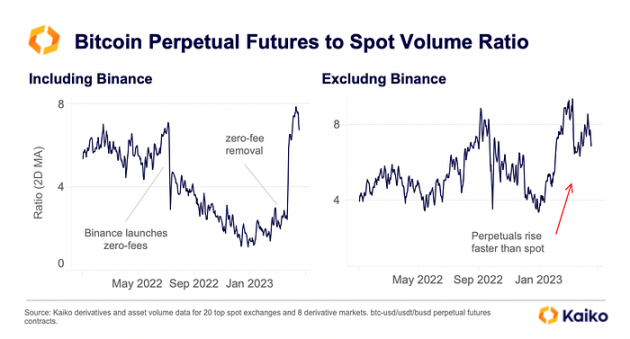
The ratio of BTC perpetual contracts to spot volume returned to growth in April, reaching its highest level since July 2021, indicating strong derivatives inflows. We calculate this ratio as the volume of BTC perpetual futures divided by the spot volume of the top 15 BTC spot markets. When spot volumes grow faster than perpetual futures volumes, the ratio falls.
The launch of zero-fee BTC trading on Binance last July led to a spike in global BTC spot volumes, arguably making the ratio a less reliable gauge of demand for spot versus derivatives. Therefore, we calculated ratios including and excluding Binance.
Interestingly, the gap between these two ratios - with and without Binance - widens significantly in early 2023. While with Binance the ratio was at a low 2:3, without Binance it rose above 10 in early March before dropping sharply for the rest of the month. This suggests that derivatives trading volumes drove the market in early 2023, while the March rally was largely attributable to the spot market.
After Binance removed its zero-fee promotion on March 22, both ratios rebalanced and are now moving in the same direction — an increase in early April. This points to an acceleration in derivatives inflows, also contributing to the current price action. That trend appeared to reverse last week as the spot market rallied following the Shapella upgrade.
the macro
Bitcoin’s correlation with U.S. equities has diverged.
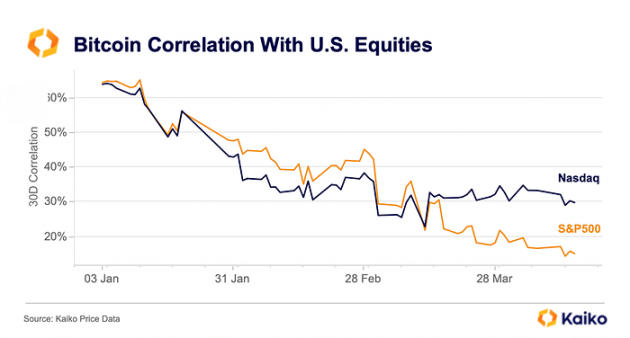
The correlation gap between BTC and the tech-heavy Nasdaq 100 and the broader S&P 500 is the widest since May 2021. BTC, up 52% since March 10, remains more correlated with tech stocks, which also benefited from bets on Fed easing and gained 11%.
The S&P 500 lagged, dragged down by losses in financials, which make up about 10 percent of the index. Its correlation with BTC is currently at a two-year low of just 15%.
Overall, BTC has moved less in line with risk assets this year, as crypto-specific factors such as low liquidity and seller exhaustion also played a role in price performance.