Behind Coinbase's latest quarterly earnings: Regulatory woes and possible future



Original author: Xijiaxiang, ChainCatcher
As the leading compliance exchange in the United States, Coinbase represents the limit of the country's government's tolerance for the encryption industry. The rise and fall of its stock price not only directly reflects the quality of its financial performance, but also reflects the capital market's expectations for US encryption regulation.
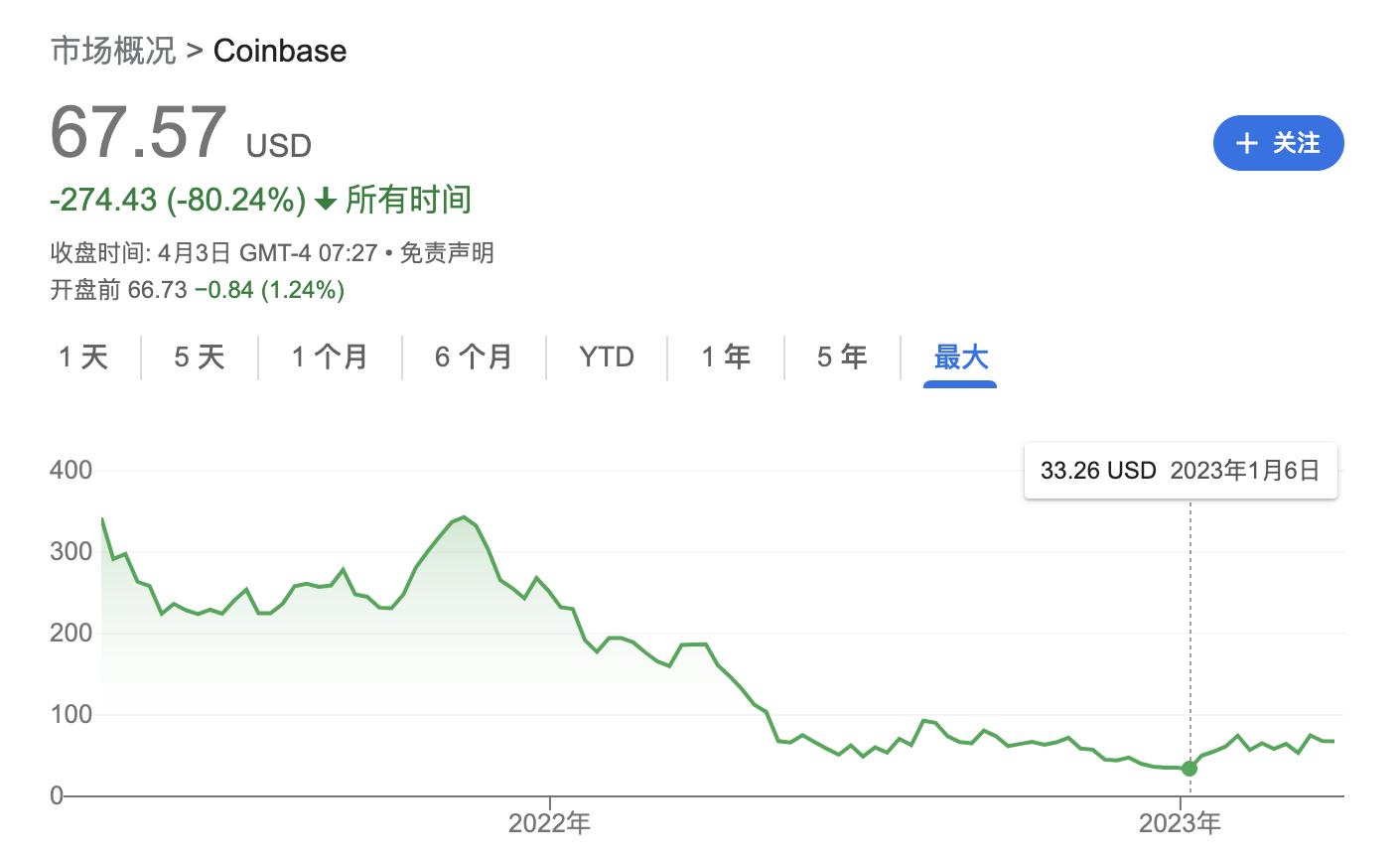
As we all know, Coinbase was at its peak when it was listed on the market. In the following years, its performance was bleak, negative news was entangled, and the stock price fell endlessly. Since the beginning of this year, it has finally bottomed out. With the recovery of the encryption market, its stock price has more than doubled from the low of $30+.
first level title
Coinbase’s Global Expansion Has Been Unfinished
As one of the longest-established companies in the encryption industry that has experienced multiple rounds of bulls and bears, since its establishment in 2012, Coinbase has rapidly developed into a top cryptocurrency exchange known for its compliance.
But similar to most industry giants, Coinbase seems to be in a growth dilemma after experiencing its peak period. The rapid expansion not only failed to bring gratifying growth figures, but the sharp decline in revenue and profits caused the stock price to plummet. According to the financial report, in the first three quarters of 2022, Coinbase's cumulative losses reached 2.069 billion US dollars.
At the beginning of 2021, Coinbase had only 1,250 employees, and by the end of 2021, it had expanded to nearly 3,200 employees. According to a public conference call in early 2022, Coinbase stated that it plans to triple the size of the company and continue to recruit more than 2,000 people. The continued growth in the number of employees directly reflects Coinbase's expansion ambitions.
However, with the emergence of black swan events such as Luna and the rapid cooling of the encryption market, Coinbase had to take a cautious approach: it first announced in May that it would slow down the pace of recruitment, and soon stated that it would suspend recruitment and cancel some accepted offers. Finally, it further announced large-scale layoffs, reducing the size of the team by about 18% to reduce the company's expenses. Coinbase even canceled free employee lunches, according to the Wall Street Journal.
Company CEO Brian Armstrong pointed out that due to the possible economic recession, Coinbase needs to control the speed of capital consumption and improve efficiency.
At the same time that the industry is in the cold, Coinbase's global expansion strategy has also encountered repeated disadvantages.
Take the Indian market as an example. In early April 2022, Brian Armstrong and his team came to Bangalore. During their visit, Coinbase had more than 300 full-time employees in various states and regions of India. At a meeting related to the trip, Coinbase also announced that it is adding support for the UPI payment tool in India. But then the UPI developer came forward to deny the cooperation with Coinbase, which caused Coinbase to stop supporting UPI soon.
first level title
Behind Coinbase's latest quarterly earnings report
Despite the unfavorable year in 2022, it needs to be pointed out that Coinbase's bottoming out at the beginning of 2023 seems to be sending a sufficiently positive signal to the market: as the world's second largest encryption exchange, it still firmly grasps the fundamentals.
This can be seen from Coinbase's latest quarterly financial report (2022 Q4):
1) While revenues are falling sharply due to continued low cryptocurrency trading volumes, the company delivered a solid fourth quarter, with both revenue and earnings growth beating expectations;
2) Coinbase has obtained considerable interest income from assets held on the platform, which will increase by 79% quarter-on-quarter to US$182 million in 2022 Q4;
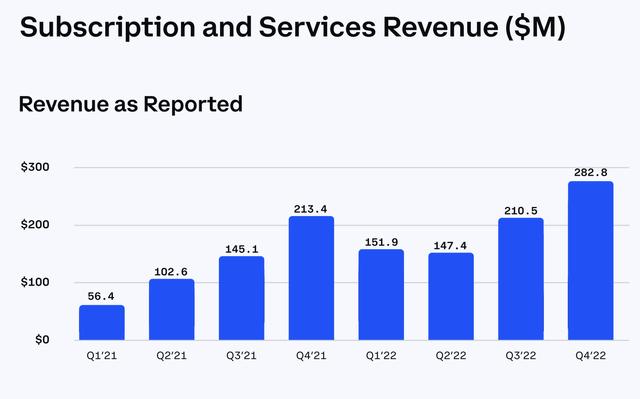
3) Its subscription and service revenue also rose 32.5% YoY to $282.8 million.
Since the crypto market went bearish in Q1 2022, Coinbase has been facing a very difficult situation, and the collapse of Terra and FTX has continued to exacerbate the situation since then. But fortunately, Coinbase itself is tough enough, and it is still in a solid top position.
The first reason for "stable" is that the source of its platform trading volume is healthier.
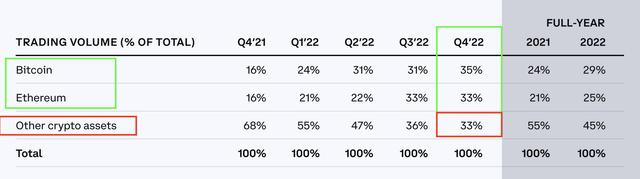
The above table reflects the proportion of trading volume of different asset classes on the Coinbase platform, Bitcoin, ETH and others, including some so-called "altcoins".
Comparing the past five quarters, the proportion of the "Other" category dropped from 68% in 2021 Q4 to 33% in 2022 Q4. This is both a result of the sharp decline in "altcoins" and new ICOs, and it also shows that more relatively high-quality and stable transactions are continuing to grow on the Coinbase platform.
The second reason for "stable" is that the types of platform customers are healthier.
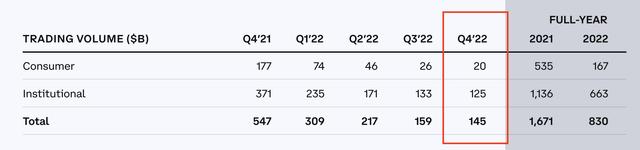
The above table shows the proportion of trading volume contributed by the two types of traders on Coinbase. In terms of dismantling, retail (Consumer) transaction volume dropped from 177 billion US dollars in 2021 Q4 (accounting for 32%) to 2022 Q4's 20 billion US dollars (accounting for 14%); although institutional (Institutional) transaction volume is also declining, From $371 billion in 2021 Q4 to $125 billion in 2022 Q4, its share rose from 68% to 86%.
This is good for Coinbase, it shows that institutional funds are taking this new class of crypto assets more seriously (even if interest has declined in the short term), and it is also proof that Coinbase is gaining the trust of institutions (and therefore choosing to trade here).
In 2022 Q3, Coinbase was selected by BlackRock, the world's largest asset management company, to provide encrypted trading channels for its Aladdin (end-to-end investment platform) customers. In January 2023, BlackRock chose to add Bitcoin as an investment target to its global allocation fund.
In the 2022 Q4 earnings call, Coinbase management also stated that they are seeing more and more institutional investors joining its Coinbase Prime program.
The third reason for "solid" is that Coinbase is opening up new types of revenue.
Coinbase is generating income from assets held on its platform through a combination of staking and interest income. According to the financial report, its 2022 Q4 interest income increased by 79% month-on-month to US$182 million. This is mainly driven by the rise in interest rates, which has achieved considerable returns on the huge client assets under its custody.
first level title
Possible Futures for Coinbase
Although Coinbase currently has relatively solid fundamentals, its future development still needs to take into account a series of "tailwind" and "headwind" factors.
Obviously, the biggest factor affecting Coinbase is when the crypto market picks up. The reason is simple, the increase in Coinbase revenue started with the return of investors, and the return of investors must be due to the increase in the overall price of the crypto market. Although the 2022 Q4 financial report exceeded expectations, it needs to be admitted that it has suffered a heavy blow in 2022, and monthly active users and transaction revenue continue to decline.
Therefore, the return of the crypto bull market is crucial for Coinbase. This is the most effective catalyst to help Coinbase regain lost users.
The second most important "tailwind" factor for Coinbase is naturally new revenue streams.
One bright spot to look forward to is staking revenue, after all, as of now, this number is on the rise. In 2021, staking accounted for less than 1% of Coinbase's total revenue; but by 2022 Q3, it accounted for more than 10% of revenue.
The problem here, of course, is that the SEC has made staking a regulatory focus. In February, the SEC fined crypto exchange Kraken $30 million for offering staking products to investors and signaled a blow to the industry. In response, Coinbase has repeatedly emphasized that staking is not a security product. But in the end, no one can know how things will go.
In addition to staking, Coinbase is also looking for other sources of income. One is subscription revenue, which is the subscription fee for products such as Coinbase Cloud. The second is the international business - Coinbase Global. It continues to push forward with global expansion, and it shows no signs of slowing down.
Coinbase's strategic move also includes partnering with Optimism to launch Base, a secure, low-cost, developer-friendly L2 solution for Ethereum. Perhaps it could eventually serve as a platform for institutional investors, especially in terms of offering new DeFi products, which could open up new revenue streams for Coinbase.
But many of the above "tailwind" factors will ultimately be constrained by one question - how much legal and regulatory risk will Coinbase face?
It seems like every month, the SEC announces a big push against a new area of the crypto industry.
Coinbase needs to address this issue head-on, or at least let the market see its resolve. That's why it went head-to-head with the SEC on staking, because it not only shows how important this source of revenue is to the company, but also shows that it's willing to actively address potentially significant challenges in the industry.
In addition, Coinbase recently launched the "Crypto 435" advocacy campaign, which will advance a lobbying campaign for crypto policies in the 435 U.S. congressional districts, encouraging lawmakers to be more crypto-friendly.
Suffice it to say, all the evidence suggests that Coinbase has a long game brewing.
Brian Armstrong once emphasized in a letter to employees that "Coinbase has survived multiple bear markets in the past decade." He believes that Coinbase will benefit from stricter encryption regulatory policies because this will help clear the industry. lagging company.
We believe that the growth of Coinbase reflects the changes in the entire industry. Although until now, the many use cases carried by the underlying technology of blockchain have not really worked out, or in other words, have not worked out in the way its inventors intended. However, encryption companies represented by Coinbase are still actively looking for solutions to push the industry as a whole forward.