AC Capital: Shanghai upgrade is coming soon, why LSD is highly anticipated


Original author: Bittracy, AC Capital Research
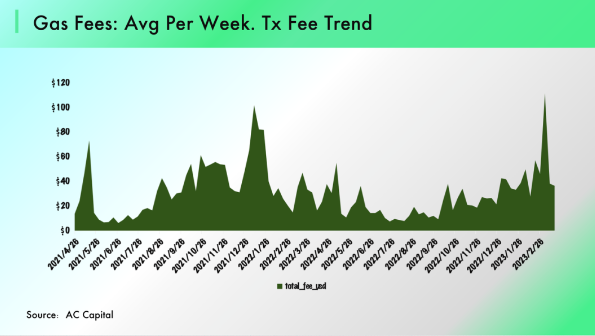
The decentralized world has just experienced a historic bull market, and countless innovations are presented in front of us. Compared with the bull-bear conversion in 2018, the decentralized world has various basic settings such as DeFi, NFT, derivatives, Lanuchpad, Incubator, etc. With the gradual maturity of protocols such as Layer 2, LSD, and ZK , the world on the chain presents more rich content. After 2023, the activity on the chain will increase significantly, and the rise in asset prices will drive up the transaction volume. The switch of market fluctuations this time is very interesting. From the perspective of Macro, the prices of digital assets such as BTC and the Nasdaq index are showing a trend. After the economic vitality of the United States weakened, due to the pressure of inflation, the Fed's firmer attitude of raising interest rates has suppressed market sentiment to a certain extent.
01 The market environment for the rise of LSD
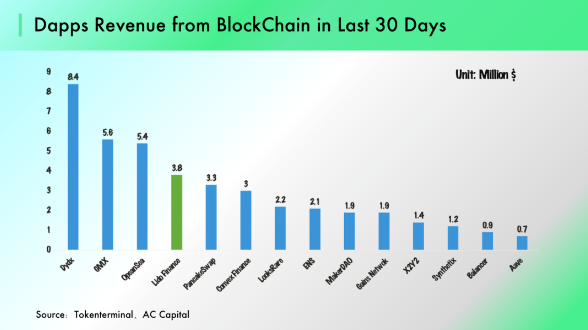
In Q4 of 2022, practitioners can have a clearer picture of investors' preferences: institutions are more inclined to infrastructure, rather than protocols such as GameFi and NFT that rely heavily on liquidity; project books such as MPC wallets, cross-chain bridges, ZK, and middleware Most sought after in the market. It is worth mentioning that there is also a clear differentiation in infrastructure agreements. After experiencing black swan events such as Terra and FTX, investors’ risk appetite has been significantly suppressed, and everyone hopes to see that the protocol can generate positive returns for their own development, rather than asking investors for money. From the perspective of business model, the revenue growth of agreements such as ZK and wallets needs to rely on active transactions on the chain. It is difficult for agreements with strong Beta attributes to obtain sufficient income during the bear market period. In this context, the LSD protocol represented by Lido has developed rapidly. Thanks to its clear business model and definite profitability, Lido's market value has already surpassed MakerDao before the market rebounded, ranking within 50.
02 The rise of the LSD protocol
Looking back at the last round of bull market, DeFi, Layer 1, and GameFi have successively taken over the market. At the beginning of 2023, LSD (Liquid Staking Derivatives) performed well in the secondary market and became the focus of investors. First of all, the Staking income of Ethereum itself is too attractive. From the perspective of absolute scale, GAS/MEV and Staking Reward provide developers with enough market space to capture value. "Vast market space (valuation) + high-speed TVL growth (Performance)" means investment opportunities with high certainty, so we have seen the LSD agreements represented by Lido and Frax shine in the past three months. This article will focus on analyzing the operating mode of the LSD protocol, and discuss and analyze high-quality LSD protocols.
What is the LSD protocol? LSD (Liquid Staking Derivatives): Liquid Staking Derivatives, the purpose of which is to help the tokens that have been pledged on the chain release liquidity and expand income. In the blockchain world, network interaction needs to be achieved through a consensus mechanism, and the POS protocol requires nodes to obtain the right to verify transactions by pledging tokens. Let's take Ethereum as an example. In the setting of ETH 2.0, users need to pledge 32 ETH + servers running independent nodes to become verification nodes to obtain pledge income. First of all, 32 ETHs put forward high requirements on the amount of user funds, and independent maintenance of node equipment requires a lot of energy. At the same time, the pledged ETH cannot be withdrawn until the Shanghai upgrade, and these requirements put liquidity pressure on Ethereum pledgers. In response to these problems, the LSD protocol helps users obtain pledge income & release the liquidity of locked tokens by creating derivative tokens.

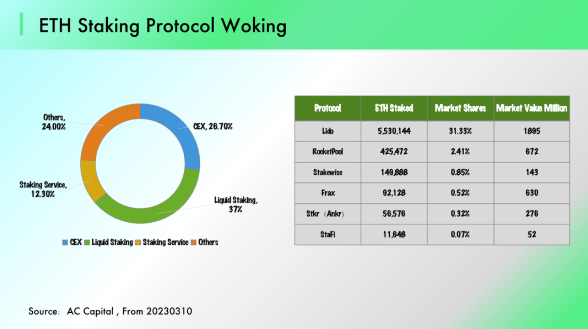
Why is the LSD protocol an investment opportunity? The current pledge rate of Ethereum is only 14%. Compared with the pledge ratio of other POS public chains (more than 50%), the market space for Ethereum node pledge has not yet been fully opened. The income of Ethereum nodes comes from the amount of pledge and fee income. Make a neutral assumption. If Shanghai is upgraded, the pledge rate of Ethereum can reach 50%, which is 257% higher than the current level. The Consensus Layer Reward for operating nodes It is expected to increase by more than 60% (Consensus Layer Reward is not linearly related to the amount of pledge). At the same time, after the Shanghai upgrade, a more flexible mechanism will further compress the price difference between ETH and its derivatives, which will help activate the ecological application of LSD Token. Therefore, in the foreseeable future, the profitability and development potential of the LSD protocol are expected to increase.
03 How to assess LSD
How should we define a good LSD protocol? This section will answer this question by dismantling and analyzing what we consider to be a high-quality LSD protocol.
(1) What is a good LSD protocol—take Convex as an example
The core value of the LSD protocol is to help solve the pain points of the basic protocol: due to Curve's unique business model and token economy, many problems will be encountered in actual use. For investors, it is very difficult to obtain investment income by holding CRV tokens. If the share of tokens you want to hold is not diluted, you must lock CRV for a long time to obtain Boost Revenue (the lock-up period is 4 years to achieve the highest return), which means that investors will sacrifice a lot of time and have to work with Curve Deep binding. For ecological builders, Curve provides a trading place for DeFi protocols and participates in CRV distribution, but this requires developers to hold a large amount of VeCRV to ensure the effectiveness of participation (guarantee CRV emissions for opening a Pool), which is very important for the initial development of the protocol , need to bear greater financial pressure and conversion costs.
The development of LSD is based on the prosperity of the underlying protocol: the operating model of the LSD protocol lies in the dismantling of the economic model of the underlying protocol, thereby helping token holders to obtain better benefits and convenience, so the scale of the underlying protocol determines Space for the development of the LSD protocol. As an important stablecoin trading venue for Ethereum, Curve has accumulated a huge amount of liquidity and trading volume, and has become an important place for DeFi protocols to deploy machine gun pools. During the development period of "DeFi Summer", a large number of machine gun pools were gathered on Curve, and Trading Fee and CRV Reward provided developers with a broad market space.

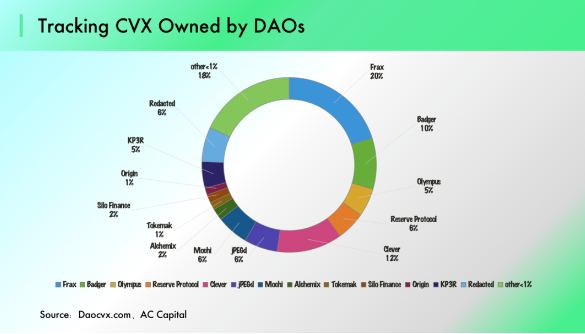
Curve’s entanglement, Convex’s solution: Convex solves the above two problems very well. First of all, for the problem that Curve’s inflation attribute is too strong, Convex locks a large amount of CRV in its hands through CRV / cvxCRV (LSD mode), so that the investment Those who can achieve Max Boost Revenue can also immediately obtain cvxCRV to release liquidity. Secondly, in response to Curve’s governance issues, Convex stripped Voting Power from VeCRV and mapped its governance rights to CVX. Developers who wish to open smart pools on Curve can trade governance rights through the Bribe Marketplace. In this way, Convex will firmly grasp the control of Curve, and the strong Boosting Yield will continue to attract users to deposit CRV into Convex. At the same time, Bribe Marketplace will bring Convex a steady stream of income. The underlying protocol has disassembled and reconstructed the economic model and operating mechanism. On the one hand, it helps users maximize Staking Return, and on the other hand, it creates an LSD secondary market with sufficient liquidity. Bittracy believes that this may be the most profitable LSD in 2021. Successful LSD agreement.
(2) The core advantages of LSD track development—taking Frax as an example
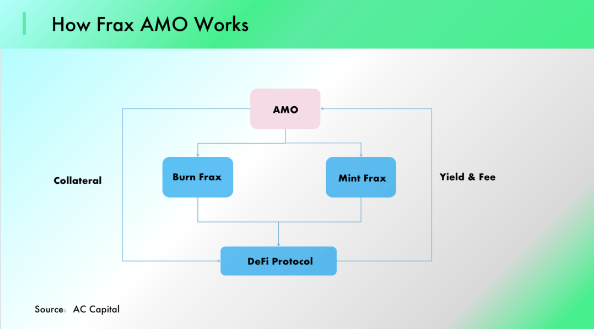
Frax started the project as early as 2019. Compared with MakerDao, Frax's biggest difference is that it adopts a dual-token mechanism to support algorithmic stablecoins with fractional-algorithmic stablecoins. In order to realize the value anchoring of stablecoin governance and improve the utilization efficiency of funds, Frax Finance innovatively launched the automatic market making mechanism (AMO) in the V2 version. Under such a mechanism setting, AMO can flexibly adjust the ratio of USDC and FRAX in the FRAX 3 CRV Curve, thereby ensuring the anchoring relationship between FRAX and USDC.
Over the past three months, we can clearly see that Frax Finance's TVL has skyrocketed with a very steep slope. If Lido increases the rate of return on user pledges through multi-layer nesting with AAVE. Then Frax realizes user income improvement through binding with Convex.
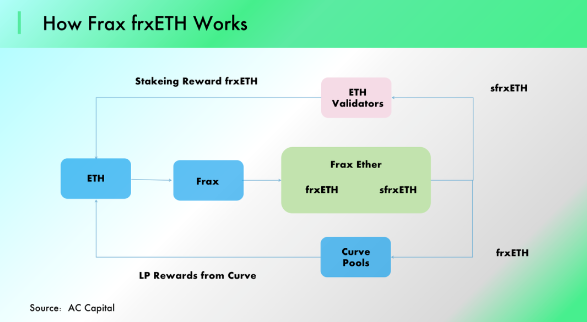
Frax's LSD mode: Participants have two choices after staking ETH on Frax Finance to obtain frx ETH;
Option 1: By changing frxETH into sfrxETH, you can obtain the pledge income of ETH;
Option 2: Pledge frxETH and ETH to the Curve pool to obtain mining income;
Summarize
Summarize
The LSD protocol is an innovation based on a mature protocol. The scale of the protocol determines the development space of LSD: for example, the existence of LIDO is to maximize the pledge income for Ethereum network pledgers, and CVX is to capture the value of Curve. Therefore, the scale of the basic protocol largely determines the ceiling of the LSD protocol, and LSD with development potential needs to be built on a successful basic protocol.
Boosting Yield determines the core competitiveness of the LSD protocol: the value will ultimately be stabilized through its ability to earn a share of protocol revenue when staking in the staking contract. The battleground for LSD is who can capture the most base tokens. Therefore, the core competitive advantage of LSD lies in capture and lock-up, and the earning power and token mechanism determine the capture and lock-up capabilities of the LSD protocol.
The LSD protocol needs to have a relatively solid moat: this type of protocol faces the Target Market of the underlying protocol. If the moat is not strong enough, it is easy to be overtaken by latecomers. Convex has set in the model one-way exchange of CRV / VeCRV, which also ensures that Convex's position in Curve will not be weakened, thereby avoiding being demolished by competitors. Compared with Curve's staking ecology, Ethereum's staking nodes can also dismantle different segmented node markets. Currently, EgienLayers seems to show this potential.
04 How will the LSD protocol develop
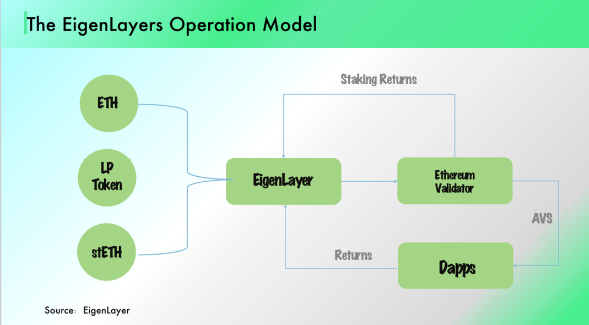
Security & decentralization has become an important development direction: With the continuous increase of Lido's pledge income, the stable operation and security of nodes have been valued by the market. SSV and EigenLayer are undoubtedly the best-performing protocols. SSV Network decouples node deployment and verification confirmation through DVT (Distributed Validator Technology). Specifically, SSV establishes a network through sharding keys, and integrates multiple nodes to perform the work of Validator together, making network verification more decentralized, safer and more stable. EigenLayer provides a superfluid staking method. On the one hand, the protocol supports a variety of liquid staking including ETH, ETH LP, ETH LSD, etc., providing staking services for more users. More importantly, EigenLayer introduced the concept of ReStakeing. Users can hand over the choice of pledged nodes to EigenLayer, and the pledged tokens can change its application, which enhances the scalability of Ethereum trust, and users can also obtain other Ecological AVS provides additional benefits brought by pledge verification.
The loan agreement will benefit from the Shanghai upgrade: the development of the LSD agreement comes from the pledge income and loan interest rate of ETH. After the Shanghai upgrade, the ETH redemption mechanism will be activated, and the interest rate difference between ETH and stETH will be significantly narrowed, which will also make users have higher leverage. ETH Farming Yield comes from the loan interest rate difference between the pledge income and the leverage ratio, so we cannot accurately judge whether LSD can provide better returns to pledgers after the upgrade in Shanghai, but the TVL of the lending agreement may show a significant increase. We can draw a somewhat unexpected conclusion that the loan agreement may be the biggest beneficiary of Shanghai's upgrade.
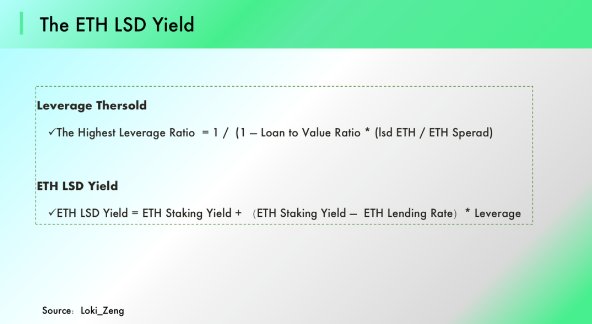
Loki_Zeng: The interest rate difference between staking and lending is essentially a liquidity premium and a risk exposure premium. Choosing staking requires sacrificing the liquidity of assets and bearing greater losses. The reason why leverage is now used to achieve gains of up to 10% -20% is mainly due to the uncertainty of ETH Shanghai upgrades. The longer the uncertainty, the higher the volatility risk of stETH. Therefore, after ETH is opened for staking redemption, a highly certain result is that the interest rate spread will narrow, and eventually a balance will be formed, and the income of leveraged staking will return to a reasonable range. Another high-certainty result is that lending has become one of the leverage methods of Staking, and the LSD lending market has become more prosperous. As pointed out in the Capitalism Lab article, lending has become a hidden winner of LSD.
05 Summary
references
references
1.https://tokeninsight.com/en/research/analysts-pick/jglp-from-jonesdao-how-it-offers-higher-yield-for-glp-holders
2.https://tokeninsight.com/en/research/analysts-pick/jglp-from-jonesdao-how-it-offers-higher-yield-for-glp-holders
3.https://foresightnews.pro/article/detail/19689