






Honey or arsenic? An article exploring the future of private voting in DAO governance


Original compilation: 0x 11 , Foresight News
Original compilation: 0x 11 , Foresight News
DAOs are the new governance structures that cryptocurrencies have brought to the world, designed to bring more autonomy to the way individuals and teams coordinate and organize. Like many new things that come with cryptocurrencies, the DAO has created a lot of chaos, most notably The DAO hack, which led to Ethereum's first hard fork. Even though cryptocurrency is new and not perfect, DAOs built on top of it still exist and survive. On the practical side, billions of dollars worth of assets are held in DAO vaults; on the philosophical side, many deep thinkers are beginning to study the far-reaching implications of DAOs (I recommend Stanford Blockchain Review'slatest articles)。
To this day, DAO governance practices are almost exclusively based on token-based voting schemes. In a typical DAO, members hold some sort of governance token to represent voting rights. DAO decisions related to treasury are usually decided by on-chain voting, such as simple majority, quadratic voting, or some kind of dynamic threshold scheme. Due to technical limitations, all DAO governance on the current complete chain is open and transparent.
With the popularity of zkSNARKs, on-chain privacy voting for DAO governance becomes possible. Recently, one of the best-run cc 0 NFT DAOs (Nouns DAO) began exploring the introduction of privacy voting into its governance practices.0x DigitalOilarticlearticleproposalproposalPassed, but still controversial. First, voter participation (>40% vs. 30% under normal circumstances). Second, although the proposal passed, there was still a large number of negative votes. Notably, the Nouns founding team voted against the proposal out of concern that the privacy vote might have a negative impact on the Nouns culture.
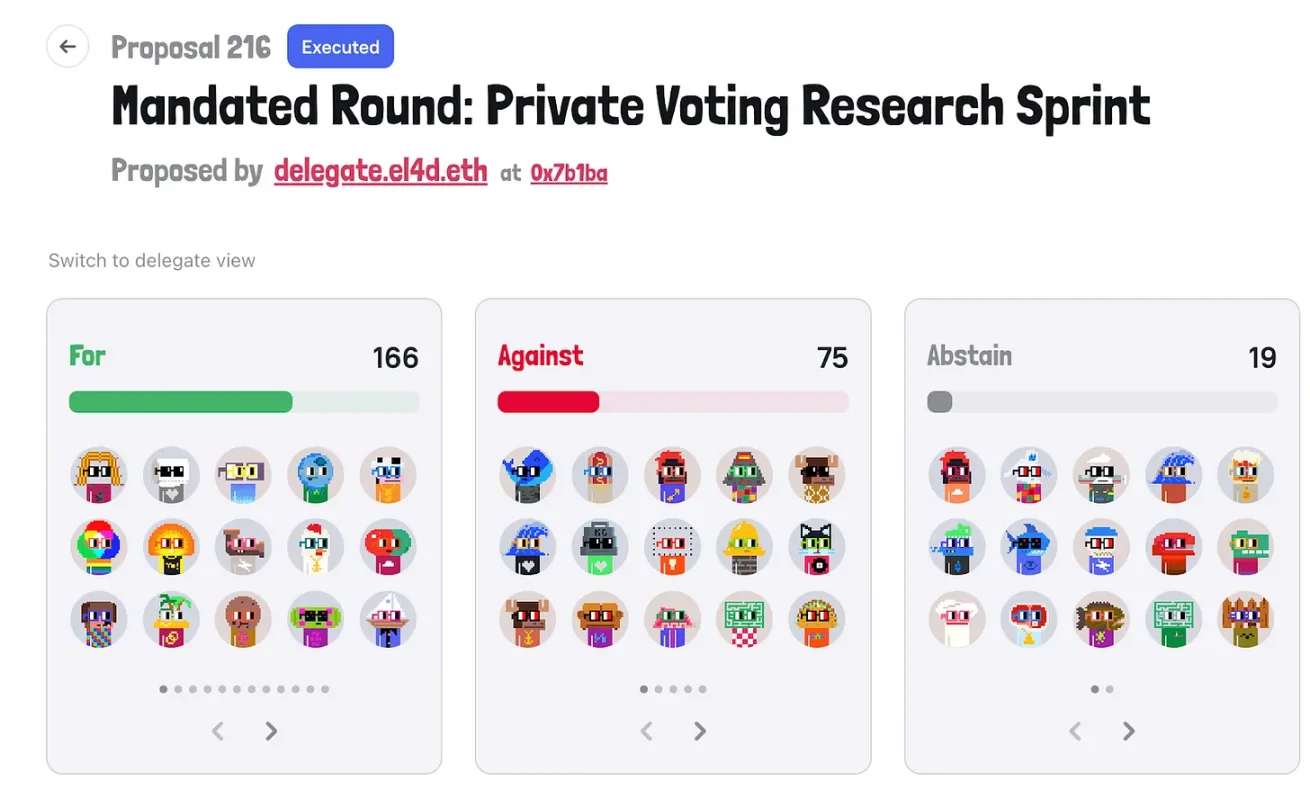
This leads to an interesting question? Should the DAO adopt a privacy voting scheme, assuming the technology is ready.
Arguments for the Privacy Vote
If you compare it from a philosophical point of view, DAO is a civil society. Then, privacy voting is an important guardrail to free speech, a constitutional right written in one of the most successful "DAOs" - the United States of America. I don't think readers of this article need to question the value of free speech. In a DAO, voting is the final form of expression.
From a practical standpoint, there is evidence that vote swapping is widespread, as 0x DigitalOil clarified in his Nouns forum post. A lot of times DAO members don't necessarily vote for what they think is best. They may worry that their vote will affect their image; they may worry that their negative vote will hurt their chances of passing future proposals. Voter retaliation could become an issue in real life, more so in DeFi related DAOs.
The Arguments Against the Privacy Vote
Philosophically, again using the civil society analogy, private voting removes voter accountability. An open and transparent voting record could be an important source of a robust social layer for a DAO reputation system. A similar design can be seen in democratic political systems: voting records in the U.S. Senate and House of Representatives are fully public.
Since the DAO's private voting system is not yet live, I cannot foresee possible negative effects. But it is conceivable that vote trading and bribery could become a problem due to the lack of accountability. Although there are thinkers like Peter Thiel who believe that private transactions and equestrian transactions are the "lubricant" of a democratic society. I personally might disagree with this. Since voting is distributed among different addresses, the current voting scheme evenOpacity existsThe problem.
The Future of Privacy Voting in DAO Governance
Optionality: Voters can choose to be public or private. One possible problem though is that opting not to be public could be a signal in itself.
Hybrid approach: similar to US Senate/House of Representatives and presidential elections, retaining accountability mechanisms for prestigious members and privacy mechanisms for the general public.
Optionality: Voters can choose to be public or private. One possible problem though is that opting not to be public could be a signal in itself.
Original link


