Reflection on the USDC Incident: Is "Perfect Stablecoin" a False Proposition?



On March 16, Circle announced that it had essentially cleared all backlogged USDC minting and redemption requests. This also means that USDC has basically survived the unanchor crisis caused by the "thunderstorm" of Silicon Valley Bank.
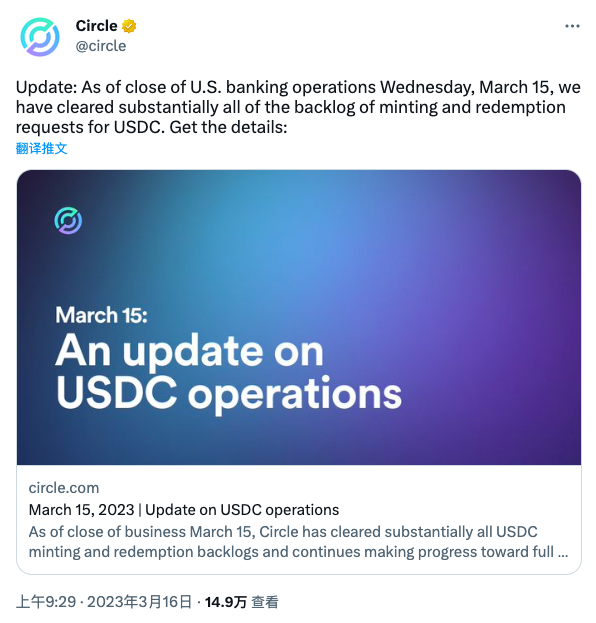
Looking back on this incident, since Circle disclosed that it has 3.3 billion US dollars in reserve funds in Silicon Valley Bank, until the US Treasury, the Federal Reserve, and the Federal Deposit Insurance Corporation (FDIC) announced that depositors can withdraw all funds, USDC, which was once regarded as a cooperative The benchmark stablecoin has been greatly de-anchored due to market panic, and the lowest discount was as low as 0.877 US dollars.
secondary title
no one can escape the risk
"Will you lose money by holding stablecoins?"
This is something that many investors in the industry have never considered. Although with the anchoring of USDC, DAI, and FRAX, this crisis was ultimately just a false alarm, but what kind of stable currency can guarantee "stability" has become the focus of attention at the industry level.
In the past few days, we have seen many discussions on related topics. Part of the discussion focused on some stable currencies (such as USDT, TUSD, LUSD, sUSD) that were not affected by this crisis, trying to find the direction of the "perfect stable currency".
But just look a little closer,You can find that these stable coins have different types of risks.
The situation with USDT is a cliché. Although as an indirect beneficiary of this incident, its issuance scale has further increased to about 75 billion US dollars, but the opaque reserve status is always a sharp sword hanging over USDT.
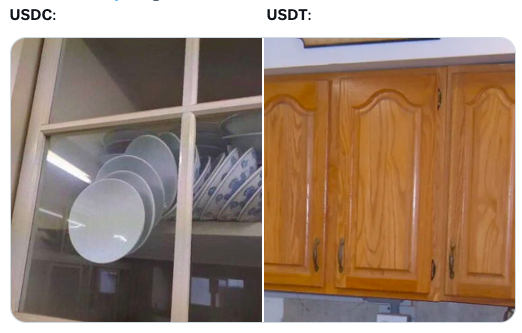
In terms of mechanism, TUSD is the same as USDC, which is a centralized stable currency with transparent reserve status. Therefore, in theory, what happened to USDC is entirely possible to reproduce in TUSD, but this time it happened that USDC chose Silicon Valley Bank to issue (TUSD's reserve funds are mainly in the Capital Union Bank of the Bahamas).
The situation of LUSD and sUSD deserves further elaboration. As decentralized stablecoins generated entirely by over-collateralization of native encrypted assets (the former ETH and the latter SNX), the two have avoided the risks arising from the banking system this time, but this mortgage mechanism is inevitable In some places, there will be problems such as low capital efficiency (for example, the collateral ratio requirement of sUSD is 400%) and slow expansion of issuance.
From the perspective of safety only, stablecoins such as LUSD and sUSD are not completely risk-free - in extreme market conditions, the liquidation efficiency of mortgage assets will directly affect the health of the protocol. Once upon a time, DAI also went through this path, but in the 312 historical level market fluctuations, due to untimely liquidation, it generated about 4 million US dollars of bad debts. After that, Maker gradually deepened its relationship with USDC, which seems to be transparent enough. bound.
in summary,It seems that no stable currency can perfectly isolate all risks, so that "there are thousands of risks, and I will stand still"secondary title
"Risk" and "Hidden"
Back to the origin of stablecoins.
Cryptocurrency is a niche industry. It has high threshold for those with weak demand and high risk for those with strong demand. The emergence of stablecoins is precisely to solve these problems, that is, to provide deposit and withdrawal channels for those with weak demand, and to provide a medium of exchange for those with strong demand.
The vulnerability of stablecoins is manifested in,As a bridge connecting the encrypted world and the real world, it must bear bilateral risks - on the one side of the encrypted world, this may be manifested as collateral asset fluctuations, hacker attacks, etc., and on the other side of the real world may be manifested as reserve gaps, liquidity crunch, etc. .
current,The existing stablecoins on the market all need to bear risks from both ends of the encrypted world and the real world, but the risk composition of each is completely different.
Taking the unanchored USDC as an example, the main risk it bears comes from the real world.
As for DAI, another unanchored stablecoin. Due to the risk transmission of USDC, DAI also bears certain real-world risks, but due to the existence of the upper limit of exposure, this risk situation will be slightly lower than that of USDC on the whole; however, because another part of DAI’s collateral is mainly ETH, etc. It is a native encrypted asset, so it also needs to bear certain risks in the encrypted world.
As for LUSD and sUSD, the main risks they bear come from one side of the encryption world.
From this, we can simply make a mathematical model, assuming that the risk coefficients from both ends of the real world and the encrypted world are 1. The risk composition of USDC may be 0.9 + 0.1; DAI may be 0.7 + 0.3; LUSD and sUSD may be 0.1 + 0.9; as for USDT and some unsecured algorithmic stable coins, the numbers at both ends may exceed 1...
(Odaily Note: These figures are only for a more concrete statement, and the risk status among different stablecoins cannot be accurately quantified.)
Based on this evaluation system, we have also rethought the future development trend of the stable currency track. Rather than looking for some kind of "perfect stablecoin",We are more inclined to believe that in the future, there will still be a variety of stablecoins with completely different risk structures coexisting, and they can serve as each other's hedging options.
Cryptocurrency has always been a high-risk industry,The endless and diverse external "accidents" determine that the definitions of "risk" and "risk aversion" are constantly changing, which also makes the roles of "risk assets" and "safety assets" even interchangeable under different circumstances. In this banking crisis, LUSD and sUSD have become the "safe haven assets" of USDC, but under extreme market conditions, USDC may also become the "safe haven assets" of the former.
Ibsen once said: "Life is always risky, and the longer you live, the greater the risk."
The same is true for the cryptocurrency industry. With the further development of the industry, more unpredictable risks will continue to emerge. What we need to do is to face up to the risks and manage them better.