Comprehensive interpretation of ENS development status and prospects: Web3 domain name ruler


Original compilation: Peng SUN, Foresight News
Original compilation: Peng SUN, Foresight News
If cryptocurrencies do go mainstream, there will be a huge market for Web3 domains. Because "everyone" will eventually have a Web3 wallet, human-readable digital wallet addresses are as common as email addresses. In this report, we will start from the business model of Web3 domain name service, network effect and financial situation, token economics, valuation/target (addressable) market, technology and roadmap, core team/supporters, DAO governance/ The 9 sections of Community/Social, Competition and Risk introduce ENS, the largest Web3 domain name provider in the market.
1. Business model
There are many fascinating parallels between the early internet and the early crypto industry. ENS is a great example of this. Before the advent of web domain names in 1986, Internet users would identify websites by their IP address, a string of random numbers. Every computer on the network recognizes each other in this way, allowing data sharing between computers.
Of course, this is not conducive to the popularity of the Internet. The Internet cannot go mainstream until IP addresses are mapped to human-readable domain names, or URLs.
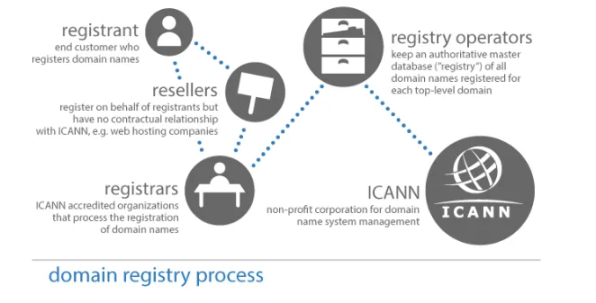
Today, the Internet Corporation for Assigned Names and Numbers (ICANN — a nonprofit corporation) manages the top-level development and architecture of the Internet's domain name space. ICANN accredits domain name registrars through whom domain names can be registered or reassigned to end users/registrants. The process is as follows:
image description
icann.og
Crypto wallet addresses today are similar to website IP addresses in 1986. On the Ethereum network, the address looks like this: 0x d 85 f 8858478 a 054 d 3 ea 67 e 8 fb 3d 088 b 2 ec 86 edce.
Services such as ENS make wallet addresses human-readable, like "michael.eth".
Crypto addresses are more than just digital wallets. They can represent websites, identities, information services, and more. As far as websites are concerned, ENS currently supports ".com", ".org", ".io", ".app", etc., and browsers that support ENS include Brave, Opera, Status (mobile) and MetaMask (mobile) ).
Today, human-readable website addresses are represented by extensions such as ".com", ".org", ".net", ".edu", ".gov", etc. ENS introduced ".eth" to the world and seeks to become the number one domain/address registry on the Ethereum network, aiming to enable crypto users to easily identify each other through human-readable blockchain addresses or wallets. ENS does not break a website's traditional domain name. Instead, the protocol was built to integrate directly with traditional ".com", ".org", ".edu" domains - bringing together content, blockchain-native payments, and custody of digital goods (NFTs) under one roof. on the user interface.
The ENS protocol makes money by selling new address registrations and renewals. Users prepay for their crypto domain name/address for a certain number of years, while renewals drive further revenue.
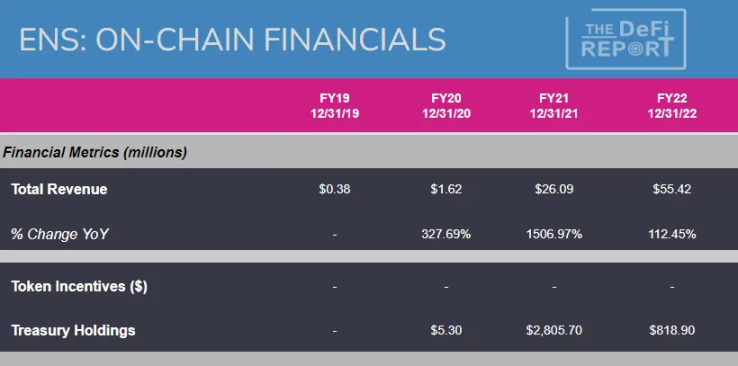
The agreement generates $55 million in revenue in 2022 and $4.8 million in 2023 to date.
2. Network Effect
The network effect of ENS is directly derived from Ethereum, the largest smart contract platform in the market. As a Layer 1 blockchain, Ethereum dominates nearly 80% of the market in terms of developer talent, applications, locked value, revenue, developer tools and standardization (token standards, programming languages, EVM, etc.).
If you believe that Web3 will go mainstream and Ethereum will be one of the major public chains, then betting on ENS is essentially betting on Ethereum (without leverage).
image description
Data: Etherscan, Dune @makoto, Glassnode
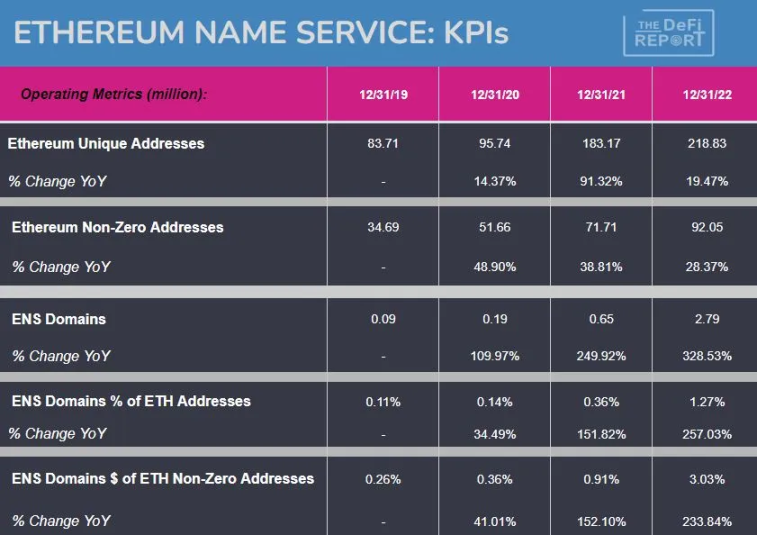
There are currently over 95 million non-zero Ethereum wallet addresses worldwide. At the same time, only 2.8 million of these addresses use the ".eth" domain name, accounting for about 3%, and the gap is very large. We believe that the vast majority of wallet addresses will hopefully become human readable at some point in the future. Of course, our assumptions depend on mainstream adoption and usage, where human-readable wallets become a necessity. Considering the growth rate that has been presented, we think there is an opportunity.
In terms of renewals, on-chain data shows that the average churn rate is about 50%—user stickiness is quite good. In terms of overall registration growth, ".eth" has grown 228% annually over the past 3 years.

Data: Dune @makoto
image description
Data: Arcana, Token Terminal
We can see that the agreement continues to grow in new signups and revenue. Meanwhile, ENS token incentives are 0 so far - a positive sign of product/market fit. In terms of spending, the DAO consumed $1.27 million on its core work in the second half of 2022.
Additionally, ENS has one of the largest balance sheets in the crypto space - with over $900 million currently locked in the DAO treasury. We note that the treasury primarily holds ENS tokens, so there is definitely some downside risk. Having said that, the capital of the project development is mainly derived from income, and has a healthy balance sheet that can withstand the downturn in the market.According to the DAO wallet address on Etherscan, the treasury currently holds approximately USD 17 million in USDC, USD 24 million in ETH and USD 132 million in ENS. The remaining value comes from unreleased ENS tokens.
3. Token Economics
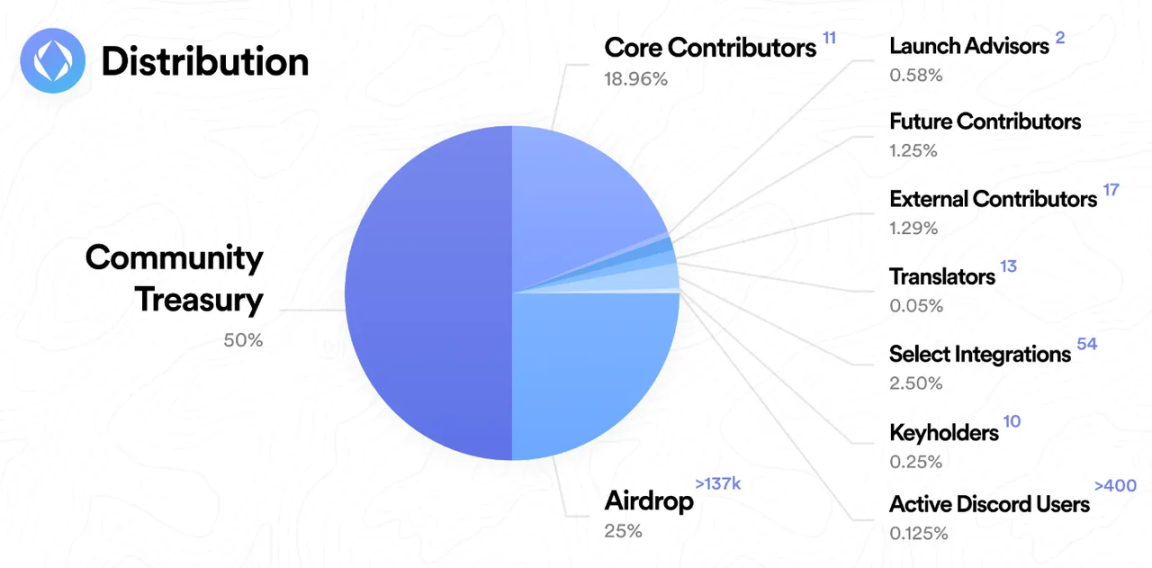
The maximum supply of ENS is 100 million. The current circulating supply accounts for approximately 25.7%. Its distribution is as follows:
25% allocated to early ".eth" domain name holders - based on how long an address has held the domain name. These tokens are unlocked and distributed all at once.
25% allocated to early contributors to ENS (100+ individuals, groups and 450+ active Discord users). At present, 24% have been unlocked, and the remaining tokens will be unlocked linearly in 4 years, with 13,369 ENS unlocked every day. Tokens for core contributors will be unlocked by the end of 2025.
50% is allocated to the DAO community treasury. 10% (5 million tokens) was allocated to the DAO when the project was launched, and the rest was unlocked over a 4-year period. 24% are now unlocked, and the remaining tokens are unlocked 30,801 per day. The community part will be unlocked by the end of 2025.
There are currently at least 64,000 token holders. The largest wallet addresses outside of The DAO appear to be two Binance exchange accounts, holding a combined 5.2% of supply.
Since ENS was spun off from the Ethereum Foundation and operated as a non-profit, there were no outside investors or VCs involved. This helps reduce the risk associated with large insider sell-offs, but we should be aware that early contributors hold a large amount of tokens that are being unlocked linearly. And, while a large number of tokens are unlocked every day, the DAO cannot spend these tokens without community approval. In fact,The community recently voted to sell some ETH to cover operating costs for the next few years。
4. Valuation and target market
Current Token Price: $12.63
Current Market Cap: $256 million
Fully diluted valuation: $1.26 billion
Income in the past year: $50.98 million
P/E ratio for the past year: 24.71 (fully diluted)
There are currently 95 million non-zero Ethereum addresses — this number has grown at an average annual rate of 39% over the past 3 years, and about 3% of them (2.79 million, with a 3-year average growth rate of 228%) have ".eth" domains .
(1) Basics
The basic situation can assume that the growth rate of Ethereum's non-zero addresses will be 30% in the next three years, and there will be more than 200 million non-zero addresses in the world in 2025. If we assume a growth rate of 30% for ENS names over the same period (3-year average growth rate of 228%), then there will be at least 13.5 million ENS names, accounting for 6.6% of all Ethereum non-zero addresses. Billed at $15 per year per address (an average of $19.71 last year), the protocol will also generate $200 million in annual recurring revenue (ARR).
(2) Bear market
A bear market can assume 15% growth in Ethereum non-zero wallets, 15% growth in ENS addresses, a $10 annual registration fee, and roughly $64 million in annual recurring revenue.
(3) Bull market
If the growth of Ethereum’s non-zero addresses and ENS addresses grow at a rate of 45% per year in the next 3 years, and each ENS address is calculated at $15, the network’s annual recurring revenue can reach nearly $400 million. In this case, by 2025 we will have over 280 million non-zero addresses, over 9% of which will have the ".eth" extension. 280 million Ethereum addresses account for just 5% of global internet users.
If Ethereum non-zero addresses reach 500 million (8.9% of current Internet users), 15% of people adopt ".eth" domain name addresses, and the average registration cost is $10, this will equate to $750 million in revenue.
relative valuation. ENS's Web2 benchmark is Verisign, which currently trades at a P/E ratio of 31.7 and a market capitalization of $20 billion. We think ENS has the potential to be larger commercially than VeriSign, because if Ethereum goes mainstream, the vast majority of Web3 users will own Web3 domains - not the relatively small percentage of Internet users who own Web domains today.
5. Technology and Roadmap
The technology of ENS is fairly straightforward. Domain name registration consists of a single smart contract, which maintains all domain names and sub-domain names, while storing three key information for each domain name:
The owner of the domain name (blockchain native address)
Domain name resolver (converting domain names into addresses)
The cache time-to-live value (TTL) of all records under this domain name
The owner of the domain name can be an external account (user) or a smart contract. A registrar is simply a smart contract that owns a domain name and issues subdomains that follow the rules defined by the contract. A subdomain of "thedefireport.eth" might look like this: "pay.thedefireport.eth".
The team is currently focusing on business integration, PR and marketing. Coinbase is partnering with ENS to provide its 110 million verified accounts with Coinbase-managed Web3 usernames. In this case, "cb.id" is the registrar on ENS, and the subdomain is the user address -- for example, "mike.cb.id". This allows Coinbase users to transfer money between human-readable accounts, rather than random strings of numbers and letters tied to Coinbase accounts.
audit. We cannot forget about auditing. The ENS smart contract has been audited by Consensys and ChainSecurity.
6. Core Team / Supporters
ENS was originally funded by the Ethereum Foundation and officially operated by a non-profit organization registered in Singapore. The ENS Foundation has three directors: Nick Johnson, Brantly Millegan and Kevin Gaspar. Ethereum founder Vitalik Buterin is a supporter of the ENS team, and in a recent article titled "Exciting directions in the Ethereum ecosystem"The project was highlighted in the article.
In order to facilitate upgrades and maintenance, the ENS root domain contract Root is controlled by 4/7 multi-signatures, and the private key holders are members of the core team and related projects. In the long run, the protocol plans to replace root multisig with decentralized decision-making as the system emerges. Multi-signature members include:
Nick Johnson - ENS
Dan Finlay - MetaMask
Aron Fischer - Colony
Martin Swende - Ethereum Foundation
Sergey Nazarov - Chainlink
Taylor Monahan - MyCrypto
Jason Carver - Ethereum Foundation
7. DAO Governance / Community / Social
ENS is a non-profit organization that runs the infrastructure for Web3 domains through ENS Labs. We believe that Internet domain names are basic Internet infrastructure, which should not be owned by a single centralized entity - just like base layer Internet protocols such as SMTP (email) are not owned by anyone. The ENS Charter provides a binding set of rules for DAOs to take legal governance actions.
In terms of "encrypted presence", ENS is quite strong. The ENS Twitter account has more than 240,000 followers. The Discord channel has over 43,000 members and the LinkedIn account has over 17,000 followers.
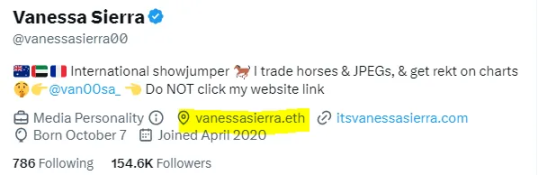
We noticed that many Twitter users displayed their ".eth" addresses on their public-facing profiles—a form of "social proof" that users were "crypto-native" and could serve as a strong link to the protocol. A powerful form of organic marketing.
8. Competition
Currently, Unstoppable Domains is ENS's biggest competitor. Unfortunately, they have a Web2 business model. As such, they are not transparent about their finances or growth other than their internal reporting.
Unstoppable Domain registrations are lifetime, so there is no recurring revenue. Users never have to think about the issue of renewal or being snatched after the domain name expires. In contrast, ENS domains are registered annually or for several years at a time. Both solutions are ERC-721 tokens (NFT). Unstoppable domains offer various chain extensions: ".zil", ".888", ".dao", ".blockchain", ".x", ".nft", ".wallet", ".crypto" , ".bitcoin". At the same time, ENS only provides one extension on the Ethereum network: ".eth".
Both products canIntegrate with other networks/wallets, and both offer subdomains. For example, a user could register "thedefireport.eth", and the subdomain could be "pay.thedefireport.eth".
Currently, ENS is the more popular domain name provider on the Ethereum network. As mentioned earlier, ".eth" domains are used on Twitter as a social signal that you are a "crypto veteran". We think this is quite powerful and could allow ENS to dominate the Ethereum network to capture the majority of the crypto domain name market (80% market share). We expect Unstoppable Domains to compete in more horizontal markets of Layer 1 ecosystems.
In the end, we believe ENS' position that "Web3 domains are public infrastructure" is a strong business strategy for crypto-native. We've seen the power of open source projects compared to closed source projects. The competition between ENS and Unstoppable Domains is a bit like the competition between (monetized) Wikipedia and Encarta. As Joy's law states: "No matter how many smart people work for you, there will always be more smart people working for others." Open source is often a long-term win. It will be difficult for competing centralized solutions backed by VCs to surpass the narrative and power of open source without presenting a clear differentiation.
9. Risk
ENS is built on the Ethereum blockchain, so it is closely related to the adoption and growth of Ethereum. Ethereum's 80% dominance in smart contracts is hard to shake in the short to medium term. However, over time, competitors may cut their market share. Each blockchain network may have its own domain name extension. For example, ENS' counterpart in the Solana ecosystem is Bonfida - which introduced the ".sol" extension for Web3 domain names.
There are also smart contract risks and financial risks - because the assets of the DAO treasury are mainly the native token ENS.
Verticals such as DNS domain name services typically tend to have winners dominate most markets. The ".com" extension is so inspiring that at least half of the Internet's domain names have it as an extension. Today, there are two domain giants in Web3: ENS and Unstoppable Domains. The business models of the two are quite different, so it remains to be seen whether users prefer Unstoppable Domains' "lifetime domain name" model or ".eth" recurring revenue model.
ENS is still a very young project. Many decisions today are made by the 7 "ENS Board" members who control the multisig wallet. For the long-term success of the project, we need the following 5 things: a growing developer base, integration with ecosystem infrastructure, ongoing maintenance of smart contracts, effective marketing, and responsible stewardship of the DAO treasury. We have seen the implementation of these aspects and will continue to monitor the project.