






A detailed explanation of Liquity Protocol: a DeFi protocol focusing on stable currency + lending


first level title
Introduction to Liquidity Protocol
Liquity Protocol is a decentralized lending protocol, also known as Collateralized Debt Protocol-Collateralized Debt Protocol (CDP), which can apply for interest-free loans by mortgaging ETH (ETH is the only type of collateral accepted by Liquity), and obtain LUSD stable currency loans. As a DeFi protocol, Liquity Protocol has the characteristics of immutability, non-custodial, and free governance, and is a completely decentralized DeFi protocol.
The difference between LUSD and USDC and USDT stablecoins is that the latter is pegged to the U.S. dollar at a ratio of 1: 1. If assets and liabilities are separated from 1: 1, such stablecoins will collapse and become unstable. The difference with LUSD is that instead of being pegged to fiat currency (physical cash stored in a bank), LUSD is pegged to ETH. And the agreement is anti-censorship, no regulatory agency can prohibit the issuance of LUSD, the agreement is completely operated by code, and the code is immutable.
The Liquity Protocol’s interest-free lending mechanism is that the protocol charges a one-time borrowing and redemption fee. This fee is algorithmically adjusted based on the most recent redemption time. For example: if more redemptions happen in the near future (meaning that LUSD may trade below $1), the borrowing rate (fee) will increase, discouraging borrowing.
secondary title
Liquidity Protocol use cases
Its use cases include:
- Borrow LUSD by mortgaging ETH;
- Deposit LUSD to the stable currency pool to ensure liquidity;
- Pledge LQTY to earn fees paid for borrowing and redeeming LUSD;
- Exchange 1 USD of LUSD for 1 USD worth of ETH when LUSD is below 1 USD.
Liquity revenue sources are:
-LUSD Bonds
- Staking LQTY
-LUSD stable pool
LUSD Bonds Earnings
Bond has an enhanced auto-compounded yield that can be held or traded. Yield growth is also achieved by converting its earnings into bLUSD through three different sources. Bond itself can be technically used as an NFT and traded on OpenSea.
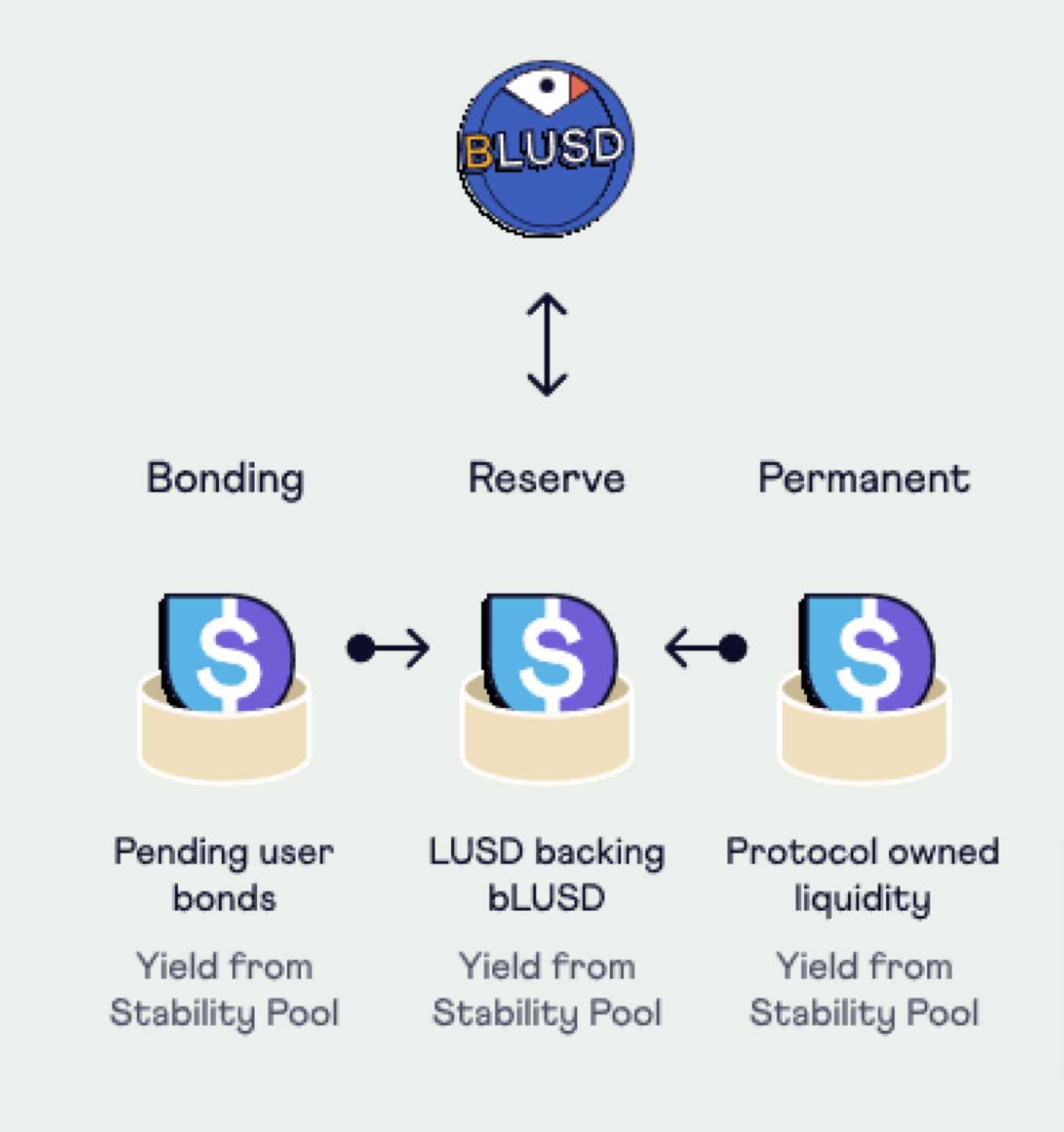
The advantages of bLUSD are:
It provides a higher yield than depositing LUSD in a stable pool;
The income generated is automatically harvested and compounded;
It is also an ERC-20 token that can be used as collateral for a reserve price increase.
Staking LQTY
Earn part of the protocol fees (ETH, LUSD) by staking LQTY. After starting the staking, users can earn borrowing and redemption fees in proportion. DefiLlama data shows that LiquityProtocol ranked 11th by fees in the past 24 hours.
The redemption mechanism of Liquity Protocol is that users can redeem 1 dollar of LUSD for 1 dollar of ETH without limit according to the price, and the LUSD will be destroyed, but the redemption process needs to pay a certain fee. As mentioned above, with the amount of redemption As more LUSD increases (meaning LUSD may fall below $1), the borrowing fees charged will also increase, making borrowing less attractive, a mechanism that prevents new LUSD from entering the market and pushes the price below $1.
LUSD stable pool
first level title
Special mechanism of LUSD
So how does LUSD maintain a stable peg to ETH and maintain its own circulating supply? LUSD has several special mechanisms.
The hard peg mechanism means that LUSD can be exchanged for ETH at 1: 1. The system charges a one-time redemption fee, which will increase each time. If there is no redemption over time, it will gradually decrease to zero. LUSD is destroyed upon redemption.
For example, if Peg = $0.98, the arbitrageur buys LUSD at $0.98 and redeems it at $1, making a profit of $0.02, and the buying pressure on LUSD will make its price rise; if Peg = $1.15, the arbitrageur buys LUSD at 110% The mortgage rate takes out the max borrow and sells LUSD for a $0.05 profit. LUSD selling pressure lowers the price.
The soft peg mechanism means that LUSD also benefits from the indirect dollar parity mechanism, and the LUSD dollar parity as the Schelling point is one of them. Since Liquity Protocol regards LUSD as equivalent to the U.S. dollar, the parity between the two is The implicit equilibrium state of the protocol.
In addition, the same mechanism of LUSD borrowing and redemption fees also prevents LUSD supply from getting out of control. Depositing ETH to borrow LUSD, the borrowing fee and redemption fee have the same operation method (more people issue LUSD, and the fee will rise).
Liquity Protocol's stable pool as a liquidity reserve is also a source of liquidity for debt repayment in liquidated positions. If the stable pool is exhausted due to liquidation, the debt and collateral will be equally distributed. This mechanism is also a risk buffer for Liquity Protocol.
first level title
How to get LUSD
first level title
Dex:Uniswap、Curve
CEX:Gemini
Liquity Protocol Partners and Token Economy
Liquity Protocol's cooperation lineup is also very strong, including Pantera Capital, Polychain, Nexus Mutual, Synthetix, Coinbase, Velodrome, OlympusDAO, Gemini, Huobi, and LUSD is also the top ten stable currency by market value.
Reference link:
Reference link:





