






Analysis of Ethereum Staking Prospects in 2023


After years of testing and development, the "Merge" enabled Ethereum to successfully move from Proof of Work (PoW) to a more efficient consensus mechanism - Proof of Stake (PoS). This paves the most important way for Ethereum's future expansion plan, and at the same time allows DeFi to have its own encryption-native yield tool-now ETH can be used to protect the blockchain in exchange for stable income.
In traditional finance, income assets will generate a huge market, and the Staking track with encrypted native yield tools will also allow Ethereum to have a larger ecology.
secondary title
Active staking ecology
Ethereum staking is a key feature in PoS Ethereum, which allows users to stake (lock) a certain amount of Ethereum (Ether) on the Ethereum network to become a validator of the network. This process not only allows users to obtain a stable return of about 5-8%, but also helps strengthen the security and scalability of the Ethereum network.
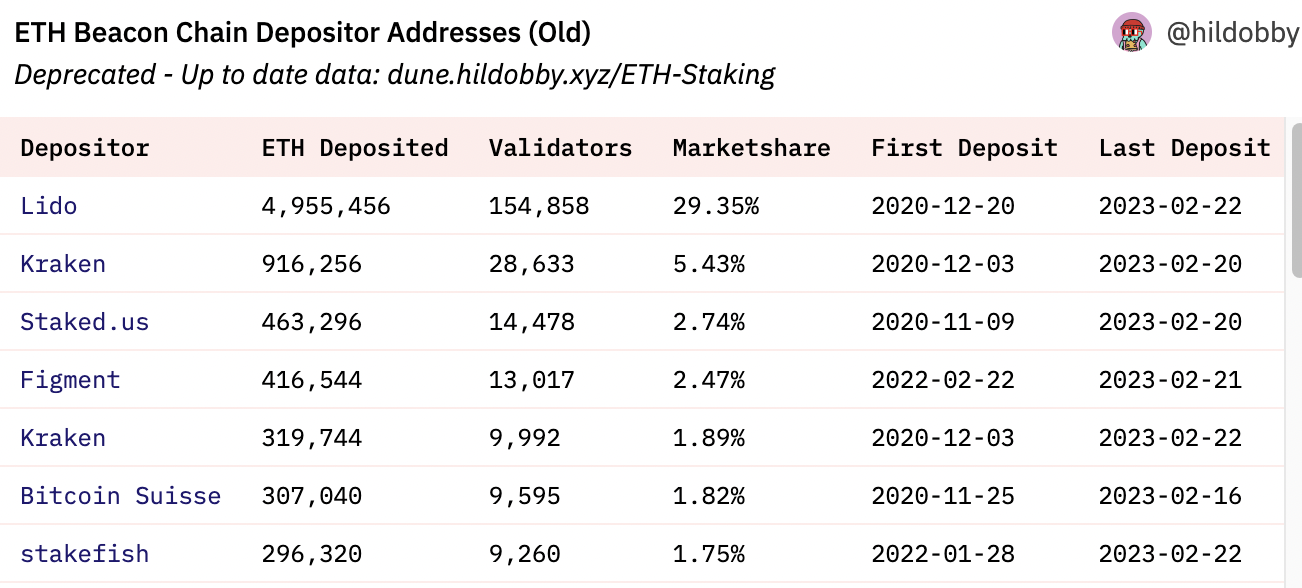
Currently, Lido Finance (stETH), which holds the largest market share among liquid staking products, is not only the leading liquid staking protocol, but also one of TVL's largest DeFi protocols. On the Lido platform, users pledge ETH at a ratio of 1:1 in exchange for stETH, and these stETH can be deployed on other platforms such as Yearn, Aave, etc., thereby improving the capital efficiency of users.
In summary, there are currently 4 ways to pledge ETH:
CEX class/full custody: Using the exchange’s staking solution, there is no need to create verification keys and withdrawal keys. Fund management and node operations are completely completed by the exchange, which belongs to the full custody model.
Pooled Staking: such as Lido and Rocket Pool's Staking solutions. Users do not need to create verification keys and withdrawal keys. Node operations and fund management are done by operators in the big pool, which is an approximate full custody model, but the big pool scheme provides more room for operations.
SaaS (Staking as a Service): Staking services provided by third-party service providers need to create verification keys and withdrawal keys by themselves, but node operations and fund management are completed by third-party service providers, which belongs to the non-custodial mode.
secondary title
text
text
image description
Data source: Dune
With most ETH stakers at a loss, there is little economic incentive to sell ETH at current prices. About 2 million pieces of ETH were pledged at a price in the range of 400-700 US dollars, which represented the earliest pledgers in December 2020. Since liquid staking was little known at the time, most of this part of ETH was illiquid. The Shanghai upgrade will eliminate liquidity risks and uncertainties during the lock-up period, and it will most directly affect impulsive short-term investors.
secondary title
Good Staking Prospects
So, what is the future of Ethereum staking? Returns on Ethereum staking are typically between 5-8%, which is more attractive than most traditional investments. That makes it a reliable source of income, especially with the current bear market.
In addition, through pledge, more future expansion plans of the Ethereum network can be implemented. This will accelerate the development of decentralized applications, thereby increasing the attractiveness of the Ethereum network.
With the launch of Ethereum PoS, Ethereum staking will become a necessary process. Therefore, the importance of Ethereum staking will be even more prominent. Overall, the outlook for Ethereum staking is very promising, providing stable returns and improving the security and scalability of the Ethereum network.
secondary title
Competitiveness of SaaS
Among the many Ethereum staking solutions, the most noteworthy is the SaaS (Staking as a Service) solution. Compared with other solutions, it has many advantages and prospects.
First of all, the SaaS solution provides users with a convenient way to participate in the Staking of ETH. Users only need to deliver it to the mining pool to enjoy the automated Staking service without having to deal with tedious technical details and management. very friendly.
Secondly, SaaS solutions are usually provided by professional Staking service providers. These service providers have rich experience and professional technical teams. They can adjust their server capacity according to market demand, and can also provide better services, such as improving The security and stability of nodes, reducing the risk of fines for Staking, etc.
Finally, SaaS solutions can also promote the development of decentralization. From a technical point of view, the mining pool cannot touch user funds and only provides operation and maintenance services, which is conducive to the decentralization of Ethereum nodes. This means that users no longer need to choose a pool with a high proportion of the network, resulting in the occurrence of "super large nodes". These measures will help promote the decentralized development of Ethereum.
In general, the SaaS model, as a convenient, safe, reliable and scalable staking solution, has very broad development prospects and will provide more users with opportunities to participate in staking.
The most representative SaaS service provider recently is Ebunker. Ebunker adopts a non-custodial model. Unlike other custodial staking pools, Ebunker does not touch or manage users' funds, which means that users have full control over their assets. The user directly interacts with the official Ethereum mortgage contract, and does not need to let the third party know the withdrawal private key. Ebunker only provides node operation and maintenance services.
Compared with the traditional centralized model, this model enables users to independently manage their own private keys, avoiding the risk of user funds being violated by a third party. Therefore, the SaaS model has obvious advantages in protecting the security of user funds.
At the same time, Ebunker's open source code allows users to view and verify it at any time, so every execution layer and consensus layer rewards are completely transparent and directly correspond to transactions on the chain.
Of course, while the SaaS model has many advantages, it also has some disadvantages, that is, it cannot provide an LSD solution. Because in the SaaS mode, the user's private key is completely managed by the user himself, and third-party service providers cannot directly process user funds, so they cannot issue LSD. This needs to be paid attention to when using the SaaS model.
Ebunker official website: https://www.ebunker.io
Ebunker official website: https://www.ebunker.io





